MATERIALS, QUALITY & COMPLIANCE
How Should Buyers Investigate Silicone Packaging Odor Transfer?
Investigate silicone packaging odor transfer with controlled conditioning, component isolation, blind sensory checks, traceability and buyer release criteria.
DIRECT ANSWER
What B2B Buyers Need to Know
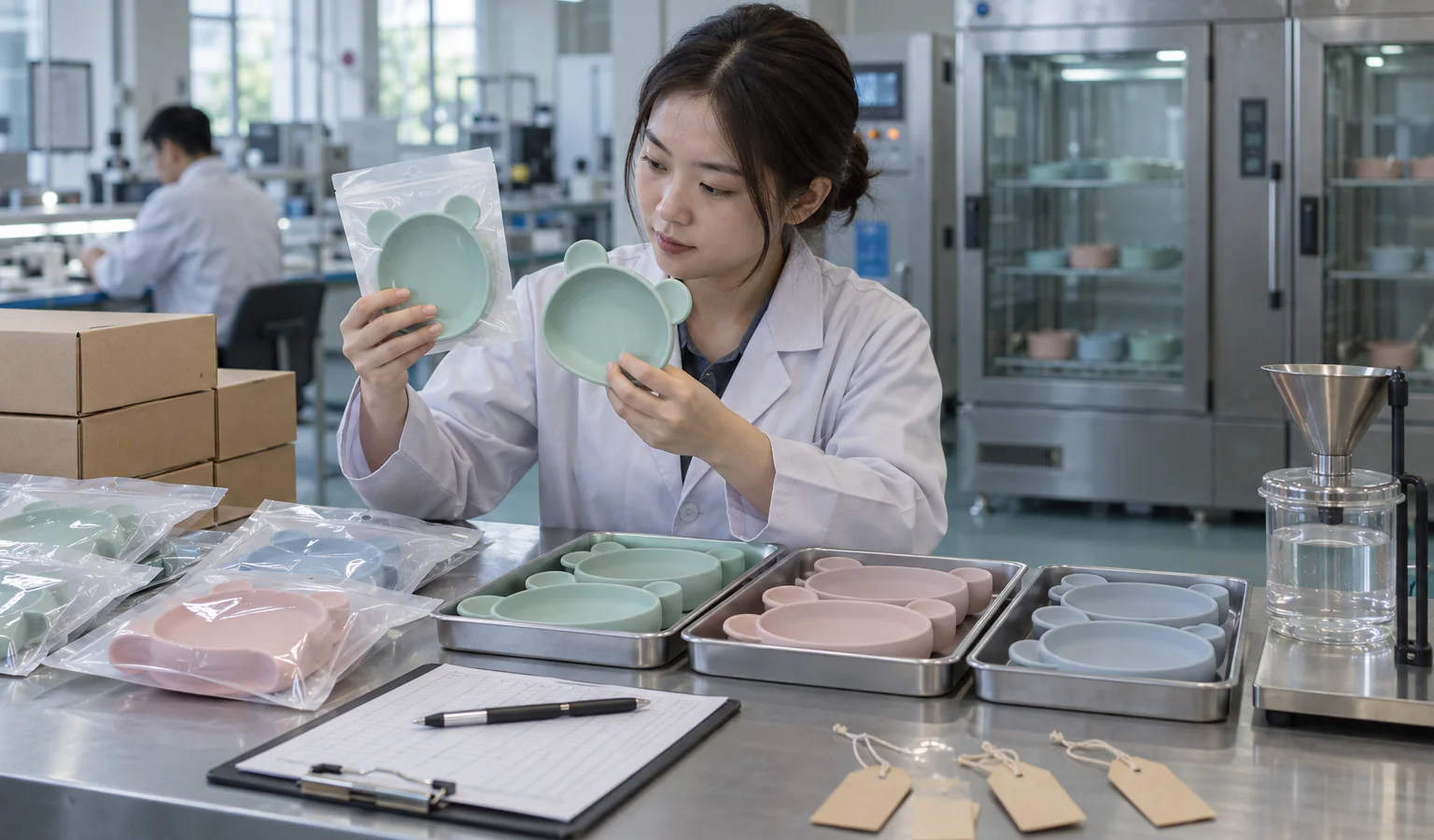
Buyers should investigate silicone packaging odor transfer by comparing the unpackaged product, each packaging component and the complete sealed selling unit after controlled conditioning. Use blind evaluation, clean blanks, approved references and fixed opening procedures. Trace any difference to silicone processing, film, ink, adhesive, paperboard, storage or packing timing before changing material or accepting a shipment.
This guide is written for silicone product importers, private-label brands, retailers, packaging engineers, supplier-quality teams, compliance managers and procurement professionals. It provides a decision framework rather than legal advice or a universal specification. Product classification, use conditions and destination market should be confirmed before final testing, labelling or compliance decisions.
Key Takeaways
- Separate molded-product odor, package-component odor and complete-pack first-opening odor before assigning a cause.
- Condition controls and suspect samples for the same time, temperature, package state and storage orientation.
- Evaluate samples blind with a clean blank, approved reference, fixed opening sequence and written rating rule.
- Isolate film, ink, adhesive, paperboard, insert and silicone components when the assembled pack differs from the control.
- Trace every result to material, process, cleaning, packaging and storage lots instead of changing the silicone compound by assumption.
- Keep acceptance, corrective action, claims, MOQ, price and lead time conditional on the approved SKU and packaging route.
Silicone Packaging Odor Investigation Matrix
Compare matched samples under one controlled method. Odor observations are quality evidence, not automatic proof of safety, compliance or chemical identity.
| Sample route | Question it answers | Required control |
|---|---|---|
| Unpackaged silicone control | Whether the conditioned molded product has the observed odor without retail packaging | Same SKU, material, color, process age, cleaning state and conditioning time |
| Empty package components | Whether film, ink, adhesive, insert or paperboard contributes an odor | Component lot identity, surface area, chamber volume and blank container |
| Complete sealed selling unit | What the customer encounters at first opening after closed storage | Defined seal timing, pack ratio, storage temperature, duration, orientation and opening sequence |
| Repacked isolation sample | Whether odor transfers between the silicone and a suspect packaging component | Matched controls, fixed contact arrangement and no unrecorded ventilation |
| Reference and disputed lot | Whether the new lot differs from the approved commercial baseline | Blind order, evaluator instructions, rating scale and decision rule |
| Corrective-action confirmation | Whether the identified process or package change resolves the difference | Controlled single-variable trial followed by production-representative verification |
SECTION 01
Define the First-Opening Odor Decision Before Testing
Define the intended use, market and risk assumptions before choosing test methods or requesting supplier documents.
Define the Customer-Relevant First-Opening State for silicone packaging odor transfer
Start by defining the commercial moment that matters. A buyer may be concerned about odor when a warm part leaves molding, when a loose sample arrives after courier transit, or when a consumer opens a sealed retail pack after weeks in storage. Those are different sample states. For production approval, we normally choose the complete selling unit after a stated closed-storage interval, while loose molded parts remain diagnostic controls rather than the final customer-experience sample.
Write the acceptance question without absolute language; replace odorless or no smell with the package state, conditioning period, opening procedure, evaluator instructions, rating scale and reject rule. Record whether short ventilation is part of normal use. A product that changes after opening may require an investigation, but the team should not invent a safety conclusion from a sensory observation. Compliance evidence and odor acceptance answer different questions and remain in separate records.
Separate Sensory Observation From Compliance Evidence
Treat odor as an observation that triggers evidence review, not as a direct chemical identification. A weak or absent odor does not prove food-contact suitability, and a noticeable first-opening odor does not identify the source. The applicable compliance file must still match the compound, pigment, finished SKU, intended contact, destination market and current revision. Sensory work helps control the commercial product state; it cannot replace regulatory assessment or targeted analytical work when qualified reviewers determine that such work is needed.
In the factory file, state which decision the sensory method can authorize. It may release a lot against an approved reference, send a lot for controlled ventilation, open a source-isolation investigation or reject a confirmed foreign-odor condition. It should not authorize broad purity, non-toxicity or zero-migration claims. This boundary matters when sales, quality and compliance teams share the same result, because an attractive packaging statement can easily outrun what the original evaluation actually established.
Create Matched Unpackaged and Packaged Controls
Build matched controls before opening the disputed cartons; select the same product revision, color, compound route, cavity mix, washing state and production age. Keep one group unpackaged under protected conditions and place another group in the approved package. If the control and retail unit differ, the package or the interaction becomes a reasonable investigation branch. If both differ from the golden reference, review molding, cure, post-cure where applicable, washing, drying and storage before blaming the packaging converter.
Controls need known history; mark the molding date, lot, cavity, process release, cleaning and drying completion, time packed and time sealed. Protect loose controls from dust and uncontrolled room exposure without placing them in a material that creates a new variable. Use enough units to distinguish a recurring condition from one contaminated piece. When a historical reference is used, record its age and storage state so natural aging is not mistaken for a current-lot difference.
SECTION 02
Isolate Silicone, Process and Packaging Contributors
Match every claim and report to the correct material, finished SKU, sampling condition and current revision.
Trace Molding, Post-Cure, Washing and Drying History
Trace the silicone route from compound receipt to pack-out. Incoming material, pigment, mixing, molding conditions, cooling, any post-cure, washing chemistry, rinse, drying, printing and handling can affect the sample state. Compare the disputed lot with the approved process window and ask whether parts were packed warm, damp or before the normal conditioning hold. One shortcut at the end of the line can change the sealed headspace even when the molded geometry and material certificate are unchanged.
Avoid changing the post-cure cycle by intuition; a longer or hotter cycle can consume capacity, alter color or dimensions and still fail to correct an odor introduced by film or ink. Verify the material supplier's processing basis and the product-specific validated route, then run controlled trials on production-representative parts. Keep temperature, load, airflow, support, cooling and conditioning records together. The corrective action should address a demonstrated source rather than using heat as a universal remedy.
Isolate Film, Ink, Adhesive and Paperboard
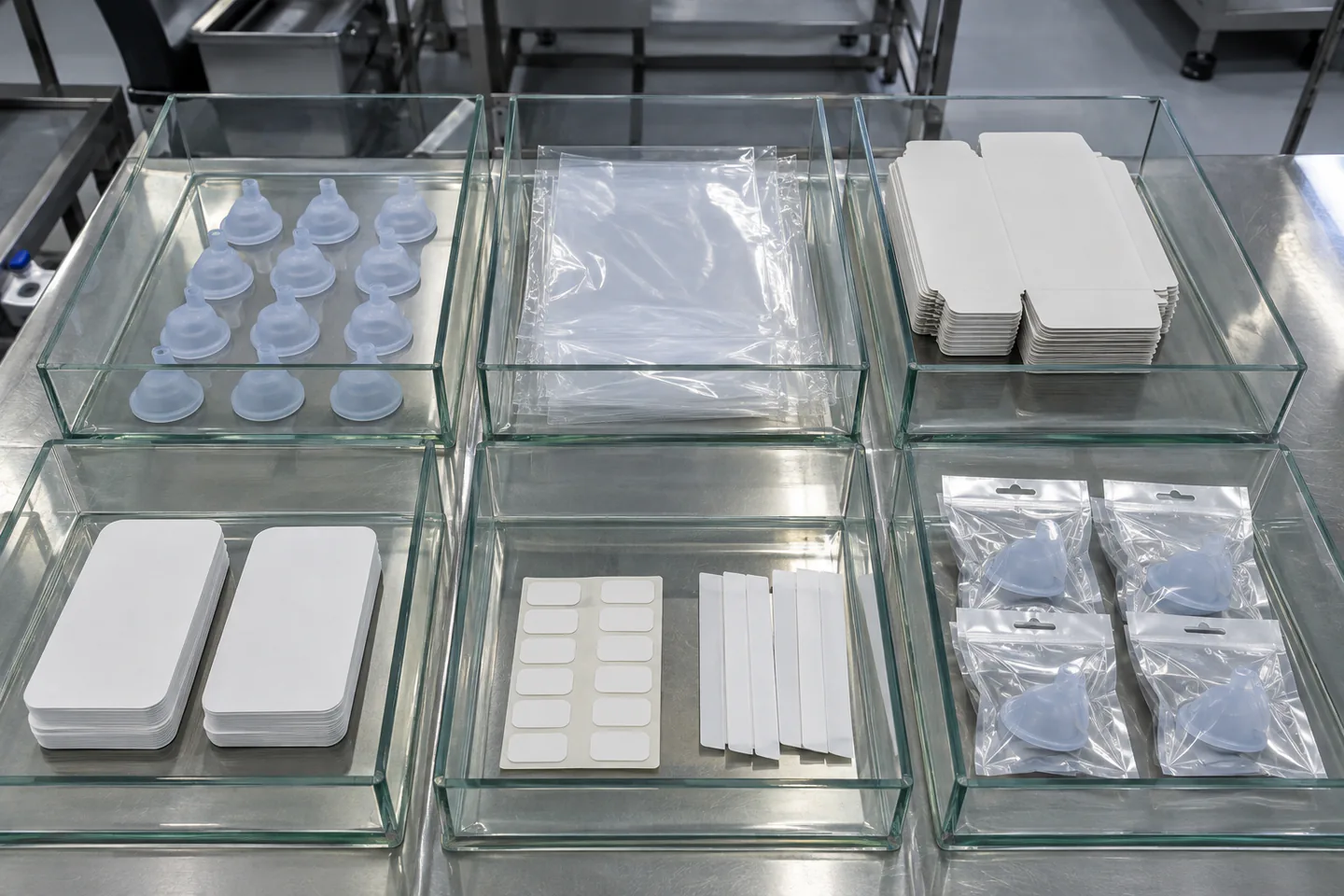
Separate the package into film, printed layer, adhesive, paperboard, insert, label and any desiccant or accessory that shares the sealed space. Condition each component in a clean inert chamber with an appropriate blank, using controlled surface area and chamber volume. Then evaluate the empty assembled package and the complete selling unit. This sequence often reveals whether the first-opening character comes from one fresh component, a combination of components or transfer during direct contact with the silicone surface.
Printing and converting dates matter because fresh ink, lamination, adhesive cure and stored film can present differently across lots or immediately after conversion. Request component lot numbers, specifications, declarations relevant to the intended use, converter dates and approved change records. Do not assume that two visually identical pouches are equivalent. If the converter substitutes resin, ink, adhesive, coating or production site, repeat the applicable part of the package evaluation before allowing the new construction into a purchase order.
Control Pack Ratio, Seal Timing and Headspace
Control the ratio between product surface and sealed headspace. One small silicone item in a large pouch does not create the same package environment as several nested pieces tightly sealed in a compact bag. Record component count, nesting, direct-contact surfaces, residual air, sealing method and any ventilation feature. The pack used for approval should match the physical selling unit, not a convenient laboratory arrangement that dilutes or concentrates the condition differently.
Packing time is another process variable, so define the minimum cooling and drying state, maximum protected hold and seal deadline. Parts left open for an uncontrolled period may ventilate more than production units, while parts sealed immediately after washing may trap moisture or process notes. A clear work instruction keeps the approval sample and repeat orders comparable. If a planned packing change is needed for throughput, validate it as a change rather than treating it as an invisible scheduling adjustment.
SECTION 03
Build a Repeatable Conditioning and Sensory Method
Build production checks around critical characteristics that can be measured, recorded and investigated by lot.
Set Conditioning Time, Temperature and Orientation
Condition all comparison groups for the same duration, temperature, humidity where relevant and storage orientation. ISO 2233 provides a framework for conditioning complete filled transport packages before tests, while ISO 23529 shows why preparation and conditioning history matter for rubber test pieces. Neither source defines a universal finished-product odor protocol. Buyers and factories must write the actual package-specific method, then preserve it with the approved product and package revision.
Use realistic intervals tied to manufacturing, shipment or shelf exposure, and include an accelerated condition only when the team understands what decision it supports. An accelerated result should not be translated automatically into a guaranteed shelf-life equivalence. Record start and finish times, chamber state, temperature excursions and whether cartons were opened during conditioning. If samples come from different sites, align transport and waiting history before comparing their scores.
Run Blind Evaluation With Blanks and References
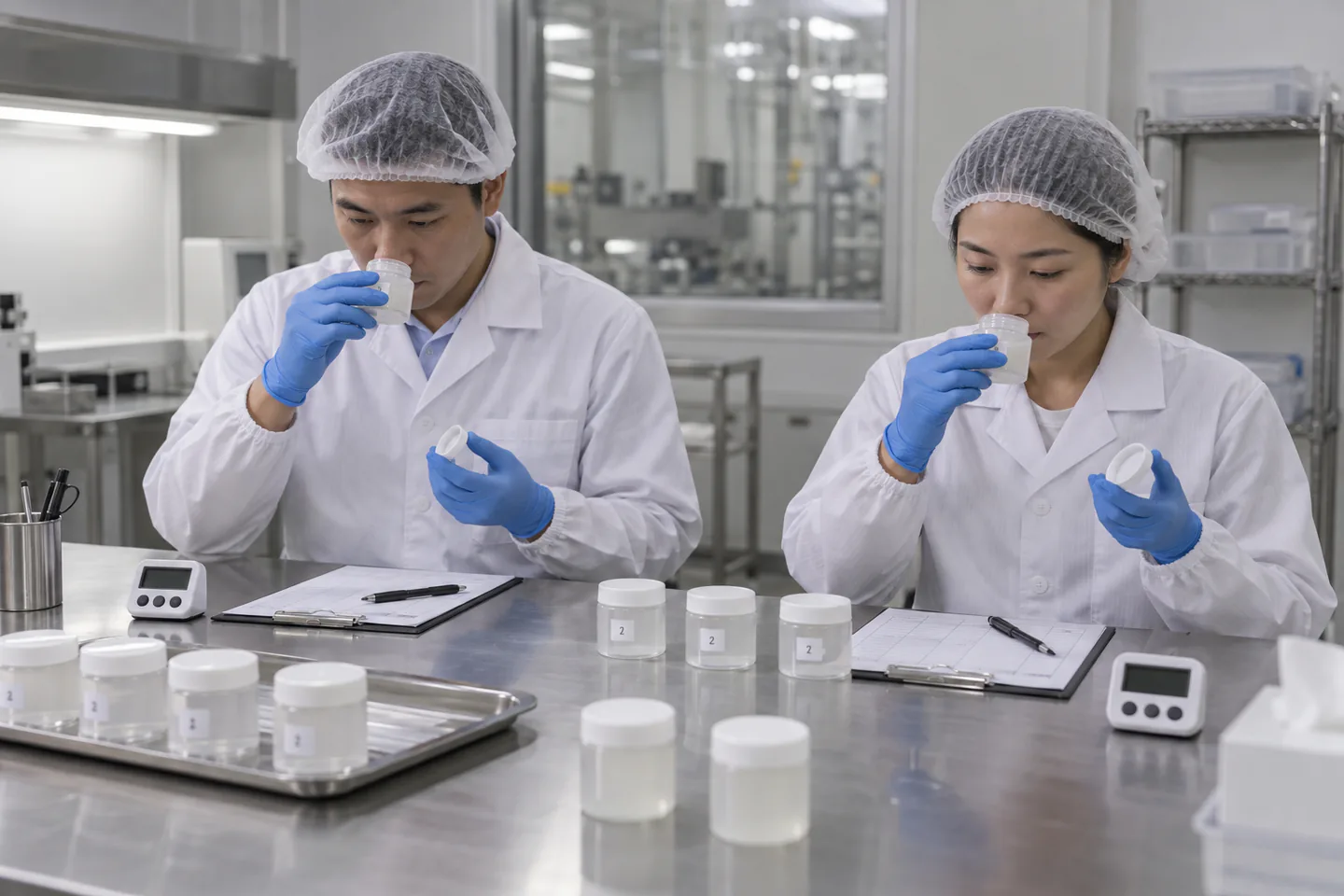
Run the evaluation with a clean blank, an approved reference and randomized codes. Define the room, container, opening sequence, sniff distance, time before rating, pause between samples and whether evaluators may revisit a sample. Keep perfumes, food, cleaning chemicals and strongly scented materials away from the session. The objective is not to turn people into analytical instruments; it is to make a commercial sensory decision sufficiently consistent for training, investigation and lot release.
Use several trained evaluators when the risk and program size justify it, and preserve individual ratings before discussion because a group conversation before scoring can anchor later opinions. Set the decision rule in advance, including what happens when evaluators disagree or the blank is abnormal. Re-run only under a documented reason, not until a preferred answer appears. For recurring programs, periodically check evaluator agreement against retained references and replace degraded reference samples through an approved process.
Classify Results and Investigation Triggers
Classify results so the factory knows what to do next: a match to the approved reference may release the lot, while a temporary difference that resolves within an approved ventilation step may require controlled reconditioning and verification. A persistent foreign or package-specific note may trigger component isolation, quarantine and supplier investigation. A single contaminated unit may require a broader sample to determine scope. Each category needs an owner, record and disposition instead of a vague pass-or-fail comment.
Keep the sensory outcome separate from visible residue, tack, color shift, deformation or package damage because those findings may share a cause but require their own acceptance criteria and escalation. Trend observations by product, color, cavity, silicone lot, package component lot, shift and storage condition. Patterns provide stronger direction than one complaint narrative. A condition isolated to one pouch lot leads to a different corrective path from a condition present in unpackaged controls across several package lots.
SECTION 04
Release Production Through Traceability and Change Control
Maintain an evidence file that remains usable when a material, color, process, supplier or destination market changes.
Confirm Corrective Action With One-Variable Trials
Confirm corrective action with a one-variable trial whenever practical; if film is suspected, compare the approved and suspect film while holding silicone lot, component count, sealing and conditioning constant. If packing time is suspected, use defined intervals with the same product and package. If washing or drying is suspected, record those routes without simultaneously changing pigment or post-cure. Controlled comparisons reduce the risk of approving a costly change that merely coincides with normal sample variation.
Move from laboratory isolation to production-representative verification before closing the case, using actual line handling, pack quantities, sealing equipment, component lots, cartons and storage conditions. Confirm that the proposed change does not create new issues in appearance, dimensions, print adhesion, package integrity or throughput. Retain samples from the baseline, failure and corrected run. Link the final conclusion to the specific revision and conditions rather than claiming the change will solve every future odor concern.
Release Lots With Retained Samples and Records
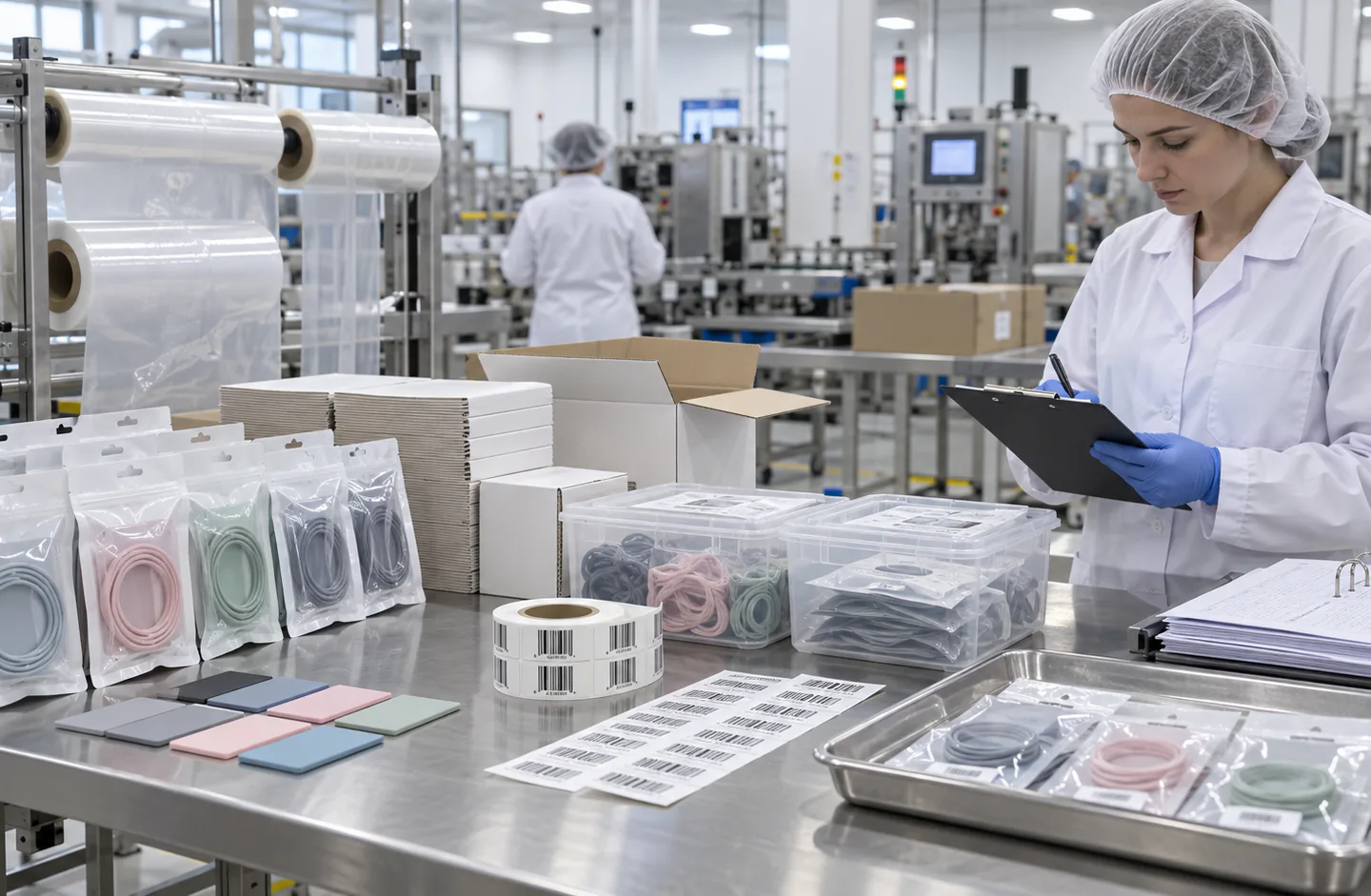
Release documentation should connect the finished SKU, silicone and pigment lots, process route, package component lots, sealing record, conditioning method, evaluator results and authorized disposition. GS1 traceability concepts can support identification and event records across the pack hierarchy, but the buyer still has to define the data required for this product. The retained sample should remain in its approved package state with known storage so a later comparison has a defensible history.
Translate the investigation method into proportionate production controls: routine lots may rely on approved materials, process records, packing-state checks and sampled first-opening evaluation, while higher-risk changes receive expanded conditioning or component isolation. Define who can release, recondition, rework or reject. Do not leave the decision inside a laboratory email that production cannot access. The purchase specification, quality plan and deviation process should reference the same current protocol and golden selling unit.
Control Packaging Changes Across Repeat Orders
Change control must cover the silicone compound, pigment, cure route, washing chemistry, drying, printing, film, ink, adhesive, paperboard, insert, component count, sealing equipment, pack dimensions and production site. Assess whether each proposed change can affect the first-opening state, direct contact, compliance file or customer instructions. Decide which matched-control and complete-pack checks must be repeated before mass use. A supplier's assurance that the substitute is equivalent should start the review, not finish it.
For an RFQ, send the product drawing or sample, intended market, color and compound basis, process route, complete package construction, component contacts, target storage state, odor concern, forecast and launch schedule. Ask the supplier to identify controlled steps, isolation capability, documentation, package-converter responsibilities, sample plan and conditional commercial impact. MOQ, validation cost, yield, capacity and lead time depend on the approved selling unit and test scope; they should not be promised from a generic material description.
ACTION FRAMEWORK
Buyer Checklist Before Commercial Approval
Use this checklist as a meeting agenda. It is intentionally concise so the team can identify missing evidence without replacing its own quality, legal or supplier-management procedure.
| Check | Question | Why It Matters |
|---|---|---|
| Commercial state | Is acceptance based on warm molded parts, conditioned loose parts or the sealed retail unit? | Different states can produce different observations and corrective actions. |
| Sample identity | Are SKU, color, material lot, cavity, process date and cleaning route recorded? | A comparison cannot isolate packaging when the silicone samples are not equivalent. |
| Package identity | Are film, ink, adhesive, insert, carton and sealing lots traceable? | Packaging substitutions can change first-opening conditions without a silicone formulation change. |
| Conditioning | Are time, temperature, humidity, orientation and package ratio fixed? | Unmatched storage histories can create an apparent supplier difference. |
| Evaluation | Are blank, reference, blind order, opening sequence, evaluator count and rating rule defined? | Informal smelling is difficult to reproduce across factory and buyer teams. |
| Isolation | Will components be conditioned separately if the complete pack fails? | Changing the compound without source isolation may add cost while leaving the real cause unchanged. |
| Decision | Does the protocol distinguish accept, investigate, recondition and reject outcomes? | A numerical score is not useful unless it leads to an agreed disposition. |
| Change control | Which product, process or package changes trigger reapproval? | Earlier evidence should not be extended silently to a new selling-unit construction. |
NEXT READING
Continue the Supplier and Product Review
These internal resources connect the guide with Naike Silicone product, factory, customization and inquiry pages. Open the route that matches the next decision in your project.
Verify when silicone post-curing is required
Use verify when silicone post-curing is required to gather the next level of product, manufacturing or commercial information.
Open internal resource →Review private-label silicone packaging controls
Use review private-label silicone packaging controls to gather the next level of product, manufacturing or commercial information.
Open internal resource →Read a silicone product test report
Use read a silicone product test report to gather the next level of product, manufacturing or commercial information.
Open internal resource →Review Naike Silicone quality-control capabilities
Use review naike silicone quality-control capabilities to gather the next level of product, manufacturing or commercial information.
Open internal resource →Explore all silicone product categories
Use explore all silicone product categories to gather the next level of product, manufacturing or commercial information.
Open internal resource →Review Naike Silicone manufacturing knowledge
Use review naike silicone manufacturing knowledge to gather the next level of product, manufacturing or commercial information.
Open internal resource →PRIMARY REFERENCES
Authoritative External Sources
The sources below are official primary references. Applicability depends on the product, intended use and destination market. Buyers should obtain qualified advice for final legal or regulatory decisions.
ISO 23529:2016 Rubber Test-Piece Preparation
Official ISO procedures for preparing, storing and conditioning rubber test pieces and the interval between forming and testing.
ISO 2233:2000 Packaging Conditioning for Testing
Official ISO page for conditioning complete, filled transport packages and unit loads before packaging tests.
GS1 Global Traceability Standard
Official GS1 traceability standard describing Identify, Capture and Share concepts, Critical Tracking Events and Key Data Elements for interoperable traceability systems.
BUYER QUESTIONS
Frequently Asked Questions
Can packaging make a silicone product smell different at first opening?
Yes. Film, ink, adhesive, paperboard, inserts, residual process air, pack ratio and sealing timing can influence the sealed environment or transfer odor. Compare matched unpackaged controls, isolated package components and the complete selling unit before assigning the source.
Does an odor prove that silicone is unsafe or noncompliant?
No. Sensory observation does not identify a chemical or establish regulatory status. Review food-contact or other compliance evidence separately against the exact material, pigment, finished SKU, intended use and destination market, and obtain qualified assessment when an investigation requires it.
How long should a packaged silicone sample be conditioned?
There is no universal duration for every SKU. Define a period that represents the commercial decision, then control temperature, humidity where relevant, orientation, package ratio and opening sequence. Record accelerated conditions separately and avoid presenting them as an automatic shelf-life equivalence.
What samples are needed for a packaging odor investigation?
Use a clean blank, approved reference, matched unpackaged silicone, each relevant empty packaging component, the empty assembled pack and the complete sealed selling unit. Add suspect and known-good lots with traceable material, process and package histories.
Should the factory increase post-curing when a packed product has an odor?
Not without evidence. First compare unpackaged and packaged controls and trace molding, cooling, washing, drying and packing. A post-cure change can affect color, dimensions and capacity while failing to correct film, ink, adhesive or moisture-related sources.
What should buyers include in the repeat-order control plan?
Identify the approved silicone and package revisions, component suppliers and lots, pack timing, conditioning and sampled evaluation method, retained-sample rule, release authority and change triggers. Link deviations and corrective actions to the exact production and package configuration.
Editorial and Scope Note
Conclusion: Silicone Packaging Odor Transfer Investigation
Move from buyer research to a controlled supplier brief
A silicone packaging odor investigation should begin with the customer-relevant pack state, then separate the molded product, process history and each packaging component through matched controls. Controlled conditioning, blind evaluation, component isolation, lot traceability and retained references turn a subjective complaint into an actionable factory decision. Odor observations do not replace market-specific compliance evidence. Share the finished SKU, package construction, storage history and disputed samples with Naike Silicone to request a conditional investigation and release plan.
This factory-insider guide supports a controlled packaging investigation and supplier discussion. It does not replace product-specific engineering, analytical, regulatory, legal or commercial review for the destination market.