MATERIALS, QUALITY & COMPLIANCE
When Does Silicone Need Post-Curing, and How Should Buyers Verify It?
A factory-insider guide to silicone post-curing, odor conditioning, stain trials, surface inspection and repeatable buyer verification records.

DIRECT ANSWER
What B2B Buyers Need to Know
Silicone needs post-curing only when the selected compound, cure route, product geometry, intended use or validated specification requires it. Buyers should not accept a generic time-and-temperature claim. Verify the finished SKU through a controlled post-cure record, defined cooling and conditioning, representative odor and surface checks, applicable compliance evidence, retained samples and repeat-production change control.
This guide is written for quality teams, retailers, importers, houseware brands, baby-product buyers and supplier auditors. It provides a decision framework rather than legal advice or a universal specification. Product classification, use conditions and destination market should be confirmed before final testing, labelling or compliance decisions.
Key Takeaways
- Replace subjective quality claims with defined methods.
- Control sample conditioning before odor review.
- Connect post-curing and packaging with product evaluation.
- Use realistic food and cleaning exposures.
- Approve surface limits with visual references.
- Investigate batch changes before accepting drift.
Evidence plan for odor, stain and surface approval
| Quality question | Controlled evidence | Buyer decision |
|---|---|---|
| Does the finished SKU have unacceptable odor? | Conditioned samples in defined package states, evaluator instructions and an approved reference | Accept, investigate process or packaging, or repeat after controlled conditioning |
| Is post-curing required for this product? | Validated cure and post-cure record linked to compound, geometry and intended use | Approve the route and verify repeat production records |
| Will realistic foods leave unacceptable staining? | Named media, temperature, contact time, cleaning cycle and color reference | Approve the claim boundary and care instruction |
| Is the visible finish commercially acceptable? | Zone map, light level, distance, viewing time and defect photographs | Classify defects and set sampling or 100% inspection where justified |
| Can the result be reproduced by another lot? | Material, pigment, cavity, process, washing, handling and packaging traceability | Release the lot or open a documented investigation |
SECTION 01
Build a Repeatable Sensory Baseline
Define the intended use, market and risk assumptions before choosing test methods or requesting supplier documents.
Define the Sensory Requirement for silicone post-curing
Start by separating three different questions: initial odor, odor after closed-package storage, and odor transferred during intended use. A sample taken warm from molding can smell different from a conditioned retail unit, while a tightly sealed pack can concentrate volatile notes that dissipate after opening. The buyer must define which state represents the commercial acceptance decision.
Replace words such as odorless, no smell, or premium smell with an agreed sensory method. Identify the sample quantity, container, conditioning time, opening procedure, room conditions, evaluator count, reference samples, rating scale, and reject rule. A subjective property becomes manageable only when suppliers and inspectors evaluate the same condition in the same sequence.
Do not turn a sensory result into a safety conclusion. Odor may prompt investigation, but the presence or absence of a smell does not by itself prove food-contact suitability, chemical composition, or compliance. Regulatory and material evidence must remain connected to the actual compound, pigment, finished article, intended use, and destination market.
Control Sample Conditioning
Control the time between molding and evaluation. Silicone parts may pass through cooling, post-curing where applicable, washing, drying, storage, printing, assembly, and packaging before a buyer receives them. Record that route so a sample from one stage is not compared with a production unit from another stage and mistakenly treated as material drift.
ISO 23529 describes general procedures for preparing, storing, and conditioning rubber test pieces and the interval between forming and testing. It does not prescribe one universal odor protocol for finished silicone goods, but it demonstrates why sample history matters. Buyers should write their chosen conditioning sequence into the product-specific approval plan.
Use a controlled blank and an approved reference. The blank helps identify odor from the vessel, packaging, detergent, cloth, or room, while the retained reference anchors the accepted product state. Rotate sample order and avoid telling evaluators which unit is new, disputed, or expected to fail when a blind comparison is practical.
Understand Cure and Post-Cure
Post-curing is a manufacturing decision tied to compound chemistry, molded geometry, intended use, process evidence, and supplier instructions. It may be used to support completion of cure or reduction of certain volatile residues for a defined product, but it is not a universal badge of quality. One time-and-temperature recipe should not be copied across unrelated parts.
The factory should document equipment, load arrangement, airflow, time, temperature, ramp or stabilization rules, and product support. Thick bases, thin walls, inserts, pigments, and stacked parts can respond differently to heat. A cycle that improves one condition may distort another feature, change color, or consume capacity without proving a buyer-relevant benefit.
Approve the route on production-representative parts after cooling and agreed conditioning. Compare dimensions, hardness where relevant, surface condition, color, odor, function, and packaging recovery with the approved baseline. Keep the conclusion conditional on the actual compound and product rather than claiming that post-curing automatically makes silicone safe or compliant.

SECTION 02
Test Staining and Cleanability
Match every claim and report to the correct material, finished SKU, sampling condition and current revision.
Evaluate Packaging Odor
Packaging can create or concentrate an odor that is absent from an unpackaged part. Film, ink, adhesive, paperboard, insert, cleaning residue, and trapped process air can all contribute to the first-opening experience. Evaluate the complete sale unit after a defined closed-storage interval instead of testing the molded component alone and assuming the retail result will match.
Run component isolation when a pack fails. Condition the silicone, empty package, printed insert, and assembled unit separately under comparable conditions, then compare them with the approved control. This prevents an unnecessary compound change when the actual source is fresh ink or an incompatible packaging material.
Define ventilation and packing timing as controlled operations. Packing warm or incompletely dried parts can change the sealed environment, while excessive open storage creates dust and traceability risks. The work instruction should state the release condition, maximum hold period, protection, and lot identity before final sealing.
Design Stain Trials
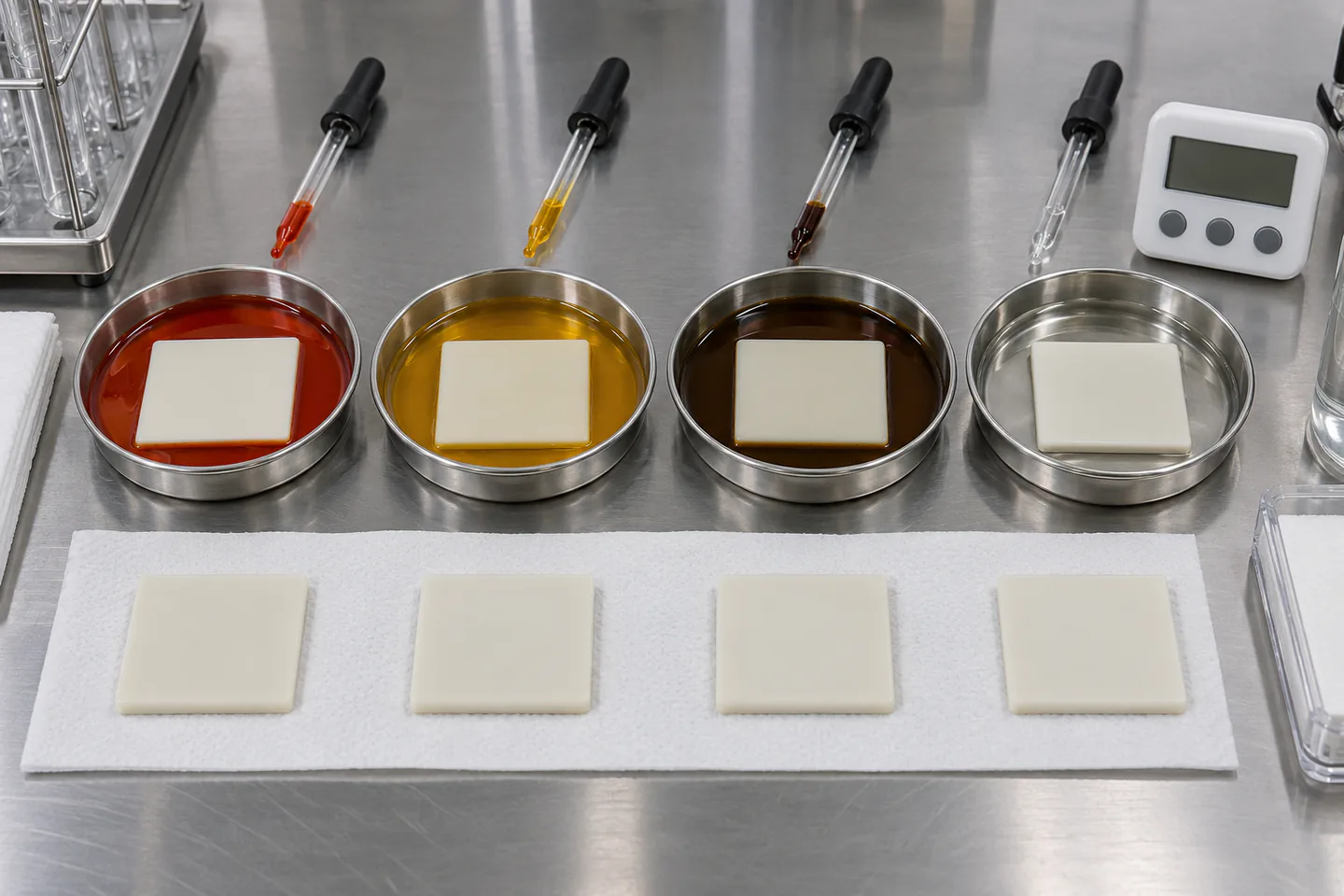
A stain claim must name the staining media and exposure conditions. Tomato sauce, turmeric oil, coffee, tea, food colorants, cosmetics, and industrial liquids behave differently, and the actual risk depends on product use. Select a realistic panel, control concentration and temperature, and avoid a broad stain-proof promise that no defined trial supports.
Write the sequence from pre-cleaning through exposure, dwell, rinse, washing, drying, and final conditioning. Record whether the sample is flexed, heated, immersed, wiped, or left in contact on one surface. The comparison is useful only when the same product revision and method are used across suppliers, colors, and repeat lots.
Assess both appearance and function after cleaning. A light residual color may be cosmetic, while swelling, tack, cracking, odor retention, or loss of fit can signal a different concern. Define the lighting, background, viewing distance, instrumental color method if used, and separate visual acceptance from dimensional or functional limits.
Set Cleaning Conditions
Cleaning performance depends on the approved cleaning method, not on silicone as a material name. Detergent chemistry, concentration, water temperature, wash time, mechanical action, dishwasher rack position, drying, and cycle count can change the result. Align the trial with the care instructions the buyer intends to place on the product or package.
Include difficult geometry such as grooves, textured surfaces, undercuts, suction channels, lid seals, and narrow transitions. A flat plaque can support a controlled material comparison, but it cannot demonstrate cleanability of the finished article. Use both a representative test piece and the actual molded product when each answers a different question.
Inspect for residue and surface change after repeated cycles. Look for haze, tack, gloss shift, chalking, abrasion, embedded particles, deformation, and trapped soil under the same defined conditions. If the buyer changes detergent, temperature, or equipment, treat the new result as a separate use scenario rather than silently extending the original conclusion.
SECTION 03
Define Surface Acceptance
Build production checks around critical characteristics that can be measured, recorded and investigated by lot.
Create Cosmetic and Functional Zones
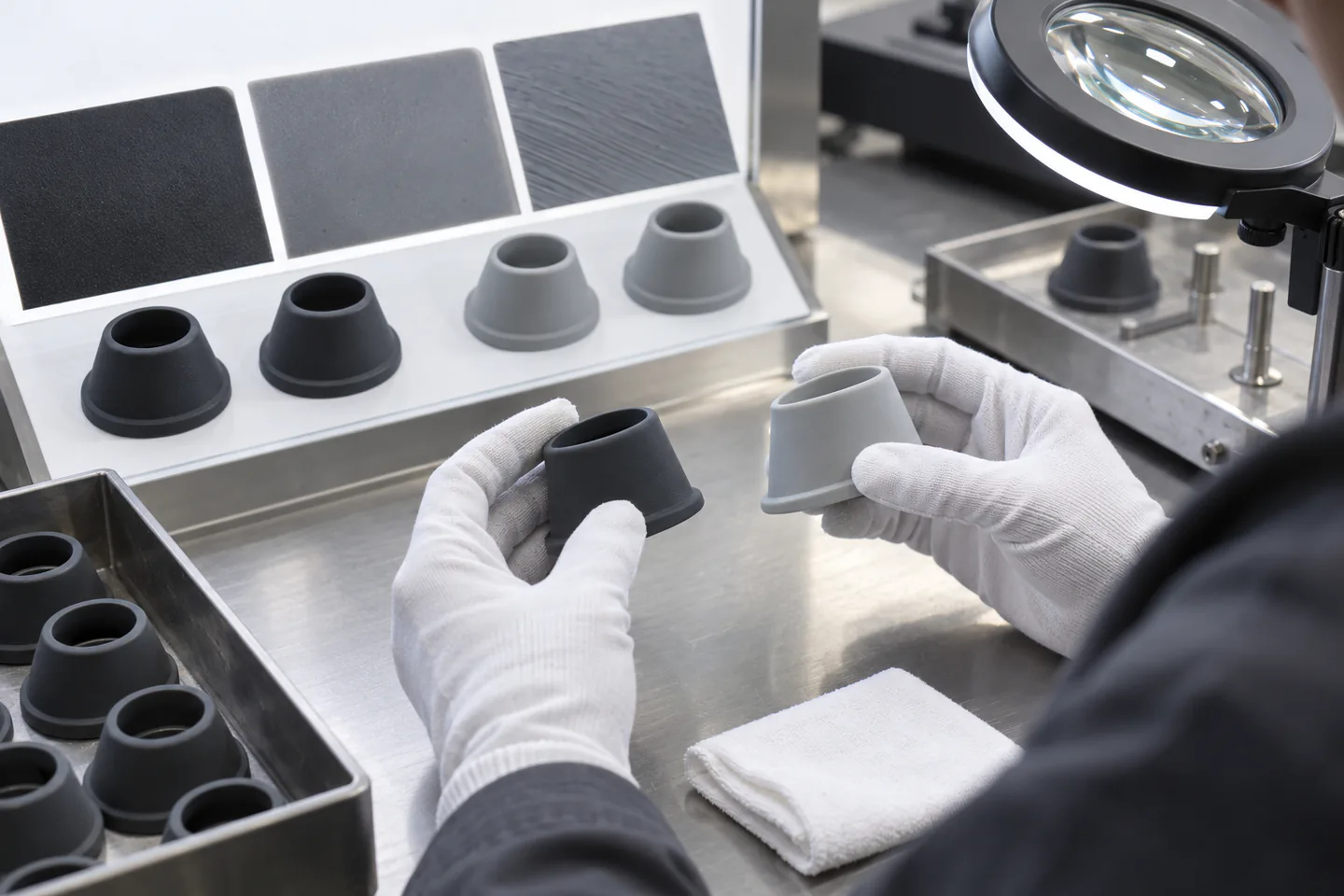
Divide the surface into cosmetic and functional zones. A small speck on a hidden underside may have a different consequence from the same speck on a sealing face, printed logo, skin-contact edge, or premium visible panel. The defect catalogue should show location, size, frequency, contrast, and whether the condition affects cleaning or function.
Control the viewing setup with illuminance or a named light source, color temperature where relevant, background, distance, angle, and magnification. Dark, translucent, glossy, and textured silicone can reveal different marks under different lighting. A buyer and factory can both act reasonably yet disagree when the visual setup is not written.
Use acceptable, limit, and reject samples for specks, flow lines, knit appearance, gloss variation, surface drag, and other recurring conditions. Photographs are useful for training and remote review, but scale, exposure, compression, and screen settings can hide the boundary. Preserve identified physical references for shipment decisions when practical.
Trace Material and Process History
Trace odor, stain, and surface findings to the exact material and processing history. Records should connect compound supplier and lot, catalyst or cure system, pigment batch, mixing, molding machine, cavity, cure condition, post-cure if used, washing, finishing, and packaging lot. Without this chain, teams tend to debate impressions instead of testing likely causes.
Investigate patterns before changing the specification. A result limited to one color may point to pigment or contrast; one cavity may indicate contamination or tool condition; one package lot may implicate ink or film; one shift may reveal cleaning or handling. Stratified data reduces unnecessary broad corrective action.
Retain samples from conforming and disputed lots under controlled storage. A retained unit is useful only if its identity, pack state, date, storage, and handling remain known. Compare it with the approved reference and current production using the same method, then record whether the observed change is material, process, packaging, aging, or inspection variation.
Classify Defects and Sampling
Define defect classes before selecting a sampling plan. Strong foreign odor, transferable residue, a contaminant in a critical zone, or a surface tear may need different control from a slight cosmetic shade or gloss difference. The buyer and supplier should agree critical, major, and minor classifications based on intended use and commercial consequence.
AQL sampling can support lot-by-lot attribute inspection, but it does not repair an unstable process or create an objective sensory method. Establish the lot definition, sample selection, inspection conditions, acceptance numbers, and switching rules only after the defect catalogue and evaluator agreement are ready. Some critical conditions may require process controls or complete checks.
Keep odor, stain, and surface results separate in the report. Combining them into one general appearance pass can hide which characteristic failed and which corrective route applies. Trend the results by SKU, color, cavity, material lot, process route, package lot, and order so gradual drift is visible before it becomes a complaint pattern.
SECTION 04
Release and Control Production
Maintain an evidence file that remains usable when a material, color, process, supplier or destination market changes.
Compare Supplier Methods
Supplier comparison should use the same finished-SKU baseline. Send the drawing, compound or material requirement, colors, intended use, destination, care method, package construction, forecast, and proposed evaluation protocols. If suppliers test different colors, package states, exposure media, or conditioning periods, their pass statements and prices are not comparable.
Ask what is controlled in-house and what is subcontracted. Post-curing, washing, printing, analytical testing, packaging conversion, and specialized inspection may involve different equipment or partners. The quotation should identify route assumptions, sample quantities, validation cost, capacity constraints, records, and change-notification responsibilities.
Avoid buying an absolute claim. A credible response explains which variables are controlled, which trial will demonstrate the result, and what changes trigger reapproval. MOQ, price, yield, capacity, and lead time remain conditional on the approved color mix, process route, testing, packaging, and order schedule.
Release Production Standards
Release production with a signed sensory, stain, and surface package. It should identify the product revision, material, color, sample state, protocols, physical references, defect classes, inspection frequency, retained-sample rule, packaging configuration, and authorized approvers. The drawing and purchase specification should reference the same controlled revision.
Train operators and inspectors with blind or randomized examples near the acceptance boundary. Compare their classifications and resolve disagreement before shipment inspection begins. Periodic calibration against the master references helps detect drift caused by memory, worn samples, lighting changes, or informal local standards.
Use first-production and repeat-order reviews to confirm the approved state remains achievable. Compare process records, sensory ratings, stain results, visual defects, rework, complaints, and packaging observations with the baseline. Escalate trends before adjusting a post-cure cycle, detergent, pigment, mold surface, package material, or inspection limit.
Control Changes and Repeat Orders
Change control should cover compound, catalyst, pigment, supplier, mold surface, cavity, cure conditions, post-cure, cleaning chemistry, finishing, package film, ink, adhesive, production site, and evaluation method. The responsible team should assess the impact and decide which parts of the approval plan must be repeated before the change reaches a purchase order.
For an RFQ, provide representative parts or drawings, intended use, markets, colors, odor concern, likely staining media, cleaning instructions, surface zones, package concept, forecast, and target launch date. Request a conditional sample plan, test methods, boundary references, process controls, documentation, MOQ, price, and lead time instead of a generic promise.
The strongest program treats sensory, stain, and surface quality as connected but separately measurable decisions. It avoids unsupported zero-odor and stain-proof language, keeps compliance evidence in its proper scope, and gives the factory an inspection system that can be repeated. That is the basis for a defensible approval and a stable repeat order.
ACTION FRAMEWORK
Buyer Checklist Before Commercial Approval
Use this checklist as a meeting agenda. It is intentionally concise so the team can identify missing evidence without replacing its own quality, legal or supplier-management procedure.
| Check | Question | Why It Matters |
|---|---|---|
NEXT READING
Continue the Supplier and Product Review
These internal resources connect the guide with Naike Silicone product, factory, customization and inquiry pages. Open the route that matches the next decision in your project.
Review platinum-cured silicone claim controls
Use review platinum-cured silicone claim controls to gather the next level of product, manufacturing or commercial information.
Open internal resource →Learn how to review a silicone test report
Use learn how to review a silicone test report to gather the next level of product, manufacturing or commercial information.
Open internal resource →Select silicone hardness for molded performance
Use select silicone hardness for molded performance to gather the next level of product, manufacturing or commercial information.
Open internal resource →Review Naike Silicone quality-control capabilities
Use review naike silicone quality-control capabilities to gather the next level of product, manufacturing or commercial information.
Open internal resource →Explore all silicone product categories
Use explore all silicone product categories to gather the next level of product, manufacturing or commercial information.
Open internal resource →Review Naike Silicone manufacturing knowledge
Use review naike silicone manufacturing knowledge to gather the next level of product, manufacturing or commercial information.
Open internal resource →PRIMARY REFERENCES
Authoritative External Sources
The sources below are official primary references. Applicability depends on the product, intended use and destination market. Buyers should obtain qualified advice for final legal or regulatory decisions.
BfR Recommendation XV: Silicones
Official German Federal Institute for Risk Assessment recommendation covering silicones and silicone elastomers.
European Commission: Food Contact Materials
Official European Commission overview of the EU framework for materials and articles intended to contact food.
ISO 23529:2016 Rubber Test-Piece Preparation
Official ISO procedures for preparing, storing and conditioning rubber test pieces and the interval between forming and testing.
BUYER QUESTIONS
Frequently Asked Questions
Can food-grade silicone still have an odor?
A food-contact or material claim does not define a sensory result. Odor can be influenced by compound, curing, post-curing where applicable, washing, handling, storage and packaging. Buyers should evaluate the actual finished SKU under a controlled conditioning and opening method, while reviewing regulatory and material evidence separately for its stated scope.
Does every silicone product need post-curing?
No. Post-curing depends on the compound, molding process, product geometry, intended use, supplier instructions and validation objective. The factory should approve a product-specific route and verify representative parts after cooling and conditioning. A generic post-cure cycle should not be treated as an automatic safety, purity or compliance guarantee.
How should buyers test silicone staining?
Name the staining media, concentration, temperature, contact mode, duration, cleaning method, drying and final conditioning. Use an unstained control and the actual approved color and geometry. Assess residual appearance under defined lighting, then separately check odor, dimensions, tack, cracking and product function where those outcomes matter.
Why should packaging be included in odor approval?
Film, ink, adhesive, paperboard, inserts, cleaning residue and trapped process air can affect first-opening odor. Condition the complete sale unit for an agreed interval, then isolate the silicone and packaging components if a failure occurs. This helps the team correct the real source instead of changing the silicone compound without evidence.
What should a silicone surface defect standard include?
Divide the product into functional and cosmetic zones, define defect types and classes, and state size, frequency, contrast and location limits. Control lighting, background, distance, angle and magnification. Use identified acceptable, limit and reject references, and connect the standard to the current product, color, mold, cavity and inspection plan.
What evidence should buyers request from a silicone supplier?
Request the approved material and color identity, process route, cure and post-cure controls where relevant, conditioning and evaluation protocols, stain and cleaning records, surface boundary samples, batch traceability, package configuration, defect trends and change-notification rules. Ask for production-representative samples rather than relying on generic material statements.
Editorial and Scope Note
Conclusion: Silicone Post-Curing Verification Guide
Move from buyer research to a controlled supplier brief
Treat odor, staining and surface appearance as three controlled quality questions, not one vague promise. Send Naike Silicone your intended use, product color, packaging state, cleaning method and visible-zone priorities to build a sample and production acceptance plan before quotation or tooling release.
This factory-insider guide supports sourcing preparation and supplier discussion; it does not replace product-specific engineering, laboratory, regulatory, legal or commercial review for the destination market.