PRODUCT SOURCING GUIDES
Silicone Stretch Lids Vs Rigid Lids: Silicone Stretch Lids vs Rigid Storage Lids: Which Format Fits a Retail Program?
Compare silicone stretch lids and rigid storage lids by fit, sealing, cleaning, shelf efficiency, tooling, evidence and retail-program economics.
DIRECT ANSWER
What B2B Buyers Need to Know
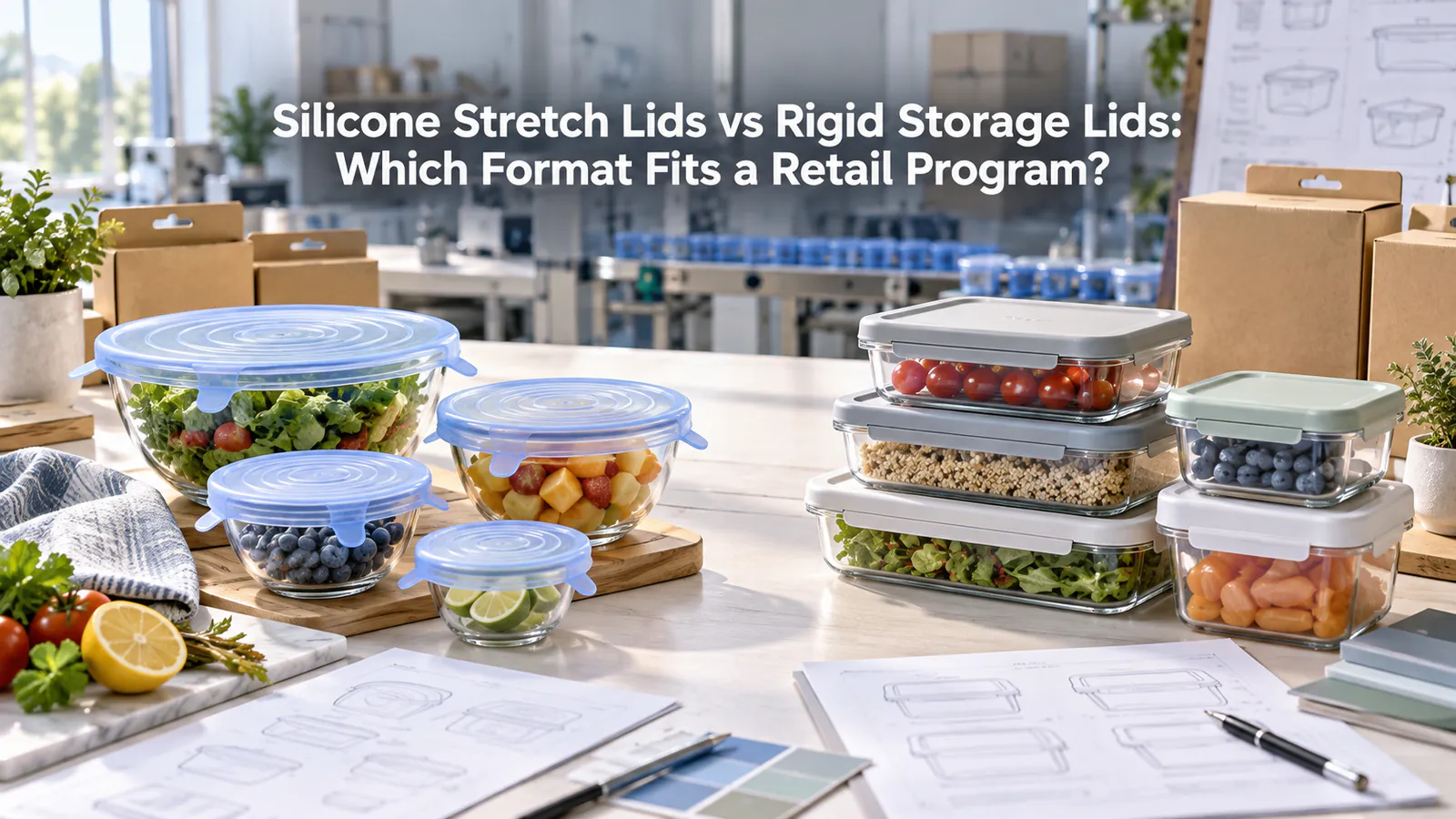
Silicone stretch lids fit retail programs that prioritize versatile container coverage, compact nesting and a multi-size value story. Rigid storage lids fit programs that prioritize matched-container closure, predictable stacking and clearer transport positioning. Buyers should choose from validated use cases, fit or interface drawings, repeated-use evidence, cleaning results, packaging volume and landed-cost assumptions—not from material preference alone.
This guide is written for household-product brands, importers, retailers, distributors, category managers, product developers and sourcing teams comparing private-label food-storage formats. It provides a decision framework rather than legal advice or a universal specification. Product classification, use conditions and destination market should be confirmed before final testing, labelling or compliance decisions.
Key Takeaways
- Choose stretch lids for validated multi-container coverage and compact set architecture, not for an unsupported universal-fit promise.
- Choose rigid lids when matched interfaces, stacking and closure consistency matter more than adapting to unrelated vessels.
- Separate retention, leakage, transport and repeated-use claims because each needs its own finished-system evidence.
- Compare cleaning traps, recovery or closure wear, packaging dimensions and replacement policy alongside unit price.
- Use the same forecast, color mix, validation scope, packaging and delivery basis when comparing supplier quotations.
- Keep performance, evidence scope, MOQ, price, capacity and lead time conditional on the approved product program.
Silicone Stretch Lids vs Rigid Storage Lids: Buyer Decision Matrix
Compare both formats against the same customer, use, claim, packaging and forecast assumptions. Results remain conditional on the approved finished system.
| Decision area | Silicone stretch lids | Rigid storage lids |
|---|---|---|
| Fit architecture | One flexible size can cover several validated rim geometries; user application affects the result | One lid matches a controlled container interface; component tolerance stack-up affects closure |
| Retail proposition | Versatile coverage, compact multi-size set and use with existing compatible vessels | Organized matched system, modular stacking and clearer portion or transport positioning |
| Repeated use | Monitor membrane, bead, tab and dimensional recovery after extension | Monitor snap, hinge, latch, gasket and closure-force change after cycling |
| Cleaning | Inspect bead undercuts, rings, tab roots, inversion and nested drying | Inspect gasket channels, latches, seams, disassembly and reassembly |
| Packaging | Usually compact but size identification and nesting separation need control | Often larger because matched containers or protective dividers may be included |
| Tooling and cost | Multiple thin-membrane sizes with bead and cavity consistency controls | Coordinated lid, container, gasket or latch tools plus assembly controls |
SECTION 01
Compare the Retail Job and Product Architecture
Begin with the target buyer, channel and assortment role so every specification decision supports a sellable range.
Define the Retail Job Before Choosing a Lid Format for silicone stretch lids vs rigid lids
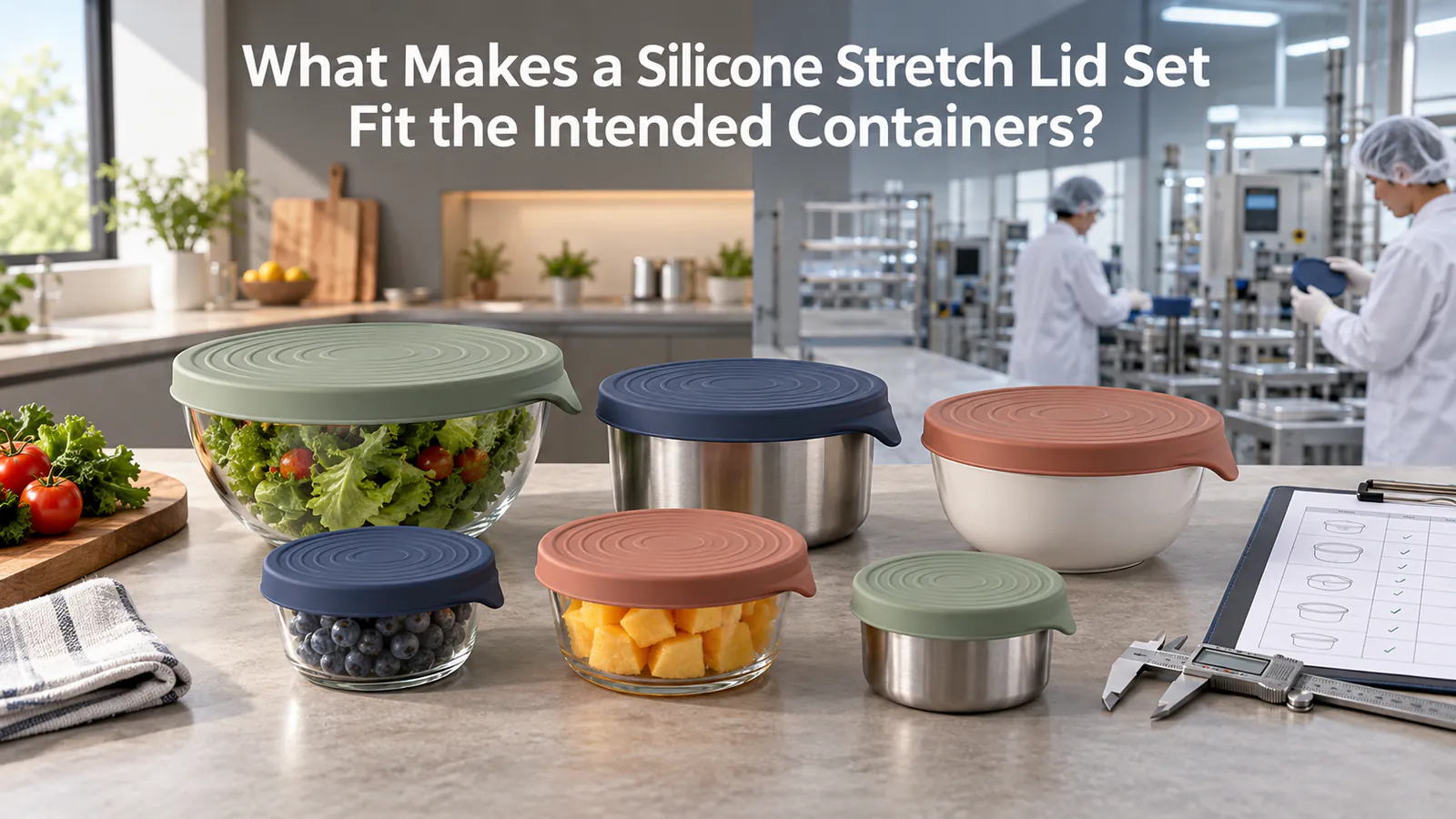
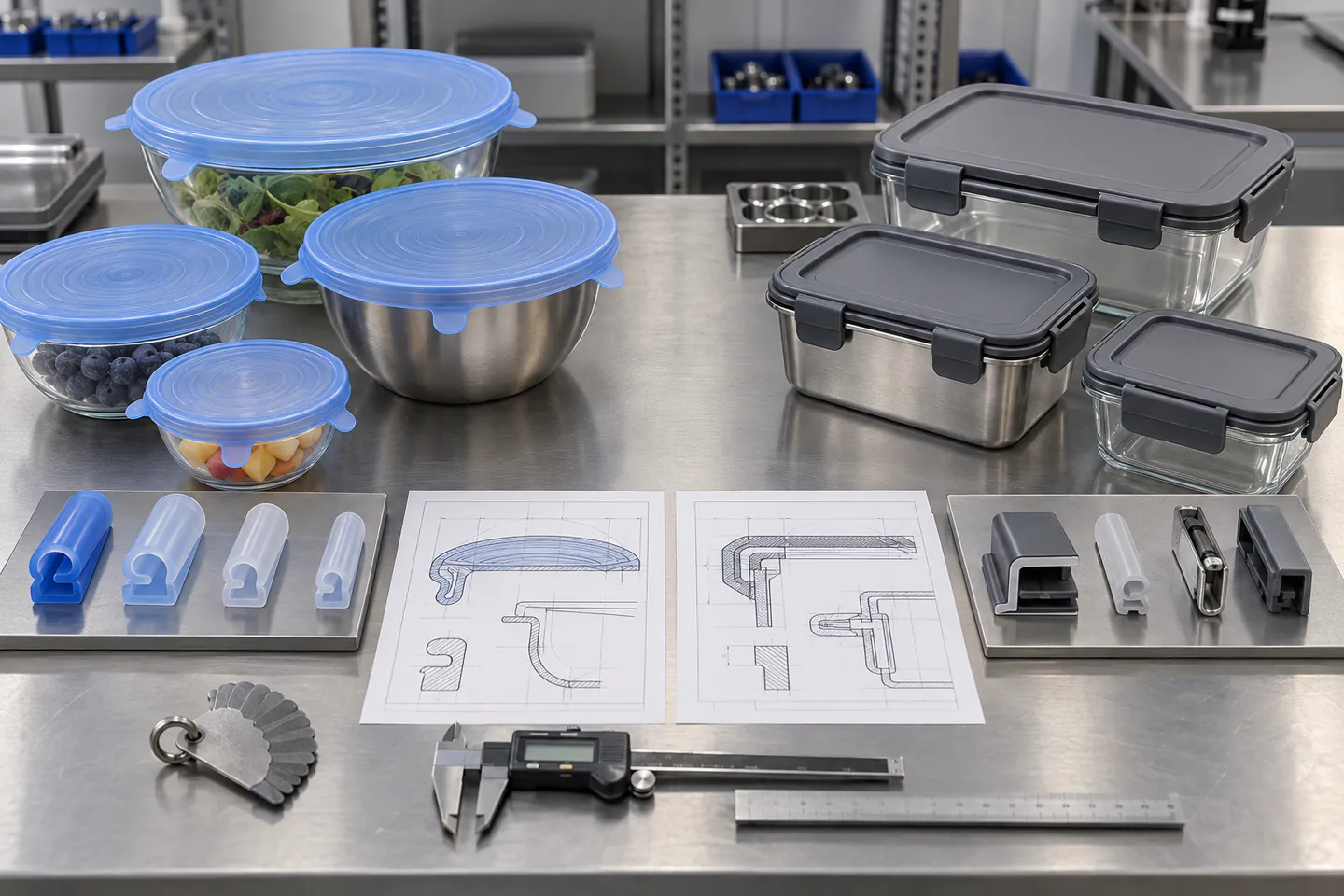
Retail buyers should compare these formats as different storage systems, not as interchangeable covers. A silicone stretch lid adapts one flexible membrane to several compatible rims, while a rigid lid is designed around a defined container interface and closure path. The first decision is therefore whether the program sells versatile covers for containers customers already own or a matched container-and-lid family with controlled geometry.
Write the retail promise before reviewing samples. If the promise is compact multi-size coverage, a stretch-lid set may create more value per shelf unit; if the promise is organized stacking, predictable closure and transport within a matched range, a rigid system may be stronger. Neither advantage is automatic, and every claim still needs production-representative samples, named containers and an approved use scenario.
Compare Flexible Coverage With Matched-System Closure
Stretch lids depend on elastic extension, perimeter-bead contact and recovery after removal. Their apparent versatility can reduce the number of components in a selling unit, but it transfers more work to the user, who must select a size, center the membrane and apply it around the rim. A buyer should test this sequence with intended users rather than accepting a skilled factory demonstration as evidence of easy use.
Rigid lids depend on a repeatable mating interface such as a snap bead, gasket, hinge or latch. They usually offer a clearer yes-or-no fit because the lid is assigned to one container family, yet dimensional variation in the container and closure can accumulate into excessive force, loose engagement or corner lift. The quotation and sample plan should identify whether the supplier controls both components or is fitting a lid to buyer-owned containers.
Control the Vessel Matrix and Interface Tolerance Stack
The stretch-lid fit matrix should list vessel material, outside rim dimensions, flange section, wall taper, corner radius and obstructions for every intended combination. Assign each lid a minimum, preferred and maximum vessel rather than publishing one broad diameter range without boundaries. This makes gaps visible and prevents the retail team from turning a one-time reach demonstration into a repeat-use fit statement.
The rigid-lid interface drawing should show container and lid datums, engagement depth, gasket compression where used, corner geometry and closure sequence. Stack-up analysis matters because small shifts in rim width, container bow, lid shrinkage and latch position can combine at assembly. A matched system therefore needs tolerance evidence from both components, not only a lid dimension report.

SECTION 02
Validate Fit, Closure, Cleaning and Repeated Use
Translate the range plan into comparable product, packaging and approval evidence before requesting final quotations.
Separate Retention From Leakage and Transport Claims
Retention must be separated from leakage, pressure and transport claims. A stretch lid may remain seated during refrigerated storage yet roll off when the bowl is inverted or when oil reduces friction at the rim. A rigid lid may latch securely but still leak through a distorted gasket channel, vent feature or corner that has not fully engaged.
Define fill level, food or liquid, orientation, duration, temperature, handling motion and allowed loss before comparing formats. Run the same realistic scenario where possible, then record format-specific failure modes such as bead roll, membrane sag, partial latch engagement, gasket displacement or container distortion. Claim wording should reflect the tested boundary instead of collapsing every result into airtight, leakproof or spillproof language.
Compare Recovery Wear With Closure-Component Wear
Repeated use stresses the two systems differently. A stretch lid accumulates extension history in its membrane, bead and pull tabs, so recovery should be measured after defined dwell and conditioning intervals. A rigid system concentrates wear at snap features, hinge lines, latches and gaskets, which should be checked for force change, cracking, permanent deformation and incomplete closure.
Build a cycle sequence around application, storage, removal, washing, drying and reassembly. Use checkpoints that matter to the retail promise: fit range and relaxed dimensions for stretch lids; closure force, latch condition and gasket seating for rigid lids; plus appearance, odor and cleaning condition for both. Limited cycling can qualify a design revision, but it should not become an unconditional service-life guarantee.
Inspect Cleaning Access, Drying and Reassembly
Cleaning architecture often changes the decision after the first attractive sample. Flexible lids may hide residue under a perimeter undercut, around pull-tab roots or inside decorative rings, while rigid lids can retain film in gasket channels, latch cavities and multi-part seams. Inspect those locations after the proposed hand-wash or dishwasher routine instead of judging only the large visible surfaces.
A rigid lid with a removable gasket adds a disassembly and replacement question that a one-piece stretch lid may avoid. A stretch lid, however, can fold or invert during washing and may need controlled drying so nested moisture does not remain trapped. The care instructions, dishwasher statement and storage method should all be validated against the final geometry and the named wash conditions.
SECTION 03
Model Assortment, Packaging and Landed Cost
Protect margin by reviewing production controls, landed-cost drivers and launch risks as one commercial system.
Measure Shelf Footprint, Nesting and Carton Efficiency
Shelf efficiency is not the same as consumer storage efficiency. Stretch lids can nest into a thin set, allowing several nominal sizes in a compact sleeve, but deep nesting can lock beads together or make the smallest sizes difficult to identify. Rigid lids occupy more package volume and often require matched containers, yet their stacked presentation can communicate size and organization more clearly.
Measure the actual selling unit, inner pack and master carton for both proposals. Record product count, protective components, packed dimensions, gross weight, units per carton and pallet or courier assumptions before comparing landed cost. A lower unit price can be offset by dimensional freight, additional container pieces, carton void or damage protection.
Build the Assortment Around Customer Use Cases
Assortment planning should start from jobs to be done rather than color count. A stretch-lid offer may cover leftover bowls, cut produce and mixed household vessels, while a rigid line may support meal preparation, portion control and modular pantry or refrigerator stacking. Choose the format that expresses the retailer's intended customer problem and price architecture.
Good-better-best tiers need a meaningful reason to exist. For stretch lids, tiers might differ by size coverage, membrane construction, identification and pack format; for rigid systems, they might differ by container material, gasket, latch, modularity and replacement availability. Do not add colors or pack counts that fragment MOQ and forecast without improving the customer proposition.
Match Food-Contact Evidence to the Finished System
Material evidence follows the finished product and intended contact conditions, not the word silicone or rigid. FDA reference tables distinguish food types and conditions of use, while the European food-contact framework connects market placement with applicable safety and good-manufacturing requirements. The evidence file should identify compound or resin, pigments, gasket materials, finished colors, production route and the exact SKU revision.
ISO 37 can support controlled tensile comparison of vulcanized or thermoplastic rubber specimens, but it does not prove that a finished stretch lid fits every vessel. Rigid-lid resins, latches and gaskets require their own relevant material and finished-assembly evidence. Ask the supplier to explain what each report covers, what it excludes and which design or color change triggers reassessment.
SECTION 04
Release Evidence, Tooling and Supplier Controls
Use early sales and replenishment assumptions to decide which variants deserve expansion and which should remain controlled.
Compare Tooling, MOQ and Total Program Cost
Tooling economics differ because the part families are organized differently. A stretch-lid set can require several thin-membrane cavities or tools with tight control at the bead and tab, whereas a rigid system may require coordinated tools for lid, container, latch and gasket. The least expensive initial tool is not necessarily the lowest-risk program when cavity balance, assembly and replacement parts are considered.
Request quotations on the same commercial basis: approved sizes, active cavities, colors, selling-unit quantity, inspection, packaging, forecast and delivery terms. Separate tooling, samples, validation, packaging setup and recurring unit cost so comparisons remain auditable. MOQ, price, available capacity and lead time should remain conditional until geometry, order mix and production timing are confirmed.
Translate Each Mechanism Into Production Inspection
Production inspection should mirror the mechanism that creates value. Stretch lids need identity, relaxed dimensions, membrane and bead sections, appearance, tab integrity, cavity traceability and fit checks on named fixtures or vessels. Rigid systems need container and lid dimensions, warpage, closure features, gasket condition, assembly force and matched-system checks.
Golden samples should not replace measured limits. Use them for appearance, tactile comparison and pack-out while drawings, fixtures and functional methods control measurable release points. Retained samples, lot records and change approvals help the buyer determine whether a later complaint reflects use conditions, component variation, packaging deformation or an unapproved change.
Plan Returns, Replacements and the Final Supplier Review
Returns and replacement policy belong in the sourcing decision. A versatile stretch set may generate fit-related returns when packaging promises compatibility too broadly, while a rigid system can generate replacement demand when one lid is lost or a latch breaks. Model how customer service identifies the correct size, supplies care guidance and handles component replacement before the launch.
Review retailer feedback by failure category instead of treating all returns as product defects. Separate wrong-vessel selection, difficult application, loss of recovery, latch misuse, gasket omission, staining, odor and package damage. This classification helps Naike Silicone and the buyer choose whether the response is a geometry change, clearer instructions, revised claims, a stronger pack-out or a different format.

ACTION FRAMEWORK
Buyer Checklist Before Commercial Approval
Use this checklist as a meeting agenda. It is intentionally concise so the team can identify missing evidence without replacing its own quality, legal or supplier-management procedure.
| Check | Question | Why It Matters |
|---|---|---|
| Retail job | Is the offer meant to cover existing vessels or provide a matched storage system? | The customer problem determines which architecture creates real value. |
| Fit basis | Is there a vessel matrix or a matched-interface drawing with controlled revisions? | Nominal size cannot define bead contact, latch engagement or tolerance stack-up. |
| Claims | Are retention, leakage, stacking, transport and recovery claims separated? | One successful closure demonstration cannot support every storage statement. |
| Cycle method | Do trials include application, storage, removal, washing, drying and reassembly? | The formats wear at different interfaces and need different checkpoints. |
| Cleaning | Were beads, tabs, gaskets, channels, latches and seams inspected after realistic foods and washing? | Large smooth surfaces can hide residue in small functional geometry. |
| Selling unit | Are product count, nested order, instructions, package dimensions and carton density approved? | Shelf and freight economics depend on the physical pack-out. |
| Evidence | Do reports identify material, color, finished SKU, intended contact and test condition? | Generic documents cannot prove the final design or retail claim. |
| Commercial basis | Do quotations use the same tooling, samples, validation, color mix, forecast and delivery terms? | MOQ, price, capacity and lead time are comparable only under shared assumptions. |
NEXT READING
Continue the Supplier and Product Review
These internal resources connect the guide with Naike Silicone product, factory, customization and inquiry pages. Open the route that matches the next decision in your project.
Review the custom silicone stretch lid set
Use review the custom silicone stretch lid set to gather the next level of product, manufacturing or commercial information.
Open internal resource →Specify a stretch-lid fit matrix
Use specify a stretch-lid fit matrix to gather the next level of product, manufacturing or commercial information.
Open internal resource →Select silicone hardness from finished-product evidence
Use select silicone hardness from finished-product evidence to gather the next level of product, manufacturing or commercial information.
Open internal resource →Plan private-label silicone packaging
Use plan private-label silicone packaging to gather the next level of product, manufacturing or commercial information.
Open internal resource →Explore all silicone product categories
Use explore all silicone product categories to gather the next level of product, manufacturing or commercial information.
Open internal resource →Review Naike Silicone manufacturing knowledge
Use review naike silicone manufacturing knowledge to gather the next level of product, manufacturing or commercial information.
Open internal resource →PRIMARY REFERENCES
Authoritative External Sources
The sources below are official primary references. Applicability depends on the product, intended use and destination market. Buyers should obtain qualified advice for final legal or regulatory decisions.
ISO 37:2024 Rubber Tensile Stress-Strain Properties
Official ISO page for the method used to determine tensile stress-strain properties of vulcanized and thermoplastic rubbers; finished-lid fit still requires product-specific validation.
FDA: Food Types and Conditions of Use for Food Contact Substances
Official FDA guidance describing food types and conditions of use used when evaluating food-contact substance applications; applicability still depends on the actual material and finished product.
European Commission: Food Contact Materials
Official European Commission overview of the EU framework for materials and articles intended to contact food.
BUYER QUESTIONS
Frequently Asked Questions
Are silicone stretch lids always more versatile than rigid lids?
They can cover more compatible vessel sizes per set, but only within a validated fit matrix. Rim shape, corners, handles, surface condition, application force and recovery can limit the practical range.
Which format is more likely to be leakproof?
Neither format is automatically leakproof. Stretch-bead contact, gasket compression, latch engagement, container distortion, fill, orientation, temperature and duration all affect leakage, so the exact finished system needs a claim-specific test.
Which lid format uses less retail and shipping space?
Stretch-lid sets often nest compactly, while rigid systems may include matched containers and protective dividers. Compare measured selling-unit and carton dimensions, weight, pack density and damage controls rather than assuming from the loose samples.
Can tensile elongation data prove a stretch lid's fit range?
No. Tensile data describes controlled material specimens. A finished lid stretches through its membrane, bead, rings and tabs over real rim geometry, so fit, application, removal and recovery still require production-representative trials.
What should buyers compare in cleaning tests?
Use the proposed wash method and representative foods, then inspect stretch-lid beads and tabs or rigid-lid gaskets, channels, hinges and latches. Record drying, odor, residue, deformation and reassembly as separate results.
What information is needed for a comparable quotation?
Provide approved vessel or container drawings, size mix, colors, order quantity, forecast, intended claims, validation scope, destination market, packaging and delivery terms. Tooling, MOQ, price, capacity and lead time become comparable only when those assumptions match.
Editorial and Scope Note
Conclusion: Silicone Stretch Lids vs Rigid Lids
Move from buyer research to a controlled supplier brief
Stretch lids and rigid storage lids solve different retail jobs. The stronger program connects the chosen architecture with controlled fit or interface drawings, claim-specific trials, repeated-use and cleaning evidence, physical pack-out, tooling scope and repeat-order controls. Compliance scope, performance, MOQ, price, capacity and lead time remain conditional on the approved material, finished geometry, colors, packaging, destination and purchase order. Send Naike Silicone your target vessels or container drawings, selling-unit concept, forecast and claim language to request a sample comparison, tooling review, packaging assessment or supplier-evaluation quotation.
This factory-insider guide supports sourcing preparation and supplier discussion; it does not replace product-specific engineering, laboratory, regulatory, legal or commercial review for the destination market.