PRODUCT SOURCING GUIDES
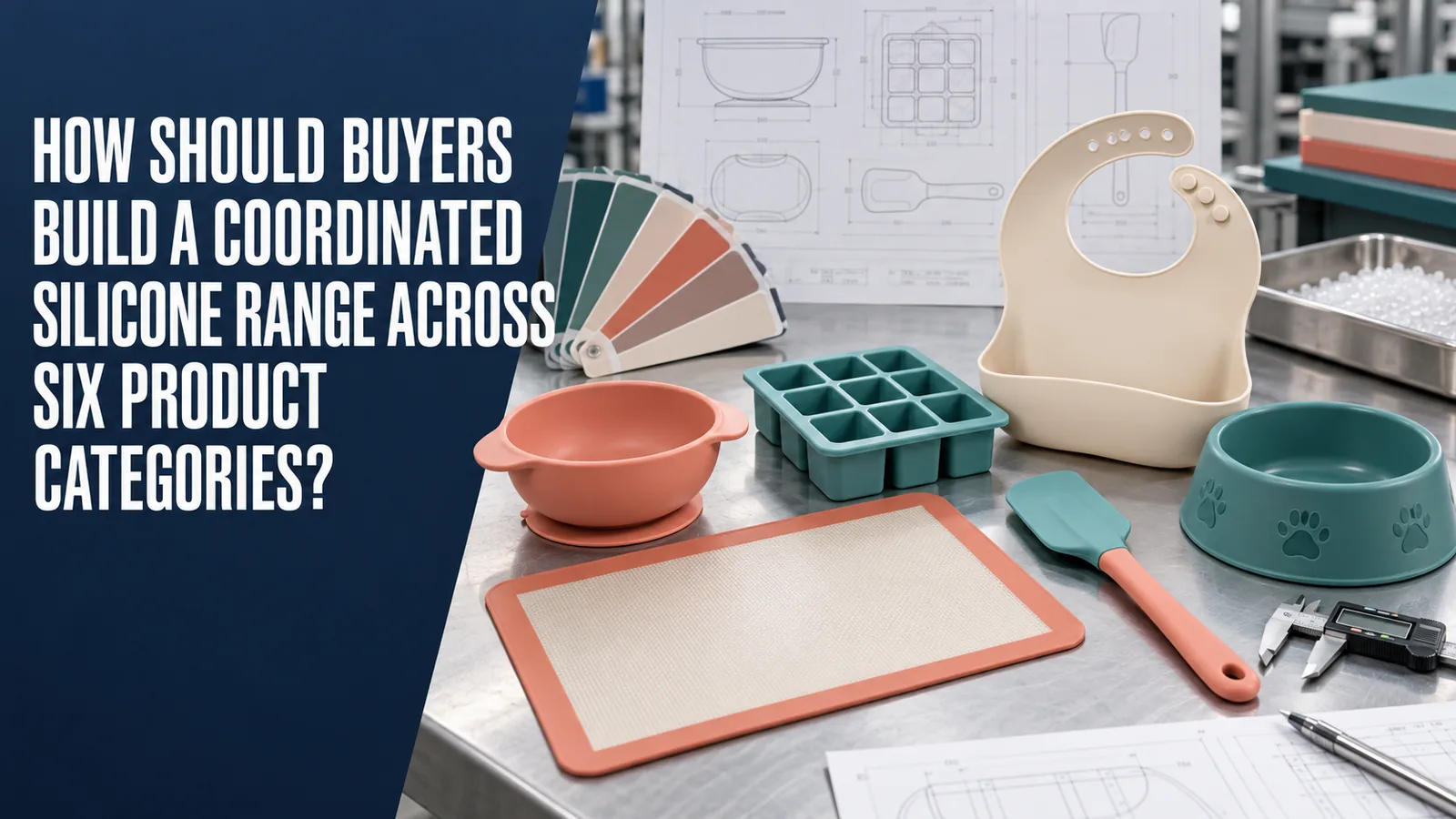
How Should Buyers Build a Coordinated Silicone Range Across Six Product Categories?
Build a coordinated silicone product range across six categories with controlled portfolio roles, specifications, evidence, packaging and launch decisions.
DIRECT ANSWER
What B2B Buyers Need to Know
Buyers should build a coordinated silicone range from one portfolio brief, then control each category as a separate finished-product program. Align target customer, channel, color language, branding, packaging hierarchy and forecast across the collection, but validate material, geometry, performance and market evidence by SKU. Release the range in waves so shared decisions create efficiency without forcing unsuitable specifications onto different products.
This guide is written for private-label brands, importers, distributors, retailers, category managers and sourcing teams building multi-category silicone collections. It provides a decision framework rather than legal advice or a universal specification. Product classification, use conditions and destination market should be confirmed before final testing, labelling or compliance decisions.
Key Takeaways
- Start with one customer, channel and portfolio brief before selecting products or tools.
- Give each of the six categories a clear commercial job and a controlled SKU count.
- Coordinate color, branding and packaging while retaining product-specific drawings and tests.
- Link every compliance or performance record to the exact finished SKU it supports.
- Model MOQ, tooling, packaging and capacity at both collection and individual-SKU level.
- Phase the launch by evidence and operational readiness, then control shared changes across the range.
Six-Category Range Architecture and Decision Conditions
The collection can share commercial and visual rules, but every category needs a finished-product decision file. The exact classification and evidence depend on intended use and destination.
| Category route | Coordinated range role | SKU-specific decision to verify |
|---|---|---|
| Baby products | Feeding entry point and controlled portion assortment | User, geometry, suction or stability, cleaning, material and destination evidence |
| Kitchen products | Bakeware and preparation products that extend the color system | Temperature/use conditions, reinforcement, release, dimensions and packaging |
| Household products | Daily kitchenware and utensil basket builders | Handle or interface strength, flex, finish, cleaning and component fit |
| Industrial products | Custom ice and freezer molds with distinct cavities | Fill volume, release, lid fit, low-temperature use and cavity consistency |
| Medical products | Current site route for bib and feeding-accessory programs | Actual intended use, neck/closure/pocket criteria, claims and applicable classification |
| Pet products | Feeding, mat and treat-tool extension for another customer occasion | Capacity, stability, cleaning, geometry, labeling and destination requirements |
SECTION 01
Define the Range Architecture Before Selecting SKUs
Begin with the target buyer, channel and assortment role so every specification decision supports a sellable range.
Start With Customer, Channel and Commercial Role for multi category silicone products
A coordinated silicone range begins with one portfolio brief, not six unrelated requests for quotations. Define the target customer, sales channel, price architecture, destination markets and the commercial job of every category before choosing shapes or colors. A baby suction bowl, baking mat, kitchen utensil, ice mold, silicone bib and pet bowl may share a visual language, yet each solves a different use problem and carries different evidence, packaging and forecasting conditions. The range should therefore look related without pretending that every SKU can use the same specification.
Create one collection matrix that names the category, target retail price, expected annual volume, selling unit, launch wave and intended margin role for each item. Mark which products attract the first purchase, build basket value or support repeat orders. This map lets engineering, tooling, quality and packaging teams judge whether a shared feature saves cost or spreads one compromise across six products.
Assign Each of the Six Categories a Portfolio Job
Give each established category a distinct portfolio job. Baby products can emphasize controlled portions and stable feeding; kitchen-products may cover baking molds or mats; household-products can supply utensils and daily-use kitchenware; industrial-products can include custom ice and freezer molds; medical-products in the current site architecture can hold bib or feeding-accessory programs; pet-products can extend the same brand system into bowls, mats and treat tools. The category label is an organizational route, not a claim that all products share one compliance classification.
Document where the assortment intentionally overlaps and where it must remain separate. A common color family may connect a baby bowl and pet bowl visually, but geometry, claims and tests should not be copied without review. An ice mold and baking mold may both use cavities, yet temperature exposure, release behavior, fill volume and packaging can differ. Early boundaries make quotations easier to compare because suppliers price the same portfolio logic.
Build Good-Better-Best Tiers Without Duplicating SKUs
A good-better-best structure is useful only when the tiers are visible in function, configuration or service, not when they multiply nearly identical SKUs. A good tier might use existing tooling, a controlled standard color and simple packaging; a better tier can add a coordinated set, differentiated geometry or upgraded pack-out. A best tier may justify custom tooling, a proprietary texture, special component integration or a more demanding validation plan. Keep the tier rationale tied to buyer value and avoid creating colors or sizes that serve no channel need.
Model the SKU count before approving tools. Six categories multiplied by three tiers, four colors and two pack formats produce 144 combinations, each with forecast, artwork and inventory consequences. Identify hero SKUs, conditional extensions and concepts that wait for demand proof. MOQ, price, capacity and lead time must be quoted against the actual mix because aggregate volume split across low-volume variants may remain inefficient.

SECTION 02
Coordinate Specifications and Shared Brand Decisions
Translate the range plan into comparable product, packaging and approval evidence before requesting final quotations.
Define Shared Design Language and Brand Boundaries
Define the shared design language as a controlled set of decisions: color families, corner character, surface gloss or texture, logo treatment, packaging hierarchy and the visual relationship between components. Do not force identical wall thickness, hardness or edge details across products simply to make them look related. A thin flexible bib, a reinforced baking mat and a stable pet bowl need different mechanical behavior. Brand consistency should sit above product engineering, while each drawing preserves the geometry needed for its use.
Create a collection design sheet with approved visual references and separate product drawings beneath it. The collection sheet controls palette, artwork, logo clear space and surface direction; each SKU drawing controls dimensions, tolerance, material identity, finish and interfaces. Record any performance-driven exception instead of silently altering the tool. Naike Silicone can then review shared decisions at range level and manufacturability at SKU level.
Standardize Color Families Without Ignoring Material Geometry
A digital color code is a starting direction, not proof that six molded products will look identical. Pigment response can change with compound, cure route, thickness, translucency, texture and viewing conditions. Build a physical color approval system that identifies the material, surface, minimum and maximum thickness zones, light source and comparison tolerance for each product family. If products use different compounds or surface finishes, approve coordinated appearance rather than demanding a numerical match that ignores how the finished objects are seen.
Plan the palette as a small family with controlled substitutions. A core neutral and two signature colors may span the range, while category-specific accents can help shoppers distinguish use; approve plaques for compound control and molded samples for finished appearance because one cannot replace the other. Pigment MOQ, clean-down, color-change sequence and scrap risk are conditional on the actual material and production plan. Consolidating colors can reduce complexity, but only after the buyer confirms that the resulting product combinations remain commercially useful.
Reuse Components Only When Interfaces Are Verified
Shared components can reduce tooling, inventory and replacement complexity when their interfaces are genuinely common. Examples include a removable utensil handle insert, a packaging tray family or a lid that serves two validated container bodies. Before declaring a component common, compare datum scheme, fit, compression, pull direction, cleaning access, tolerance stack and the way users assemble it. A nominally identical diameter does not prove that a lid will seal, a suction base will hold or an accessory will remain safe in another configuration.
Control commonality through one component code and an interface specification referenced by every affected SKU. Run interchangeability trials with production-representative samples from each intended tool and cavity, then record permitted combinations. If one product change can affect three categories, the engineering-change workflow must notify every owner before approval. Reusing a component without this discipline creates hidden dependencies: a small tool correction for one SKU can disrupt fit, packaging or replenishment across the entire coordinated range.

SECTION 03
Validate Category-Specific Evidence and Pack-Out
Protect margin by reviewing production controls, landed-cost drivers and launch risks as one commercial system.
Create Category-Specific Specifications and Tests
Every category needs its own specification and validation logic even when the brand system is shared. The baby bowl may require dimensional, suction and feeding-use checks; the baking mat needs flatness, reinforcement and use-condition review; the kitchen utensil needs handle, head and pull-interface controls; the ice mold needs cavity volume, release and lid-fit checks; the bib needs neck, closure and pocket criteria; the pet bowl needs stability, capacity and cleaning considerations. Methods, fixtures, conditioning and acceptance limits should be agreed for the real geometry.
Separate material-control evidence from finished-product performance. Hardness, pigment and compound identity help control production, but they do not alone establish suction, release, flex life, thermal behavior or retail suitability; use first-article reports, golden samples and product-specific functional records to release each SKU. Where a claim or test method is still under review, describe it as pending and keep the quotation conditional. This prevents a range-level statement such as premium silicone from becoming an unsupported promise applied indiscriminately to every product.
Map Compliance Evidence to Each Finished SKU
Build an evidence matrix with one row per finished SKU and columns for intended use, destination, applicable requirement, supporting document, tested sample identity, report owner and expiry or review trigger. A supplier certificate or laboratory report must be connected to the actual material, color, construction and market claim before it supports a release decision. One report from a baby bowl should not be attached automatically to a pet bowl, ice mold or printed utensil merely because all are described as silicone.
ISO 9001:2026 can help buyers evaluate whether the supplier controls processes, documented information, performance and improvement, but a management-system certificate does not certify a particular SKU. Product evidence remains conditional on its scope and sample identity. Ask the factory to explain changes in compound, pigment, decoration, subcontracted operation, tool, package or destination that require a new review. The evidence matrix should show gaps openly so launch sequencing reflects readiness instead of concealing uncertainty behind a large folder of unrelated files.
Approve Packaging as a Coordinated Retail System
Treat packaging as a coordinated retail and logistics system. Decide whether the collection uses open bands, cartons, sleeves, inserts or sets; establish a shared information hierarchy; and reserve space for product identity, instructions, responsible-party data, claims and machine-readable identifiers where applicable. Then validate the physical pack for each SKU. A common dieline family may improve brand recognition, but soft products, heavy bowls, long utensils and flexible mats do not impose the same support, deformation or carton-efficiency demands.
GS1 barcode standards provide a common identification framework, while the GS1 Global Traceability Standard describes Identify, Capture and Share concepts around critical tracking events and key data elements. Buyers still need to assign identifiers correctly and connect them to SKU, pack level, lot and business records. Approve artwork, barcode placement, scannability, selling-unit count, master-carton quantity and shipping marks on production-representative packs. Packaging MOQ, price and lead time depend on material, print process, finish, supplier scheduling and the number of artwork variants.
SECTION 04
Release the Collection Through Forecast and Change Control
Use early sales and replenishment assumptions to decide which variants deserve expansion and which should remain controlled.
Model MOQ, Tooling and Inventory at Collection Level
Calculate feasibility at collection and SKU level. The collection view shows tooling, forecast and supplier capacity; the SKU view exposes small color runs and inefficient packaging variants. Ask quotations to separate tooling, unit price, packaging, testing, samples and logistics assumptions. A blended price can hide that one hero product supports uneconomic extensions or that packaging drives the minimum order.
Use a rolling forecast with firm, flexible and concept zones. Firm quantities can reserve approved material and production slots; flexible quantities may change within agreed limits; concept items should not consume capacity until their specifications and demand are mature. Capacity is conditional on tool availability, cycle time, cavities, color sequence, secondary operations, packaging readiness and the confirmed factory schedule. Do not convert a monthly tonnage statement into a guaranteed delivery date for a multi-category assortment without mapping those constraints to each purchase order.
Phase the Launch Around Capacity and Evidence Readiness
Release the range in waves according to evidence and operational readiness, not simply the order in which ideas were proposed. A first wave might contain existing-tool hero SKUs with stable packaging, followed by custom-tool differentiators after validation, and finally experimental color or bundle extensions after demand data is available. The sequence should also consider factory changeovers, packaging arrival, inspection access and the buyer's warehouse or retail calendar. A coordinated launch does not require every SKU to leave the factory on the same day.
Build a milestone plan from DFM review through tool trial, corrected sample, evidence review, artwork approval, pilot pack-out, purchase-order confirmation, production, inspection and shipment. Assign a decision owner and required output to every gate. Lead time remains conditional until open inputs are closed; a tool can be ready while artwork, test samples or cartons are not. Use one collection dashboard to expose dependencies, while retaining product-level records so a delay in one optional extension does not automatically hold every approved core SKU.
Govern Repeat Orders With a Collection Change Matrix
Repeat orders need a collection change matrix because range coordination creates shared dependencies. List every common color, component, logo file, packaging element, material family and supplier process, then identify which SKUs must be reviewed when it changes; classify changes by approval authority and evidence requirement. A pigment substitution may require appearance and document review across several categories, while a local carton-strength correction may affect only one pack level. Never let the latest purchase order become the only record of what changed.
For a Naike Silicone range review, send the brief, priority SKUs, references, destinations, forecast, color direction, packaging concept and launch waves. We can map existing-tool options, custom tooling, SKU-specific validation and quotation assumptions before the range is frozen. Certification scope, performance, MOQ, price, capacity and lead time remain conditional on the approved material, geometry, color, package, evidence plan and order schedule.

ACTION FRAMEWORK
Buyer Checklist Before Commercial Approval
Use this checklist as a meeting agenda. It is intentionally concise so the team can identify missing evidence without replacing its own quality, legal or supplier-management procedure.
| Check | Question | Why It Matters |
|---|---|---|
| Portfolio brief | Are customer, channel, price architecture and category roles approved? | Without one commercial brief, the range becomes a collection of unrelated supplier suggestions. |
| SKU matrix | Are hero, extension and conditional SKUs identified by color, tier and pack? | An uncontrolled combination count increases MOQ, inventory, artwork and inspection complexity. |
| Design system | Are shared color, finish, logo and packaging rules separated from product drawings? | Brand consistency should not overwrite the geometry or behavior required by each product. |
| Common parts | Have interfaces and interchangeability been validated across all intended combinations? | A nominal dimension does not prove fit, seal, retention or safe use in another SKU. |
| Evidence matrix | Does every report identify the material, sample, SKU, market and claim it supports? | A broad certificate folder can hide gaps and cannot replace finished-product scope review. |
| Packaging | Are identifiers, artwork, selling unit, protection and carton data approved per SKU? | A shared visual system still needs physical pack validation and accurate traceability records. |
| Commercial model | Do MOQ, tooling, unit price, capacity and lead time use the same SKU mix? | A blended quotation may conceal inefficient variants or different supplier assumptions. |
| Change control | Does the change matrix show every SKU affected by shared colors, components or files? | A local change can disrupt several categories when dependencies are not visible. |
NEXT READING
Continue the Supplier and Product Review
These internal resources connect the guide with Naike Silicone product, factory, customization and inquiry pages. Open the route that matches the next decision in your project.
Plan a silicone baby tableware assortment
Use plan a silicone baby tableware assortment to gather the next level of product, manufacturing or commercial information.
Open internal resource →Source a coordinated silicone kitchen collection
Use source a coordinated silicone kitchen collection to gather the next level of product, manufacturing or commercial information.
Open internal resource →Build a silicone pet feeding set
Use build a silicone pet feeding set to gather the next level of product, manufacturing or commercial information.
Open internal resource →Explore all silicone product categories
Use explore all silicone product categories to gather the next level of product, manufacturing or commercial information.
Open internal resource →Review Naike Silicone manufacturing knowledge
Use review naike silicone manufacturing knowledge to gather the next level of product, manufacturing or commercial information.
Open internal resource →Understand the customized-service workflow
Use understand the customized-service workflow to gather the next level of product, manufacturing or commercial information.
Open internal resource →PRIMARY REFERENCES
Authoritative External Sources
The sources below are official primary references. Applicability depends on the product, intended use and destination market. Buyers should obtain qualified advice for final legal or regulatory decisions.
ISO 9001:2026 Quality Management Systems
Official ISO page for the current 2026 quality-management-system requirements; it frames controlled information and processes but does not certify this particular silicone SKU.
GS1 Barcode Standards
Official GS1 overview of barcode standards used to encode identifiers for products, shipments and locations; buyers must still assign and verify identifiers for the actual pack hierarchy.
GS1 Global Traceability Standard
Official GS1 traceability standard describing Identify, Capture and Share concepts, Critical Tracking Events and Key Data Elements for interoperable traceability systems.
BUYER QUESTIONS
Frequently Asked Questions
Should all six silicone categories use the same material specification?
Not automatically. Products may share a controlled material family, but intended use, geometry, color, process and destination evidence can differ. Approve material identity and finished-product validation for each SKU rather than relying on one generic silicone statement.
How many colors should a coordinated silicone range launch with?
Use the smallest palette that serves the channel and forecast. A core neutral plus limited signature colors often controls complexity better than many low-volume variants, but pigment MOQ, changeover, packaging and product-specific appearance must be confirmed before the palette is fixed.
Can existing molds be used to build the first collection?
Yes, when the available geometry, ownership, condition and validation fit the brief. Existing tools can support faster hero-SKU trials, while custom tooling should be reserved for differentiation that buyers can justify commercially and technically.
Can one compliance report cover the complete silicone collection?
Only when its scope, sample identity, material, construction, colors, intended use and destination requirements genuinely cover every listed SKU. In most mixed-category ranges, buyers need an evidence matrix that shows which documents apply to which finished products.
How should a buyer compare quotations for a six-category range?
Issue one controlled collection matrix and require suppliers to separate tooling, unit product, packaging, testing, samples and logistics assumptions. Compare the same SKU mix, quantities, colors, pack-outs, Incoterm and evidence scope rather than only a blended unit price.
What information should we send Naike Silicone for a range review?
Send the customer and channel brief, six-category priorities, reference products or drawings, destinations, forecast by SKU, color and branding direction, packaging concept, target dates and known validation requirements. Naike Silicone can then propose a tooling, sample and supplier-evaluation path with conditional commercial assumptions.
Editorial and Scope Note
Conclusion: Coordinated Silicone Range Buyer Guide
Move from buyer research to a controlled supplier brief
A coordinated silicone range succeeds when the collection shares a commercial and visual system while every finished product retains its own specification, evidence and release decision. Control SKU count, interfaces, packaging, forecast and change impact before placing the order. Certification scope, performance, MOQ, price, capacity and lead time remain conditional on the approved material, geometry, color, packaging, destination, evidence plan and production schedule. Send Naike Silicone your range brief, priority SKUs, forecast and target markets to request a collection review, tooling plan, sample proposal or supplier-evaluation quotation.
This factory-insider guide supports sourcing preparation and supplier discussion; it does not replace product-specific engineering, laboratory, regulatory, legal or commercial review for the destination market.