CUSTOM MANUFACTURING & TOOLING
How Do Product, Logo and Packaging Approvals Work Together?
Coordinate product, logo and packaging approvals for silicone SKUs through one revision-controlled release set. See buyer checkpoints and request a sample review.
DIRECT ANSWER
What B2B Buyers Need to Know
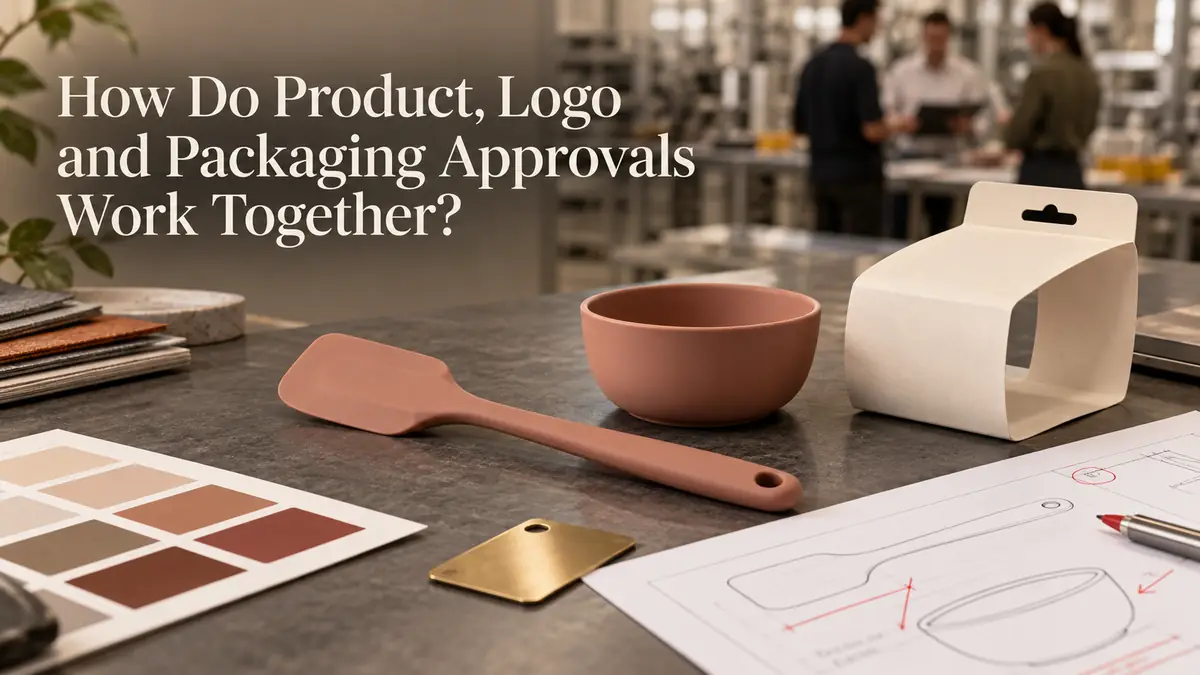
Product, logo and packaging approvals should be linked by one silicone SKU revision, not signed as three unrelated files. First confirm the molded geometry and material on a physical sample; then approve logo position, depth and visibility on that revision. Finally check artwork and packaging with the actual marked product. Release production only when owners, evidence and change triggers agree.
This is a linked release decision, not three independent sign-offs. The molded sample, mark treatment and packed selling unit need their own approvers and evidence, all tied to the same SKU and destination.
Key Takeaways
- Treat the silicone product drawing and golden sample as the baseline for every downstream sign-off.
- Approve a logo on its real molded surface, not only on a flat vector proof.
- Do not release printed packaging until it matches the approved product and logo revisions.
- Record the buyer, factory, brand and market reviewer responsible for each decision.
- Escalate geometry, pigment, logo, claim or pack changes to the affected approval gates.
- Quote MOQ, tooling, price and timing against the agreed release set and current capacity.
Three Interdependent Approval Gates for a Silicone SKU
The next sign-off is valid only while its upstream product and intended market assumptions remain unchanged.
| Gate | Approval artifact | What can reopen it |
|---|---|---|
| Product | Controlled drawing, material reference, critical measurements and golden molded sample | Tool, geometry, compound, pigment or functional acceptance change |
| Logo | Vector master, placement drawing and approved marked sample | Mark size, depth, surface texture, mold insert or brand artwork change |
| Package | Signed artwork, bill of materials and packed golden sample | Selling-unit count, label claim, barcode, destination or product/mark revision |
| Production release | Linked revision register, owners, first-article checks and purchase-order basis | Any unresolved deviation or unapproved substitution |
SECTION 01
Anchor Every Decision to a Product Revision
Convert the commercial concept into controlled dimensions, functions and approval criteria before DFM begins.
Identify the Selling Unit Before Parallel Work for product, logo and packaging approvals
A private-label launch often starts with product engineering, brand design and packaging working at the same time. Parallel work is useful only when everyone names the same selling unit: the silicone part, any companion pieces, instructions, proposed logo treatment and destination market. At our review bench, a plain bowl and a bowl with a molded emblem are not automatically the same approved SKU. Record which components reach the customer and which are only development aids before a team signs a drawing or artwork file.
Give the program one SKU identifier and separate revision numbers for product, logo master and package. A register should show how those numbers combine into a saleable configuration, including colors and languages where they create separate versions. If the first order mixes colors but one carton, state whether the printed label identifies each variant. This prevents a generic proof from masking different packing instructions.
Freeze the Drawing, Material and Functional Sample
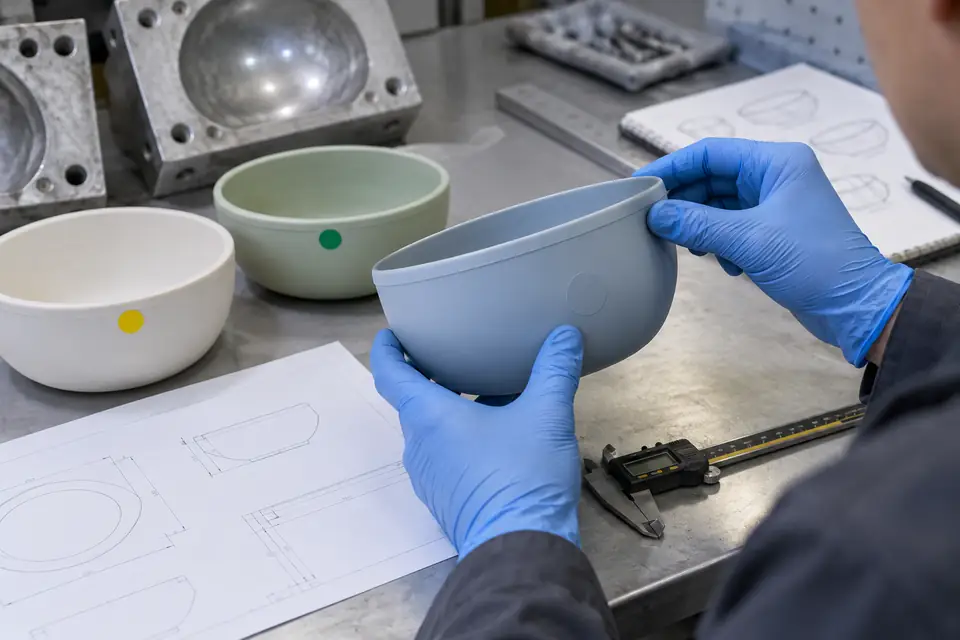
The product drawing should control geometry, tolerances that matter in use, material identity and the proposed mark area. A golden molded sample then tests the drawing in the buyer's hand, including flex, surface finish, cleaning access and how the part actually sits inside the proposed selling unit. A digital render may show a beautiful logo placement on a rim that later becomes too narrow after a mold correction. Freeze the critical product features before interpreting that render as permission to cut a logo insert or print a package panel.
For a feeding bowl, a change to rim thickness can alter both logo visibility and the clearance inside a sleeve. For a spatula, moving the handle grip zone may change the safe location for a raised mark, the hanging hole and the silhouette shown on the carton. We compare the current sample with the drawing and write the deviations before choosing which file becomes the baseline. Functional performance, food-contact scope or cleaning claims remain conditional on the finished configuration and agreed evidence rather than a generic material label.
Assign a Decision Owner to Each Gate
The buyer's engineer approves function, a brand owner approves the logo master and a market reviewer checks printed claims. The factory can assess mold repeatability and packed-sample conformity, but not assume ownership of another party's trademark or regulatory statements. Put those responsibilities on a release matrix. An empty signature box is an unresolved requirement, not tacit approval.
Define what each person is signing: a drawing revision, a physical sample with an identifier, a color standard, a print proof or a complete packed unit. A sales manager's acceptance of a photograph is not equivalent to quality's acceptance of a dimensional sample unless the scope explicitly says so. If two markets use different care language, the relevant reviewer must approve each version before printing. The decision log should retain the date, result, open conditions and a route for escalation when an approver requests a correction.

SECTION 02
Approve Brand Identity on the Physical Silicone Part
Close the process, material and mold decisions that determine tooling scope, trial evidence and revision cost.
Choose a Manufacturable Logo Zone
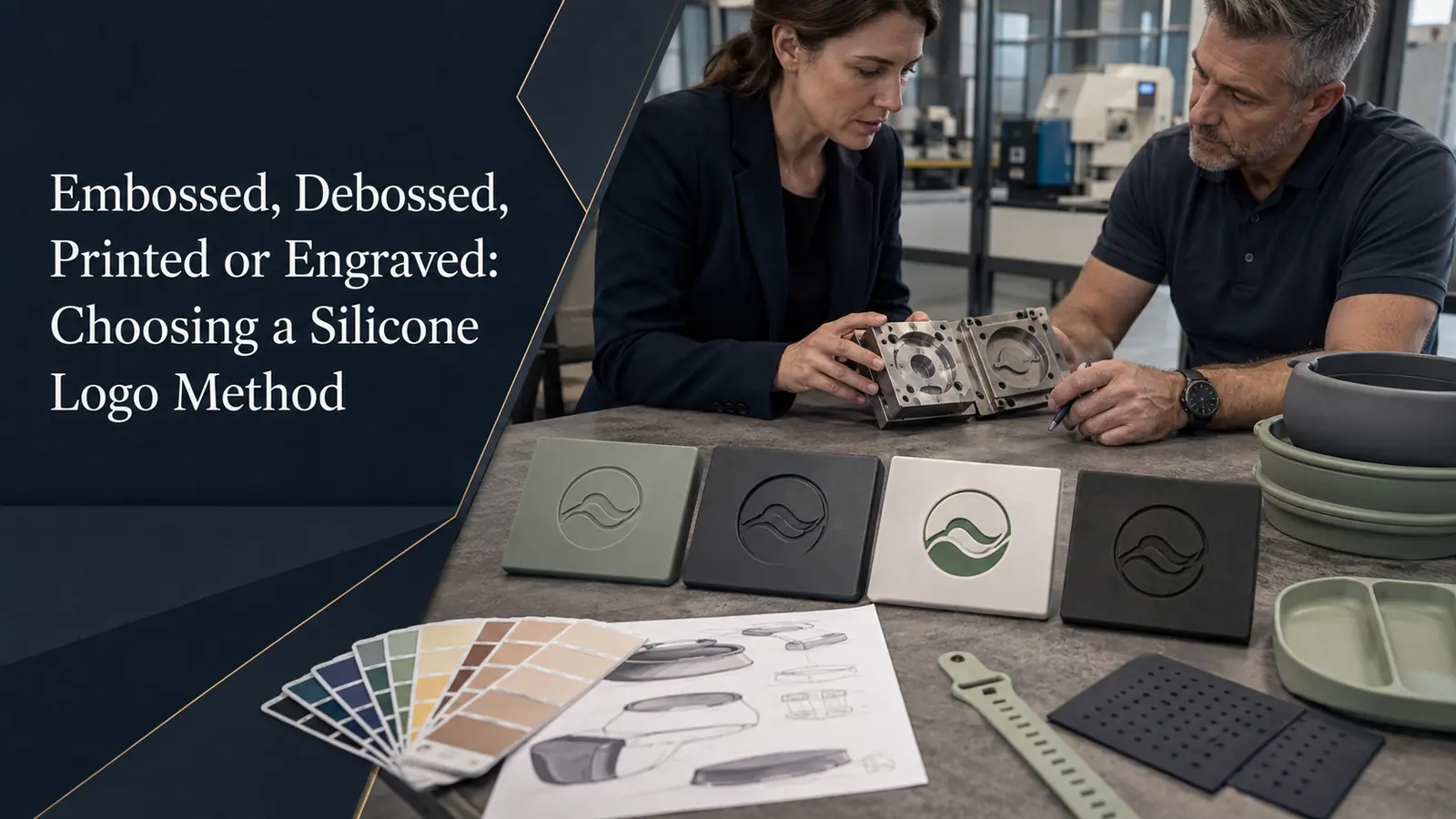
A silicone logo belongs in a zone that survives molding, demolding, handling and cleaning. On a suction plate, a mark on the contact surface could interrupt the seal or create a harder-to-clean recess; on a utensil, the grip and neck need review. Evaluate curvature, parting line, texture and access before committing to an embossed or debossed feature. A vector alone cannot demonstrate a manufacturable three-dimensional result.
Map the logo boundary onto the drawing with distances from edges, ribs and other relevant features. A replaceable insert may suit variants sharing one base tool, subject to tool structure and changeover cost. A large emblem may distort when the part flexes or be hidden by a retail sleeve. Review shelf orientation and use, then approve its position on a molded sample.
Judge Mark Depth and Legibility on Molded Parts
The logo sample should be judged at the intended scale, not by zooming a vector file until thin strokes look substantial. Ask the toolmaker to review minimum line width, depth, edge transition and release direction for the specific compound and part geometry. A shallow mark might disappear under a textured surface, while a deep recess may trap residue or change the feel of a grip. The appropriate depth is a sample-based manufacturing decision, not a universal value that can be copied from a different product.
Use a physical marked sample and photograph it under agreed lighting from both normal viewing distance and a close inspection angle. Record legibility, distortion, local flash, stress marks and cleaning access against a signed reference. If the buyer wants both a molded mark and a printed element, qualify each process on the actual material and intended contact area; do not treat one adhesion observation as evidence for every color. Preserve the vector master and accepted sample together so a future logo refresh can be evaluated as a change rather than quietly substituted.
Approve Pigment and Surface Under Real Viewing
Silicone pigment, surface texture and wall thickness can change how a chosen color appears next to a paperboard print. Review the molded product under specified lighting beside the color reference and erected package proof, not only as two isolated screen images. If a translucent or thin region looks lighter than a thick handle, decide whether that variation is acceptable or whether the design or pigment target must change. An exact visual match across dissimilar materials is not an assumption to make at the quotation stage.
Record the compound, pigment reference, finish and approved viewing condition on the color sign-off. The printed sleeve may need its own tolerance and substrate proof because ink, coating and board texture create a different appearance from pigmented silicone. When a new color is introduced, check whether the molded mark remains visible and whether the product photograph on the package still describes the sold variant. A signed physical pairing is more reliable for a repeat order than a color name copied between purchase orders.
SECTION 03
Connect Artwork and Packed-SKU Evidence
Treat each mold trial as a measured engineering gate rather than a visual sample-selection exercise.
Map Product and Logo Revisions into Artwork
Once the product and mark are approved, the packaging team should receive the exact revision pair rather than a folder of latest-looking images. Connect the product identifier, logo file, marked sample and artwork version in one release register. The retail image, logo orientation and description on the outside must agree with what a customer sees after opening the pack. This is an identity check; the earlier packaging-development guide deals more deeply with structural carton engineering and insert clearance.
For a multi-piece utensil set, the drawing may describe each silicone component while the brand artwork depicts the whole assortment. Compare the printed count, color and included accessory to a physically assembled set, then check that the molded marks face the expected direction. A last-minute addition of a spoon changes more than the component list: the image, pack count, perhaps the carton and often the quotation basis also change. Send that alteration back to the relevant gates rather than allowing packaging to be the only team notified.
Separate Claim Ownership from Print Production
The brand or its authorized reviewer should substantiate product names, age statements, food-contact wording, care instructions and any certification claims for the destination. The supplier can flag copy that differs from the supplied specification or will not fit a printable panel, but factory print approval is not a legal opinion. A report for one compound or SKU should not be transferred to a changed pigment, finished article or market without checking its scope. Keep the evidence reference and responsible claim owner next to the specific artwork version.
Trademark permission, industrial-design rights and production permission are separate questions. WIPO explains the context for protecting visual design, but a website overview cannot establish who owns a particular mark or how it may be used in a given jurisdiction. Request a supplied vector master and written authorization path before engraving somebody else's brand into a mold. If the license or claim wording changes, halt the affected artwork and mark releases until the responsible team documents the new approval.
Inspect the Complete Marked and Packed SKU
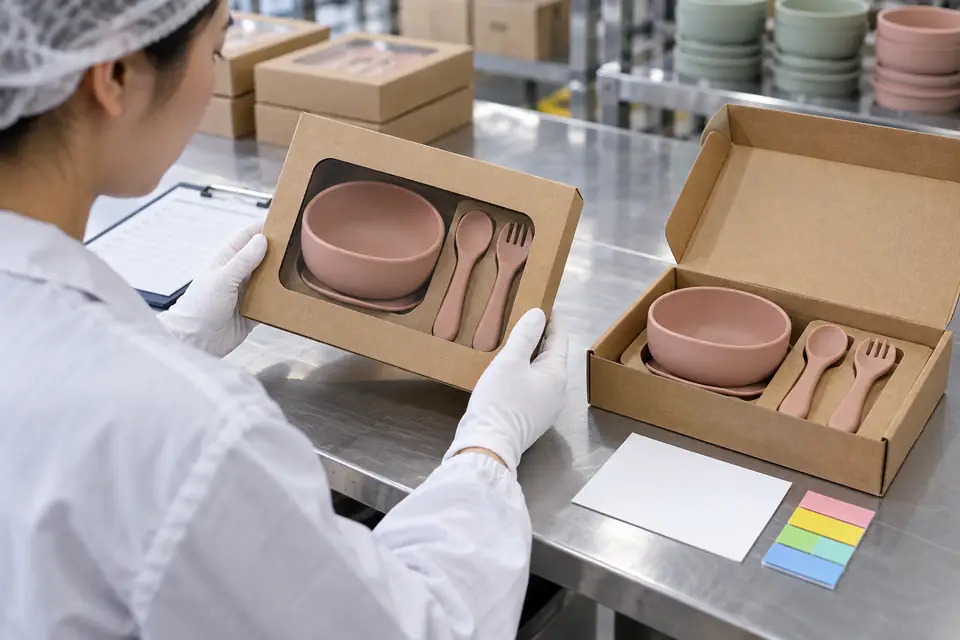
Bring a production-representative marked silicone part to the final packed-SKU inspection. Compare the item inside the box with the printed product photograph, color name, component count, barcode and care leaflet; look for a mismatch that neither an isolated product test nor an artwork proof would reveal. Check the visibility of the logo through a window or after opening if that is a selling feature. Record the opened and closed presentation with the same sample and revision identifiers.
The inspection method should distinguish appearance, function and identification. A pack may look correct but contain the wrong color variant, and a perfectly molded part may be paired with an obsolete instruction insert. Define a sample quantity and acceptance basis for the initial pack-out, then note which checks recur during production. Distribution marks, where necessary, have their own purpose; ISO 780:2015 addresses graphical handling symbols for packages, not approval of the product artwork or the silicone's intended use.
SECTION 04
Release Production with Traceable Change Control
Release production only when drawings, golden samples, inspection records and change authority describe the same revision.
Link First-Article Checks to the Signed Release Set
A signed golden pack is a reference, but first production still needs a check against it. Verify the cavity result, compound, pigment, molded mark, artwork, component count and carton identification before volume assembly. Retain a first-article product and packed unit for each relevant variant. The release record should point to the approved drawing and sample, not merely an email saying production may proceed.
Set a line-clearance step between colors, logo customers or language versions so leftover inserts and printed sleeves do not cross into the next order. An inspector should be able to compare an observable feature or code, not infer the right version from a box of mixed proofs. ISO 9001:2026 describes a quality-management framework that supports controlled processes and information, but its public overview is not proof that this SKU passed any test. Use the agreed SKU-specific checks and retain deviations with their disposition.
Route Engineering and Artwork Changes to the Right Gate
A drawing change should be assessed for its downstream effects, not classified by the department that requested it. Moving a molded logo can alter cavity tooling, artwork photography and the point visible through a pack window. Changing the product color may require another mark-legibility sample and a new physical print comparison. A change matrix should name the affected approval artifact, approver and whether a new sample, test, artwork proof or packed first article is necessary.
Not every change needs every gate repeated. An internal carton count change might leave the consumer logo untouched, while a new destination market could reopen copy and label review without changing the tool. Document that reasoning so a later buyer understands why a gate remained valid. Reject silent substitutions of compound, logo insert, print supplier, care statement or included accessory merely because the nominal product name stays the same.
Quote and Reorder from the Controlled Configuration
Quote the complete release configuration: number of tools or logo inserts, mark variants, pigment splits, printed versions, selling-unit count and inspection plan. A factory molding minimum and a printer's economical run size may not align, particularly when the same silicone part carries several private-label identities. Separate setup charges from recurring unit cost and identify who owns any tooling or artwork. Price comparisons based on one plain sample and another fully branded pack are not comparable quotations.
A sample and launch schedule begins after product, mark and packaging gates are scoped, allowing for proof corrections and buyer sign-off. MOQ, price, capacity and lead time depend on geometry, order mix, tests, print quantities and the current production window. For a reorder, reference the approved register and check changed assumptions. Send Naike Silicone the drawing or sample, logo vector, destination, pack concept and quantity for a joined review.
ACTION FRAMEWORK
Buyer Checklist Before Commercial Approval
Use these questions to align product engineering, brand, packaging and quality approvers. A missing physical reference or owner should remain open until the linked release record is complete.
| Check | Question | Why It Matters |
|---|---|---|
| Product baseline | Which drawing and molded sample control the SKU? | A late geometry change can invalidate mark position and packed fit. |
| Mark zone | Has the logo been reviewed on a real molded surface? | Curvature, parting lines and texture alter visibility and release. |
| Brand ownership | Who signs the artwork and any licensed mark? | Factory production approval does not convey trademark rights. |
| Market copy | Who substantiates care, safety and certification statements? | A generic report cannot authorize the finished SKU's printed claims. |
| Packed sample | Does the actual marked part match the printed selling unit? | A digital mockup can conceal omissions, mismatches and orientation errors. |
| Revision register | Are product, logo and package files linked by identifier? | Purchasing and factory teams need one unambiguous release set. |
| Change path | Which alterations force a new sample, proof or test? | A small-looking change may reopen several dependent approvals. |
| Commercial lock | Which configuration underlies MOQ, tooling and delivery? | Quantity, artwork versions and production slots can alter the quotation. |
NEXT READING
Continue the Supplier and Product Review
Move from logo method and placement to the approved physical selling unit; the factory and customization pages then help scope a joined sample review.
Review silicone logo method trade-offs
Use review silicone logo method trade-offs to check the revision or evidence needed before the joined product, mark and package release.
Open internal resource →Check logo placement and artwork approvals
Use check logo placement and artwork approvals to check the revision or evidence needed before the joined product, mark and package release.
Open internal resource →Plan the physical private-label package
Use plan the physical private-label package to check the revision or evidence needed before the joined product, mark and package release.
Open internal resource →Explore all silicone product categories
Use explore all silicone product categories to check the revision or evidence needed before the joined product, mark and package release.
Open internal resource →Review Naike Silicone manufacturing knowledge
Use review naike silicone manufacturing knowledge to check the revision or evidence needed before the joined product, mark and package release.
Open internal resource →Understand the customized-service workflow
Use understand the customized-service workflow to check the revision or evidence needed before the joined product, mark and package release.
Open internal resource →PRIMARY REFERENCES
Authoritative External Sources
These official references frame management-system controls, necessary distribution symbols and design-right context. None establishes that a particular molded logo, private-label claim or packed silicone SKU has been approved.
ISO 9001:2026 Quality Management Systems
Official ISO page for the current 2026 quality-management-system requirements; it frames controlled information and processes but does not certify this particular silicone SKU.
ISO 780:2015 Distribution Packaging Symbols
ISO 780:2015 concerns necessary distribution-package handling symbols. Its scope does not approve retail artwork, trademark use or a silicone product claim.
WIPO: Industrial Designs
Official World Intellectual Property Organization overview of industrial-design protection.
BUYER QUESTIONS
Frequently Asked Questions
Which approval should happen first for a private-label silicone SKU?
Start by defining the finished selling unit, destination and controlled product drawing, then validate a physical molded sample. Logo placement and packaging can be explored in parallel, but their final sign-offs must cite that product revision. A changed product may reopen either downstream gate.
Can we approve the molded logo from a vector proof?
The vector is the artwork master, not the molded acceptance sample. Review mark scale, depth, position, visibility and cleaning access on the actual silicone surface, then retain a signed physical reference. Tooling feasibility depends on geometry and molding route.
Who is responsible for logo rights and package claims?
The brand or its authorized representatives must establish mark-use permission and substantiate destination-specific claims. Naike Silicone can review manufacturability and compare production with supplied approved files, but a factory sign-off is not a transfer of trademark rights or legal certification.
What if the silicone color changes after the carton artwork is approved?
Recheck the physical color pairing, mark legibility, printed product depiction and any SKU color identifier. Record whether a new proof or packed sample is needed for that variant. Do not silently reuse approval evidence from a different compound or pigment configuration.
What belongs in the final approval packet?
Include the controlled drawing, material and color reference, golden molded and marked samples, logo vector and placement file, signed artwork, component bill, packed golden unit, relevant test scope, first-article inspection method and named approvers. Each artifact should carry its own revision and the same selling-unit identifier.
How do a late logo edit or component change affect MOQ and timing?
A mark edit may need a new insert, molded trial and pack proof; an added component can alter carton size, counts and print inventory. MOQ, tooling cost, price, sample timing and delivery depend on the confirmed variants, tests, quantities and current production slot. Request an updated quotation against the changed release set.
Editorial and Scope Note
Conclusion: Product, Logo and Packaging Approvals for Silicone
Move from buyer research to a controlled supplier brief
A release-ready private-label silicone SKU has one controlled product drawing and golden sample, an approved physical logo treatment, and packaging whose artwork, component count and claims match that exact marked product. The brand owns trademark authorization and destination-specific claims; the factory can review manufacturability, sample fit and repeatable inspection against the agreed revision. ISO 9001:2026 frames quality-management controls, ISO 780:2015 concerns distribution handling marks, and WIPO provides industrial-design context; none approves a particular SKU or grants trademark rights. Send the sample or drawing, logo vector, target market, artwork and quantity for a joined review; price, MOQ, capacity and timing remain conditional on the final configuration and production window.
Ask for a linked review of the molded part, mark and packed unit; a sign-off on one file cannot authorize the remaining two without their own approved evidence and responsible owners.