PRODUCT SOURCING GUIDES
How Should Buyers Source Wholesale Silicone Pet Products?
Source wholesale silicone pet products through controlled bowl, mat, quality and packaging decisions. Send Naike Silicone your retail range brief for review.
DIRECT ANSWER
What B2B Buyers Need to Know
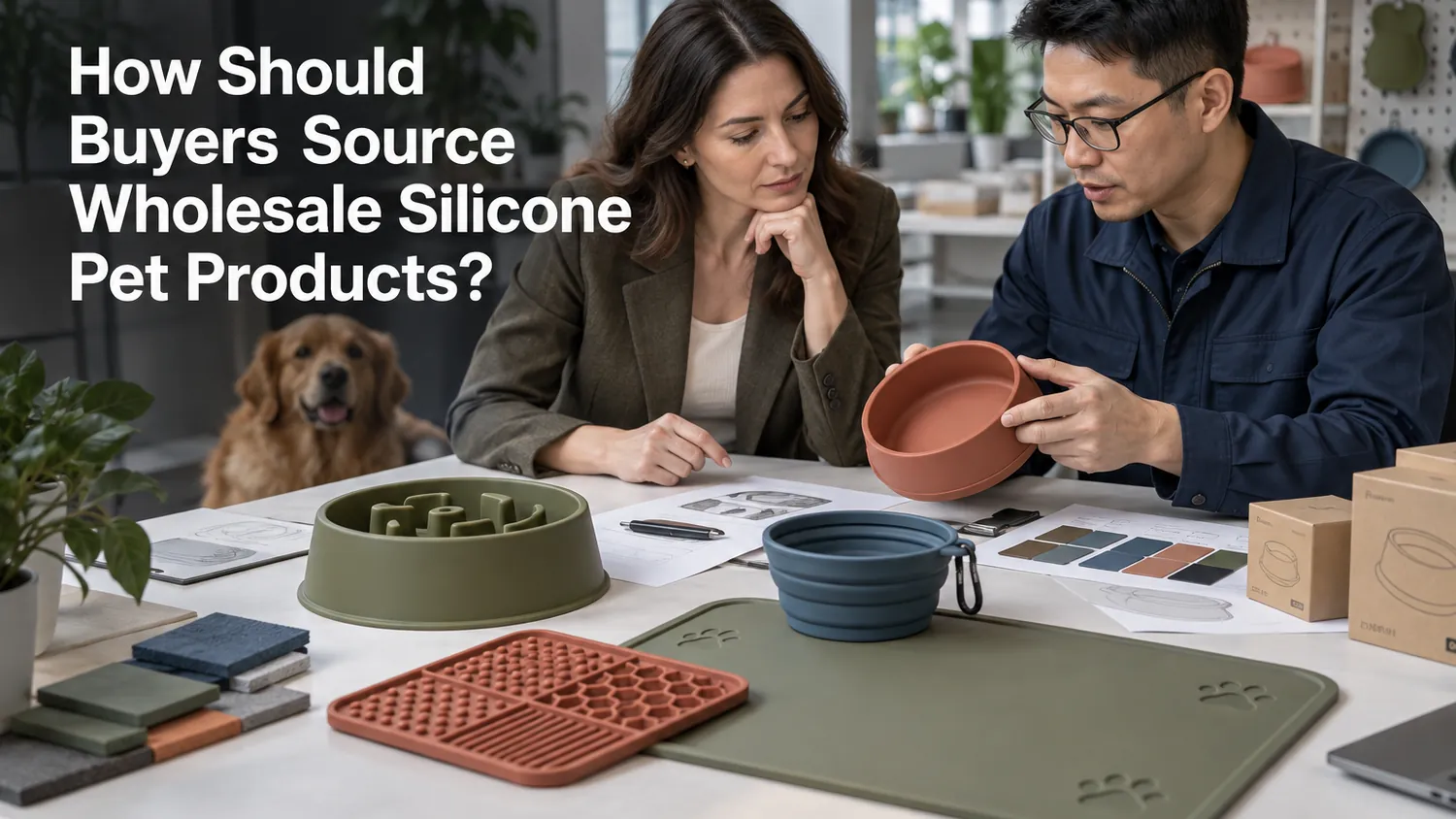
Wholesale silicone pet products should be sourced as a controlled retail program, not as unrelated bowls and mats. Buyers should define pet size, feeding behavior, channel, geometry, stability, cleaning, color, packaging and evidence before comparing suppliers. The right mix of weighted bowls, slow feeders, rimmed mats and travel formats depends on the intended use, approved specification, destination market and forecast.
This guide is written for pet-product importers, private-label brands, retailers, distributors, category managers, product developers and sourcing teams. It provides a decision framework rather than legal advice or a universal specification. Product classification, use conditions and destination market should be confirmed before final testing, labelling or compliance decisions.
Key Takeaways
- Segment the range by pet size, feeding behavior, use location and channel before choosing product shapes.
- Specify bowl capacity, access diameter, base stability and slow-feeder geometry with measurable approval points.
- Control feeding-mat footprint, edge height, flatness and underside texture for the intended floor and cleaning routine.
- Link silicone compound, pigment, finished SKU and supporting evidence through traceable production records.
- Approve color, logo, selling unit and master carton together because they change retail readiness and landed cost.
- Keep MOQ, price, lead time, capacity and performance conditional on the final assortment, specification and order mix.
Wholesale Silicone Pet Product Format Comparison
No single format suits every pet or channel. Buyers should compare products under defined pet-size, food, floor, cleaning, packaging and commercial conditions.
| Product format | Where it can fit | Evidence to approve |
|---|---|---|
| Weighted or broad-base bowl | Everyday food or water programs where floor stability and easy access lead the brief | Capacity, opening diameter, base contact, tip or push method, wall profile, cleaning check and packed dimensions |
| Slow-feeder bowl | Programs addressing feeding pace with geometry appropriate to the target pet and food type | Pattern depth, channel width, access clearance, fill quantity, supervised use trial, cleaning access and edge inspection |
| Rimmed feeding mat | Home feeding stations needing spill capture, bowl organization and wipe-clean handling | Footprint, rim height, flatness, underside texture, floor-condition check, roll recovery and carton presentation |
| Collapsible travel bowl | Portable, outdoor and travel assortments prioritizing packability and repeat folding | Open capacity, fold geometry, hinge thickness, cycle method, shape recovery, attachment detail and carry package |
SECTION 01
Start Wholesale Silicone Pet Products With the Feeding Scenario
Begin with the target buyer, channel and assortment role so every specification decision supports a sellable range.
Retail Channel, Pet Size and Feeding Scenario for wholesale silicone pet products
Start with the animal and the shopping mission, not with a catalog photograph. A buyer serving large dogs needs a different bowl opening, capacity and floor footprint from a retailer assembling a compact cat-feeding range; a travel channel adds packability and attachment concerns that a home-feeding range may not have. Record the expected pet size, food form, feeding location and supervision assumptions beside each proposed SKU before asking factories to quote.
Build a small assortment map with a reason for every item: an everyday water bowl, a food bowl, a slow-feeder option and a mat may solve different jobs, while four differently colored bowls of the same geometry may simply split demand. Ask sales and merchandising teams which format earns shelf space and which is only an optional color extension. This distinction affects tooling investment, inventory depth and the minimum viable first order.
Bowl Capacity, Diameter and Stable Base Geometry
Nominal capacity is only a starting point. A bowl that holds a stated volume at the rim may spill when carried or pushed, so the brief should distinguish brimful capacity from the recommended working fill and specify the method used to measure both. Check opening diameter against the target pet's access, then review wall height, rim shape and the space available for the animal's muzzle without assuming one dimension works for every breed.
A broad base can improve stability, but the result depends on the floor, fill level and how force is applied. During sample review, place the bowl on the flooring representative of the buyer's intended use and document a repeatable push or tip check rather than describing it as simply 'non-slip.' If a weighted insert, bonded part or unusually thick base is proposed, identify its construction and cleaning implications before accepting the additional mass or cost.
Slow-Feeder Pattern Depth and Access Clearance
A slow-feeder pattern should be specified as an access problem, not a decorative maze. Record the channel width, feature height, corner radii and the food types the buyer expects customers to use; dry kibble and wet food can behave differently in the same channels. Review whether the target pet can reach the feed without sharp or inaccessible pockets, and avoid promising a particular feeding-time reduction without a defined animal and trial method.
Cleanability is part of the pattern decision. Request a production-representative sample and have the buyer's team wash it using the stated care method, looking for trapped residue where walls meet the floor of the bowl. A photograph of a clean sample does not prove the cavities remain easy to clean after use. Keep the approved pattern, surface finish and any subsequent tooling correction linked to the same revision so reorders retain the evaluated geometry.
SECTION 02
Translate Each Bowl and Mat Format Into Measurable Requirements
Translate the range plan into comparable product, packaging and approval evidence before requesting final quotations.
Feeding-Mat Footprint, Rim Height and Flatness
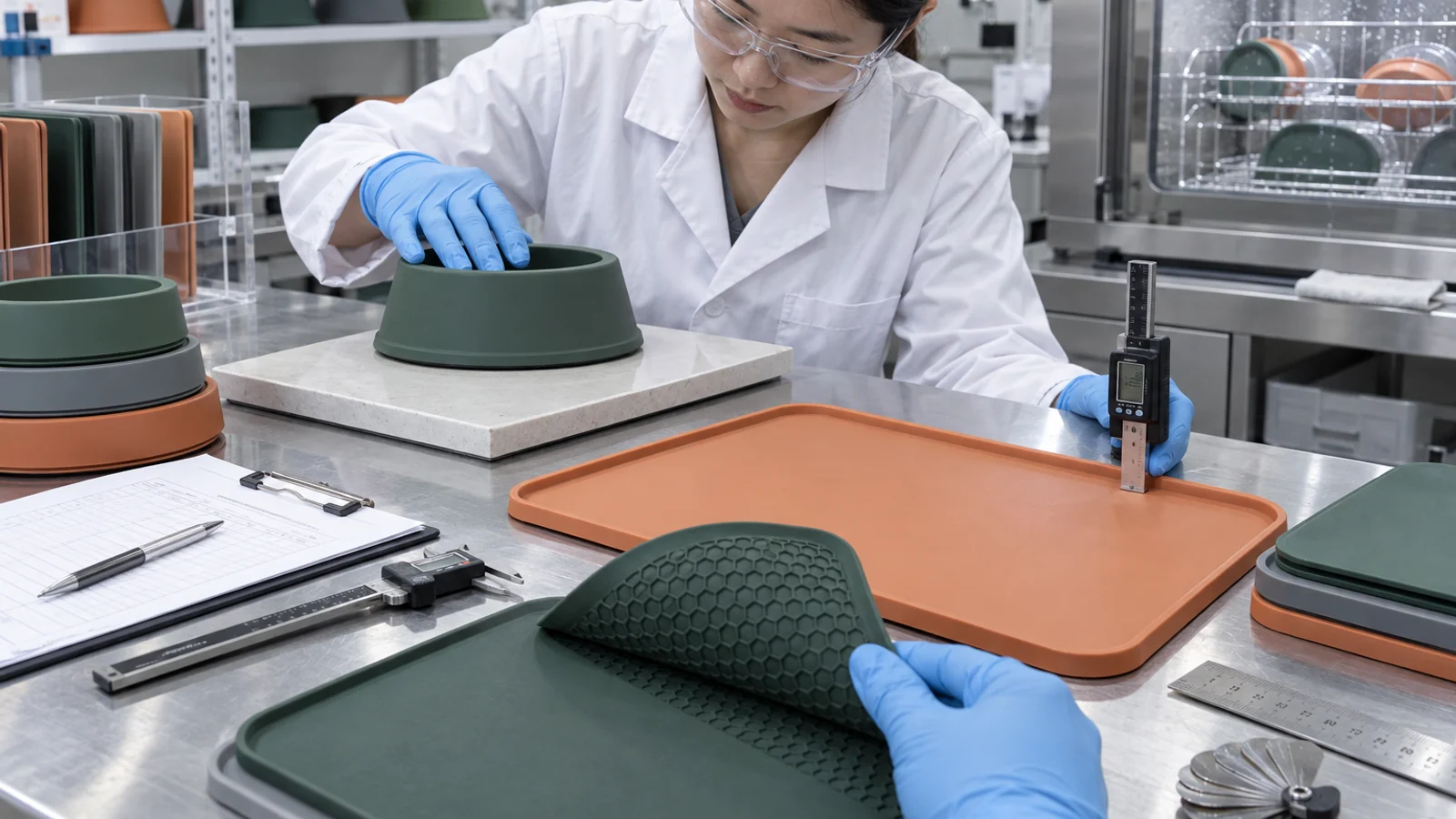
A feeding mat has to fit the actual feeding station. State its overall footprint, bowl placement area, edge height and whether it will be sold flat or rolled; a high rim may capture spills but can also interfere with a bowl base or make pack-out bulky. For a paired bowl-and-mat set, approve their combined footprint with the bowl in its normal use position instead of measuring each product in isolation.
Flatness and grip need conditions. Test the sample on the flooring and surface state that matter to the customer, such as dry tile and a wiped kitchen counter, while recording whether the mat creeps, curls or retains a rolled edge. Do not turn a single demonstration into a universal anti-slip claim. The factory and buyer should agree on an observable acceptance rule for edge recovery and surface appearance after the proposed packaging and storage period.
Collapsible Travel Bowl Fold Lines and Recovery
For a collapsible travel bowl, the fold line carries a different risk from the body wall. Identify the open and folded dimensions, working volume, hinge or crease thickness and any clip or carabiner attachment before samples are approved. A slim fold can be attractive at retail, but an excessively thin crease or poorly supported attachment can undermine the use case. Review both water and food scenarios if the product is marketed for both.
Agree on a practical cycle protocol: who folds the bowl, in which direction, how many times, under what temperature and how recovery is judged. Inspect the crease, rim and attachment after the trial, and photograph the same features at the beginning and end. The result applies to that construction and trial condition; it should not be presented as an unconditional lifetime guarantee. Recheck the method whenever the compound, wall design or tooling revision changes.
Silicone Compound, Hardness and Pigment Traceability
A generic 'food-grade silicone' label does not identify the finished pet SKU or the evidence behind it. Ask the supplier to identify the compound, curing route, pigment system, hardness target and relevant material or finished-article test basis for the intended market. If a bowl is intended for food contact, confirm which legal framework and use conditions apply; pet-product positioning alone does not establish that every food-contact rule or test report is relevant.
Traceability should connect incoming compound and pigment lots to the molded item, color and purchase order. Keep a retained sample and documented change route if a pigment, supplier, post-cure step or mold changes. A report for a different color or older construction may be useful background, but it is not automatically proof for the current finished item. Ask for the test method, sample description, date and scope before accepting a compliance claim in listing or packaging copy.
SECTION 03
Prove Quality, Material and Cleaning Decisions With Evidence
Protect margin by reviewing production controls, landed-cost drivers and launch risks as one commercial system.
Surface Texture, Odor, Cleaning and Use-Condition Checks
Silicone surfaces invite strong claims about odor resistance and easy cleaning, but those claims need a defined comparison and use condition. Inspect a representative sample after molding and any agreed post-cure step, then repeat the odor assessment after packaging storage if the pack can concentrate smell. Define who evaluates it and what constitutes a rejectable odor; avoid a vague zero-odor promise that no supplier can measure consistently.
For cleaning, follow the care instructions the brand plans to print. Check whether deep grooves, textured undersides or molded logos retain residue, and look for whitening, tackiness or visible damage after the chosen wash method. If dishwasher suitability is proposed, specify a cycle, placement and number of repeats before approving the statement. A visual sample pass should be filed with the exact color and surface finish because a changed texture can alter the cleaning experience.
Color Family, Logo Method and Packaging Architecture
Color architecture is a commercial choice before it becomes a production instruction. A coordinated two- or three-color family can make bowls and mats look like a range, but each added color may divide volume and change pigment approval work. Give the factory a physical or measured reference, viewing conditions and a tolerance discussion for the finished molded part, not merely a screen image. Approve the color on the final texture and wall thickness where it will actually be seen.
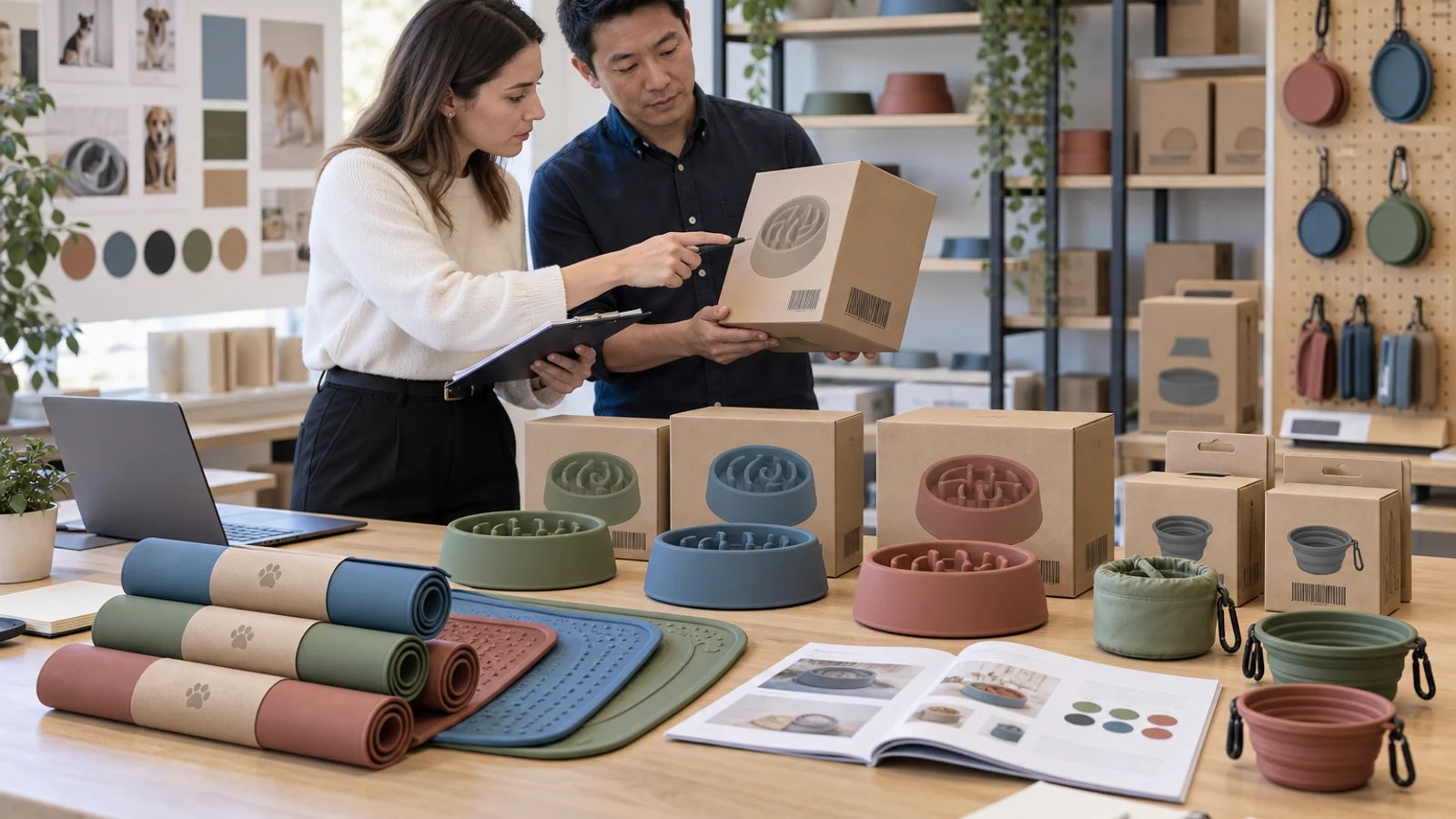
Choose logo placement with cleaning and wear in mind. A mark molded into the underside may preserve the eating surface, while a visible exterior mark may improve shelf recognition but need a different tooling or decoration route. Review the final selling unit with the product, artwork, care text, barcode, country-of-origin information and any required market labeling together. Packaging choices should reflect whether the item hangs, stacks, nests or ships as a bowl-and-mat set.
Sample Approval, Inspection and Golden References
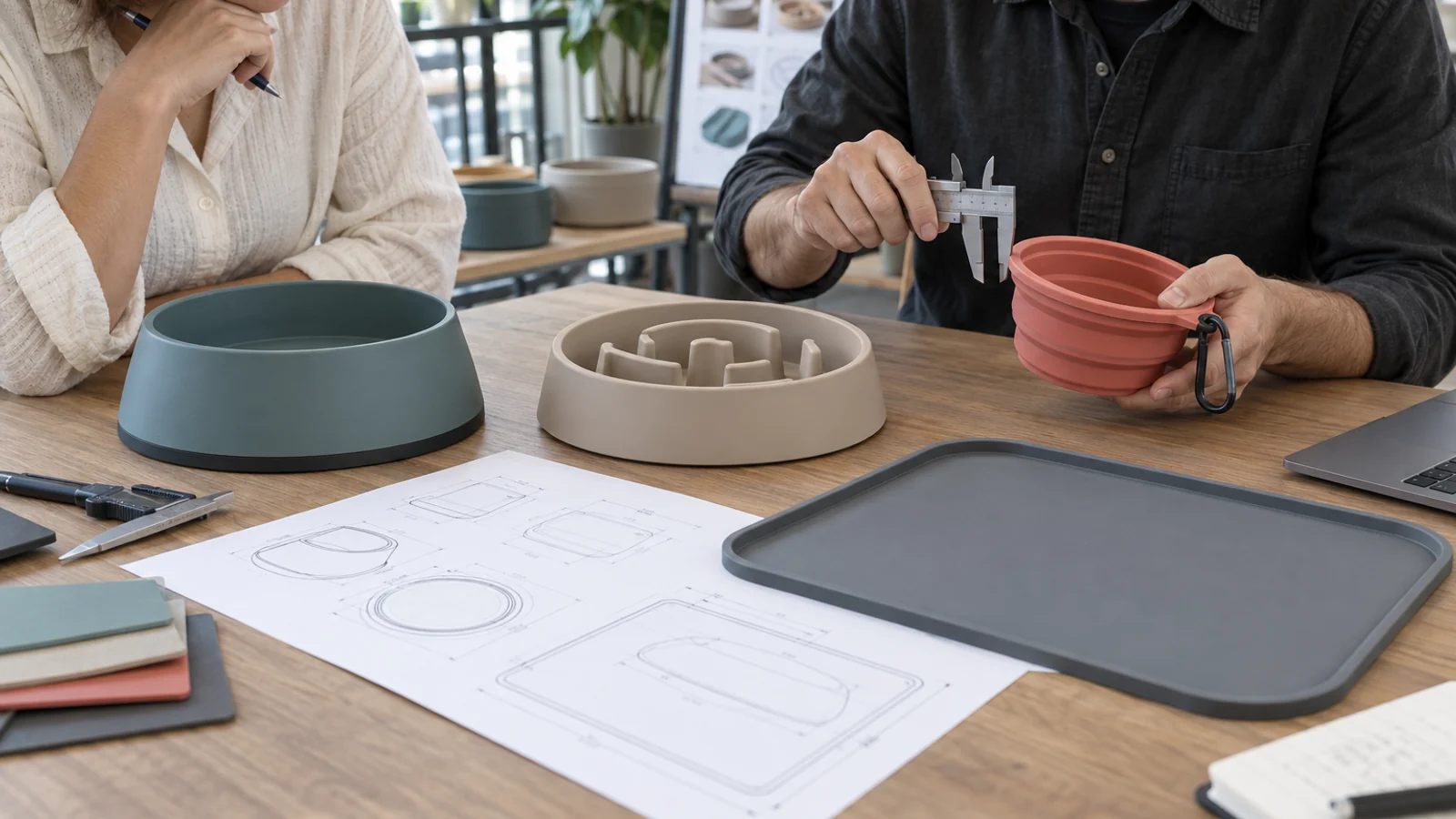
The golden reference must be more than the prettiest prototype on a meeting table. Identify the approved sample by SKU, color, tooling revision and date, then attach a signed or otherwise controlled disposition covering capacity, dimensions, base contact, surface finish and packaging. A slow-feeder bowl may need separate acceptance photographs for the maze floor and rim because those areas are difficult to judge from a single hero view.
Inspection should target characteristics that can drift in production: fill, flash, deformation, color, mat edge curl, bowl stability and pack-out accuracy. Agree on sampling and defect classification appropriate to the order, but do not claim an AQL value or pass rate unless it is in the actual purchase specification. When the factory makes a correction, compare the revised sample to the approved functional criteria as well as the visual reference; a cleaner parting line should not change bowl access.
SECTION 04
Build a Retail Range That Can Be Reordered Reliably
Use early sales and replenishment assumptions to decide which variants deserve expansion and which should remain controlled.
MOQ, SKU Mix, Lead Time and Repeat-Order Planning
Ask for quotations by finished SKU and color, with forecast and first-order quantities stated separately. A bowl, a mat and a packaged set consume different material, mold time, assembly labor and carton space; a blended unit price can hide those differences. Specify the Incoterm, destination, pack format and whether tooling, artwork, testing and freight are included. This lets purchasing compare like with like instead of ranking suppliers by an incomplete ex-factory number.
Treat MOQ and lead time as scenario results, not permanent promises. They can change with pigment batch size, packaging print runs, mold availability, the number of colors and seasonal loading, while capacity needs confirmation against the approved range and current production calendar. For a pilot range, identify which core SKUs are expected to reorder and which variants are deliberately limited. Set a date for reviewing sales, defects and customer feedback before expanding the assortment or committing to new tools.
ACTION FRAMEWORK
Buyer Checklist Before Commercial Approval
Use this checklist as a meeting agenda. It is intentionally concise so the team can identify missing evidence without replacing its own quality, legal or supplier-management procedure.
| Check | Question | Why It Matters |
|---|---|---|
| Use scenario | Are pet size, feeding behavior, food type, floor and supervision expectations defined? | Those conditions determine safe access, stability, geometry and the relevance of functional checks. |
| Range role | Does each bowl or mat have a distinct customer mission and price position? | Clear roles prevent decorative variation from creating overlapping SKUs and slow inventory. |
| Geometry | Are capacity, diameter, height, pattern clearance, mat footprint and rim height measurable? | Controlled dimensions make samples, quotations and repeat orders comparable. |
| Material | Can compound, cure system, pigment, hardness and production lot be traced to the finished SKU? | Generic material wording cannot establish applicability of evidence or change control. |
| Performance | Do stability, folding, cleaning and recovery checks state conditions and acceptance limits? | A pass claim is meaningful only when the method represents the intended product use. |
| Branding | Are color reference, logo method, position and visible defect limits approved? | Decoration and finish decisions affect tooling, processing, inspection and assortment consistency. |
| Packaging | Are selling unit, barcode, carton count, deformation protection and shipping marks fixed? | Pack architecture can change MOQ, cost, cube, handling and retail presentation. |
| Commercial basis | Do quotations use the same SKU quantities, color mix, package, Incoterm and forecast? | MOQ, price and lead time cannot be compared when suppliers calculate different programs. |
NEXT READING
Continue the Supplier and Product Review
These internal resources connect the guide with Naike Silicone product, factory, customization and inquiry pages. Open the route that matches the next decision in your project.
Explore silicone pet-product manufacturing options
Use explore silicone pet-product manufacturing options to gather the next level of product, manufacturing or commercial information.
Open internal resource →Review a custom silicone slow-feeder dog bowl
Use review a custom silicone slow-feeder dog bowl to gather the next level of product, manufacturing or commercial information.
Open internal resource →Compare silicone product packaging options
Use compare silicone product packaging options to gather the next level of product, manufacturing or commercial information.
Open internal resource →Calculate silicone product packaging cost
Use calculate silicone product packaging cost to gather the next level of product, manufacturing or commercial information.
Open internal resource →Explore all silicone product categories
Use explore all silicone product categories to gather the next level of product, manufacturing or commercial information.
Open internal resource →Review Naike Silicone manufacturing knowledge
Use review naike silicone manufacturing knowledge to gather the next level of product, manufacturing or commercial information.
Open internal resource →PRIMARY REFERENCES
Authoritative External Sources
The sources below are official primary references. Applicability depends on the product, intended use and destination market. Buyers should obtain qualified advice for final legal or regulatory decisions.
FDA: Food Packaging and Food Contact Substances
Official U.S. Food and Drug Administration consumer overview of substances that come into contact with food and their regulatory context.
European Commission: Food Contact Materials
Official European Commission overview of the EU framework for materials and articles intended to contact food.
BfR Recommendation XV: Silicones
Official German Federal Institute for Risk Assessment recommendation covering silicones and silicone elastomers.
BUYER QUESTIONS
Frequently Asked Questions
Which silicone pet products should a new wholesale range start with?
Start with the pet size, sales channel and feeding mission the range is meant to serve. An everyday bowl and a matching mat may be a clearer first offer than several overlapping slow-feeder patterns. Add travel or specialty formats when the buyer can define a distinct customer need, target price and expected reorder volume; test those assumptions with samples before widening the SKU list.
How can a buyer compare bowl stability between suppliers?
Use the same fill level, surface and push or tip procedure for each candidate, and record the bowl's base geometry and mass. A supplier's 'non-slip' wording is not a common test method. Compare the result with the approved use scenario, then repeat the check on a production-representative sample if the mold, compound or underside texture changes.
Does food-grade silicone automatically make a pet bowl compliant?
No. The phrase does not by itself identify a legal framework, tested sample or use condition. Ask for the relevant compound and finished-article evidence, including color, method, date and intended market, then have a qualified reviewer confirm applicability to the actual pet feeding product. Do not transfer a report from another SKU or pigment without a documented equivalence assessment.
What should be tested on a slow-feeder bowl sample?
Review access clearance, pattern depth, stability, edge finish and cleaning with the food type and target pet defined. If the brand intends to claim a slower feeding rate, that claim needs an appropriate supervised use trial and a stated comparison basis. The mold drawing and approved sample should preserve the exact maze geometry used in the review.
Can a feeding mat be shipped rolled without permanent curl?
It may be possible, but recovery depends on material, thickness, rim design, roll diameter, storage duration and temperature. Pack a production-representative sample as planned, hold it under a defined condition and measure edge lift after a specified recovery interval. Approve that packaging only against the buyer's acceptance limit rather than assuming all silicone mats will flatten in the same way.
What determines MOQ and quotation timing for a private-label pet range?
MOQ and timing depend on the mold route, color and SKU mix, compound order, packaging print quantity, approval work and current factory schedule. Send the supplier a per-SKU forecast, first-order quantities, artwork status, destination and desired ship window. Ask for separate assumptions for existing-tool and custom-tool options so the commercial comparison reflects the range you actually plan to buy.
Editorial and Scope Note
Conclusion: Wholesale Silicone Pet Products Buyer Guide
Move from buyer research to a controlled supplier brief
Wholesale silicone pet products become commercially reliable when the feeding scenario, format, geometry, material identity, functional checks, branding, packaging and repeat-order controls are approved as one range. Buyers should compare finished SKU programs rather than isolated sample prices. MOQ, price, lead time, capacity, regulatory scope and performance remain conditional on the approved product, test method, destination, quantity and purchase order. Send Naike Silicone your target pet segment, reference products, SKU forecast and package concept to request a range, sample and quotation review.
This factory-insider guide supports sourcing preparation and supplier discussion; it does not replace product-specific engineering, laboratory, regulatory, legal or commercial review for the destination market.