SUPPLY CHAIN & PROCUREMENT
How to Audit Silicone Production Capacity Without Relying on Claims
Audit silicone production capacity using order-specific machine, mold, material, labor, yield, quality and pack-out evidence instead of supplier claims.

DIRECT ANSWER
What B2B Buyers Need to Know
To audit silicone production capacity, begin with one defined order and trace it through compatible machines, ready molds, approved materials, qualified shifts, practical yield, inspection and packing. Observe the real route, sample current records and reconcile witnessed output with the promised schedule. Treat machine counts, certificates and annual totals as context—not proof of cargo-ready capacity for the specific SKU.
This guide is written for silicone product importers, sourcing managers, supplier-quality auditors, operations leaders and private-label procurement teams. It provides a decision framework rather than legal advice or a universal specification. Product classification, use conditions and destination market should be confirmed before final testing, labelling or compliance decisions.
Key Takeaways
- Audit one defined order scenario instead of accepting factory-wide annual output claims.
- Walk the complete route and reconcile interviews, observations and sampled records.
- Verify compatible machine time and production-ready molds as separate resources.
- Witness practical good-part output and trace the bottleneck through inspection and packing.
- Test reservation logic and contingency readiness with realistic disruption scenarios.
- Close findings with objective evidence while keeping commercial figures conditional on the approved order.
Capacity Claim Versus Audit Evidence
Use the same order-specific baseline for every supplier. An audit conclusion is limited to the sampled resources, period, SKU conditions and records reviewed.
| Supplier claim | Audit evidence | Buyer interpretation |
|---|---|---|
| Many molding presses | Compatible machine group, current load, downtime, maintenance and reserved time | Count only technically suitable and genuinely available hours |
| High daily output | Witnessed good parts, active cavities, cycle distribution, yield and completed pack rate | Separate practical saleable output from perfect theoretical multiplication |
| Backup capacity available | Qualified alternative machine or tool, trained roles, activation lead time and approval path | Treat an untested alternative as a proposal rather than contingency |
| ISO-certified factory | Order-specific records, actual practices, inspection resources and controlled finding closure | A system certificate supports context but does not guarantee this delivery |
| Production slot reserved | Anonymized load plan, entry milestone, expiry rule and double-booking check | Distinguish a conditional window from a firm commitment |
SECTION 01
Define the Audit Scope and Follow the Real Production Route
Set the purchasing scenario with a realistic SKU mix, forecast, delivery window and cost-comparison basis.
Build the Audit Plan Around One Order Scenario for audit silicone production capacity
A useful audit begins with one purchase scenario, not a tour of every machine in the building. Before arrival, give the factory the SKU revision, required quantity, color and packaging split, cargo-ready window, forecast and critical acceptance checks, then ask it to map those requirements to named resources. This scope lets the auditor test whether the proposed production route can deliver the order instead of collecting general facts that have no decision value.
Define the audit criteria and evidence rules in advance so the visit does not become a debate about impressions. Mark each question as document review, observation, interview, record sample or witnessed trial, and state how many records or shifts will be sampled when risk justifies it. ISO 19011:2026 provides guidance for audit principles, programs and auditor competence, but the buyer still has to choose order-specific criteria and decide what evidence is sufficient for this silicone program.
Walk the Process Before Reviewing Presentation Claims
Start with a process walk from material receipt to finished-carton release before studying the conference-room presentation. Follow one comparable lot through silicone storage, color preparation, molding, trimming, post-cure where applicable, washing, printing, assembly, inspection and packing, noting every queue and transfer point. The physical route often reveals constraints, outsourced steps and rework loops that an organization chart or annual-capacity slide does not show.
Trace responsibility at every handoff. Ask who releases material, authorizes setup, approves first pieces, controls nonconforming output and closes cartons, then compare those answers with current work instructions and records on the floor. If the actual operator, supervisor and quality team describe different rules, treat the inconsistency as an audit finding to investigate rather than accepting the most polished answer.
Verify Compatible Machines and Current Utilization
Installed press count is not verified capacity because silicone tools require a compatible operating envelope. Record the proposed machine family, platen size, clamp force, mold height, heating control, vacuum or injection features, handling method and validated process route for the target tool. A press that is idle but incompatible, awaiting maintenance or reserved for another qualified process cannot support the delivery promise.
Sample recent utilization and downtime records for the named machine group rather than requesting a factory-wide average. Compare scheduled hours, changeovers, preventive maintenance, unplanned stops and current commitments across enough weeks to show normal and peak behavior. ISO 22400-1 supplies an industry-neutral framework for manufacturing KPIs, yet the audit must still confirm definitions, data source, time boundary and whether reported values describe the exact resources proposed for this order.

SECTION 02
Verify Machines, Molds, Materials and Qualified People
Separate fixed development costs from variable production and logistics costs before negotiating commercial terms.
Inspect Mold Revision, Cavities and Maintenance Readiness
Audit the mold as a production asset, not as a line item on an ownership list. Verify tool identification, revision, cavity count, latest trial, preventive-maintenance status, vent and parting-surface condition, insert availability, storage protection and the date it can enter the planned window. A mold can exist and still be unable to make approved saleable parts at the assumed rate.
When duplicate tooling or a backup mold supports the capacity claim, inspect it separately and compare representative cavity evidence. Confirm whether it has run the approved compound, color and process, whether critical dimensions and appearance matched the golden sample, and which approval authorizes its use. Do not multiply the output of one proven tool by a second unbuilt or unqualified tool when evaluating cargo-ready capacity.
Trace Approved Material and Change Control
Material readiness should be traced from the finished SKU back to approved compound, catalyst system, pigment, inserts and packaging components. Sample purchase records, labels, incoming release, storage conditions, batch travelers and issue quantities for a comparable lot, then reconcile the identities across the route. A warehouse photograph or generic supplier certificate cannot prove that the correct released inputs are available for the audited order.
Test the change-control path with a realistic scenario such as a pigment shortage or compound substitution. Ask who can propose the change, which functions assess it, whether buyer approval or renewed testing is required, and how production is blocked until the decision is recorded. Certification and compliance scope remain conditional on the actual material, finished color, product, intended use and destination; the audit should not convert a document for another SKU into universal evidence.
Confirm Qualified Labor and Authority by Shift
Capacity depends on qualified people being present when the machine and mold are available. Compare the planned shifts with the roster for setup technicians, material preparation, molding operators, maintenance, trimming, inspection and packing, then sample training and authorization records for critical roles. Three scheduled shifts do not create three-shift capacity when first-article approval, troubleshooting or final release exists only during daytime hours.
Interview people who perform the work without coaching from the sales team. Ask an operator to explain setup release, a quality inspector to demonstrate the current defect standard, and a supervisor to describe escalation after a cavity or color problem. Consistent, evidence-based answers show that capacity controls operate beyond management claims; hesitation is not automatically a failure, but it identifies a record or practice that needs deeper sampling.

SECTION 03
Witness Practical Output and Downstream Release Capacity
Connect capacity, inspection, packaging and shipment readiness to named milestones and escalation triggers.
Witness a Representative Run and Reconcile Output
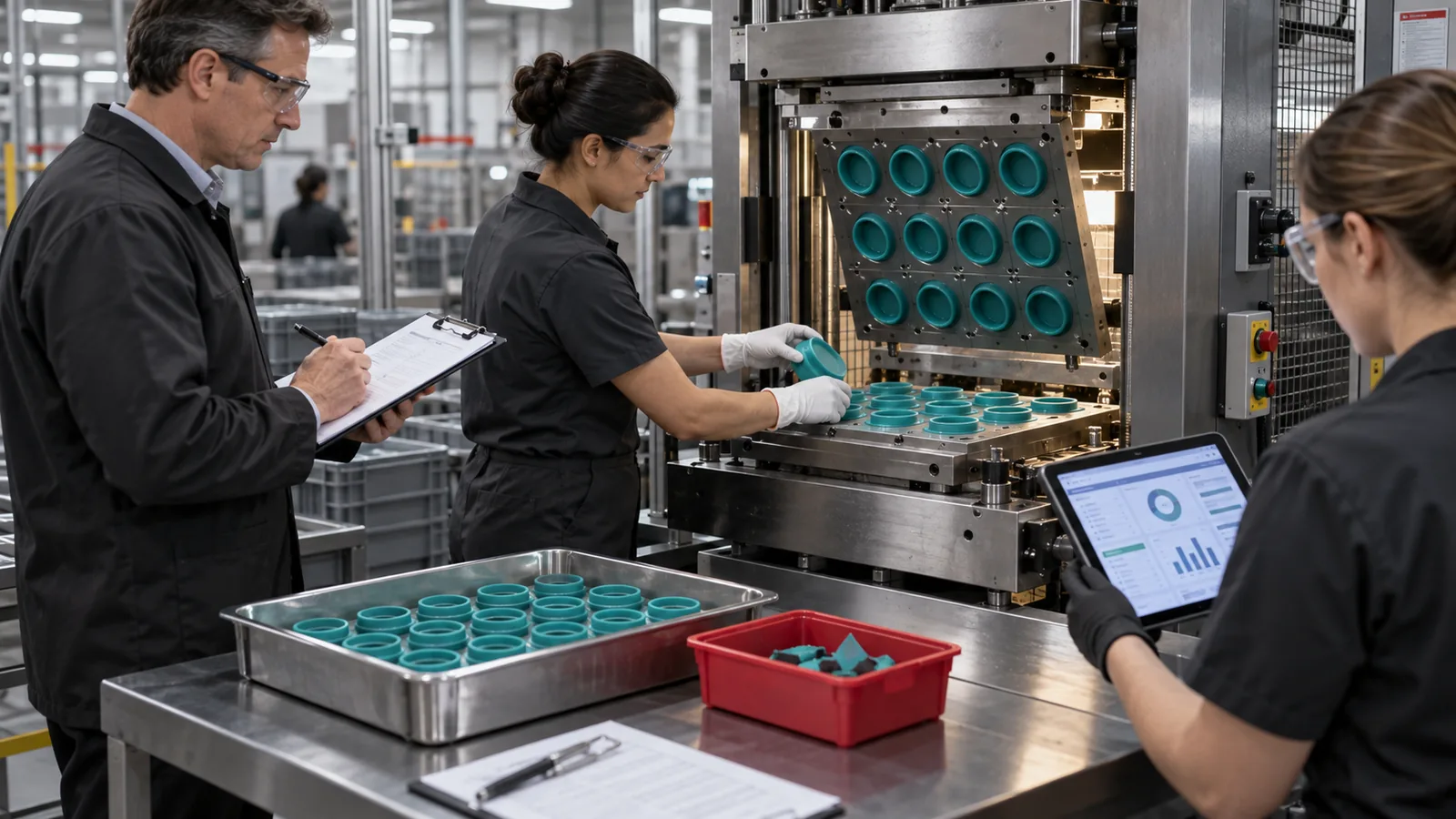
Observe a representative run whenever order value, timing or technical risk warrants it. Record setup start, warm-up loss, cycle time distribution, active cavities, good parts, scrap, rework, downtime reasons, operator count and the point at which inspection and packing actually complete. A short demonstration prepared for visitors should be labeled as limited evidence and should not be extrapolated into sustained daily output without an agreed basis.
Reconcile the witnessed result with production records and the quotation model. If the factory claims a faster cycle or higher yield, ask which approved material, tool condition, automation and acceptance standard produced that result and inspect the supporting lot record. Differences may be explainable, but they must remain visible assumptions until a production-representative pilot establishes the practical good-part rate.
Audit Inspection Capacity and Nonconformance Control
Audit the quality bottleneck with the same discipline as the molding cell. Confirm inspection characteristics, sampling or full-check rules, fixtures, gauge calibration, retained samples, cavity traceability, nonconformance segregation and disposition authority, then calculate whether the planned inspectors can release the forecasted output. Production capacity is not credible if meeting the ship date requires reducing the approved inspection scope.
Sample records from normal lots, not only the best report selected for the visit. Follow one defect from detection through containment, root-cause review, corrective action and verification, and check whether affected work-in-process and packed stock were identified. ISO 9001:2026 can support a controlled quality-management framework, but a certificate does not prove that this order has enough inspection time, suitable fixtures or stable process capability.
Follow Throughput Through Finishing and Pack-Out
Continue the audit downstream until the product is cargo ready. Measure or sample trimming, washing, printing, assembly, labeling, bagging, carton sealing and warehouse throughput, then compare the slowest sustained step with the molding plan. A press can meet its daily target while unfinished pieces accumulate in racks and the committed shipment remains late.
Packaging availability deserves its own reconciliation. Match the approved artwork revision, selling-unit components, printed-material quantities, carton specification, barcode control and arrival dates to the order mix, including leftover and damaged-material allowances. Ask the packing team to build one complete unit and master carton from released components; this practical check can expose fit, orientation, labor and line-balance assumptions hidden by a spreadsheet.
SECTION 04
Challenge Reservations, Contingencies and Finding Closure
Protect replenishment by recording review conditions for forecasts, prices, lead times, materials and order changes.
Reconcile Current Load With the Reserved Window
Compare the audit sample with current load and the specific reservation offered to the buyer. Review anonymized time blocks for compatible machines, molds, maintenance, holidays and existing commitments, then identify the milestone that makes the proposed slot firm. A provisional window tied to deposit, tool approval, material release or artwork sign-off is not deceptive when its entry and expiry conditions are written clearly.
Look for double counting across quotations, sister factories and overlapping schedules. The factory does not need to disclose other customers' identities, but it should show enough resource and time logic to demonstrate that the same press, mold crew or packing cell has not been promised to incompatible programs. Record what remains estimated and define the date or pilot result that can convert it into a firmer commitment.
Challenge the Backup Plan With a Realistic Scenario
Test the contingency rather than accepting a slide that says another machine, overtime or subcontracting is available. For each critical bottleneck, identify the warning trigger, decision owner, alternative resource, technical compatibility, trained staff, approval requirement and time needed to activate the route. A backup that has never run the tool or lacks matching inspection and packaging controls should be treated as a proposal, not verified capacity.
Use a scenario that reflects the order, such as one failed cavity, delayed pigment, unplanned press maintenance or a late printed-box delivery. Ask the responsible team to walk through detection, containment, replanning, buyer communication and recovery evidence. The aim is not to demand zero disruption; it is to determine whether the organization can recognize a capacity loss early and make a controlled decision before the cargo-ready window is missed.
Grade Findings and Close Them With Objective Evidence
Classify findings by their effect on the audited order rather than by dramatic wording. A critical finding may block product safety, legality or release; a major capacity gap may invalidate the schedule; a minor issue may require correction without changing the current decision; and an observation may identify an improvement opportunity. State the evidence, requirement, affected resource and consequence so factory and buyer can agree what closure means.
Do not close a finding with a promise or an undated photograph. Require evidence proportionate to risk, such as a revised load plan, maintenance record, qualified backup setup, training completion, corrected work instruction or representative pilot result, and name the reviewer authorized to accept it. Conditional approval is often more accurate than a simple pass or fail when the factory is capable but one milestone remains open before purchase-order release.
ACTION FRAMEWORK
Buyer Checklist Before Commercial Approval
Use this checklist as a meeting agenda. It is intentionally concise so the team can identify missing evidence without replacing its own quality, legal or supplier-management procedure.
| Check | Question | Why It Matters |
|---|---|---|
| Order baseline | Does the audit scope name SKU, quantity, colors, package and cargo-ready target? | General factory evidence cannot answer an undefined commercial requirement. |
| Process trace | Was one comparable lot followed from material receipt through packed release? | Queues, outsourced work and rework loops may sit outside the molding presentation. |
| Machine and mold | Are suitable equipment time and production-ready tooling verified separately? | An idle press or existing mold may still be unusable for the approved route. |
| Inputs and people | Are released materials, packaging and qualified shift roles synchronized? | Capacity fails when any necessary resource is unavailable during the same window. |
| Practical output | Does evidence show good parts, yield, downtime and completed pack-out? | Theoretical press output is not the same as cargo-ready throughput. |
| Quality capacity | Can the approved inspection plan be completed without reducing scope? | Delivery performance cannot be protected by silently weakening release controls. |
| Reservation | What milestone locks the slot and when can the factory release it? | Conditional windows must be visible in the purchasing schedule. |
| Finding closure | Are evidence, owner, deadline and approval authority recorded for every gap? | A verbal promise cannot support conditional supplier approval. |
NEXT READING
Continue the Supplier and Product Review
These internal resources connect the guide with Naike Silicone product, factory, customization and inquiry pages. Open the route that matches the next decision in your project.
Verify supplier capacity for a large order
Use verify supplier capacity for a large order to gather the next level of product, manufacturing or commercial information.
Open internal resource →Review the Naike Silicone supplier-qualification framework
Use review the naike silicone supplier-qualification framework to gather the next level of product, manufacturing or commercial information.
Open internal resource →Build a complete silicone quotation baseline
Use build a complete silicone quotation baseline to gather the next level of product, manufacturing or commercial information.
Open internal resource →Explore all silicone product categories
Use explore all silicone product categories to gather the next level of product, manufacturing or commercial information.
Open internal resource →Review Naike Silicone manufacturing knowledge
Use review naike silicone manufacturing knowledge to gather the next level of product, manufacturing or commercial information.
Open internal resource →Understand the customized-service workflow
Use understand the customized-service workflow to gather the next level of product, manufacturing or commercial information.
Open internal resource →PRIMARY REFERENCES
Authoritative External Sources
The sources below are official primary references. Applicability depends on the product, intended use and destination market. Buyers should obtain qualified advice for final legal or regulatory decisions.
ISO 19011:2026 Guidelines for Auditing Management Systems
Official ISO guidance for audit principles, audit-program management, conducting management-system audits and auditor competence; it does not certify a factory or prove order-specific capacity.
ISO 22400-1:2014 Manufacturing Operations KPIs
Official ISO page for an industry-neutral framework describing manufacturing-operations key performance indicators; it does not prove the capacity of a particular silicone order.
ISO 9001:2026 Quality Management Systems
Official ISO page for the current 2026 quality-management-system requirements; it frames controlled information and processes but does not certify this particular silicone SKU.
BUYER QUESTIONS
Frequently Asked Questions
What should buyers send before a silicone factory capacity audit?
Send the current SKU drawing or approved sample, quantity by color and package, forecast, target cargo-ready window, destination market and critical acceptance checks. This lets the audit test a defined order rather than general factory scale.
How long should a silicone capacity audit take?
Duration depends on product risk, process complexity, number of sites, outsourced steps and whether a representative run is witnessed. A focused second-party audit needs enough time to walk the full route, sample records and close contradictions; there is no reliable universal duration.
Is a video audit enough to verify production capacity?
A video review can confirm selected documents, equipment and practices when access or risk is limited, but it restricts independent observation and record sampling. Use it as one evidence source and escalate to onsite or witnessed production review when order exposure warrants it.
Which capacity records should an auditor sample?
Sample current machine loading, maintenance and downtime, mold history, material issue, training, cycle and yield, inspection release, nonconformance, packing output and shipment records for comparable products. Define the sampling period and preserve record identity.
Does ISO 9001 certification replace a buyer capacity audit?
No. Certification can support confidence in the quality-management system, but it does not prove available machine time, tool readiness, order-specific yield, materials, labor, packing throughput or a reserved schedule for the buyer's SKU.
How should buyers close a capacity-audit finding?
Define the missing requirement, evidence needed, owner, deadline and approval authority. Closure may require a corrected record, maintenance action, qualified backup route, training or representative pilot; a verbal promise alone is not objective evidence.
Editorial and Scope Note
Conclusion: Audit Silicone Production Capacity: Buyer Guide
Move from buyer research to a controlled supplier brief
A defensible silicone capacity audit follows one defined order through the actual machine, mold, material, shift, quality and packing route. It distinguishes observed facts from sampled records and estimates, tests reservations and contingencies, and closes gaps with objective evidence. ISO 19011:2026 guides audit practice, ISO 22400-1 frames manufacturing KPIs and ISO 9001:2026 supports quality-system controls; none guarantees output for this SKU. Send Naike Silicone the drawing, order mix, destination, package and cargo-ready target to request an evidence plan; performance, certification scope, MOQ, price, lead time and capacity remain conditional on the verified configuration and current schedule.
This factory-insider guide supports sourcing preparation and supplier discussion; it does not replace product-specific engineering, laboratory, regulatory, legal or commercial review for the destination market.