PRODUCT SOURCING GUIDES
What Makes a Silicone Stretch Lid Set Fit the Intended Containers?
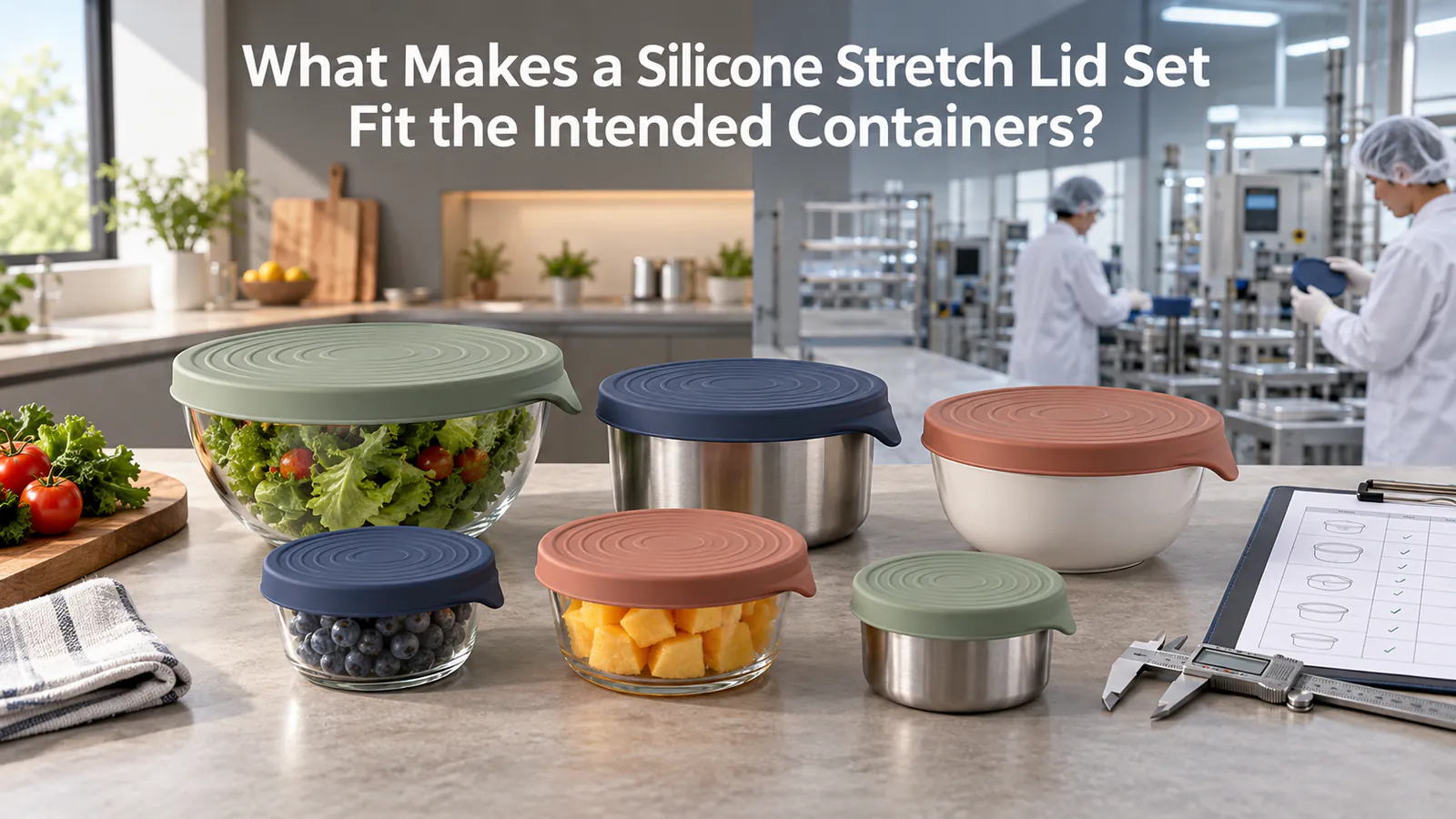
Specify a silicone stretch lid set with a controlled container fit matrix covering rim geometry, stretch range, sealing edge, recovery and pack-out.
DIRECT ANSWER
What B2B Buyers Need to Know
A silicone stretch lid set fits reliably only when every lid is matched to a controlled container matrix. Buyers should define opening dimensions, rim profile, corner radius, intended stretch range, sealing-edge geometry, application force, storage condition and recovery after repeated use. Material elongation data helps screen compounds, but production-representative lids must still pass fit, retention, removal, cleaning and packaging checks on the intended vessels.
This guide is written for household-product brands, importers, retailers, distributors, product developers and sourcing teams buying private-label silicone stretch-lid sets. It provides a decision framework rather than legal advice or a universal specification. Product classification, use conditions and destination market should be confirmed before final testing, labelling or compliance decisions.
Key Takeaways
- Start with a named container family and measured rim geometry, not a universal-fit claim.
- Assign every lid size an approved, conditional and out-of-scope range in a fit matrix.
- Control bead profile, membrane zones, application force, removal and claim-specific seal evidence.
- Use material tensile data for compound comparison but validate finished-lid multiaxial stretch and recovery.
- Repeat application, storage, removal and cleaning cycles on production-representative lids from every active cavity.
- Connect size mix, color identification, packaging and inspection to one controlled selling-unit revision.
Silicone Stretch Lid Fit Decision Matrix
Use the matrix to review each size against named container conditions. Exact limits remain conditional on the approved compound, geometry, vessel and use cycle.
| Fit variable | Buyer must define | Approval evidence |
|---|---|---|
| Container geometry | Opening, outside rim, bead or flange, wall depth, taper, corner radius and obstructions | Controlled drawing or measured vessel sample with revision identity |
| Stretch range | Relaxed lid dimensions, assigned minimum and maximum vessel, application sequence and force boundary | Fit matrix results at lower, middle and upper limits |
| Sealing edge | Bead depth, contact zone, roll-off limit, removal tab and permitted claims | Cross-section, production sample and claim-specific retention or leakage trial |
| Recovery | Extension time, storage temperature, release method, conditioning interval and repeat cycles | Dimension and refit results with temporary and permanent set recorded separately |
| Selling unit | Size count, identification, colors, nesting, instructions, packaging and carton quantity | Physical preproduction pack-out and approved SKU master |
SECTION 01
Build the Container and Fit-Matrix Baseline
Begin with the target buyer, channel and assortment role so every specification decision supports a sellable range.
Start With the Container Family and Fit Matrix for custom silicone stretch lid set
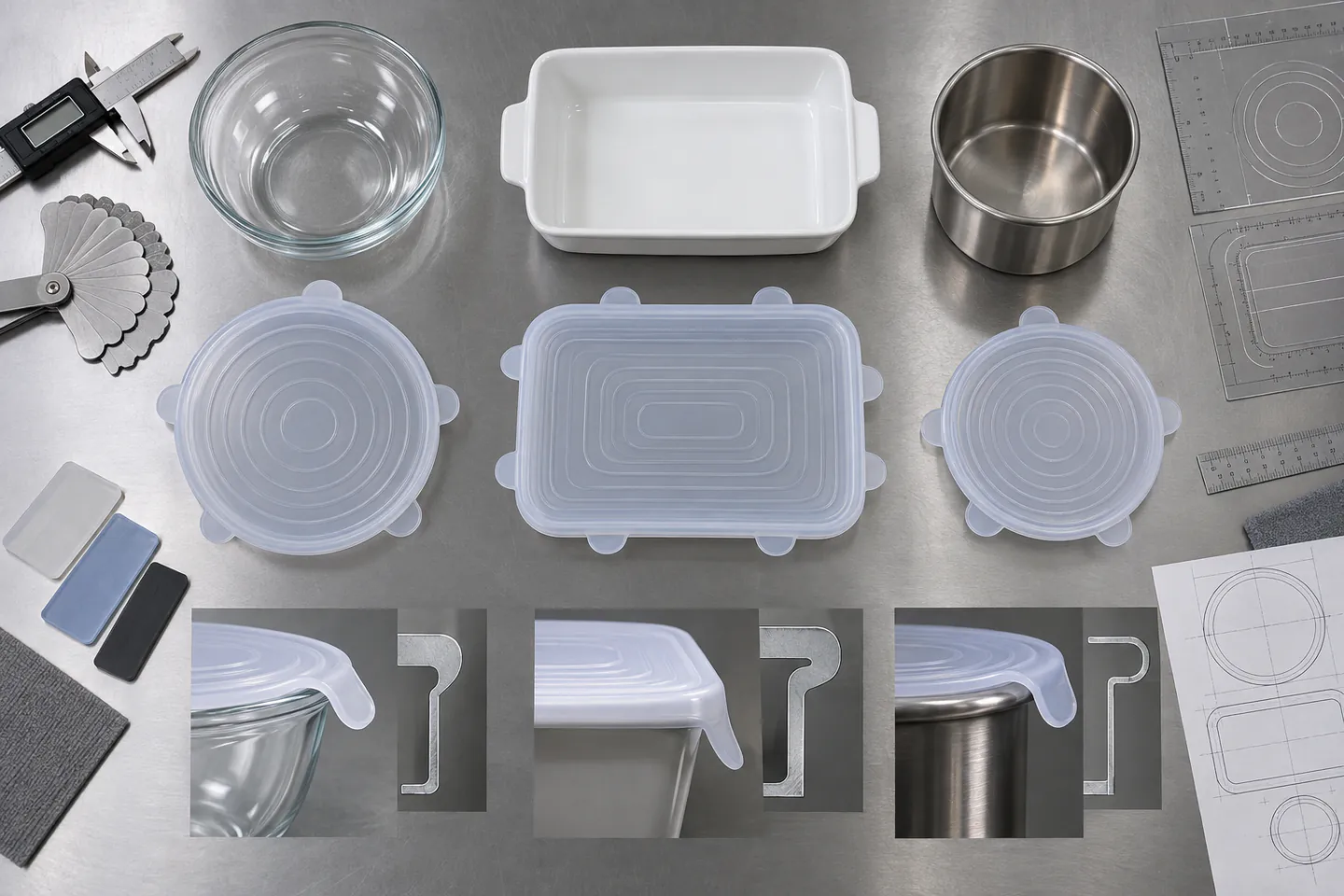
A stretch-lid project starts with the containers, not with six attractive circles arranged in a retail sleeve. List the vessel family by material, opening dimensions, rim section, corner radius, wall taper and the condition in which the lid is applied. Include glass bowls, ceramic dishes, stainless pans or cut produce only when those uses are genuinely intended. A supplier cannot validate a universal-fit promise from nominal diameter alone.
Turn that list into a fit matrix with one row for every container and one column for each proposed lid size. Record relaxed lid dimensions, application direction, stretch level, seating result, handling condition and removal result. Mark combinations as approved, conditional or out of scope instead of forcing every cell to pass. This matrix becomes the common reference for design, sampling, packaging claims and repeat-order inspection.
Measure Rim Geometry Instead of Nominal Diameter
Measure the contact geometry that the silicone actually grips. A round bowl needs outside rim diameter, rim thickness, bead or flange profile and usable wall depth below the lip; a rectangular dish also needs length, width, corner radius and corner transition. Measure several production containers when possible because nominal cookware sizes can hide meaningful rim variation. Photographs should support, not replace, a controlled dimension record.
Separate the vessel opening from the effective sealing perimeter. Rolled stainless rims, flared ceramic edges and molded glass beads can present the same opening size but require different stretch and retention behavior. Identify chips, handles, spouts, seams or textured zones that interrupt contact. If the lid must fit a buyer-owned container range, approval samples or accurate rim drawings should be treated as project inputs rather than informal references.
Define Intended Stretch Range and Material Evidence
Define the intended stretch range for each size before choosing the set count. The relaxed diameter must be smaller than the target rim to create tension, but excessive extension can thin the membrane, distort the sealing bead and increase removal force. Use measured extension ratios as development information rather than marketing shorthand. A lid that reaches a large bowl once may not recover well enough for repeated use or fit its smaller assigned vessel afterward.
Do not use elongation at break as a direct finished-lid fit specification. ISO 37 provides a controlled method for tensile stress-strain properties of rubber specimens, while the molded lid introduces thickness zones, ribs, pull tabs and multiaxial stretching. Material data can help screen compounds, but the fit range still needs finished-product trials. Preserve the compound, cure, pigment and specimen conditions with the result so later comparisons remain meaningful.
SECTION 02
Engineer Stretch, Rim Contact and User Handling
Translate the range plan into comparable product, packaging and approval evidence before requesting final quotations.
Engineer the Sealing Bead and Corner Contact
The perimeter bead is the main mechanical interface and should be shown in cross-section. Review bead depth, undercut, lip angle, transition radius and the membrane thickness immediately inside the rim. A deep hook may resist removal but become difficult to clean or fit over a thick flange; a shallow edge may apply easily but roll off under movement. Approve the balance on the hardest and easiest vessels in the target matrix.
Corners require their own design decision for non-round lids. Silicone accumulates strain differently around a rectangular radius, and the straight sides may relax while the corners remain highly stretched. Check corner whitening, lifting, local thinning and recovery after removal. If the project uses only round lids, do not imply compatibility with rectangular containers unless a separate shape and fit study supports that extension.
Control Membrane Thickness, Rings and Size Marks
Membrane thickness controls more than apparent quality. A thin center can stretch easily and reduce material use, yet it may sag onto food, puncture near sharp rims or transmit high stress into the bead. A heavy membrane can improve handling but require more force and make a small lid unsuitable for its upper fit limit. Use a thickness map across center, concentric ribs, edge transition and tab rather than one nominal value.
Concentric rings can guide size perception and distribute deformation, but they are not proof of controlled stretching. Review their depth, spacing and termination near the rim to ensure they do not create cleaning traps or tear initiators. Embossed size marks should remain legible after repeated extension without creating a weak thin zone. Mold-flow, venting and release must be considered with the chosen texture and thickness changes.
Standardize Application and Removal
Application technique can determine whether a design appears to fit. Define whether the user centers the lid, anchors one side, stretches the opposite tab and walks the bead around the rim, or uses another sequence. Test with dry and realistically damp hands and with the vessel supported as intended. A demonstration performed by an experienced technician may not represent normal use if the sequence is too sensitive or requires excessive force.
Removal should be evaluated as a separate action. The tab needs enough area and stiffness to start release without tearing, rolling the entire edge or causing the vessel to tip. Observe snap-back, splash risk and whether fingers contact stored food. If a vacuum-like effect is expected, define how air is introduced and avoid describing retention as airtight or leakproof unless the complete system passes a suitable claim-specific test.
SECTION 03
Validate Sealing Claims, Recovery and Repeated Use
Protect margin by reviewing production controls, landed-cost drivers and launch risks as one commercial system.
Separate Retention From Leak and Storage Claims
Seal language must match the use condition and test method. A lid that stays on a bowl during refrigerator storage may not resist inversion, pressure, oil contamination or a deformed vessel rim. Define orientation, fill level, liquid type, duration, temperature and allowed leakage before running a test. Keep splash resistance, odor reduction, refrigerated storage and transport leakage as separate claims with separate acceptance evidence.
Food-contact evidence also depends on the actual conditions of use. FDA reference tables distinguish food types and conditions such as refrigerated or frozen storage, while European food-contact rules require materials placed on the market to meet the applicable framework and good-manufacturing expectations. Match compound, pigment, finished article and intended contact scenario to the evidence file. A generic food-grade statement does not validate fit or every consumer claim.
Validate Recovery Through Repeated Use
Recovery determines whether the size matrix remains valid after use. Stretch the lid to a named vessel for a defined time, remove it, condition it for a specified interval and measure the relevant relaxed dimensions or fit again. Record temporary set separately from permanent change. Repeat across upper and lower fit limits because the most demanding vessel may reveal loss of tension that a middle-size bowl hides.
Build repeated-use trials around realistic cycles: application, storage, removal, washing, drying and reapplication. Set checkpoints for tears, edge roll, tab damage, tack, odor, discoloration, dimensions and retention. Do not convert a limited cycle count into a lifetime guarantee. Use the results to define design qualification, while routine production can rely on controlled material, dimensions and functional sampling linked to the approved baseline.
Review Cleaning, Drying and Storage
Cleaning access should be reviewed at the bead, tab root, decorative rings and size markings. Food film can remain under an undercut or in a narrow groove even when the center membrane looks clean. Wash according to the proposed care instructions with representative foods, then inspect after drying under consistent light. Dishwasher suitability remains conditional on the defined machine, detergent, rack position, temperature, cycle and sample condition.
Storage affects recovery and presentation. Lids can be nested, stacked, hung or rolled, but deep nesting may lock adjacent beads and prolonged folding can create temporary deformation. Test the intended retail pack and consumer storage method for separation force and dimensional return. Packaging instructions should not recommend a compressed arrangement that conflicts with the approved recovery condition or makes sizes difficult to identify.
SECTION 04
Release the Size Family, Tooling and Retail Pack-Out
Use early sales and replenishment assumptions to decide which variants deserve expansion and which should remain controlled.
Build a Rational Multi-Size Set Architecture
A coordinated set needs a rational size architecture rather than equal visual spacing. Use the container matrix and expected household assortment to decide where diameter increments should be narrow or broad. Avoid overlapping fit ranges so heavily that several lids appear interchangeable while one common vessel remains uncovered. State which size is intended for each representative container and how the user identifies it without relying only on color.
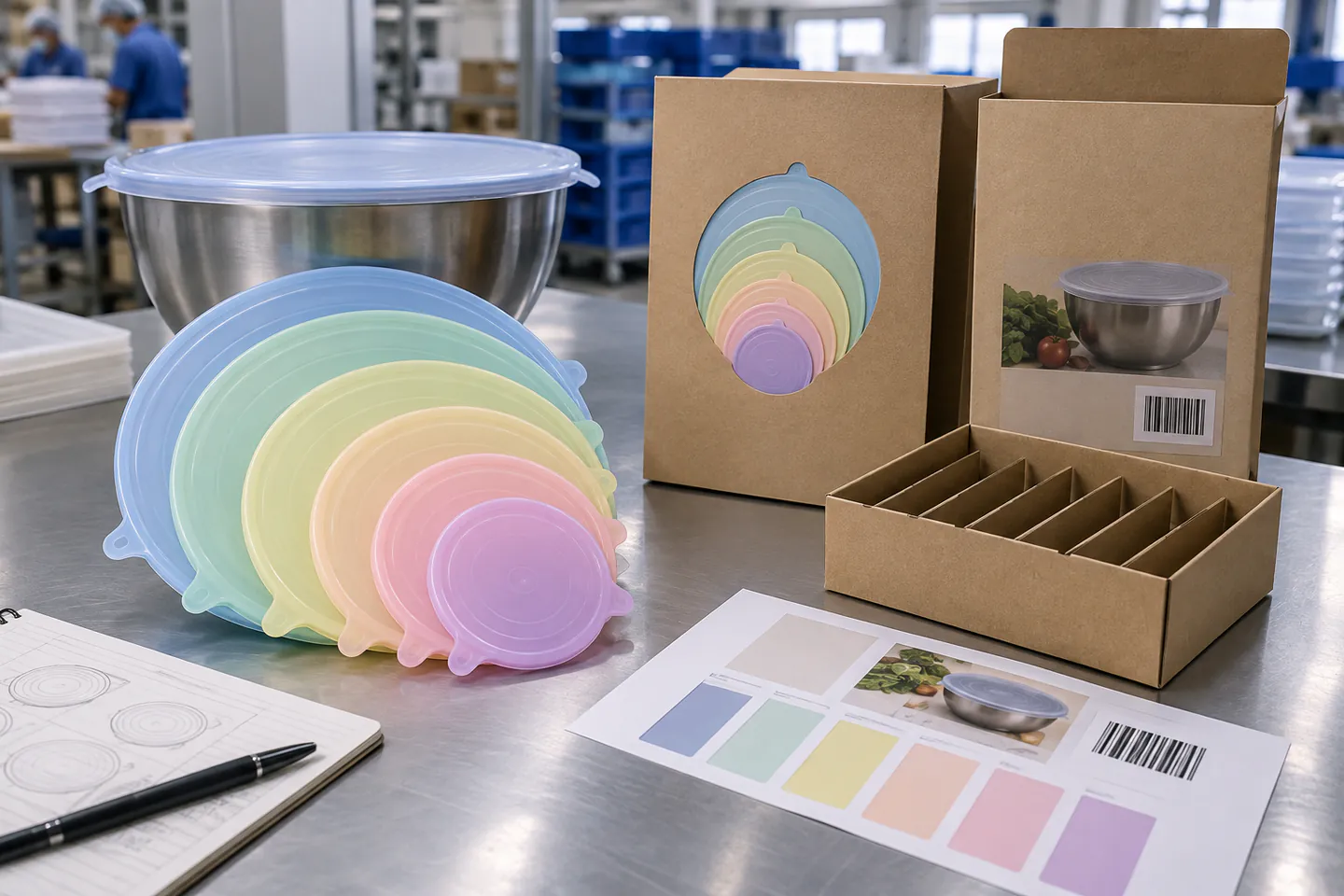
Color and molded identification are commercial controls as well as design choices. A monochrome set can look premium but needs clear size marks; a color-coded set can improve selection but adds pigment, assortment and inventory decisions. Evaluate translucency, thickness and surface finish on actual lids because color plaques do not show stretched appearance. MOQ, price and timing for each color remain conditional on batch, changeover, set mix and packaging plan.
Release Tooling and Production Fit Controls
Tooling should preserve family consistency while controlling every size as its own molded part. Review cavity layout, gate and vent locations, bead cross-section, membrane thickness, tab transition, shrinkage allowance and cavity identification. Thin membranes and deep edge features can create filling or demolding risks that differ across sizes. Require trial samples from every active cavity rather than approving one convenient lid as representative of the full set.
Translate the fit matrix into production controls. Typical checks include identity, relaxed dimensions, critical bead section, thickness zones, appearance, flash, contamination, tab integrity and fit on defined master fixtures or vessels. Name the conditioning time, application method, sampling plan and release authority. A fit result is not repeatable when operators choose different containers, stretch sequences or waiting periods for each lot.
Approve Packaging and Request a Comparable Quotation
Approve the selling unit as carefully as the individual lids. Confirm size count, nesting order, separators or sleeves, care instructions, claim wording, lot identification and master-carton quantity with production-representative materials. Observe whether compression marks, dust or color transfer appear after storage. Packed dimensions influence freight and retail space, so the quotation should include the physical pack-out instead of treating packaging as an unresolved later step.
For a Naike Silicone review, send the target containers or rim drawings, requested size range, use and cleaning conditions, material and color direction, destination market, package concept and forecast by SKU. We can map fit risks, sample sequence, tooling questions and evidence before a reliable quotation. Performance, certification scope, MOQ, price, capacity and lead time remain conditional on the approved lid family and order scenario. End with a sample request, fit-matrix trial, tooling review or supplier-evaluation quotation tied to the current revision.

ACTION FRAMEWORK
Buyer Checklist Before Commercial Approval
Use this checklist as a meeting agenda. It is intentionally concise so the team can identify missing evidence without replacing its own quality, legal or supplier-management procedure.
| Check | Question | Why It Matters |
|---|---|---|
| Container matrix | Are every target vessel, material, shape and rim profile identified? | Nominal diameter cannot describe the interface that the lid must grip. |
| Measured geometry | Do drawings or samples include the outside rim, flange, taper and usable contact depth? | Similar openings can require different bead and stretch behavior. |
| Fit limits | Does each lid have approved, conditional and out-of-scope container ranges? | A universal-fit statement hides gaps and excessive-stretch combinations. |
| Application | Are centering, anchoring, stretching and removal methods repeatable for normal users? | Technician skill can make a sensitive design appear more robust than it is. |
| Claims | Are retention, splash, refrigeration and leakage claims tested separately? | A lid staying on a bowl does not prove every sealing statement. |
| Recovery | Were upper and lower fit limits checked after controlled extension and conditioning? | Loss of tension may appear only after the most demanding use condition. |
| Cavity control | Are all sizes and active mold cavities linked to dimensions and fit fixtures? | One approved sample cannot represent an entire multi-tool family. |
| Pack-out | Are nesting order, size marks, colors, instructions and carton compression approved? | The selling unit can deform lids or make the range difficult to select. |
NEXT READING
Continue the Supplier and Product Review
These internal resources connect the guide with Naike Silicone product, factory, customization and inquiry pages. Open the route that matches the next decision in your project.
Review the custom reusable stretch lid set product page
Use review the custom reusable stretch lid set product page to gather the next level of product, manufacturing or commercial information.
Open internal resource →Choose a silicone hardness from finished-product evidence
Use choose a silicone hardness from finished-product evidence to gather the next level of product, manufacturing or commercial information.
Open internal resource →Control Shore A hardness testing
Use control shore a hardness testing to gather the next level of product, manufacturing or commercial information.
Open internal resource →Plan custom private-label silicone packaging
Use plan custom private-label silicone packaging to gather the next level of product, manufacturing or commercial information.
Open internal resource →Explore all silicone product categories
Use explore all silicone product categories to gather the next level of product, manufacturing or commercial information.
Open internal resource →Review Naike Silicone manufacturing knowledge
Use review naike silicone manufacturing knowledge to gather the next level of product, manufacturing or commercial information.
Open internal resource →PRIMARY REFERENCES
Authoritative External Sources
The sources below are official primary references. Applicability depends on the product, intended use and destination market. Buyers should obtain qualified advice for final legal or regulatory decisions.
ISO 37:2024 Rubber Tensile Stress-Strain Properties
Official ISO page for the method used to determine tensile stress-strain properties of vulcanized and thermoplastic rubbers; finished-lid fit still requires product-specific validation.
FDA: Food Types and Conditions of Use for Food Contact Substances
Official FDA guidance describing food types and conditions of use used when evaluating food-contact substance applications; applicability still depends on the actual material and finished product.
European Commission: Food Contact Materials
Official European Commission overview of the EU framework for materials and articles intended to contact food.
BUYER QUESTIONS
Frequently Asked Questions
How much larger than its relaxed diameter should a stretch lid fit?
There is no universal percentage. The usable range depends on compound, membrane and bead geometry, vessel rim, application force, storage time and recovery. Establish the range with a finished-product fit matrix rather than extrapolating from elongation at break.
Can one round silicone stretch lid fit square or rectangular containers?
Only when the specific lid and corner geometry have been validated. Corners concentrate strain and can lift straight sections, so a round-lid demonstration does not support a general rectangular-container claim.
Does a silicone stretch lid create an airtight or leakproof seal?
Not automatically. Retention during refrigerated storage, splash resistance and inversion leakage are different outcomes. Use claim wording supported by a defined test on the intended vessel, food or liquid, orientation, duration and temperature.
How should buyers test stretch-lid recovery?
Apply the lid to named upper- and lower-limit vessels for a controlled time, remove it, condition it for a stated interval, then measure relaxed dimensions and repeat the fit check. Record temporary and permanent set separately.
Can material tensile data replace finished-lid testing?
No. ISO 37 data can compare rubber specimens under controlled conditions, but finished lids stretch multiaxially through specific thickness, bead, ring and tab geometries. Use material data together with production-representative fit and cycle trials.
What information is needed to quote a custom stretch-lid set?
Provide container samples or rim drawings, target sizes, lid count, intended claims, use and cleaning conditions, colors, first-order quantity, destination market, packaging and delivery terms. Tooling, MOQ, price and schedule become firmer as the fit matrix is approved.
Editorial and Scope Note
Conclusion: Silicone Stretch Lid Set Fit Guide
Move from buyer research to a controlled supplier brief
A reliable silicone stretch lid set begins with named containers and a controlled fit matrix, then connects relaxed dimensions, rim profile, bead geometry, application, removal, recovery, cleaning and packaging to every size. Material tensile results support compound selection but do not replace finished-lid validation. Certification scope, performance, MOQ, price, capacity and lead time remain conditional on the approved size family, colors, market evidence and selling-unit plan. Send Naike Silicone your vessels or rim drawings, use conditions, size mix, forecast and packaging brief to request samples, a fit-matrix trial, a tooling review or a supplier-evaluation quotation.
This factory-insider guide supports sourcing preparation and supplier discussion; it does not replace product-specific engineering, laboratory, regulatory, legal or commercial review for the destination market.