PRODUCT SOURCING GUIDES
How Should Buyers Specify a Silicone Baby Food Freezer Tray with Lid?
Specify a custom silicone baby food freezer tray by cavity volume, lid fit, frozen release, stacking, material evidence, tooling and quality controls.

DIRECT ANSWER
What B2B Buyers Need to Know
Buyers should specify a silicone baby food freezer tray as a finished storage system, not only by cavity count. Define practical portion volume, overall dimensions, wall-thickness zones, lid retention, stacking clearance, frozen-release conditions, cleaning cycle, material and color identity, market evidence, packaging and inspection methods. Approve production-representative samples and keep performance, MOQ, price and lead time conditional on the final design.
This guide is written for baby-product brands, importers, retailers, distributors, product developers and sourcing teams buying private-label silicone freezer trays. It provides a decision framework rather than legal advice or a universal specification. Product classification, use conditions and destination market should be confirmed before final testing, labelling or compliance decisions.
Key Takeaways
- Define intended food, portion, freezing, thawing and cleaning conditions before selecting tray geometry.
- State how cavity volume is measured and validate every active mold cavity.
- Treat lid retention, splash resistance, stacking and leak claims as separate decisions.
- Balance wall thickness and rim stiffness against filling stability and frozen-portion release.
- Link food-contact evidence to the actual compound, pigment, construction and destination market.
- Approve tooling, quality methods and packaging from one controlled finished-SKU specification.
Baby Food Freezer Tray Specification Decision Matrix
Use the matrix to compare suppliers against the same finished-product conditions. Exact values depend on the target portion, use cycle, market and approved design.
| Specification area | Buyer decision | Evidence to approve |
|---|---|---|
| Cavity and portion | Cavity count, practical fill volume, depth, draft and spacing | Dimensioned cavity map, controlled volume method and results from every active cavity |
| Tray structure | Overall footprint, thickness zones, rim stiffness and carrying condition | Drawing, thickness map and filled-tray handling observation |
| Lid and stack | Retention, removal, splash claim, frozen fit, stacking and nesting | Fit method, freeze-thaw samples, stack trial and production-representative pack-out |
| Material and evidence | Compound, cure, hardness, pigment, use conditions and destination | Lot identity, applicable declarations or reports and a change-control matrix |
| Production release | Tool cavities, appearance, functional checks, packaging and inspection | Trial report, golden samples, quality plan, retained samples and release authority |
SECTION 01
Define Use Conditions, Portions and Freezer Fit
Begin with the target buyer, channel and assortment role so every specification decision supports a sellable range.
Define Intended Use and Buyer Requirements for custom silicone baby food freezer tray
Start the freezer-tray specification with the feeding and storage scenario rather than a catalog photo. Define the intended user stage, food types, nominal portion, fill method, freezing position, thawing route, cleaning method, destination market and whether the tray is sold alone or in a set. These conditions influence cavity volume, rim stiffness, lid geometry, labeling and the evidence plan at the same time. A factory cannot convert an undefined multipurpose claim into a repeatable molded product.
Separate mandatory use requirements from optional merchandising preferences. A buyer may need one-hand portion release, stable stacking and clear cavity identification, while a color palette or decorative mark can remain flexible during early costing. Record the target sales channel, expected annual demand and launch date without treating them as unconditional volume commitments. This brief gives engineering a stable basis for drawings and gives procurement a consistent basis for supplier comparison.
Specify Portion Volume and Cavity Geometry
Specify cavity volume with a named measurement method. Nominal milliliters can refer to brimful capacity, a practical fill line or a target food mass, and those values are not automatically interchangeable. State how the tray sits during filling, the liquid or representative medium, temperature, reading method and allowable variation. If portion control is part of the product claim, the approved cavity geometry and measurement record should support that wording.
Review cavity count together with total tray footprint and consumer handling. More cavities can reduce portion size or make the web between cavities too narrow, while fewer larger portions can increase release force and freezer space. Ask the supplier for a dimensioned cavity map showing pitch, depth, corner radius, draft and bottom shape. Use filled and frozen samples to confirm that every cavity behaves consistently rather than approving only the most convenient location.
Control Overall Size and Filled-Tray Stability
Overall dimensions should match realistic freezer shelves, drawers, storage bags and common handling clearances for the target market. Define length, width, height, corner radii and any handle or pull-tab envelope, then identify which dimensions are critical to packaging and stacking. An attractive tray can become awkward when a protruding tab prevents side-by-side placement or a tall lid consumes unnecessary vertical space. Check dimensions on a production-representative sample after normal conditioning.
Decide whether the tray must remain rigid enough for filled transport from counter to freezer. Silicone hardness alone does not determine carrying stability because footprint, wall thickness, rim design, web geometry and fill load work together. Specify the representative fill condition and how much bending, twist or surface contact is acceptable during lifting. If the product needs an external support frame, evaluate the assembly, cleaning and package implications as a different construction rather than assuming equivalent performance.

SECTION 02
Engineer Release, Lid Retention and Stacking
Translate the range plan into comparable product, packaging and approval evidence before requesting final quotations.
Balance Wall Thickness With Frozen Release
Wall thickness must balance flexibility, dimensional control and demolding. Thin cavity bottoms can improve finger pressure for release but may distort during filling, show local weakness or vary more across the mold; heavy walls can increase weight, cure time and release effort. Use a thickness map instead of one nominal value for the whole part. Identify intentional transitions at the rim, cavity wall, base and pull tab so tooling and inspection teams understand where variation matters.
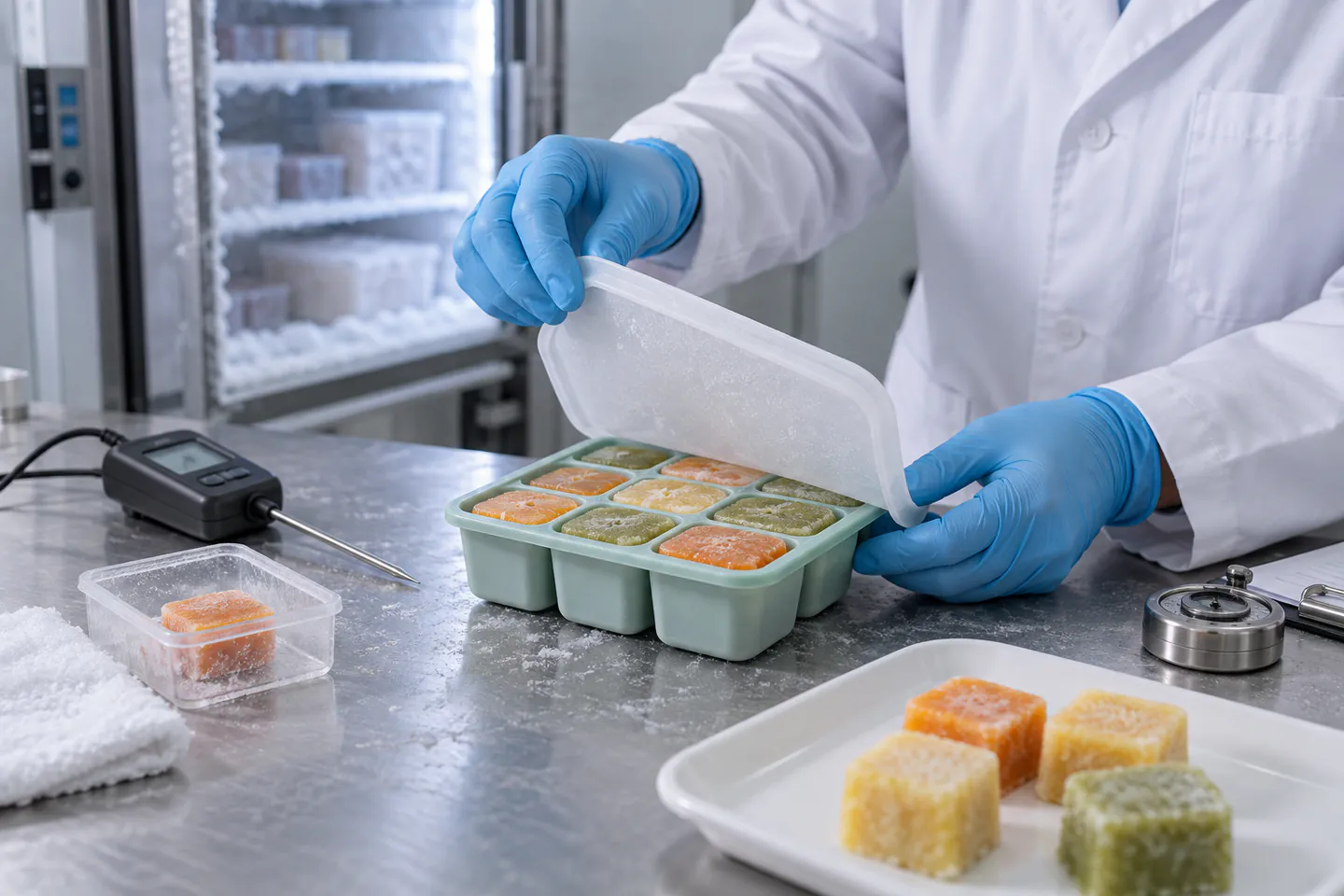
Define release performance through repeatable conditions rather than adjectives such as easy release. State the food substitute or recipe class, fill level, freezing time and temperature, removal sequence and whether the tray may flex, twist or receive bottom pressure. Observe cracking of frozen portions, residue, cavity inversion and recovery after demolding. Performance remains conditional on the tested conditions, and a result with water alone may not represent dense puree or fatty food.
Engineer Lid Fit, Retention and Claims
Treat the lid as a functional component with its own drawing and approval criteria. Define whether it rests on the rim, snaps onto a bead, seals around the perimeter or uses local tabs, then specify the intended retention and removal direction. Review gap, seating, corner lift and fit after freezing, thawing and dishwasher exposure. A tight lid is not automatically a better lid if removal deforms the filled tray or creates uncontrolled splash.
Clarify the promise the lid is expected to support. Splash resistance during freezer handling, odor protection, stacking and leak resistance under inversion are different requirements and need different tests. Decide whether a vent, date marker or write-on area is included and how that feature affects molding, cleaning and artwork. Avoid claiming an airtight or leakproof system unless the finished construction has been evaluated with a method and acceptance limit appropriate to that claim.
Validate Filled Stacking and Empty Nesting
Stacking should be assessed with empty, filled and frozen trays because the controlling surfaces can change. Define the number of units, orientation, lid presence, load duration and acceptable lean, separation or lid displacement. Feet, corner stops or lid bosses may improve alignment but can add tooling detail and cleaning surfaces. The stack design should prevent the upper tray from pressing into food while preserving enough clearance for easy removal.
Nesting is a separate packaging decision. Empty trays that nest deeply may reduce carton volume but can stick together, abrade printed areas or require separators; shallow nesting protects surfaces but increases freight cube. Measure packed height at the intended bundle quantity and observe recovery after compression and storage. Approve the actual folded or nested configuration before printing packaging, because pack-out can change shape and apparent quality at retail opening.

SECTION 03
Validate Material, Repeated Use and Market Evidence
Protect margin by reviewing production controls, landed-cost drivers and launch risks as one commercial system.
Control Silicone, Cure, Hardness and Color
Control the silicone compound, curing route, hardness range, pigment and surface finish by supplier and revision. Generic food-grade wording does not identify the material used for the approved sample or show that the finished colored tray is covered by the evidence file. Request lot traceability from compound and pigment through molding and packed SKU. Any proposed substitution should enter change control before production, even when the replacement is described as equivalent.
Color approval should account for the actual thickness and texture of the tray and lid. Translucency, gloss and local wall differences can change visual perception compared with a flat color plaque. Define the viewing light, physical reference and acceptable boundary, then retain approved samples from production-representative material. MOQ, price and lead time for special colors remain conditional on pigment availability, batch size, changeover and the total SKU mix.
Build Freeze-Thaw and Cleaning Validation
Build a validation sequence around the marketed use cycle. A practical program may include filling, freezing, removal, thawing, washing, drying and refreezing for a defined number of repetitions, with checks for dimensions, lid fit, odor, staining, cracking, recovery and visible residue. Record freezer temperature, dwell time, food simulant or recipe, dishwasher conditions and inspection intervals. Do not convert a limited cycle test into an unlimited durability claim.
Use condition-based testing to separate development learning from shipment inspection. Repeated freeze-thaw and dishwasher trials can qualify a design or detect a process change, while batch release may rely on dimensions, appearance, fit and traceability linked to the validated baseline. Identify which failures are safety, functional, cosmetic or packaging issues and assign clear acceptance criteria. Preserve pre-test and post-test samples so later changes can be compared against the original conclusion.
Map Food-Contact Evidence to the Finished SKU
Plan food-contact evidence after confirming destination market, intended food types, temperatures, contact duration and repeated-use conditions. FDA conditions of use, European Union framework requirements and relevant national recommendations answer different regulatory questions and do not create one universal silicone certificate. The tested or assessed sample should match the current compound, pigment, finished geometry and use claim. Buyers should obtain qualified regulatory advice for final market decisions.
Create an applicability matrix for every report and declaration. Record laboratory, method, sample description, color, material reference, date, result, market question and the finished SKUs the evidence supports. Link the matrix to change control so a new pigment, curing condition, supplier or lid construction triggers review. Certification and compliance scope remain conditional on the actual finished product and current evidence rather than the supplier's broadest historical document.
SECTION 04
Release Tooling, Inspection and Private-Label Pack-Out
Use early sales and replenishment assumptions to decide which variants deserve expansion and which should remain controlled.
Translate the Design Into Mold and Cavity Controls
Translate the approved tray into a mold and cavity strategy. Review parting line, gate position, venting, cavity identification, shrinkage assumptions, ejection or demolding method and how the lid is tooled relative to the base. A multi-cavity tool can improve output but adds balance and cavity-to-cavity consistency questions. Require trial evidence from every active cavity before treating a selected sample as the production standard.
Use mold trials to close measurable risks in sequence. Early samples can confirm filling and gross geometry, later trials should verify corrected dimensions, surface, lid fit, release and cycle stability under the intended material. Record each sample revision and prevent superseded trays or lids from re-entering approval discussions. Tooling cost, capacity and lead time remain estimates until design, cavities, material and trial results are sufficiently defined.
Approve Inspection and Private-Label Packaging
The production inspection plan should cover both components and the assembled selling unit. Typical controls include identity, cavity dimensions or volume, rim and lid fit, color, finish, flash, contamination, deformation, component count, labels and pack-out. Define sampling, instruments, lighting, functional fixtures, defect classes and release authority. A pass statement is weak when the inspected lot, sample size, method or approved limit cannot be reconstructed.
Inspect packaging for its effect on the flexible product. Confirm bag or carton fit, separators, dust protection, code placement, instructions, assortment count, master-carton quantity and storage orientation with production-representative materials. Test whether stacking or compression creates a temporary shape that recovers within an agreed condition. Shipping protection and final pack dimensions influence landed cost, so packaging should be quoted and approved with the tray rather than added after production.
Request a Comparable Quotation and Sample Plan
Request quotations from one controlled specification and state which values may remain conditional. Give suppliers the tray and lid drawings or reference dimensions, target material, colors, quantity by SKU, packaging, market evidence plan, inspection expectations and delivery location. Ask them to separate tooling, samples, tests, packaging and recurring unit cost. This makes commercial differences visible instead of rewarding the supplier that omits the most work.
For a Naike Silicone freezer-tray review, share the target portion size, cavity count, freezer and cleaning conditions, destination market, color plan, packaging concept and forecast range. We can identify the drawing questions, sample sequence, tooling route and evidence needed before a reliable quotation. MOQ, price, capacity, lead time, certification scope and performance remain conditional on the approved design and order scenario. End the review with a sample request, tooling assessment, quotation or supplier-evaluation action tied to the current revision.
ACTION FRAMEWORK
Buyer Checklist Before Commercial Approval
Use this checklist as a meeting agenda. It is intentionally concise so the team can identify missing evidence without replacing its own quality, legal or supplier-management procedure.
| Check | Question | Why It Matters |
|---|---|---|
| Intended use | Are food type, portion, freezing, thawing and cleaning conditions defined? | Geometry and evidence cannot be selected reliably without the real use cycle. |
| Cavity volume | Does the specification distinguish brimful capacity from practical fill volume? | Different measurement bases can create inconsistent portions and unsupported claims. |
| Tray stability | Are footprint, rim, wall zones and representative carrying load controlled? | Hardness alone does not determine stability when a filled tray is moved. |
| Lid function | Are seating, retention, removal and any splash or leak claim tested separately? | One tight-fitting sample does not establish every lid performance claim. |
| Stack and nest | Were filled stacking and empty pack-out evaluated with production materials? | Stacking controls food clearance while nesting affects recovery, package size and freight. |
| Material identity | Are compound, cure route, hardness, pigment and finish traceable by revision? | Generic food-grade wording cannot connect a shipped SKU with its evidence file. |
| Validation | Do freeze-thaw, release and wash trials name conditions and acceptance limits? | A pass statement without method cannot support comparison or repeat orders. |
| Production release | Are every cavity, packaging, inspection method and golden sample included? | Approval of one hand-selected tray is not a mass-production control plan. |
NEXT READING
Continue the Supplier and Product Review
These internal resources connect the guide with Naike Silicone product, factory, customization and inquiry pages. Open the route that matches the next decision in your project.
Review the custom baby food freezer tray product page
Use review the custom baby food freezer tray product page to gather the next level of product, manufacturing or commercial information.
Open internal resource →Specify a custom silicone suction plate
Use specify a custom silicone suction plate to gather the next level of product, manufacturing or commercial information.
Open internal resource →Build a private-label silicone feeding set
Use build a private-label silicone feeding set to gather the next level of product, manufacturing or commercial information.
Open internal resource →Compare FDA and LFGB silicone evidence
Use compare fda and lfgb silicone evidence to gather the next level of product, manufacturing or commercial information.
Open internal resource →Explore all silicone product categories
Use explore all silicone product categories to gather the next level of product, manufacturing or commercial information.
Open internal resource →Review Naike Silicone manufacturing knowledge
Use review naike silicone manufacturing knowledge to gather the next level of product, manufacturing or commercial information.
Open internal resource →PRIMARY REFERENCES
Authoritative External Sources
The sources below are official primary references. Applicability depends on the product, intended use and destination market. Buyers should obtain qualified advice for final legal or regulatory decisions.
FDA: Food Types and Conditions of Use for Food Contact Substances
Official FDA guidance describing food types and conditions of use used when evaluating food-contact substance applications; applicability still depends on the actual material and finished product.
European Commission: Food Contact Materials
Official European Commission overview of the EU framework for materials and articles intended to contact food.
BfR Recommendation XV: Silicones
Official German Federal Institute for Risk Assessment recommendation covering silicones and silicone elastomers.
BUYER QUESTIONS
Frequently Asked Questions
Should cavity volume be measured to the brim or to a practical fill line?
Choose the basis that matches the marketed portion claim and document the method. Brimful capacity, practical fill volume and food mass can differ, so the drawing, inspection record and packaging language should use the same definition.
How many cavities should a silicone baby food freezer tray have?
The answer depends on target portion, freezer footprint, carrying stability, package size and forecasted retail position. Compare complete tray scenarios rather than increasing cavity count without checking web thickness, release and handling.
Does a fitted lid make the tray leakproof?
Not necessarily. A lid can support stacking, splash resistance or odor protection without passing an inversion or pressure-based leak test. Use claim wording that matches the finished-product validation method and acceptance limit.
How should buyers test frozen-portion release?
Define recipe or representative medium, fill level, freezing temperature and time, removal method and acceptance criteria. Check portion damage, residue, required flexing and tray recovery across every production cavity.
Can one food-contact report cover every tray color?
Only when a documented applicability review supports that conclusion. Match the report to compound, pigment, finished construction, sample identity, intended use and destination requirements before extending it to another color.
What information is needed for a reliable freezer-tray quotation?
Provide cavity count and volume, dimensions, lid concept, material and color direction, quantity by variant, packaging, destination market, validation needs and delivery terms. Tooling, MOQ, price and schedule become firmer as these variables are approved.
Editorial and Scope Note
Conclusion: Custom Silicone Baby Food Freezer Tray Specification
Move from buyer research to a controlled supplier brief
A useful silicone baby food freezer tray specification connects practical portion volume, freezer fit, carrying stability, wall design, frozen release, lid behavior, stacking, material identity, evidence, tooling and pack-out. Buyers should approve the tray and lid as one traceable finished SKU under defined use conditions. MOQ, price, lead time, capacity, certification scope and performance remain conditional on the approved design, color, validation and order plan. Send Naike Silicone the target cavity count, portion, market, packaging and forecast to request a sample, quotation, tooling review or supplier evaluation.
This factory-insider guide supports sourcing preparation and supplier discussion; it does not replace product-specific engineering, laboratory, regulatory, legal or commercial review for the destination market.