PRODUCT SOURCING GUIDES
Silicone Baby Food Freezer Trays: Separate Cavities vs Connected Portions
Compare separate-cavity and connected-portion silicone baby food freezer trays by filling, release, cleaning, tooling, packaging and quality evidence.
DIRECT ANSWER
What B2B Buyers Need to Know
Separate cavities are usually better when buyers need discrete portion control, independent release and mixed foods in one tray. Connected portions can suit flexible serving sizes, faster filling and compact mold layouts, but score lines, cross-flow and cleaning must be validated. The right choice depends on food viscosity, frozen-release method, lid design, stacking, packaging and the acceptance evidence defined for the finished SKU.
This guide is written for baby-product brands, importers, retailers, distributors, product developers and sourcing teams comparing private-label silicone freezer-tray layouts. It provides a decision framework rather than legal advice or a universal specification. Product classification, use conditions and destination market should be confirmed before final testing, labelling or compliance decisions.
Key Takeaways
- Choose the layout from the filling, freezing, release and serving workflow—not from cavity count alone.
- Separate cavities support isolated foods and independent release when walls and practical fill levels are controlled.
- Connected portions can support continuous filling and flexible servings only when score or bridge behavior is validated.
- Compare lid fit, freezer footprint, cleaning access, nesting and packaging on production-representative samples.
- Qualify geometry with representative foods, temperatures and repeated use, then translate results into inspection controls.
- Keep performance, certification scope, MOQ, price, capacity and lead time conditional on the approved finished SKU.
Separate Cavities vs Connected Portions: Buyer Decision Matrix
Use the matrix to compare layout choices under the same food, fill, freezing, release and packaging conditions. Results remain design- and use-specific.
| Decision area | Separate cavities | Connected portions |
|---|---|---|
| Filling and isolation | Clear boundaries and better separation of different foods; each pocket needs accurate dosing | Faster continuous pour may suit one recipe; low divisions can allow cross-flow before freezing |
| Serving and release | One portion can usually be pressed out while others remain seated | A strip can offer variable servings, but the score or break path must separate predictably |
| Cleaning | More deep corners and divider intersections to inspect | Fewer full-height walls, but shallow grooves and bridges may retain film |
| Tooling and control | Wall height, cavity balance, bottom thickness and independent release are critical | Rib height, score geometry, flatness and break behavior are critical |
| Packaging and freight | May nest deeply but can lock or require separation features | May pack efficiently but long flexible zones or scores need protection |
SECTION 01
Compare the Portioning Workflow and Layout Architecture
Begin with the target buyer, channel and assortment role so every specification decision supports a sellable range.
Start With the Portioning Workflow for silicone baby food freezer tray comparison
Begin with the portioning workflow, because the same cavity count can serve very different buyers. Define whether a caregiver fills one recipe across the tray, separates several foods, measures a prescribed serving, or breaks a larger frozen strip into variable amounts. Record the filling tool, practical fill line, freezer position, release method and intended age range. Those decisions reveal whether independent cavities or connected portions solve the real task instead of merely creating a different visual style.
Separate the consumer promise from the procurement assumption. A promise such as individual portions, mix-and-match meals or flexible serving size needs a layout that supports it under representative food viscosity and freezing conditions. Forecast, channel and price position also matter, but they do not prove functionality. Give each supplier one written use scenario and ask for a layout response, risk list and sample method before comparing tooling or unit price.
Define Separate Cavities and Connected Portions
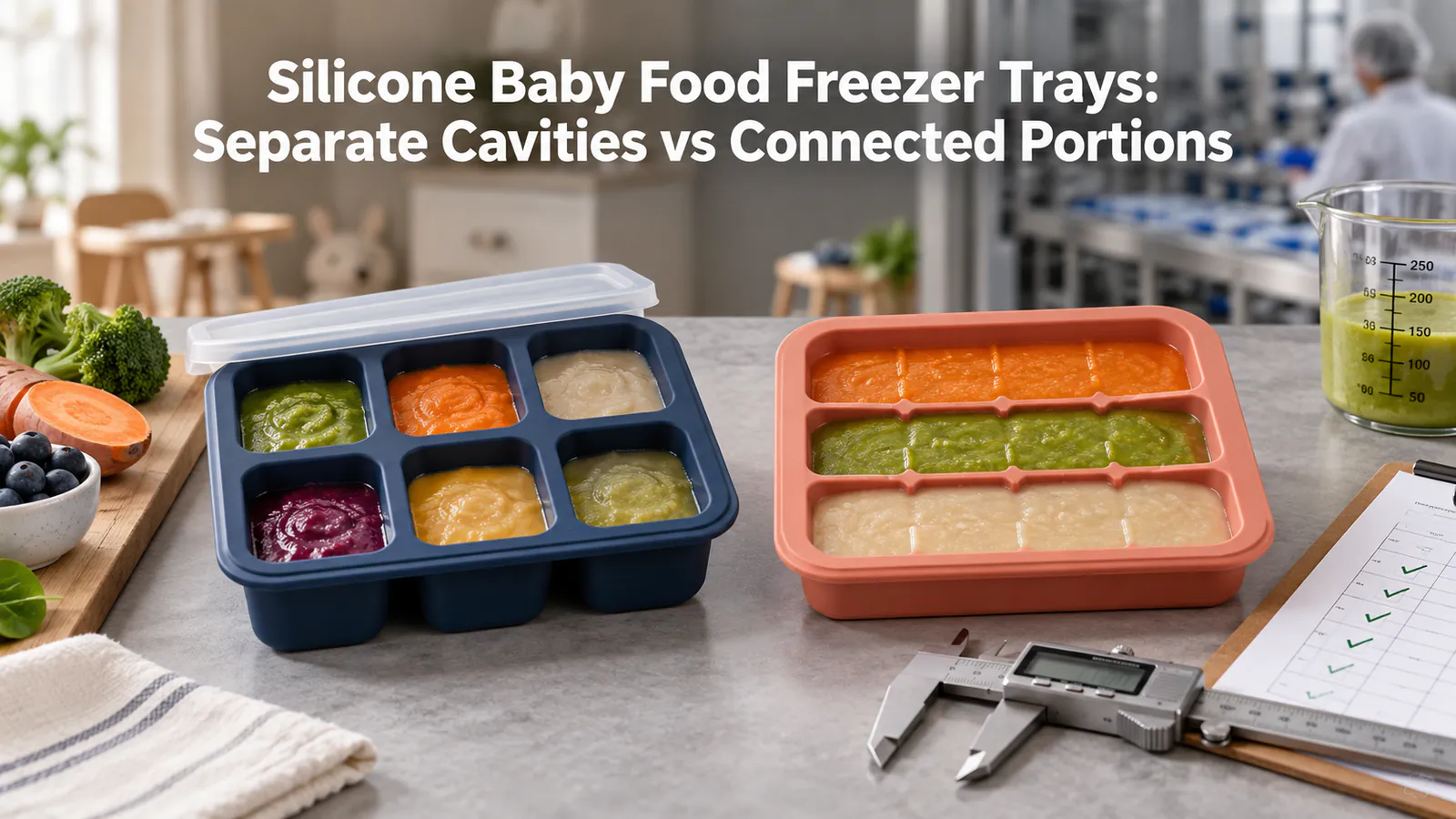
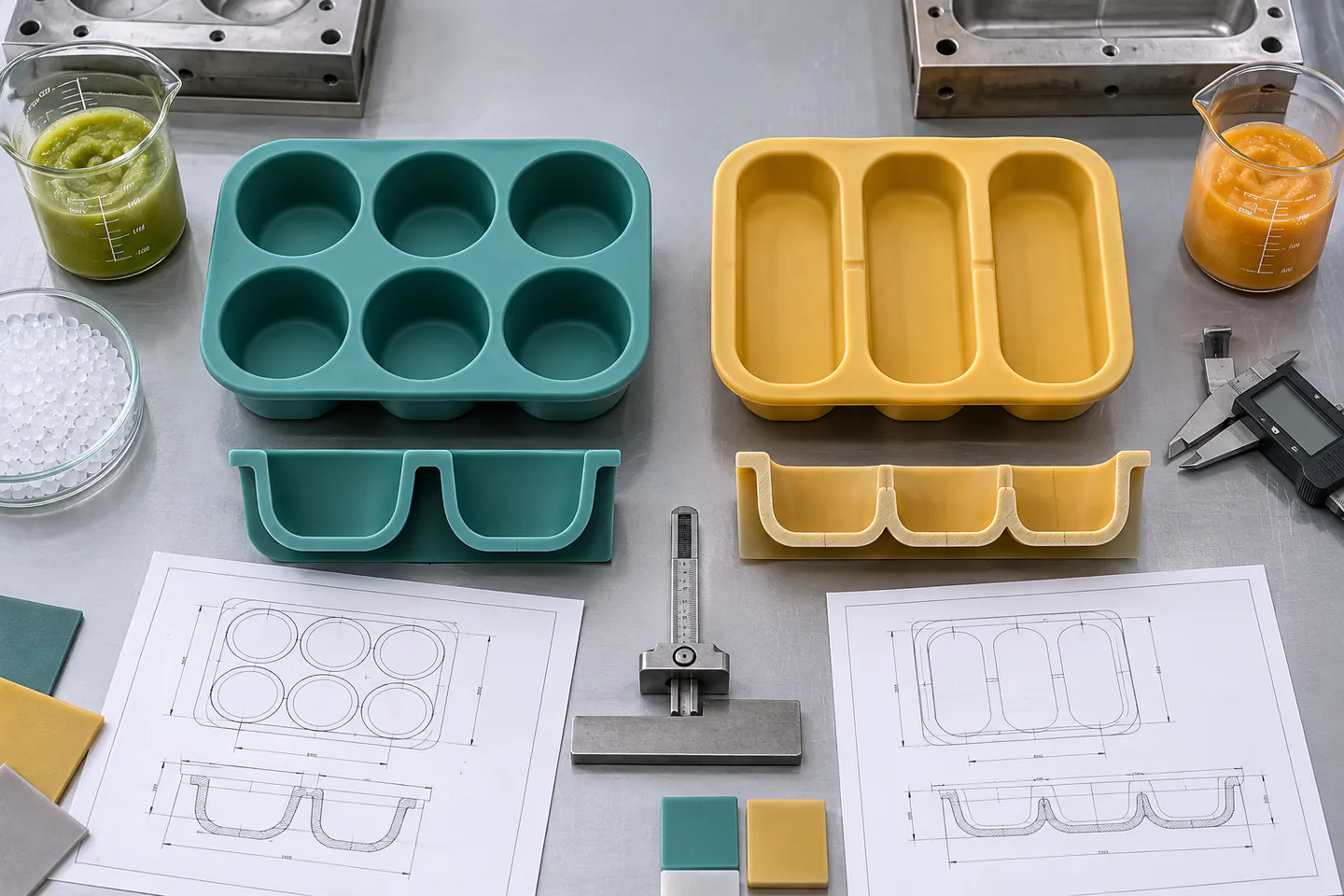
A separate-cavity tray uses walls that isolate each portion to its intended fill height. The cavities may share a flexible outer frame, yet puree should not flow between them during normal filling and carrying. This construction supports different foods in one tray and independent release, provided the dividing walls remain high and stable enough. Buyers should inspect the practical fill boundary rather than assuming that a molded grid automatically prevents cross-flow.
A connected-portion layout creates a larger reservoir divided by low ribs, bridges, score features or partial walls. The frozen mass can be bent, snapped, cut or peeled into smaller servings, depending on the design and food. Connected does not mean uncontrolled, but its portion claim depends on how consistently the divisions guide separation. The drawing should name the intended break path and show where material, food and frozen bridges are expected to remain continuous.
Compare Filling Accuracy and Spill Control
Separate cavities generally make repeatable filling easier when the operator doses one cavity at a time. High walls show the boundary clearly and reduce migration when different recipes share the tray. They can also slow a high-volume filling operation because every pocket requires placement and the tool may need to move around a wider grid. Compare manual ladling, piping and automated dosing with the actual puree viscosity before selecting the layout.
Connected portions can accept a faster continuous pour or spread across a channel, which may suit one-recipe batches. The trade-off is that a slight tray tilt, uneven rib height or overfill can redistribute food and alter serving size. Define the surface level, carrying motion and maximum practical fill, then weigh portions from several positions after freezing. A nominal score pattern is not evidence of portion accuracy when the liquid phase can move before solidifying.
SECTION 02
Evaluate Filling, Release, Freezer Fit and Cleaning
Translate the range plan into comparable product, packaging and approval evidence before requesting final quotations.
Compare Portion Release and Serving Flexibility
For independent serving, a separate cavity usually gives the caregiver the clearest release target. Bottom pressure can invert one pocket while adjacent portions remain seated, although stiff rims, deep undercuts or heavy walls can still make release difficult. Measure whether one portion can be removed without touching or loosening the others. This is especially important when the opened tray returns to storage and the brand promises convenient single-serving use.
Connected portions offer variable serving sizes when the frozen strip separates predictably. A caregiver may remove one marked section or combine two, but the break can wander when food composition, freezing temperature or score geometry changes. Evaluate crumbs, sharp frozen edges, partial fractures and accidental release of neighboring sections. If a knife or twisting action is required, instructions and safe handling should reflect that method instead of implying effortless one-hand release.
Control Walls, Bridges and Score Lines
Wall height, top width and draft govern isolation in a separate-cavity tray. Very thin dividers can flex during filling, while wide dividers consume footprint and may make the product look bulky. Review wall continuity at corners and the junction with the outer rim, because low local areas can become cross-flow paths. A cavity map should identify critical heights, practical fill level and any intentionally shared overflow feature.
For connected portions, define the bridge or score line as a controlled functional feature. Its width, height, radius and orientation affect filling, freezing, bending and mold release, and a decorative groove may not guide fracture at all. Request cross-sections at every transition rather than approving only a top view. Tool wear, flash and trimming should not erase or sharpen the feature beyond the approved production boundary.
Evaluate Freezer Fit, Lids and Stacking
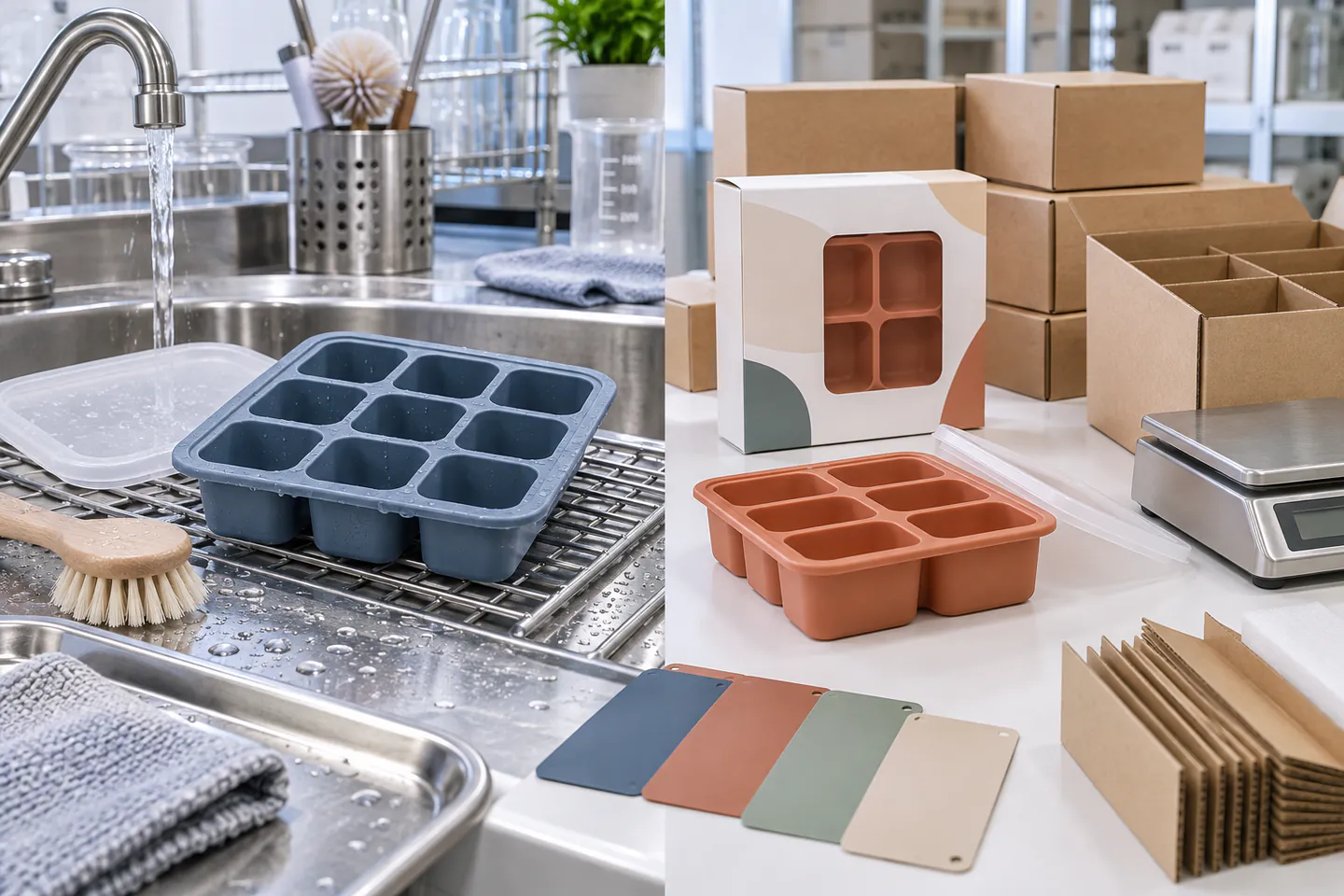
Freezer fit is a complete-system decision. Compare overall footprint, filled carrying stiffness, lid clearance, stack height and the space needed to flex the tray during release. Separate cavities can create a thicker molded base, while a connected reservoir may use the footprint efficiently but require a longer bending zone. Test both layouts in the intended freezer drawer and storage bag rather than choosing from isolated cavity-volume calculations.
The lid should be reviewed against each layout because internal food height and tray deformation differ. A connected strip that rises above a score rib can contact the lid, while separate foods may need clearance to prevent color or flavor transfer. Check seating after filling, freezing and stacking, and distinguish splash resistance from inversion leakage. One common lid is possible only if the rim geometry, deflection and functional claims are validated for both bases.
SECTION 03
Validate Material, Tooling and Representative-Use Evidence
Protect margin by reviewing production controls, landed-cost drivers and launch risks as one commercial system.
Compare Cleaning Access and Residue Risk
Separate cavities create more corners and wall intersections, so cleaning access depends on radii, depth and surface finish. Residue can remain where the cavity bottom meets a divider, especially after starchy or fatty foods dry. Wash with the planned brush, dishwasher cycle or hand method, then inspect under consistent lighting after drying. Do not infer cleanability from smooth silicone alone when geometry creates narrow or shaded retention zones.
Connected portions reduce some full-height walls but may add shallow grooves that trap film while appearing clean from above. Score channels, embossed portion numbers and flexible bridges should be checked after repeated freeze, release and wash cycles. Compare cleaning time, visible residue, odor and tray recovery for representative recipes. If a design needs a special brush or immediate rinse, that condition belongs in buyer approval and consumer care instructions.
Match Layout to Material and Mold Strategy
Material selection should support the geometry rather than force every layout into one hardness. Separate cavities may need flexible bottoms with a stable rim, while connected portions need enough bend at the score path without uncontrolled distortion during filling. Use thickness zoning and approved finished samples to tune the response. A Shore A value measured on a standard specimen cannot by itself guarantee release, break behavior or carrying stability in the molded tray.
Mold strategy also changes the commercial comparison. Deep independent pockets can challenge venting, demolding and cavity-to-cavity balance; long connected channels can magnify flatness, rib-height and shrinkage variation. Review parting line, gate, vent, cavity identification and trial plan with the proposed compound and pigment. Tooling price, cycle time, capacity and lead time remain conditional until the design, cavity count and acceptable process window are defined.
Build Evidence Around Real Food and Freeze Conditions
Build development evidence with representative foods, not only water. Include at least one thin puree that can cross a low boundary and one dense or fatty recipe that may release differently, while controlling fill mass, freezer temperature and dwell time. Record results by tray position and active mold cavity. The objective is not to declare one layout universally superior, but to show which design meets the named use conditions with less variation.
Use a sequential trial: fill and carry, freeze and stack, release and portion, then wash and inspect. Preserve pre-test dimensions, photographs and sample identities so a corrected tool or material batch can be compared with the same baseline. Separate design qualification from routine lot inspection; the latter may use dimensions, fit and visual controls linked to the validated sample. Performance statements should remain conditional on the tested recipes, temperatures and handling method.
SECTION 04
Control Packaging, Inspection and Supplier Quotations
Use early sales and replenishment assumptions to decide which variants deserve expansion and which should remain controlled.
Compare Packaging, Freight and Retail Presentation
Packaging can reverse an apparently simple cost advantage. A separate-cavity tray may nest deeply but lock against neighboring rims, while a connected layout may pack flatter yet need protection for a long flexible edge or score feature. Measure nested height, separation force, recovery after compression and selling-unit dimensions at the proposed bundle quantity. Use those results in carton and freight calculations instead of comparing silicone weight alone.
Retail presentation should explain the layout without overstating it. Portion icons, fill guidance and release illustrations need to match the approved cavity or score geometry and the way frozen food actually separates. Check visibility through any window, lid orientation and component count in the packed set. MOQ and price can change with custom inserts, printed sleeves, color assortments and carton configuration, so approve physical pack-out before final commercial release.
Translate Layout Choice Into Inspection Controls
Turn the chosen layout into measurable production controls. For separate cavities, useful checks include wall height, cavity volume, divider continuity, bottom thickness and independent release. For connected portions, include rib or score dimensions, flatness, break-path behavior and residual bridge condition. Both layouts still need material identity, color, finish, lid fit, contamination, component count and packaging controls tied to one revision-controlled SKU.
Write sampling and authority into the quality plan. Identify which features are checked at startup, by active mold cavity, during production and at final release, with instruments or fixtures named where appropriate. Retain approved tray and lid samples together because mixing revisions can create a false fit failure. Any deviation affecting portion isolation, break behavior, food contact, lid function or instructions should require buyer review rather than informal acceptance at packing.
Request Comparable Samples and Quotations
Ask suppliers to quote both layouts from a normalized brief when the decision remains open. Provide target serving range, recipes, cavity or score concept, overall envelope, lid requirement, colors, destination, packaging, validation and quantity by SKU. Request separate costs for design work, tooling, samples, testing, packaging and recurring production. The cheapest headline unit price is not comparable if one offer omits a lid tool, portion trial or required retail pack.
For a Naike Silicone layout review, send the intended food and serving workflow, freezer and cleaning conditions, target dimensions, lid concept, market, forecast and packaging direction. We can compare manufacturability, sample sequence, mold route and evidence for separate cavities versus connected portions. Certification scope, performance, MOQ, price, capacity and lead time remain conditional on the approved finished design and order plan. Close the review with a sample request, quotation, tooling assessment or supplier-evaluation action tied to the current revision.

ACTION FRAMEWORK
Buyer Checklist Before Commercial Approval
Use this checklist as a meeting agenda. It is intentionally concise so the team can identify missing evidence without replacing its own quality, legal or supplier-management procedure.
| Check | Question | Why It Matters |
|---|---|---|
| Use scenario | Is the tray for one recipe, mixed foods, fixed portions or variable servings? | The serving workflow determines whether isolation or controlled separation is more valuable. |
| Fill method | Were manual, piping or automated filling and representative viscosities evaluated? | Cross-flow and dosing time can change the apparent advantage of each layout. |
| Layout geometry | Are walls, bridges, ribs, scores, draft and critical dimensions shown in cross-section? | A top view cannot define isolation or frozen break behavior. |
| Release method | Can the intended serving be removed without loosening unwanted portions? | Independent cavities and connected strips use different motions and create different failure modes. |
| Lid and freezer fit | Were clearance, stacking, deformation and lid seating checked after freezing? | A shared perimeter does not prove equal system performance. |
| Cleaning | Were corners, score grooves and markings inspected after representative wash cycles? | Smooth material can still retain food where geometry limits access. |
| Evidence | Do trials name food, fill mass, temperature, dwell time, mold cavity and acceptance criteria? | Uncontrolled demonstrations cannot support buyer comparison or repeat orders. |
| Commercial scope | Do quotations separate tooling, samples, tests, packaging and recurring production? | MOQ, price, capacity and lead time are comparable only under the same approved scenario. |
NEXT READING
Continue the Supplier and Product Review
These internal resources connect the guide with Naike Silicone product, factory, customization and inquiry pages. Open the route that matches the next decision in your project.
Review the custom baby food freezer tray product page
Use review the custom baby food freezer tray product page to gather the next level of product, manufacturing or commercial information.
Open internal resource →Specify a silicone baby food freezer tray with lid
Use specify a silicone baby food freezer tray with lid to gather the next level of product, manufacturing or commercial information.
Open internal resource →Build a private-label silicone feeding set
Use build a private-label silicone feeding set to gather the next level of product, manufacturing or commercial information.
Open internal resource →Compare FDA and LFGB silicone evidence
Use compare fda and lfgb silicone evidence to gather the next level of product, manufacturing or commercial information.
Open internal resource →Explore all silicone product categories
Use explore all silicone product categories to gather the next level of product, manufacturing or commercial information.
Open internal resource →Review Naike Silicone manufacturing knowledge
Use review naike silicone manufacturing knowledge to gather the next level of product, manufacturing or commercial information.
Open internal resource →PRIMARY REFERENCES
Authoritative External Sources
The sources below are official primary references. Applicability depends on the product, intended use and destination market. Buyers should obtain qualified advice for final legal or regulatory decisions.
FDA: Food Types and Conditions of Use for Food Contact Substances
Official FDA guidance describing food types and conditions of use used when evaluating food-contact substance applications; applicability still depends on the actual material and finished product.
European Commission: Food Contact Materials
Official European Commission overview of the EU framework for materials and articles intended to contact food.
BfR Recommendation XV: Silicones
Official German Federal Institute for Risk Assessment recommendation covering silicones and silicone elastomers.
BUYER QUESTIONS
Frequently Asked Questions
Are separate cavities always better for accurate portions?
They usually make the fill boundary clearer and reduce cross-flow, but accuracy still depends on dosing method, practical fill line, tray level, food viscosity and cavity variation. Validate filled and frozen portions from every active mold cavity.
What does a connected-portion freezer tray mean?
It uses one larger reservoir divided by low ribs, bridges, grooves or score features. The frozen food is intended to separate along those divisions, so buyers must approve the break method and evidence rather than relying on the visual pattern.
Which layout releases frozen puree more easily?
Separate cavities often support independent bottom pressure, while connected portions may release as a strip and then divide. Ease of release depends on recipe, temperature, dwell time, wall thickness, draft and the permitted handling method, so compare representative samples.
Which baby food tray layout is easier to clean?
Neither is automatically easier. Separate cavities add deep corners and intersections; connected layouts may add shallow score grooves that retain film. Test the intended washing method with representative foods and inspect after repeated cycles.
Can one lid fit separate-cavity and connected-portion trays?
Only if both bases share a controlled rim and the lid is validated against their different deformation, food height, freezing and stacking conditions. A shared perimeter does not by itself prove equal fit or leakage performance.
What inputs are needed to quote both tray layouts?
Provide serving range, intended foods, tray envelope, cavity or score concept, lid requirements, material and colors, quantities, destination market, packaging, validation scope and delivery terms. Ask suppliers to separate tooling, sample, test, packaging and unit-cost assumptions.
Editorial and Scope Note
Conclusion: Separate vs Connected Baby Food Tray Portions
Move from buyer research to a controlled supplier brief
Separate cavities usually suit buyers prioritizing isolated recipes, fixed portions and independent release; connected portions can suit one-recipe filling and flexible serving sizes when the division path works under real frozen-food conditions. Compare both layouts through controlled samples covering fill, carry, freeze, release, cleaning, lid fit, nesting and pack-out. Certification scope, performance, MOQ, price, capacity and lead time remain conditional on the approved material, geometry, market evidence, packaging and order plan. Send Naike Silicone your serving workflow, recipe range, target size, market and forecast to request samples, a quotation, a tooling review or a supplier-evaluation comparison.
This factory-insider guide supports sourcing preparation and supplier discussion; it does not replace product-specific engineering, laboratory, regulatory, legal or commercial review for the destination market.