PRODUCT SOURCING GUIDES
What Should Buyers Specify for a Custom Silicone Faucet Splash Guard Mat?
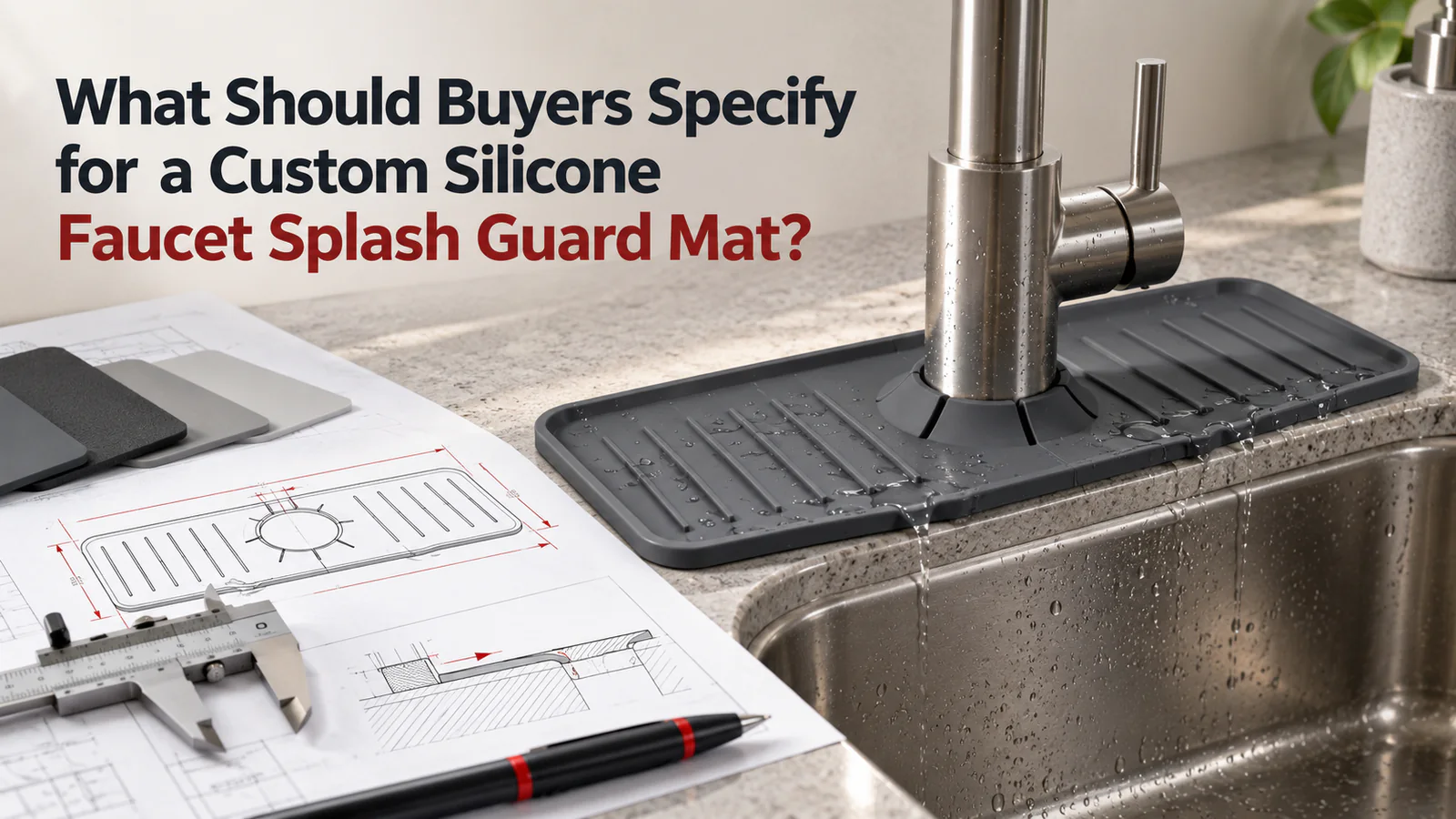
Specify faucet opening, counter fit, drainage, stiffness, color and packaging for a custom silicone faucet splash guard mat before requesting a B2B quote.
DIRECT ANSWER
What B2B Buyers Need to Know
Buyers should specify the actual sink and faucet installation, faucet-base opening, usable counter footprint, sink-edge relationship, drainage direction, silicone stiffness, wall and rib geometry, color, logo, packaging and validation method. Approve the design on identified fixtures and define measurable release criteria. MOQ, price, lead time and performance remain conditional on the final geometry, tooling, evidence scope and order configuration.
This guide is written for housewares importers, private-label brands, retailers, distributors, product developers, quality teams and sourcing managers. It provides a decision framework rather than legal advice or a universal specification. Product classification, use conditions and destination market should be confirmed before final testing, labelling or compliance decisions.
Key Takeaways
- Identify the sink, faucet, countertop and accessories that define the fit claim.
- Dimension the faucet opening, counter footprint, sink edge and backsplash clearance from common datums.
- Validate drainage with a defined water dose, installation condition and residual-water criterion.
- Approve hardness, thickness and ribs together on a production-representative molded sample.
- Control color, logo, packaging recovery and compatibility wording by finished-SKU revision.
- Keep MOQ, price, capacity, timing and performance conditional on the approved order scenario.
Faucet Splash Guard Specification Decisions
Use one installation baseline when comparing suppliers. Values and claims remain conditional until the final product is tested on the identified fixtures.
| Decision area | Buyer must define | Evidence before approval |
|---|---|---|
| Faucet opening | Base range, position, slit or closed-hole route and installation method | Drawing plus fit and recovery trials on identified faucets |
| Counter footprint | Usable depth, width, wall gap, sink-rim relationship and accessory exclusions | Measured installation record and flatness check |
| Drainage | Collection zone, slope, ribs, outlet and residual-water criterion | Controlled water trial after packing and cleaning cycles |
| Material feel | Compound reference, Shore method, thickness and stiffness intent | Reference plaque plus finished-product handling and drainage checks |
| Appearance | Color, texture, logo, visual limits and viewing condition | Approved molded sample and defect standard |
| Packaging | Fold or roll method, recovery time, size code and fit wording | Complete packed-SKU approval and recovery inspection |
SECTION 01
Define the Sink Installation and Fit Envelope
Begin with the target buyer, channel and assortment role so every specification decision supports a sellable range.
Identify the Sink and Faucet Installation Family for custom silicone faucet splash guard mat
Start with the sink installation rather than a generic mat size. Record whether the faucet is deck-mounted through the sink, mounted through the countertop, or positioned against a raised rear ledge, because each arrangement changes the available footprint and the path that collected water must follow.
Identify the sink, faucet and countertop samples by model or revision, then photograph the installation from above and at both sides. A buyer who sends only a front photograph leaves the factory guessing about the faucet base, wall clearance, soap dispenser and rear lip that may decide whether the mat can lie flat.
Where a range is intended to fit several kitchens, list approved, conditional and excluded installations before tooling. The selling claim must stay inside the measured sample set; a nominal sink width or faucet style is not enough to support universal-fit wording.
Measure the Faucet Base and Opening or Slit
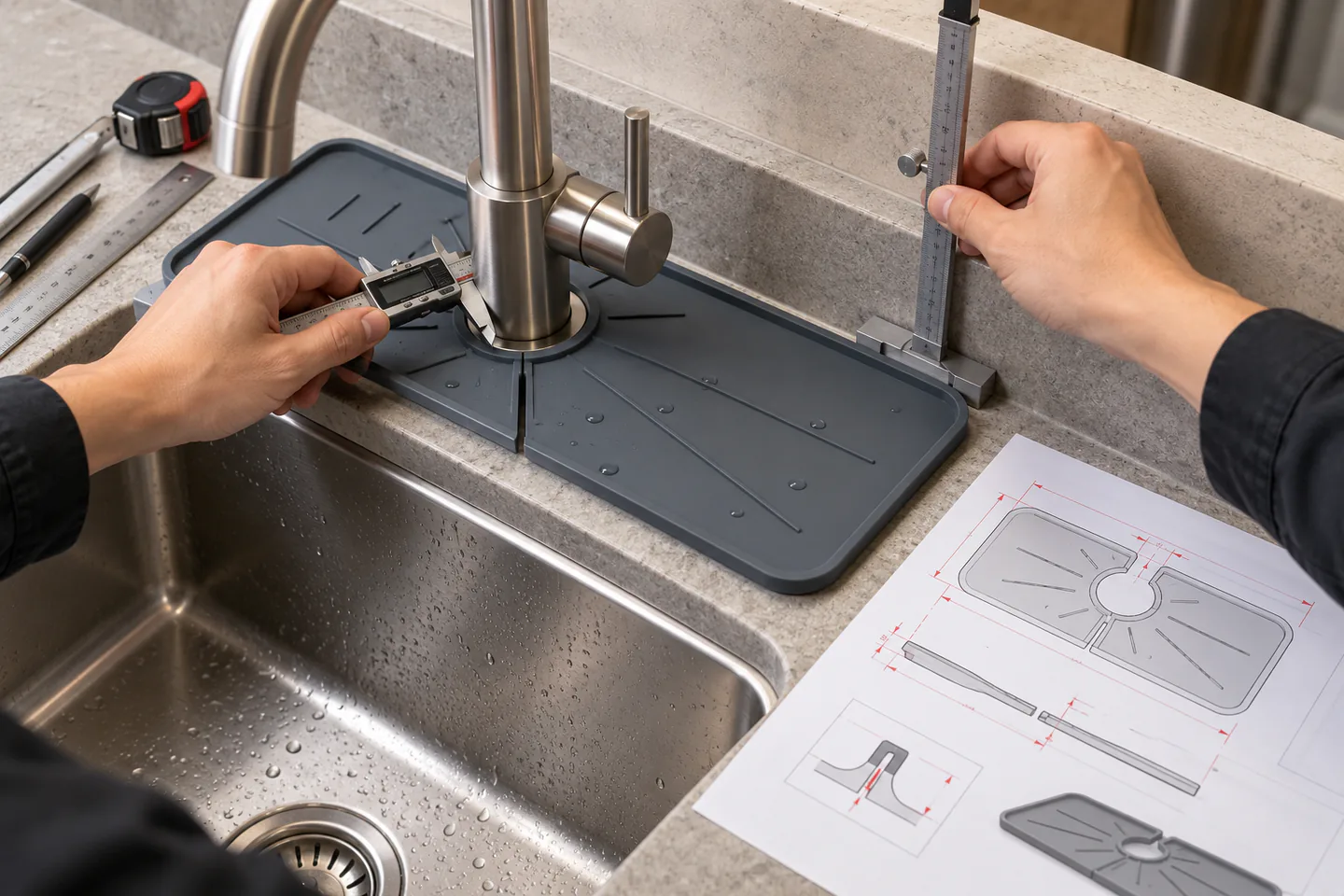
Measure the faucet base at the plane where the silicone will sit, including any escutcheon plate, seal bead or irregular rear profile. Record the maximum base width and depth, stem position, distance to the backsplash and the direction from which the mat must be installed around existing hardware.
Define whether the opening is a closed hole, a rear slit, a flexible keyhole or an interchangeable insert. Each choice changes installation force, visible gaps, water migration and tooling, so the drawing should show the relaxed opening, permitted stretch and acceptance condition after installation.
Do not specify a slit only as ‘fits most faucets.’ State the intended base range and the locations where a gap is allowed, then trial the design on identified fixtures. If stretching whitens the silicone, lifts the mat or leaves a channel behind the faucet, the opening or material system needs another review.
Set the Countertop Footprint and Sink-Edge Relationship
Map the usable countertop footprint from the faucet centerline to the sink rim, wall, soap dispenser and nearby accessories. Dimension the front edge, rear edge, left and right extents, corner radii and any cutout rather than relying on a retail length-by-width label.
The mat should not bridge a raised sink flange or hang into the basin unless that relationship is deliberate and tested. Create a section view across the counter, mat and sink edge so tooling and quality teams understand where the product must contact, drain or remain clear.
For stone, laminate, stainless and molded sink decks, confirm whether seams, grout, caulk or texture interrupt flat contact. These conditions can change pooling and stability, so compatibility notes should identify the surfaces actually reviewed instead of converting a showroom sample into an unconditional claim.
SECTION 02
Engineer Drainage, Flexibility and Use Conditions
Translate the range plan into comparable product, packaging and approval evidence before requesting final quotations.
Design the Drainage Slope, Ribs and Outlets
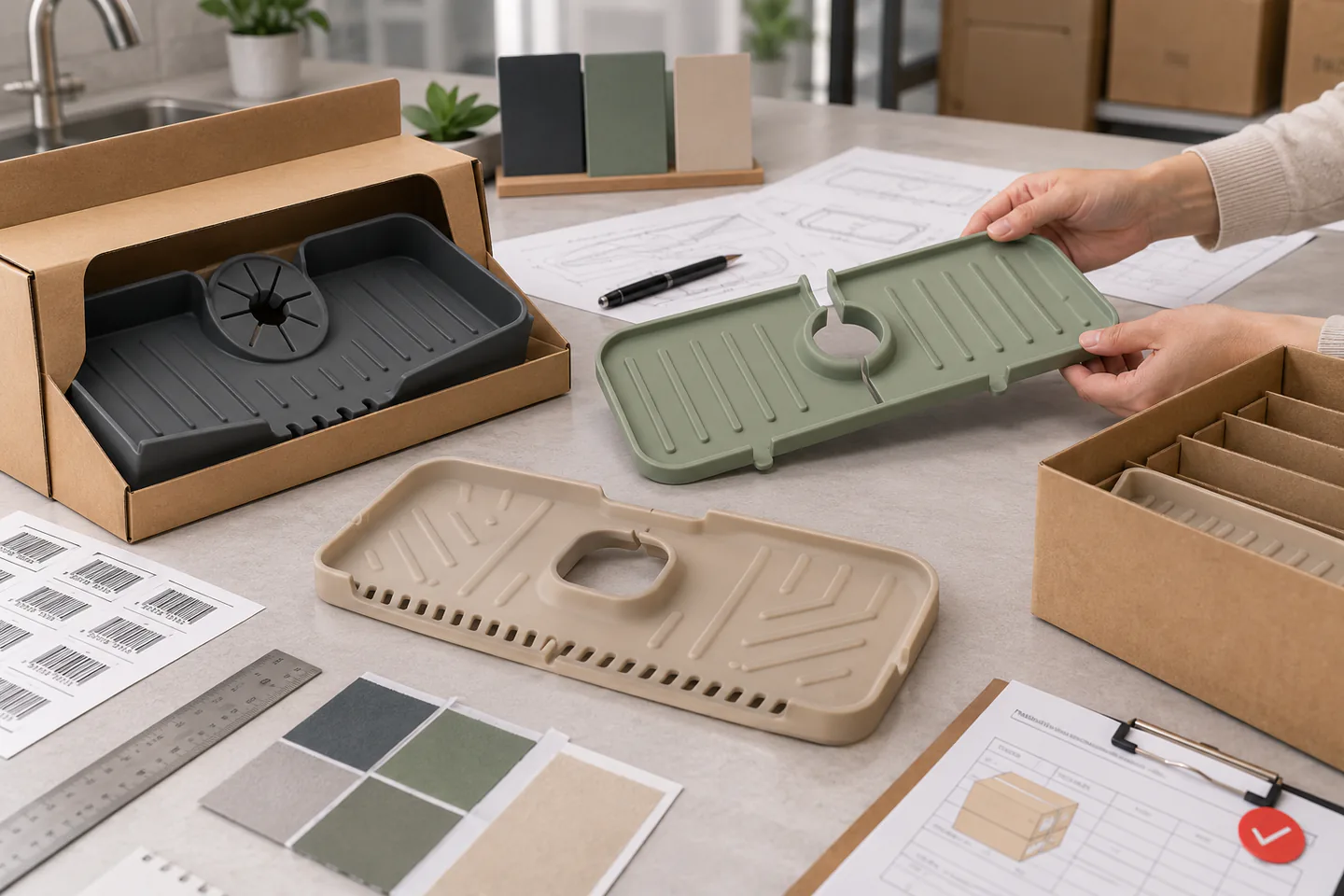
Drainage direction must be engineered into the installed geometry. Define the collection zone, outlet edge, target slope, rib layout and the lowest path toward the sink, then check that the faucet opening and rear wall do not trap a separate pool.
A CAD slope is not proof of drainage because soft silicone can conform to an uneven counter, curl after packing or flatten under an accessory. Use a representative installation, a defined water dose and observation interval, and record residual pools, reverse flow and water escaping behind the mat.
Compare more than one drainage concept before steel release when the counter relationship is uncertain. A single front outlet may be simple, while multiple channels can tolerate localized deformation; the correct route depends on the approved footprint, stiffness, surface and cleaning expectations.
Balance Shore A Hardness, Thickness and Recovery
Hardness, wall thickness and rib geometry jointly control whether the mat stays flat while remaining flexible enough for installation and cleaning. A Shore A number should be tied to an identified test method and specimen, not treated as a direct promise about the feel of a thin molded edge.
Approve both a material reference plaque and the finished molded sample. The plaque supports comparable material control, while the product trial checks edge lift, opening recovery, tray stiffness and drainage under the actual geometry; neither record can replace the other.
If the buyer requests softer silicone, review whether channels collapse or the faucet slit creeps open after repeated installation. If a stiffer construction is proposed, examine counter conformity and pack memory. Final hardness, tolerance and performance remain conditional on production-representative trials.
Control Backsplash and Accessory Clearances
Backsplash clearance and accessory cutouts should be controlled from common datums on the drawing. Record the wall gap, faucet-center offset, soap-dispenser diameter, handle sweep and any base trim that can press against the mat or prevent removal.
Test the faucet handle through its full operating range with the mat installed, including wet hands and any intended sponge or bottle position. A product can fit the static photograph yet interfere with cleaning, temperature control or an accessory during normal use.
Where accessories vary, decide whether to provide a dedicated cutout, a trim-to-fit zone or a clear exclusion. Each route needs its own instructions and visual standard so customers do not create uncontrolled cuts in structural ribs or interpret an accessory mismatch as a manufacturing defect.
SECTION 03
Convert the Approved Concept Into Tooling and Quality Controls
Protect margin by reviewing production controls, landed-cost drivers and launch risks as one commercial system.
Define Wet-Use, Cleaning and Stain Trials
Build a wet-use trial that reflects the buyer's intended claim without pretending to reproduce every kitchen. Define water amount, application points, faucet use sequence, observation time and the acceptable residual-water condition, then repeat after agreed cleaning and conditioning cycles.
Cleaning approval should cover the actual surface texture, channels, slit and underside. Record whether residue remains in corners, whether the mat can be lifted without spilling collected water, and whether washing, drying or dishwasher exposure is part of the validated care route.
Stain, odor, recovery and surface claims need named substances, contact times, temperatures and rating criteria. A supplier sample that looks acceptable after an informal rinse is useful for exploration but is not adequate evidence for a repeatable retail claim or shipment release.
Translate Geometry Into Tooling and Cavity Controls
Translate the approved contour into moldable geometry before quoting a final tool. Review draft, shutoffs around the faucet slit, thin drainage ribs, transitions, venting, gate location and the risk that a broad flat area will show distortion or sink-related variation.
Ask the factory to identify critical-to-function dimensions and the method used to check them by cavity. Opening size, overall footprint, local thickness, outlet height and edge flatness may need different gauges or fixtures; a single overall-length check will not protect drainage performance.
Tooling price and correction allowance depend on size, cavity plan, surface, insert strategy and the evidence required at first article. Keep these figures conditional until the drawing and mold-development scope are approved, and record which changes are included before treating the quotation as a fixed launch budget.
Approve Color, Texture, Logo and Visual Defects
Color, texture and logo placement should be approved on the same geometry and compound planned for production. Specify the color reference, viewing condition, acceptable variation, gloss or texture zone and any areas where flow marks, parting lines or gate evidence remain visible.
Place a molded or printed logo where drainage, cleaning and flexibility are not compromised. Confirm its dimensions and contrast on the physical sample, because artwork viewed on a screen does not show how a shallow relief, curved edge or wet surface will affect legibility.
Create a visual defect standard with acceptable, limit and reject examples. Link it to the SKU, color and surface revision so later inspectors do not borrow appearance judgments from another product whose texture, pigment or process creates a different visual baseline.
SECTION 04
Release Packaging, Commercial Terms and Repeat Orders
Use early sales and replenishment assumptions to decide which variants deserve expansion and which should remain controlled.
Release Packaging, Size Codes and Retail Claims
Approve the packed selling unit, not only the loose mat. Define whether it is rolled, folded or laid flat, how the faucet opening is protected, and how long the sample is conditioned before checking whether edges, channels and drainage slope recover.
Size code, color, barcode, quantity and compatibility wording must distinguish similar variants through receiving, fulfillment and returns. If the pack claims a faucet range or countertop fit, connect that language to the same controlled matrix used during product validation.
Run a pack-out review with the insert, bag or carton intended for production. Packaging material, compression, warehouse duration and transport orientation can change presentation and temporary deformation, so the final pack and recovery instruction should be part of sample approval.
Compare Commercial Terms and Control Repeat Orders
Compare supplier offers only after the drawing, material route, color mix, packaging and validation scope are aligned. An existing mold may lower development cost but can force compromises in faucet opening or drainage, while a custom tool may better control fit but requires forecast and tooling justification.
MOQ, unit price, sample timing, tooling charge, available capacity and production lead time are order-specific estimates. Request the assumptions behind each figure, including number of SKUs, color-change plan, package labor, test work and forecast window, then define what triggers requotation.
Release the purchase order against one revision-controlled set containing the drawing, approved samples, material reference, test plan, visual standard, packaging and claims matrix. Require written approval for changes to compound, pigment, tooling, cavity, geometry, surface, packaging or supplier process before the affected production is shipped.

ACTION FRAMEWORK
Buyer Checklist Before Commercial Approval
Use this checklist as a meeting agenda. It is intentionally concise so the team can identify missing evidence without replacing its own quality, legal or supplier-management procedure.
| Check | Question | Why It Matters |
|---|---|---|
| Installation identity | Are sink, faucet, counter and accessories identified by model, revision or controlled sample? | The fit claim is only as reliable as the installation baseline. |
| Faucet opening | Are the base range, opening geometry, slit direction and recovery criteria dimensioned? | A vague opening can leak, gap, whiten or lift the mat. |
| Counter fit | Are sink-rim, wall, caulk and accessory clearances shown from common datums? | Local obstructions can prevent flat contact or redirect water. |
| Drainage | Does the test state water dose, application points, observation time and residual limit? | Visual slope alone does not prove installed drainage. |
| Material system | Are compound, hardness method, thickness, ribs and reference samples linked? | Stiffness depends on geometry as well as the reported material number. |
| Appearance | Are color, texture, logo and visible-defect standards approved on the real part? | Screen artwork and generic plaques cannot establish finished-product appearance. |
| Pack recovery | Is the final rolled, folded or flat pack checked after a defined recovery period? | Compression can change edge flatness and channel shape at first use. |
| Commercial basis | Are MOQ, price, tooling, capacity and timing tied to the approved SKU mix and forecast? | Early estimates change when geometry, color, packaging or evidence scope changes. |
NEXT READING
Continue the Supplier and Product Review
These internal resources connect the guide with Naike Silicone product, factory, customization and inquiry pages. Open the route that matches the next decision in your project.
Review the custom faucet splash guard product
Use review the custom faucet splash guard product to gather the next level of product, manufacturing or commercial information.
Open internal resource →Select silicone hardness by function
Use select silicone hardness by function to gather the next level of product, manufacturing or commercial information.
Open internal resource →Plan custom private-label packaging
Use plan custom private-label packaging to gather the next level of product, manufacturing or commercial information.
Open internal resource →Coordinate logo and packaging approval
Use coordinate logo and packaging approval to gather the next level of product, manufacturing or commercial information.
Open internal resource →Explore all silicone product categories
Use explore all silicone product categories to gather the next level of product, manufacturing or commercial information.
Open internal resource →Review Naike Silicone manufacturing knowledge
Use review naike silicone manufacturing knowledge to gather the next level of product, manufacturing or commercial information.
Open internal resource →PRIMARY REFERENCES
Authoritative External Sources
The sources below are official primary references. Applicability depends on the product, intended use and destination market. Buyers should obtain qualified advice for final legal or regulatory decisions.
ISO 37:2024 Rubber Tensile Stress-Strain Properties
Official ISO page for the method used to determine tensile stress-strain properties of vulcanized and thermoplastic rubbers; finished-lid fit still requires product-specific validation.
ISO 48-4:2018 Shore Durometer Hardness
Official current ISO method for indentation hardness using Shore A, D, AO and AM scales; the method and specimen must be specified for a comparable result.
ISO 23529:2016 Rubber Test-Piece Preparation
Official ISO procedures for preparing, storing and conditioning rubber test pieces and the interval between forming and testing.
BUYER QUESTIONS
Frequently Asked Questions
What measurements should a buyer send for a custom silicone faucet splash guard mat?
Send the faucet-base width and depth at counter level, stem position, distance to the backsplash, usable width and depth toward the sink, sink-rim profile, accessory locations and photographs from above and both sides. Identify the measured sink and faucet models. A physical installation sample is preferable when curves, caulk, ledges or asymmetric features are difficult to capture reliably.
Is a rear slit better than a closed faucet opening?
Neither is universally better. A rear slit can simplify installation around an existing faucet but may leave a path for water or relax visibly. A closed opening can look controlled but may require disassembly or more stretch. Select the route from the installation method, base range, recovery requirement and water trial, then approve it on identified fixtures.
How should drainage performance be tested?
Use a representative sink installation and define the water dose, application points, mat orientation, observation period and acceptable residual water. Repeat after the agreed packaging recovery and cleaning cycles. Record pooling, reverse flow and leakage behind the faucet. Results apply only to the tested geometry, surface and conditions unless further evidence supports a broader claim.
Which Shore A hardness is best for a faucet splash guard?
There is no universal best value. Hardness interacts with thickness, ribs, opening design, counter texture and pack method. Compare production-representative samples for flatness, drainage, recovery and handling, while using an identified Shore method and reference specimen for material control. Approve a range only after those linked trials support the selected construction.
Can one mat be marketed as universal fit?
Only if the buyer has evidence supporting the defined meaning and limits of that claim. Faucets, backsplashes, sink rims and accessory positions vary widely. A safer program uses a controlled compatibility matrix with approved, conditional and excluded installations, plus clear dimensions. Do not convert an unmeasured fixture or capacity label into an unconditional fit statement.
What should buyers include in an RFQ to Naike Silicone?
Include installation photographs or samples, a dimensioned footprint, faucet-opening concept, drainage direction, target material feel, color, logo, packaging, destination market, forecast and desired launch timing. Naike Silicone can review existing-mold and custom-tool routes. MOQ, price, capacity, certification scope, performance and lead time remain conditional on the approved specification, evidence plan and purchase scenario.
Editorial and Scope Note
Conclusion: Custom Silicone Faucet Splash Guard Specification
Move from buyer research to a controlled supplier brief
A custom silicone faucet splash guard mat should be released from a controlled installation record, dimensioned opening and footprint, verified drainage route, approved material-and-geometry combination, visual standard and recovered packed sample. Official ISO references can support comparable rubber tensile, hardness and specimen-conditioning methods, but they do not prove fit or drainage for this product. Share your sink and faucet samples, dimensions, target market, forecast, logo and packaging with Naike Silicone for a specification review. Performance, compliance scope, tolerance capability, MOQ, price, capacity and lead time remain conditional on the approved configuration and purchase plan.
This factory-insider guide supports sourcing preparation and supplier discussion; it does not replace product-specific engineering, laboratory, regulatory, legal or commercial review for the destination market.