PRODUCT SOURCING GUIDES
Custom Silicone Air Fryer Liner Size: How Do Buyers Confirm Silicone Air Fryer Liner Size and Basket Fit?
Confirm silicone air fryer liner size from usable basket dimensions, corner radius, wall height, handle clearance, airflow and production-fit evidence.
DIRECT ANSWER
What B2B Buyers Need to Know
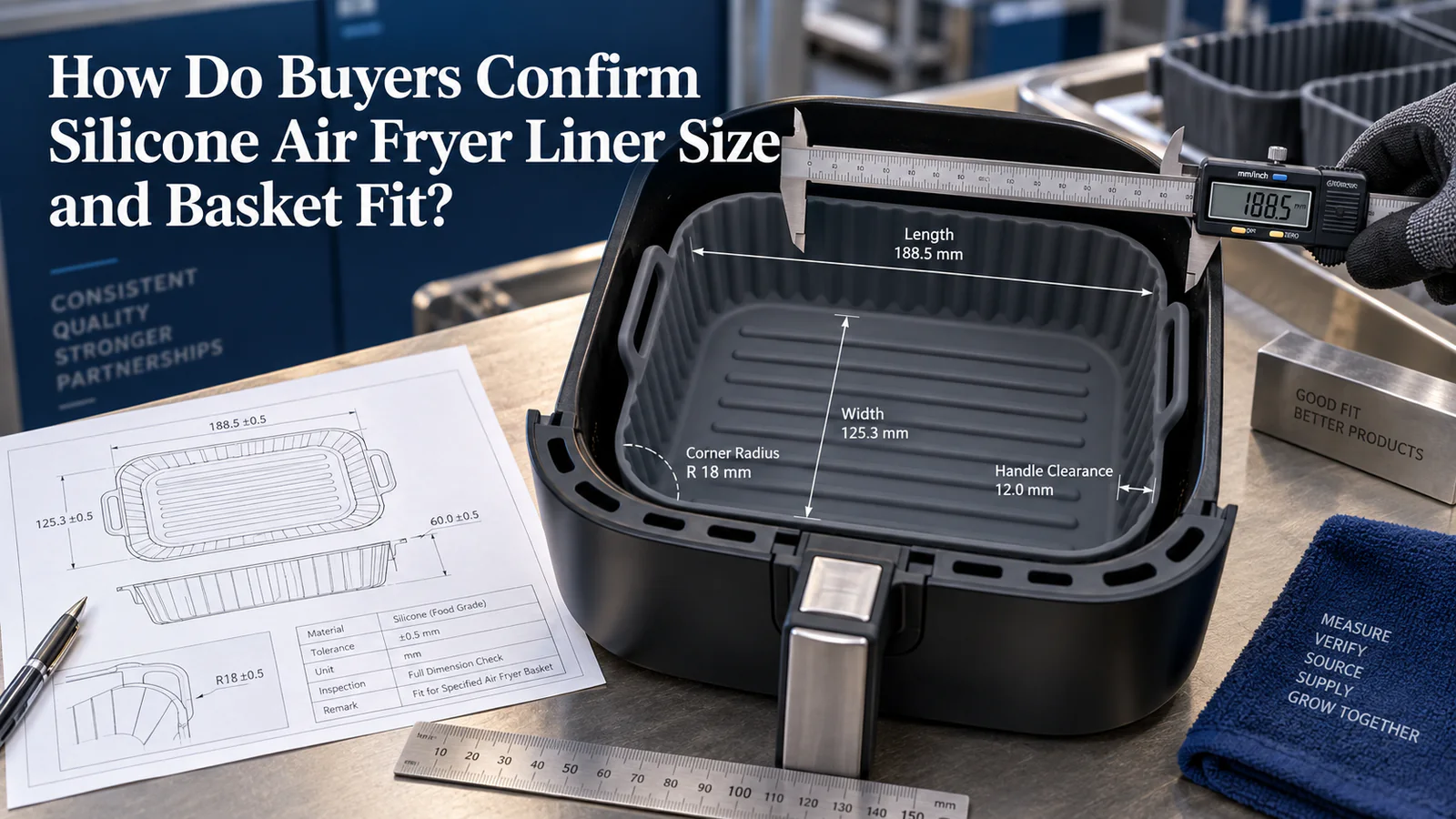
Buyers confirm silicone air fryer liner fit by measuring the basket's usable internal length, width or diameter, corner radius, base contour, wall height, handle clearance and airflow features—not by appliance capacity alone. Build a model-specific basket matrix, define intentional clearance, approve production-representative liners in actual baskets, and keep compatibility and performance claims limited to the tested combinations.
Treat the compatibility list as a controlled engineering claim, not a capacity-based shortcut. The basket sample, measurement plane, liner revision and installed-use evidence must remain connected before a model is marked approved.
Key Takeaways
- Use usable internal basket dimensions and geometry rather than the appliance's advertised liter or quart capacity.
- Measure length, width or diameter at the intended liner seating height, then record corner radius, taper and base contour.
- Define clearance around handles, vents, raised grids and other basket features before freezing the liner drawing.
- Validate every claimed appliance combination with production-representative baskets and liners from active mold cavities.
- Separate physical fit, airflow, food-contact, cleaning and heat-use conclusions because each needs its own evidence.
- Keep performance, certification scope, MOQ, price, capacity and lead time conditional on the approved size program.
Air Fryer Basket-to-Liner Fit Decision Matrix
Compare every candidate liner against a named basket model and controlled measurement method. Exact clearances remain conditional on the approved geometry, appliance instructions and validation conditions.
| Fit variable | Buyer must define | Approval evidence |
|---|---|---|
| Usable envelope | Internal length and width or diameter at seating height, basket taper and base contour | Basket drawing or controlled measurements from identified production appliances |
| Corner and wall fit | Corner radius, liner base radius, wall height, flare and intentional side clearance | Section overlay plus installed samples showing no forced folding or unstable lift |
| Obstructions | Handle roots, divider rails, vents, grids, fasteners and maximum permitted coverage | Annotated basket map and installed clearance photographs |
| Handling | Removal tabs, grip access, loaded lift boundary and cleaning method | Buyer-agreed placement, removal, wash and recovery trial |
| Compatibility claim | Approved models, conditional variants, excluded models and revision owner | Signed model-fit matrix linked to liner drawing, cavity and package artwork |
| Commercial release | Size mix, colors, packaging, forecast, MOQ, price, capacity and delivery window | Comparable quotation based on the same approved SKU and order assumptions |
SECTION 01
Build the Appliance and Basket Measurement Baseline
Begin with the target buyer, channel and assortment role so every specification decision supports a sellable range.
Start With the Named Appliance Models for custom silicone air fryer liner size
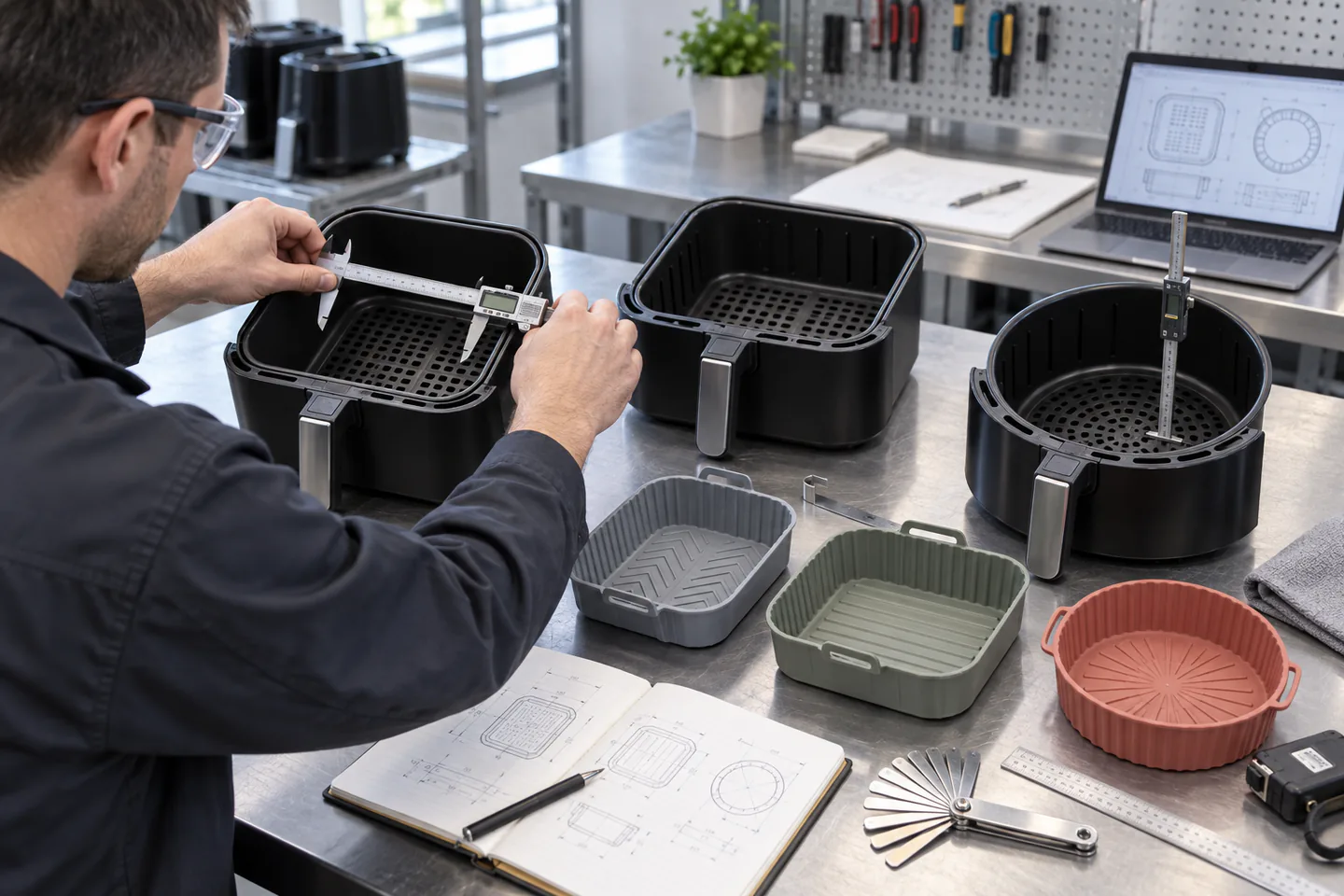
Start the fit program with a named appliance list, because a 5-quart label does not define the basket that actually receives the liner. Record brand, model number, basket revision, purchase region and the physical sample used for measurement so an apparently similar appliance cannot enter the compatibility list without review.
Ask the supplier to build the quotation around that controlled list and to mark unverified models as pending rather than compatible. A dated photograph of each identity label, a basket ID and a custody record give purchasing and engineering the same reference when later samples or customer-return claims are investigated.
Where one model is sourced from multiple regions or production periods, buy more than one basket before declaring the platform stable. Compare the samples and document any revision marks, because a silent basket change can invalidate a liner claim even when the appliance name and advertised capacity remain unchanged. Record the procurement date, market, source and physical storage location for every appliance sample so later compatibility reviews can distinguish design drift from measurement or molding variation.
Measure the Usable Basket Envelope
Measure the usable basket envelope at the height where the liner base and walls will sit, not only across the widest upper rim. For tapered baskets, capture base length and width, dimensions at the planned wall height, internal depth and any change in section that can pinch or release the silicone.
Use a consistent datum scheme and note whether dimensions were taken with removable grids or inserts installed. The measurement sheet should identify the instrument, operator, date and basket ID, while repeat readings help reveal whether a soft coating, curved wall or flexible component is affecting the result.
Do not round the recorded values merely to match a convenient catalog size. Engineering can later choose a practical nominal liner dimension, but the source readings and observed basket spread should remain visible so tolerances and clearance are based on evidence rather than an edited average.
Control Taper, Base Contour and Corner Radius
Nominal length and width cannot describe whether a liner will settle into a rounded corner or bridge over a raised base. Map each corner radius, the transition into the side wall, central crowns or channels, and any local contour that changes the contact footprint.
Overlay the proposed liner section on the basket record before committing tooling, then confirm the geometry with a physical trial. A controlled gap may be acceptable, but forced folds, unstable rocking or concentrated stress at one corner should remain open issues until the drawing and sample agree.
If the basket has asymmetric corners, record each quadrant rather than assuming one radius applies everywhere. A rotated fit trial can expose asymmetry quickly and helps the team decide whether the liner orientation must be controlled through tabs, markings or package instructions.
SECTION 02
Translate Usable Geometry Into Liner Clearance
Translate the range plan into comparable product, packaging and approval evidence before requesting final quotations.
Define Intentional Side and Top Clearance
Clearance is an engineering choice rather than leftover space after the outline is drawn. Define a target side gap, the permitted range at the base and wall, and the maximum wall height using the basket tolerance, silicone recovery and the buyer's removal method.
Too little clearance can cause bunching or make removal difficult, while excessive clearance can reduce usable area and allow the liner to shift. Approve the range against several identified baskets when model-to-model or manufacturing variation is expected, and keep the conclusion limited to those observed samples.
Check clearance after the agreed heating and cleaning cycles as well as in the new condition. Silicone recovery, retained folds and basket temperature may change the installed relationship, so the approved range should state when it is measured and which conditioning sequence precedes inspection.
Map Handles, Vents, Grids and Obstructions
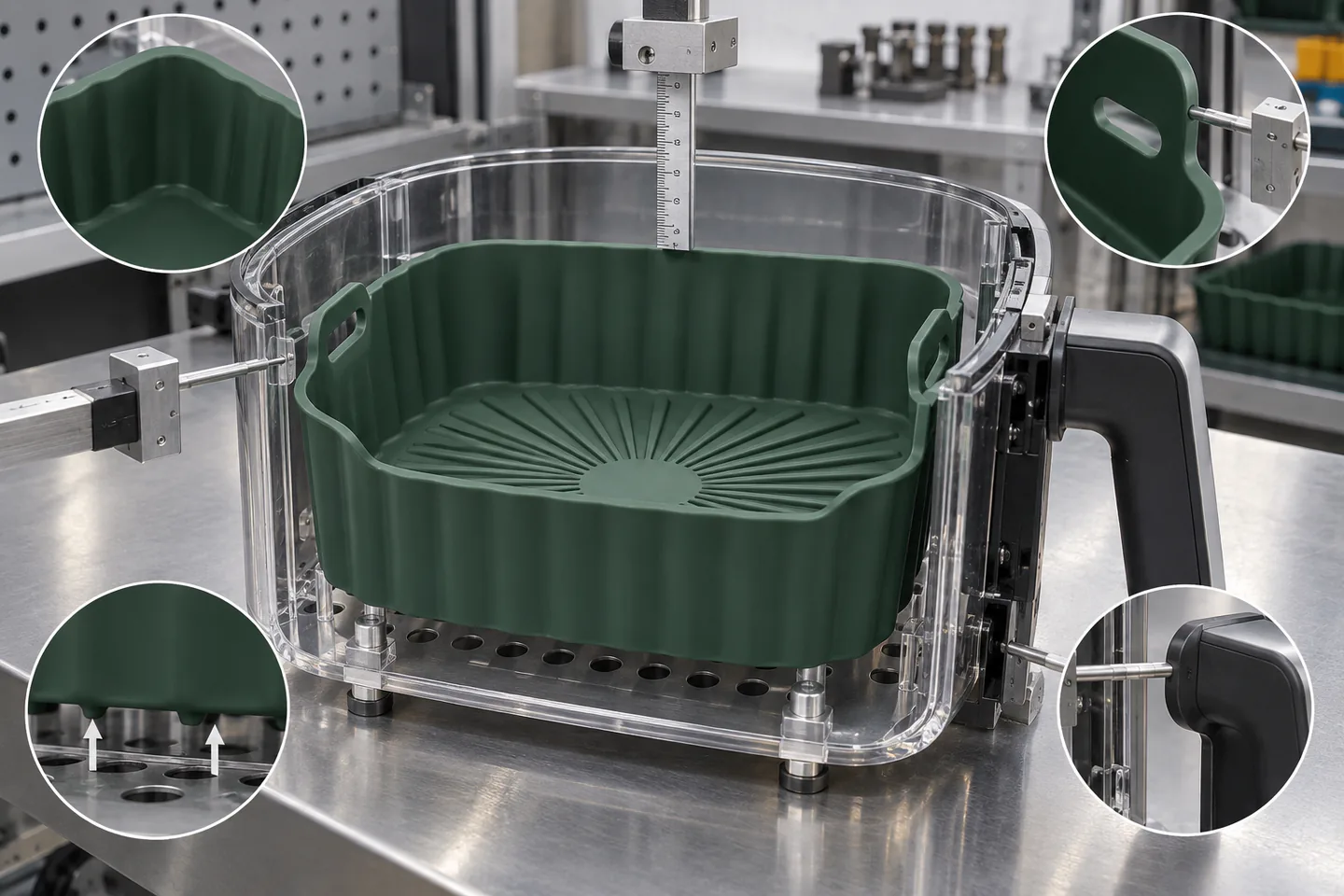
Create an obstruction map for handle roots, divider rails, fasteners, sensor features, vents and removable grids before finalizing the perimeter. Include the distance from a common datum, the feature height and any appliance-manufacturer instruction that requires an area to remain uncovered.
A liner can enter the basket and still be unsuitable if it interferes with a handle, prevents a grid from seating or covers a functional opening. Installed photographs from four sides and a marked drawing make these exclusions visible to tooling, inspection, packaging and customer-service teams.
For removable features, define both permitted configurations instead of testing whichever setup is easiest. If the liner is approved only with a rack removed or a divider omitted, that condition belongs beside the model name in the matrix and in any customer-facing use instruction.
Select Wall Height, Tabs and Removal Access
Wall height, pull tabs and grip access must be evaluated together with the intended food load and basket depth. Define where a user may grasp the liner, how far the tab may approach the basket rim, and whether the product should be lifted empty or under a specified load.
Run placement and removal trials with the agreed basket and record folding, slipping, hot-surface exposure and recovery after cleaning. Any load-bearing statement should remain conditional on the defined test setup; a convenient tab position alone does not establish safe lifting performance.
SECTION 03
Validate Fit, Airflow, Handling and Repeated Use
Protect margin by reviewing production controls, landed-cost drivers and launch risks as one commercial system.
Separate Physical Fit From Airflow Performance
Physical fit and cooking airflow are separate approval questions. First confirm that the liner seats without unintended deformation, then assess perforations, raised ribs, base coverage and food placement under the appliance instructions and the buyer's defined cooking scenario.
Document temperature, duration, food load, preheating practice, liner placement and observations for each tested combination. Results from one appliance or recipe should not become a universal cooking-performance claim, and the supplier should flag any geometry change that requires the airflow review to be repeated.
Translate the Model Matrix Into Inspection Controls
Convert the model-fit matrix into incoming and production controls instead of leaving it as a development spreadsheet. Identify critical dimensions, tolerances, measurement locations, sample frequency and the basket fixture or checking gauge used to confirm the approved seating envelope.
Link each result to mold, cavity, material batch and finished-SKU revision so a drift can be isolated without rejecting unrelated sizes. The golden liner and controlled basket should be stored with conditions that avoid distortion, and their status should be checked before they are used as acceptance references.
Build Size Codes and Compatibility Packaging
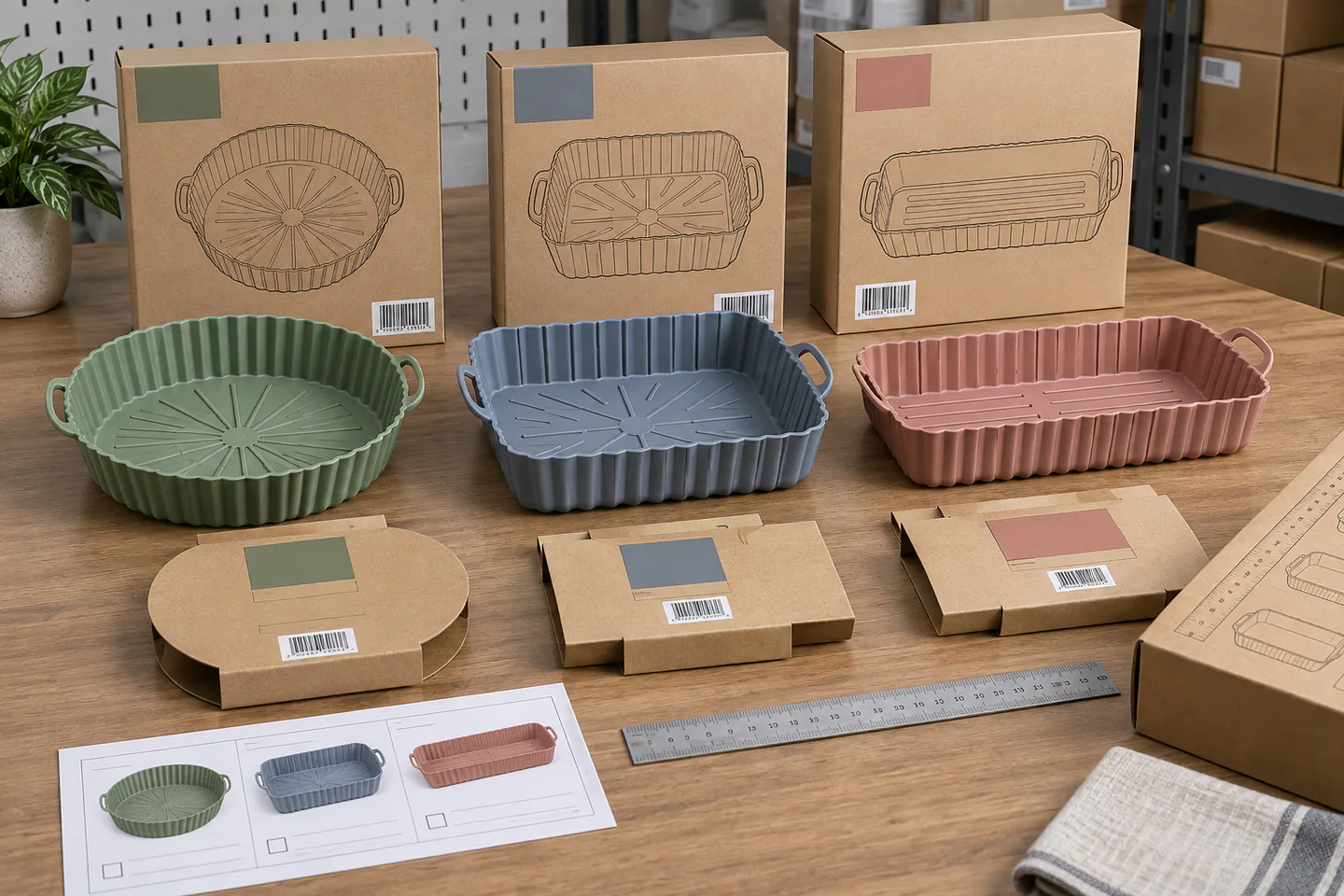
Packaging must help the buyer select the correct shape and size without implying compatibility that has not been verified. Approve the size code, dimensional diagram, round or rectangular illustration, named-model wording, exclusions and measurement instructions on the same revision as the liner.
Test the actual folded or nested selling unit because pack pressure can deform walls or tabs before first use. Barcode, carton quantity and assortment labels should distinguish similar sizes at receiving and fulfillment, reducing the chance that a correct liner is shipped under the wrong compatibility claim.
SECTION 04
Release the Size Matrix, Packaging and Supplier Controls
Use early sales and replenishment assumptions to decide which variants deserve expansion and which should remain controlled.
Compare Tooling, MOQ and Program Economics
Compare commercial offers only after the size family, cavity plan, color mix, evidence scope and packaging are aligned. Existing molds may reduce development time, while a model-specific tool can improve fit; neither route is automatically better without forecast, differentiation and return-risk assumptions.
MOQ, unit price, tooling charge, available capacity and lead time remain conditional on the approved geometry and order scenario. Request separate figures for sample work, tooling, testing and production, plus the triggers that require requotation when sizes, colors, artwork, forecasts or delivery phases change.
Release Claims, Changes and Repeat Orders
Release the program with one controlled matrix linking appliance IDs, liner drawing, mold and cavity, sample result, package artwork and approved claim. Use approved, conditional and excluded status labels so customer-facing teams cannot convert an open fit question into a universal statement.
Repeat orders should follow written change notification for material, geometry, mold repair, cavity, packaging or compatibility wording. When an appliance revision or complaint appears, quarantine only the affected claim and evidence path, investigate against retained records, and obtain buyer approval before extending or restoring compatibility.
ACTION FRAMEWORK
Buyer Checklist Before Commercial Approval
Use this checklist while the physical baskets, proposed liner drawing and compatibility matrix are available together. Keep every unresolved dimension, obstruction or use trial open until an identified owner adds the missing evidence.
| Check | Question | Why It Matters |
|---|---|---|
| Appliance identity | Are brand, model, basket revision and production sample source recorded? | Capacity labels can cover baskets with different usable geometry and internal obstructions. |
| Measurement plane | Are dimensions taken at the liner seating height rather than only at the basket rim? | Tapered walls can make top-opening measurements materially larger than the usable base. |
| Corner geometry | Are each corner radius, transition and base contour defined? | Nominal length and width do not reveal bunching, gaps or corner lift. |
| Clearance | Are handles, vents, grids and manufacturer-required open areas mapped? | A liner that physically enters the basket can still obstruct a critical feature. |
| Fit range | Does the matrix distinguish approved, conditional and out-of-scope basket models? | Universal-fit language hides incompatible geometry and unsupported performance assumptions. |
| Validation | Do trials state food load, temperature, time, placement, cleaning and acceptance criteria? | A static photo proves neither operating performance nor repeated-use stability. |
| Packaging | Are size code, shape image, compatible-model wording and physical selling unit approved? | Correct products can still create returns when package guidance is ambiguous. |
| Commercial basis | Do supplier quotes use the same sizes, cavities, colors, tests, packs and forecast? | MOQ, price, capacity and lead time are comparable only under shared assumptions. |
NEXT READING
Continue the Supplier and Product Review
These internal resources connect the guide with Naike Silicone product, factory, customization and inquiry pages. Open the route that matches the next decision in your project.
Review the custom silicone air fryer liner
Use review the custom silicone air fryer liner to gather the next level of product, manufacturing or commercial information.
Open internal resource →Compare perforated and solid air fryer liners
Use compare perforated and solid air fryer liners to gather the next level of product, manufacturing or commercial information.
Open internal resource →Select silicone hardness for finished products
Use select silicone hardness for finished products to gather the next level of product, manufacturing or commercial information.
Open internal resource →Plan private-label silicone packaging
Use plan private-label silicone packaging to gather the next level of product, manufacturing or commercial information.
Open internal resource →Explore all silicone product categories
Use explore all silicone product categories to gather the next level of product, manufacturing or commercial information.
Open internal resource →Review Naike Silicone manufacturing knowledge
Use review naike silicone manufacturing knowledge to gather the next level of product, manufacturing or commercial information.
Open internal resource →PRIMARY REFERENCES
Authoritative External Sources
The sources below are official primary references. Applicability depends on the product, intended use and destination market. Buyers should obtain qualified advice for final legal or regulatory decisions.
FDA: Food Types and Conditions of Use for Food Contact Substances
FDA's conditions-of-use framework helps define temperature and contact context for food-contact review. It does not establish basket compatibility, airflow performance or approval of this finished liner.
European Commission: Food Contact Materials
Official European Commission overview of the EU framework for materials and articles intended to contact food.
BfR Recommendation XV: Silicones
Official German Federal Institute for Risk Assessment recommendation covering silicones and silicone elastomers.
BUYER QUESTIONS
Frequently Asked Questions
Can buyers choose a silicone liner from an air fryer's quart or liter capacity?
No. Capacity is useful for market description, but baskets with the same stated volume can have different base dimensions, tapers, corner radii, depths and internal features. Use the identified appliance model and measured usable basket envelope as the fit basis, then treat any unmeasured model as conditional until a representative sample is checked.
Which basket dimensions should be sent to the silicone supplier first?
Send internal base length and width or diameter, dimensions at the planned liner wall height, usable depth, corner radii, wall taper and photographs of the base contour. Add handle roots, grids, vents, fasteners and other obstructions with locations from a common datum. The supplier may request a physical basket where geometry cannot be captured reliably from measurements.
How much clearance should a silicone air fryer liner have?
There is no universal clearance value. The target depends on basket tolerance, taper, liner wall thickness and hardness, removal method, food load and the intended airflow arrangement. Define a proposed range on the drawing and approve it through installed trials in the named baskets rather than publishing an unsupported generic number.
Does a liner that sits flat automatically preserve airflow and cooking performance?
No. Flat seating confirms only one part of physical fit. Base coverage, perforations, ribs, food placement and appliance instructions can change airflow and observed cooking behavior, so the buyer should use a separate, recorded operating trial. Keep any performance statement limited to the tested appliance, configuration and conditions.
How should a multi-size liner range be labeled for retail or e-commerce?
Give every shape and size a distinct code, clear dimension diagram and controlled compatibility statement. Show buyers how the dimension was measured, identify named models only when supported, and state exclusions or conditional variants. Validate the packed product and fulfillment labels so similar SKUs cannot be confused during storage, picking or returns handling.
What should buyers send Naike Silicone for a fit-matrix review?
Send the target appliance list, basket samples or controlled measurements, intended liner shape and wall height, food-use scenario, destination market, colors, packaging concept and forecast by size. Naike Silicone can then review an existing-mold or custom-tool route and propose samples, but MOQ, price, capacity, timing, certification scope and performance conclusions remain conditional on the final specification and validation plan.
Editorial and Scope Note
Conclusion: Silicone Air Fryer Liner Size and Basket Fit
Move from buyer research to a controlled supplier brief
A reliable air fryer liner size program begins with identified appliance models and usable basket geometry, then connects intentional clearance, wall height, corner seating, obstructions, handling and airflow boundaries to controlled validation. Buyers should approve a model-fit matrix, production samples, package compatibility wording and change rules as one system. Performance, certification scope, MOQ, price, capacity and lead time remain conditional on the approved material, dimensions, colors, packaging, destination and order plan. Send Naike Silicone your basket samples or measurements, target models, forecast and claim language to request a fit-matrix sample, quotation, tooling review or supplier evaluation.
Request a fit-matrix review using identified baskets, the current liner drawing and the proposed package claim. A dimensional match does not by itself authorize airflow, cooking, safety or universal-compatibility language; each conclusion needs evidence from its defined conditions.