PRODUCT SOURCING GUIDES
Perforated vs Solid Silicone Air Fryer Liners: Which Design Should Buyers Source?
Compare perforated and solid silicone air fryer liners by airflow, grease control, basket fit, cleaning, tooling, evidence and private-label cost.
DIRECT ANSWER
What B2B Buyers Need to Know
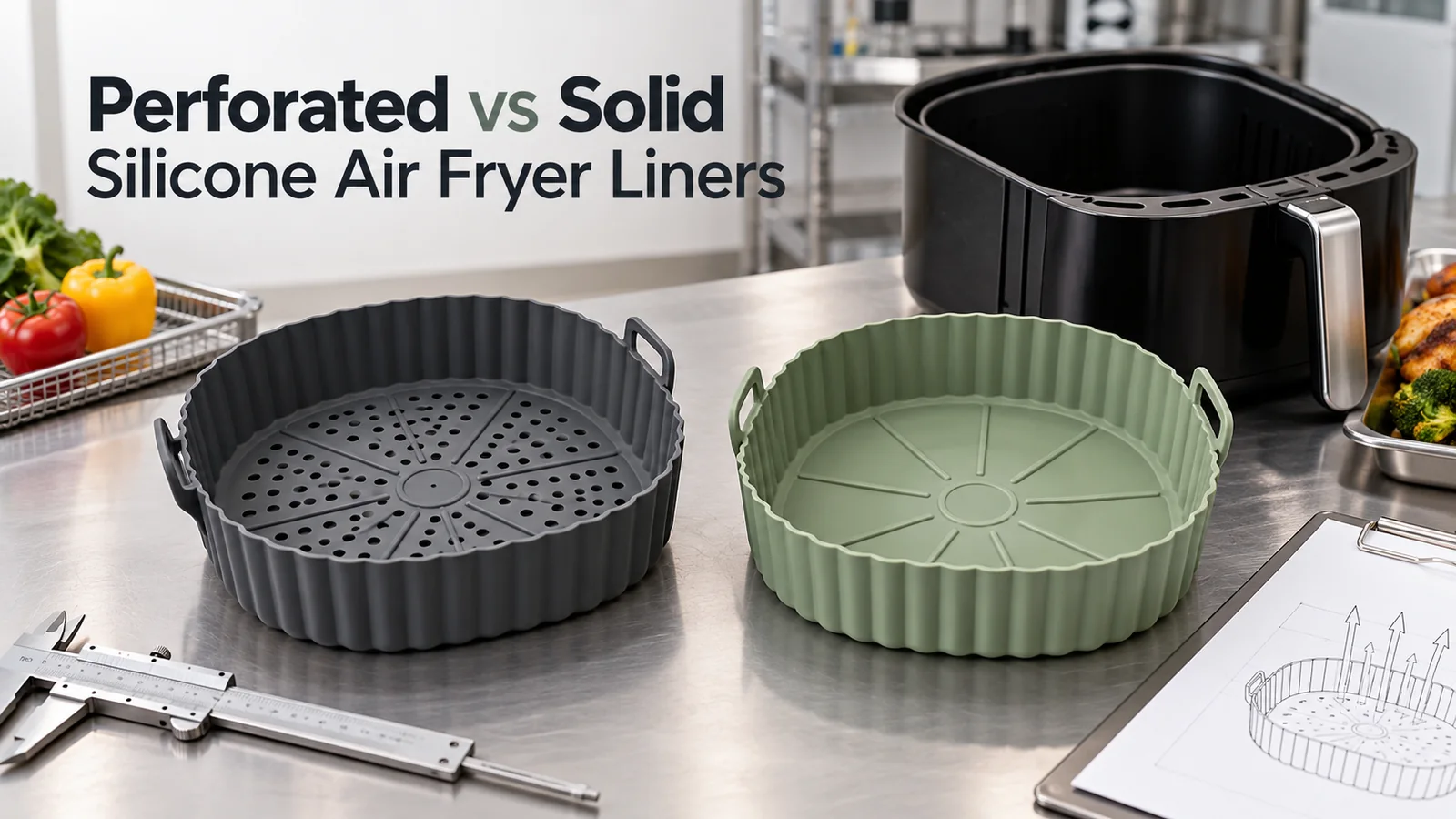
Perforated silicone air fryer liners are usually better when a buyer prioritizes direct airflow through the basket base and drainage below the food. Solid liners are usually better when grease containment and easier liner cleanup matter more. The right design still depends on basket geometry, food load, cooking evidence, cleaning method, tooling, packaging and the exact claims approved for the finished SKU.
This guide is written for appliance-accessory brands, retailers, importers, distributors, product developers and sourcing teams comparing private-label air fryer liner formats. It provides a decision framework rather than legal advice or a universal specification. Product classification, use conditions and destination market should be confirmed before final testing, labelling or compliance decisions.
Key Takeaways
- Choose the liner architecture from a named fryer, food load and customer job rather than a generic material claim.
- Perforated liners preserve more base airflow and drainage, but they leave the original basket exposed to drips and need controlled hole geometry.
- Solid liners contain more residue, but pooling, wall height and reduced open area must be tested under the intended load.
- Run side-by-side cooking and cleaning trials with the same appliance, recipe, operator method and acceptance criteria.
- Match food-contact and temperature evidence to the finished compound, pigment, product revision and conditions of use.
- Compare quotations only after tooling, validation, packaging, forecast, MOQ and delivery assumptions share one baseline.
Perforated vs Solid Silicone Air Fryer Liner Decision Matrix
Compare both formats under the same appliance, load, recipe and cleaning conditions. Performance remains conditional on the approved finished liner and test method.
| Decision area | Perforated liner | Solid liner |
|---|---|---|
| Airflow and contact | More basket-base open area and drainage paths; hole field must align with supported airflow zones | Less base open area; ribs and wall height shape circulation around the food |
| Grease behavior | Rendered fat can pass to the basket below, so basket cleaning remains necessary | More residue stays in the liner, but pooling and safe removal need validation |
| Small-food support | Hole size and pitch must prevent unacceptable contact or loss through openings | Continuous base supports small pieces but increases direct contact with retained residue |
| Cleaning | Inspect holes, bridges, ribs and flash around every opening | Inspect channel ends, wall transitions, corners and grease-film retention |
| Tooling | Controlled pins or openings, bridge strength, venting and consistent hole release | Broad-base flatness, rib fill, thickness balance and warpage control |
| Retail message | Airflow-focused positioning with clear limits on drainage and basket cleanup | Containment-focused positioning with clear limits on pooling and cooking results |
SECTION 01
Compare the Buyer Job, Basket and Liner Architecture
Begin with the target buyer, channel and assortment role so every specification decision supports a sellable range.
Define the Customer Job and Appliance Matrix for perforated vs solid silicone air fryer liner
A buyer should start by defining what the liner must change inside the appliance. A perforated liner keeps more of the basket's open area available for moving air and lets rendered fat pass below the food, while a solid liner retains more liquid and residue inside its own walls. Neither architecture is automatically superior because the correct choice depends on the basket, recipe, loading pattern, cleaning objective and claims the brand intends to make.
Write the use scenario before discussing color, logo or pack count. Record the fryer models, basket geometry, food families, batch weight, temperature range, cooking time, turning method and whether grease capture or maximum exposure to circulating air has priority. This shared scenario makes supplier samples comparable and prevents a visually attractive insert from being approved for conditions it has never reproduced.
Measure Basket Fit, Clearance and Restricted Zones
Air fryers do not have one universal basket envelope. Internal length, width, corner radius, taper, bottom step, side vents and handle clearance can differ even when two appliances carry the same advertised capacity. Buyers should measure the usable basket at the base and upper wall, then identify any protrusions that can pinch the silicone or hold it too close to an airflow opening.
The liner should sit without folding over itself, blocking the drawer latch or rising into a heating element's restricted zone. For a perforated design, the active hole field must remain inside the supported basket floor; for a solid design, the grease channels and perimeter should remain stable under the intended load. Approve every claimed fryer family in a controlled compatibility matrix instead of calling one size universally compatible.
Engineer Hole Diameter, Pitch and Open Area
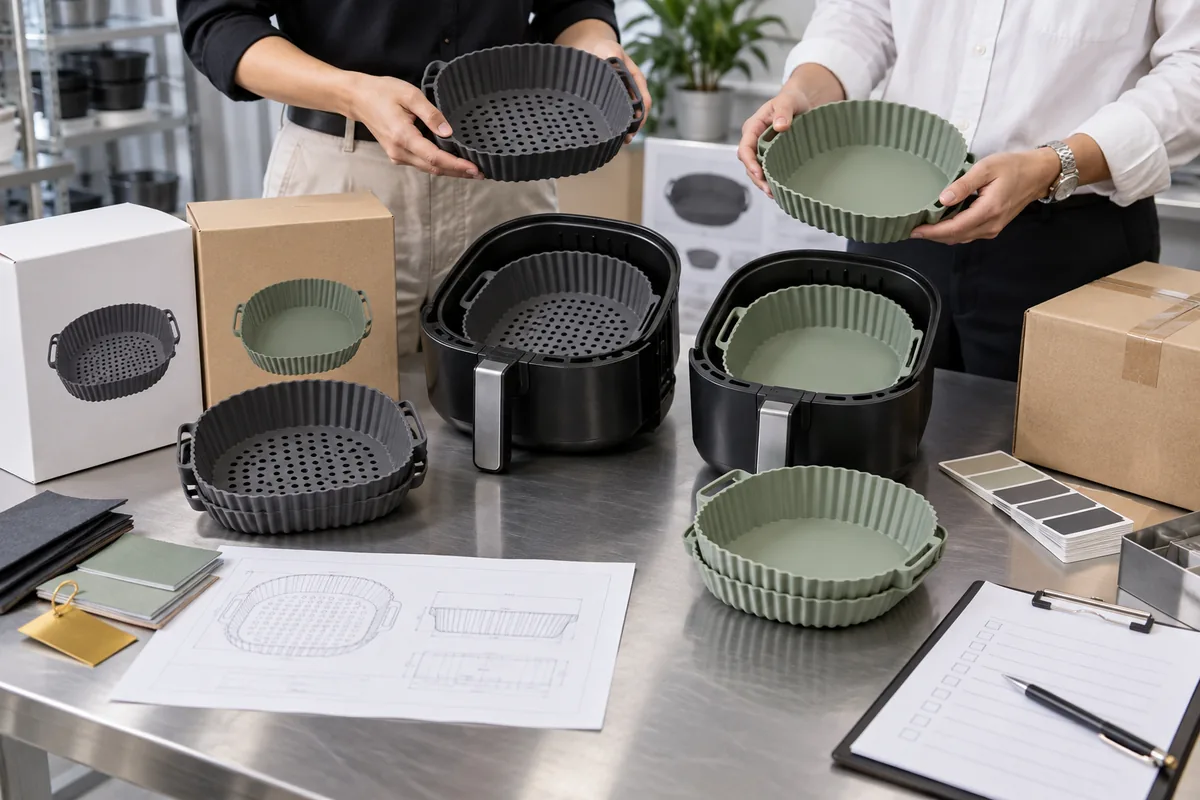
Perforation is an engineering variable, not a decorative pattern. Hole diameter, pitch, open-area ratio, edge distance and the relationship between holes and support ribs influence airflow exposure, food support, cleaning access and tear risk. A large open area may help circulation but can weaken narrow bridges or let small foods contact residue in the basket below.
Ask the supplier for a dimensioned pattern and a tolerance proposal that can be inspected at the mold and finished-part stages. Hole blockage, flash and uneven bridge width should have defined limits because a nominally perforated liner can behave differently when production variation closes part of the field. The approval sample should identify the tool, cavity, compound, color and conditioning history used for the comparison.
SECTION 02
Validate Airflow, Grease, Cooking and Cleaning Trade-Offs
Translate the range plan into comparable product, packaging and approval evidence before requesting final quotations.
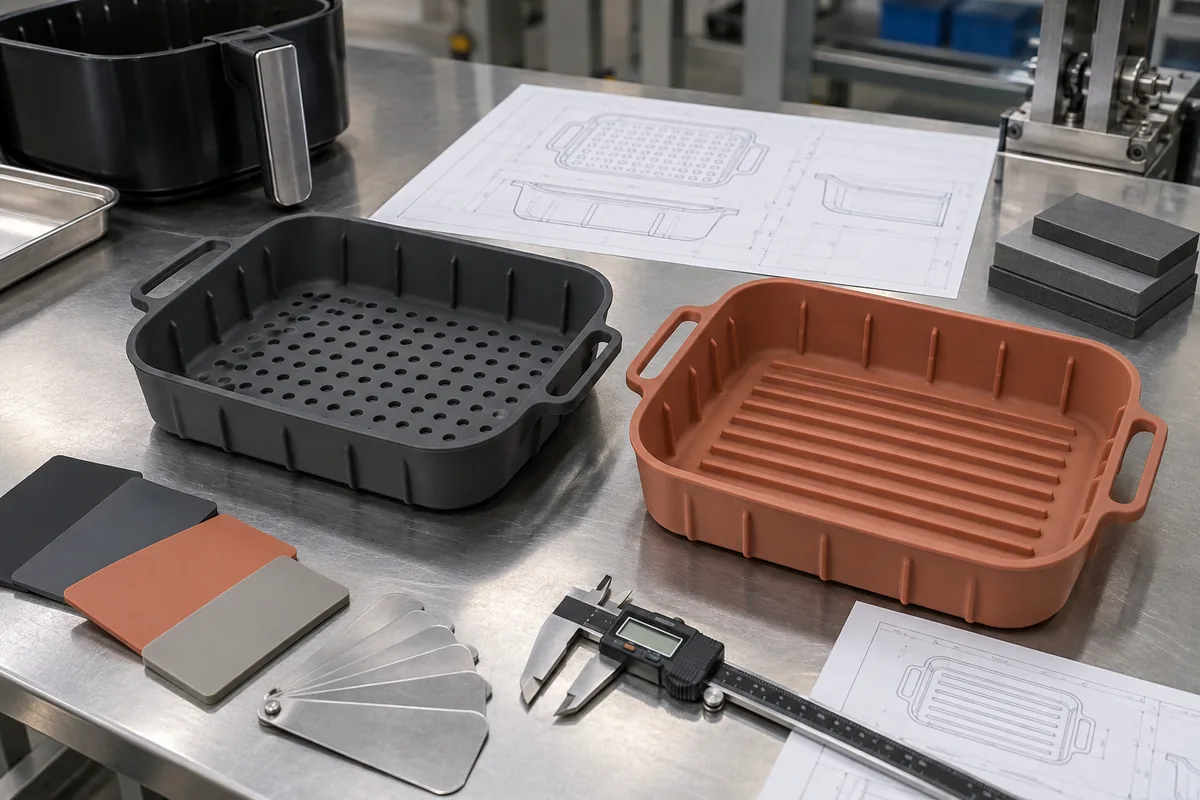
Engineer Solid-Base Ribs and Grease Channels
A solid liner still needs an internal fluid-management strategy. Raised ribs can reduce direct contact between food and collected fat, while channels can guide residue away from high-load areas, but the geometry must not create narrow pockets that are difficult to wash. Wall height also affects containment, removal and how much of the original basket side area remains exposed.
Treat grease capacity as a scenario-specific observation rather than an unconditional benefit. The same solid insert that simplifies cleanup for a modest batch may allow liquid to pool around a heavy or high-fat load, changing the cooking result and handling risk. Define the load, food preparation, time and drain procedure whenever the product page describes grease collection or easier cleanup.
Run a Controlled Cooking Comparison
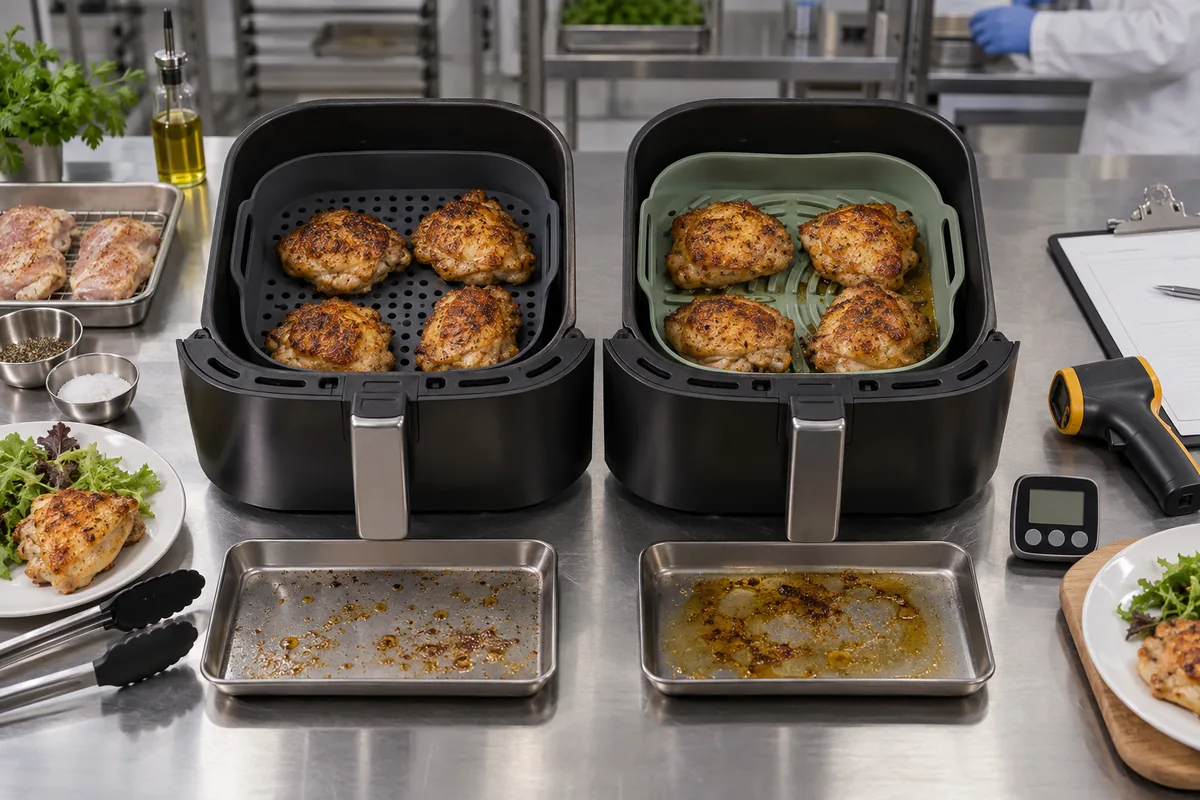
The comparison trial should hold the appliance, recipe and operator method constant. Use the same fryer model, preheat condition, food mass, piece size, spacing, seasoning, oil addition, set point, cook time and turning schedule, then repeat enough runs to distinguish a format effect from normal food variation. Record photographs, surface temperature checkpoints, mass change and visible browning with the liner revision attached to the record.
Do not turn a single kitchen demonstration into a promise of faster cooking, lower fat or crispier results. Those outcomes depend on the appliance control system, food moisture, load density and user technique as well as liner architecture. A defensible comparison states the tested condition, shows the observed trade-off and requires the buyer to approve the final claim language for the intended market.
Evaluate Airflow, Browning and Drainage Evidence
Airflow evidence should be practical enough to guide design changes. Buyers can compare temperature distribution, underside browning, wet zones and food-to-food spacing across the same basket positions, while the factory can inspect whether the perforation field aligns with the appliance's air route. If a more formal method is required, the parties should agree on sensors, locations, stabilization time and acceptance limits before samples are made.
A perforated liner often preserves more direct flow through the base, but it also transfers drips to the original basket and does not remove the need to clean that component. A solid liner often captures more residue, but high walls or pooled liquid can alter circulation around the load. The sourcing decision therefore connects cooking evidence with the buyer's real cleaning and maintenance expectations.
SECTION 03
Control Material, Tooling and Production Evidence
Protect margin by reviewing production controls, landed-cost drivers and launch risks as one commercial system.
Validate Hot Handling, Release and Removal
Food release and handling should be evaluated after realistic heating rather than at room temperature. Observe sticking on ribs and flat areas, deformation while lifting the liner, grip at the handles and the stability of collected liquid during removal. A handle that feels comfortable on an empty sample may twist or bring the user's hand too close to hot surfaces when the liner carries a full load.
Define whether users remove food first or lift the complete liner, and write instructions around the safer approved method. Integrated handles, wall stiffness and base support can be tuned, but any performance statement remains conditional on the finished geometry, load and appliance clearance. Samples should be reviewed with the intended utensils because sharp tools can cut or score silicone regardless of liner type.
Compare Cleaning, Odor and Repeated Washing
Cleaning validation must examine the features that differentiate the two formats. Perforated liners need inspection around every hole, bridge, rib intersection and handle root, while solid liners need attention at channel ends, wall transitions and any area where grease can cool into a film. Use representative fatty, starchy and strongly colored foods instead of relying on clean-water rinsing.
The wash method should identify detergent, water temperature, mechanical action, dishwasher rack orientation if applicable and the drying position. Compare retained odor, visible residue, tackiness, staining and dimensional recovery after repeated cycles. A dishwasher-safe statement should apply only to the finished SKU and the validated conditions, not to an unrelated silicone compound report.
Map Food-Contact and Temperature Evidence
Material review begins with the approved compound, cure route and pigment, then moves to the finished liner. U.S. food-contact status and European food-contact rules are relevant to the intended contact and conditions of use, but they do not prove basket fit, airflow, cleaning or long-term geometry. Ask the supplier to map every document to the material, color, product revision and market it actually covers.
High-temperature marketing language requires particular discipline because appliance set points, local hot spots and proximity to heating elements are not the same thing. Define the expected exposure and include an appropriate safety margin in the design review, then inspect the finished liner after representative heating and washing cycles. Certification scope, thermal performance and service life must stay conditional on the approved evidence and actual use conditions.
SECTION 04
Release the Assortment, Packaging and Commercial Offer
Use early sales and replenishment assumptions to decide which variants deserve expansion and which should remain controlled.
Translate Each Format Into Tooling Controls
Tooling decisions differ between the architectures. A perforated design may need many controlled pins or molded openings with stable venting and bridge geometry, while a solid design places more emphasis on broad base flatness, rib fill, wall thickness balance and deformation control. In both cases, the mold split, draft, texture and ejector strategy should support release without distorting the functional surfaces.
Review samples from every active cavity before locking the production inspection method. Critical dimensions can include footprint, upper wall, corner radius, base thickness, hole diameter, pitch, wall height, handle section and overall mass. Cavity identity and retained samples help the supplier trace a later blockage, short fill, flash or warpage concern to the correct production source.
Approve Retail Positioning and Physical Pack-Out
Retail assortment planning should avoid multiplying formats without a clear customer job. A brand may sell one perforated option for airflow-focused cooking and one solid option for grease capture, but the packaging must explain the boundary without implying that either liner makes every recipe or fryer equivalent. Size, shape and color should remain easy to identify after the carton is discarded.
Approve the physical selling unit with the product inside it. Tight folding can crease walls or handles, nested liners can stick together, and a package that hides the perforation pattern may confuse the buyer at shelf or online. Carton dimensions, insert language, barcode zone and master-carton count affect price and freight, so they belong in the same commercial revision as the liner.
Normalize MOQ, Price, Capacity and Lead Time
A comparable quotation separates product architecture from commercial assumptions. Send each supplier the same basket matrix, liner drawings, material and color scope, test plan, packaging, forecast, destination and delivery terms, then itemize tooling, samples, validation and recurring unit price. MOQ, price, available capacity and lead time can change with hole pattern, size family, pigment split, packaging quantity and the current factory schedule.
Naike Silicone can review perforated and solid concepts against the buyer's appliances, food scenarios and retail position, then propose samples and evidence gates before tooling or mass production. The final recommendation should remain a conditional engineering decision rather than a generic sales claim. Send the basket models or dimensions, intended recipes, quantity, markets and packaging brief to request a comparison sample plan, tooling review, quotation or supplier evaluation.
ACTION FRAMEWORK
Buyer Checklist Before Commercial Approval
Use this checklist as a meeting agenda. It is intentionally concise so the team can identify missing evidence without replacing its own quality, legal or supplier-management procedure.
| Check | Question | Why It Matters |
|---|---|---|
| Appliance matrix | Are fryer model, base size, upper taper, corner radius, vents and restricted zones recorded? | Advertised appliance capacity does not define liner fit or airflow clearance. |
| Food scenario | Are food type, batch mass, piece size, oil, temperature, time and turning method fixed? | Cooking observations are comparable only under controlled loading and operation. |
| Perforation or ribs | Are hole diameter, pitch and bridge width or rib height and channel layout dimensioned? | The functional architecture must translate into tooling and inspection controls. |
| Claims | Are airflow, crisping, grease capture and easier-cleaning statements separated? | One demonstration cannot support every performance or maintenance claim. |
| Handling | Is the approved food-removal and liner-lifting method safe under the intended hot load? | Handles and walls behave differently when carrying food and collected grease. |
| Cleaning | Were holes, bridges, channels, corners and handles checked after representative soils and wash cycles? | Smooth silicone can still retain residue where geometry limits access. |
| Evidence | Do material and finished-product records identify compound, pigment, SKU revision and conditions of use? | A generic report cannot establish every market or product claim. |
| Commercial basis | Do suppliers quote the same sizes, colors, tests, packaging, forecast and delivery terms? | MOQ, price, capacity and lead time are comparable only on a shared baseline. |
NEXT READING
Continue the Supplier and Product Review
These internal resources connect the guide with Naike Silicone product, factory, customization and inquiry pages. Open the route that matches the next decision in your project.
Review the custom silicone air fryer liner product page
Use review the custom silicone air fryer liner product page to gather the next level of product, manufacturing or commercial information.
Open internal resource →Choose silicone hardness from finished-product evidence
Use choose silicone hardness from finished-product evidence to gather the next level of product, manufacturing or commercial information.
Open internal resource →Compare silicone supplier quotations
Use compare silicone supplier quotations to gather the next level of product, manufacturing or commercial information.
Open internal resource →Plan private-label silicone packaging
Use plan private-label silicone packaging to gather the next level of product, manufacturing or commercial information.
Open internal resource →Explore all silicone product categories
Use explore all silicone product categories to gather the next level of product, manufacturing or commercial information.
Open internal resource →Review Naike Silicone manufacturing knowledge
Use review naike silicone manufacturing knowledge to gather the next level of product, manufacturing or commercial information.
Open internal resource →PRIMARY REFERENCES
Authoritative External Sources
The sources below are official primary references. Applicability depends on the product, intended use and destination market. Buyers should obtain qualified advice for final legal or regulatory decisions.
FDA: Food Types and Conditions of Use for Food Contact Substances
Official FDA guidance describing food types and conditions of use used when evaluating food-contact substance applications; applicability still depends on the actual material and finished product.
European Commission: Food Contact Materials
Official European Commission overview of the EU framework for materials and articles intended to contact food.
BfR Recommendation XV: Silicones
Official German Federal Institute for Risk Assessment recommendation covering silicones and silicone elastomers.
BUYER QUESTIONS
Frequently Asked Questions
Do perforated silicone air fryer liners always make food crispier?
No. Perforations can preserve more direct airflow through the basket base, but crisping also depends on the fryer, food moisture, batch density, spacing, oil, time and turning method. Approve any crisping statement only from a controlled comparison using the intended appliance and load.
When is a solid silicone air fryer liner the better sourcing choice?
A solid liner can suit programs that prioritize grease capture, residue containment and simplified liner cleanup. Buyers should still validate pooling, wall height, airflow around the load, lifting stability and the need to clean the original basket under the agreed recipe conditions.
How should buyers specify perforation size and spacing?
Define hole diameter, pitch, pattern, open-area ratio, bridge width, edge distance and alignment with the supported basket floor. Then set inspection limits for blockage, flash and damaged bridges on samples from every active mold cavity.
Can one silicone liner fit several air fryer brands?
Only when the named models pass a compatibility matrix covering base dimensions, upper taper, corner radii, wall height, vents, handle clearance and restricted zones. Advertised fryer capacity alone is not a reliable fit specification.
What evidence is needed for temperature and food-contact claims?
Start with the destination market, intended food contact and defined heating conditions. Review applicable material and pigment documents for the finished SKU, then validate geometry, dimensional stability, odor, surface condition and cleaning after representative appliance cycles.
What determines MOQ, tooling cost and lead time for each design?
Overall size, perforation or rib complexity, mold construction, cavity count, compound, colors, evidence, packaging, order mix and current capacity all affect the commercial offer. Suppliers should quote the same frozen revision and test scope before buyers compare price or timing.
Editorial and Scope Note
Conclusion: Perforated vs Solid Air Fryer Liners
Move from buyer research to a controlled supplier brief
Perforated and solid silicone air fryer liners solve different buyer priorities. A controlled decision connects the fryer matrix, food load, airflow and grease evidence, cleaning route, hot handling, material file, tooling controls and pack-out to the exact retail claim. Certification scope, performance, MOQ, price, capacity and lead time remain conditional on the approved geometry, color, validation, packaging and order schedule. Send Naike Silicone your fryer models, recipes, forecast and package concept to request comparison samples, a tooling review, quotation or supplier evaluation.
This factory-insider guide supports sourcing preparation and supplier discussion; it does not replace product-specific engineering, laboratory, regulatory, legal or commercial review for the destination market.