MATERIALS, QUALITY & COMPLIANCE
How Should a Frozen-Food Brand Validate Silicone Products Through Freeze-Thaw Cycles?
A buyer-side framework for validating silicone trays, lids and food-storage products through realistic freeze-thaw cycles, release checks, fit measurements and traceable acceptance criteria.
DIRECT ANSWER
What B2B Buyers Need to Know
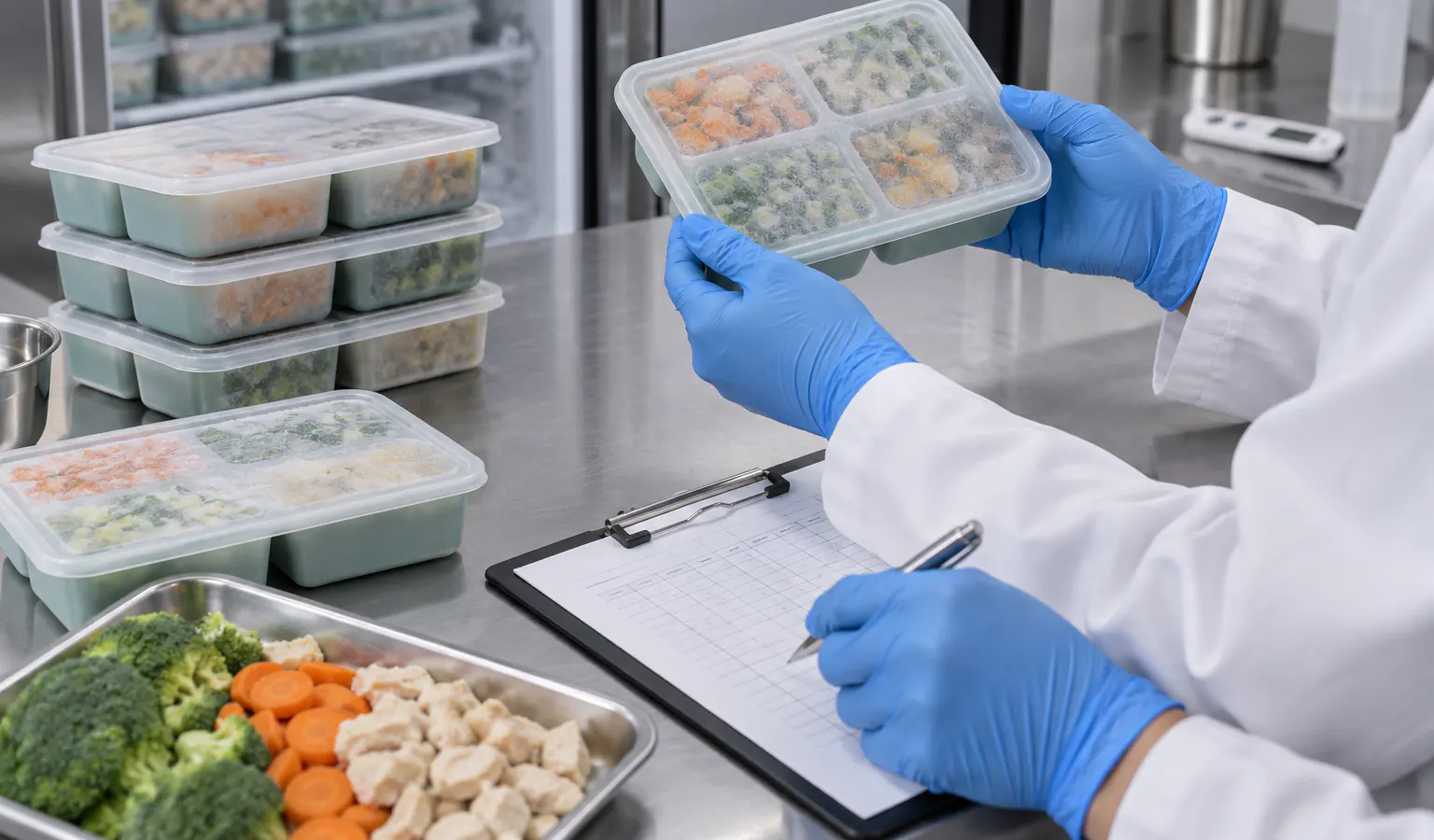
Frozen-food brands should define a product-specific freeze-thaw protocol from the intended use sequence, then record the frozen and thawed states, dwell time, transition method, cycle count, representative sample, checkpoints and acceptance limits. There is no universal cycle count for every silicone tray or lid. Pair controlled material evidence with finished-product release, fit, appearance and cleaning checks, and keep conclusions within the tested conditions.
This guide is written for frozen-food brands, private-label buyers, food-storage product developers, importers, quality engineers and supplier-quality teams. It provides a decision framework rather than legal advice or a universal specification. Product classification, use conditions and destination market should be confirmed before final testing, labelling or compliance decisions.
Key Takeaways
- Start with the real food-storage and reuse sequence rather than an arbitrary cycle count.
- Define frozen and thawed states, dwell, transition, load, lid state, cycle boundary and checkpoints.
- Test production-representative material, geometry, color, tooling revision and mating container.
- Measure release, fit, dimensions and appearance with controlled methods and matched uncycled controls.
- Keep food-contact regulatory review separate from mechanical freeze-thaw performance validation.
- Treat cycle count, pass limits, MOQ, cost and lead time as product- and project-specific, not universal promises.
Freeze-Thaw Validation Scope by Buyer Decision
The correct evidence depends on whether the buyer is screening a design, approving a finished product or investigating a field issue. These are scope examples, not a universal cycle schedule or guaranteed acceptance limits.
| Buyer decision | Evidence to specify | Boundary to preserve |
|---|---|---|
| Design screen | Compare candidate trays, cavity geometry or lid fit using one controlled sequence and the same observations | Ranks concepts under the stated protocol; it does not qualify every production variation |
| Finished-SKU approval | Traceable production-representative samples, defined cycles, release and fit checks, measurements and agreed limits | Approval applies to the listed revision, material, color, use conditions and acceptance criteria |
| Reuse or durability review | Freeze, thaw, release, cleaning and refreezing in the intended order, with checkpoints selected from risk | A selected cycle count does not equal a universal consumer lifetime claim |
| Complaint investigation | Returned, retained and matched control samples with known lots, storage and use history | Unknown history or mixed revisions may limit causal conclusions |
| Food-contact review | Market, food type, temperature, duration, repeat use, formulation and applicable evidence scope | Regulatory review is separate; a mechanical pass does not establish food-contact compliance |
SECTION 01
Translate the Frozen-Food Use Case Into a Test Question
Start with the frozen-food decision and the use sequence the brand intends to sell. Define what result would change a design, sample or supplier decision before choosing exposure conditions.
Define the Food-Storage Decision Before Choosing Cycle Count for silicone freeze thaw validation
A frozen-food brand should validate a silicone product against the use cycle it will actually sell: filled or empty freezing, frozen storage, removal, thawing, release, cleaning and refreezing where reuse is intended. Buyers should define the product, food, container, freezer conditions and decision before selecting a cycle count. There is no universal cycle number that proves every tray, lid or storage accessory fit for every application.
In factory reviews, the phrase freeze-thaw tested often appears without a protocol. It can describe one gentle laboratory excursion, a repeated consumer-use simulation or a product-specific abuse screen, and those are not equivalent. A useful report names each frozen and thawed state, dwell time, transition method, product conditioning, repetitions, checkpoints and pass criteria.
Describe the Intended Freezing, Thawing and Reuse Sequence
Start with the commercial use case rather than a copied chamber setting. A brand selling one-time frozen food portions needs different evidence from a reusable meal-prep tray that consumers repeatedly freeze, thaw, wash and refill. Record whether food is frozen in the silicone, whether the lid is fitted during freezing, how the part is removed, and whether a microwave or dishwasher step follows thawing.
For each SKU, write the foreseeable use sequence in plain language and attach the current drawing revision. Identify freezer set point or range, filled mass, cavity geometry, storage duration, stacking or compression, lid state, thaw method, wash method and intended reuse. Use those facts to decide what needs an instrumented test, what needs a controlled observation and what must be reviewed by a qualified compliance specialist.
Treat Freeze-Thaw as a Defined Exposure, Not a Generic Claim
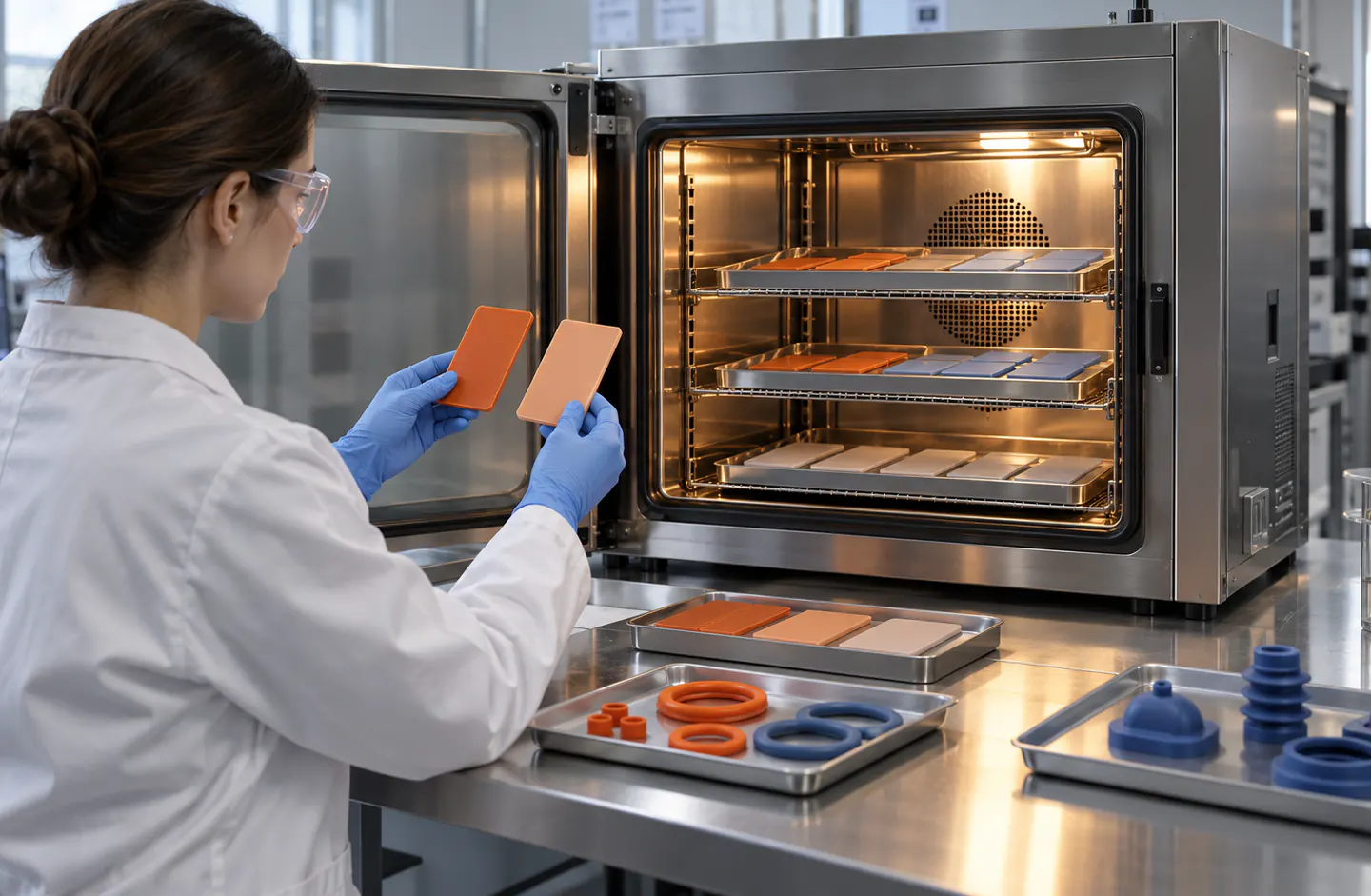
Freeze and thaw are states; the transition between them is part of the exposure. Specify the target temperature at the product or a justified chamber condition, the stabilization or dwell rule, the warm transition route, and how the next cycle begins. State whether a cycle includes a defined thaw-to-temperature period or merely removal from the freezer, because different protocols can produce materially different exposure histories.
Log actual conditions, not only set points. Record chamber identification, calibration status where applicable, product locations, loading, temperature records, start and stop times, door openings, specimen identifiers and any deviations. A protocol that can be repeated by another lab or incoming-inspection team is more valuable than a nominally severe test whose exposure cannot be reconstructed.
SECTION 02
Build a Repeatable Freeze-Thaw Exposure Protocol
A cycle is comparable only when both states and the transition are controlled. Write the product, sample identity, dwell, thaw route and checkpoints so another reviewer can reconstruct the exposure.
Specify Frozen State, Dwell Time and Thaw Transition
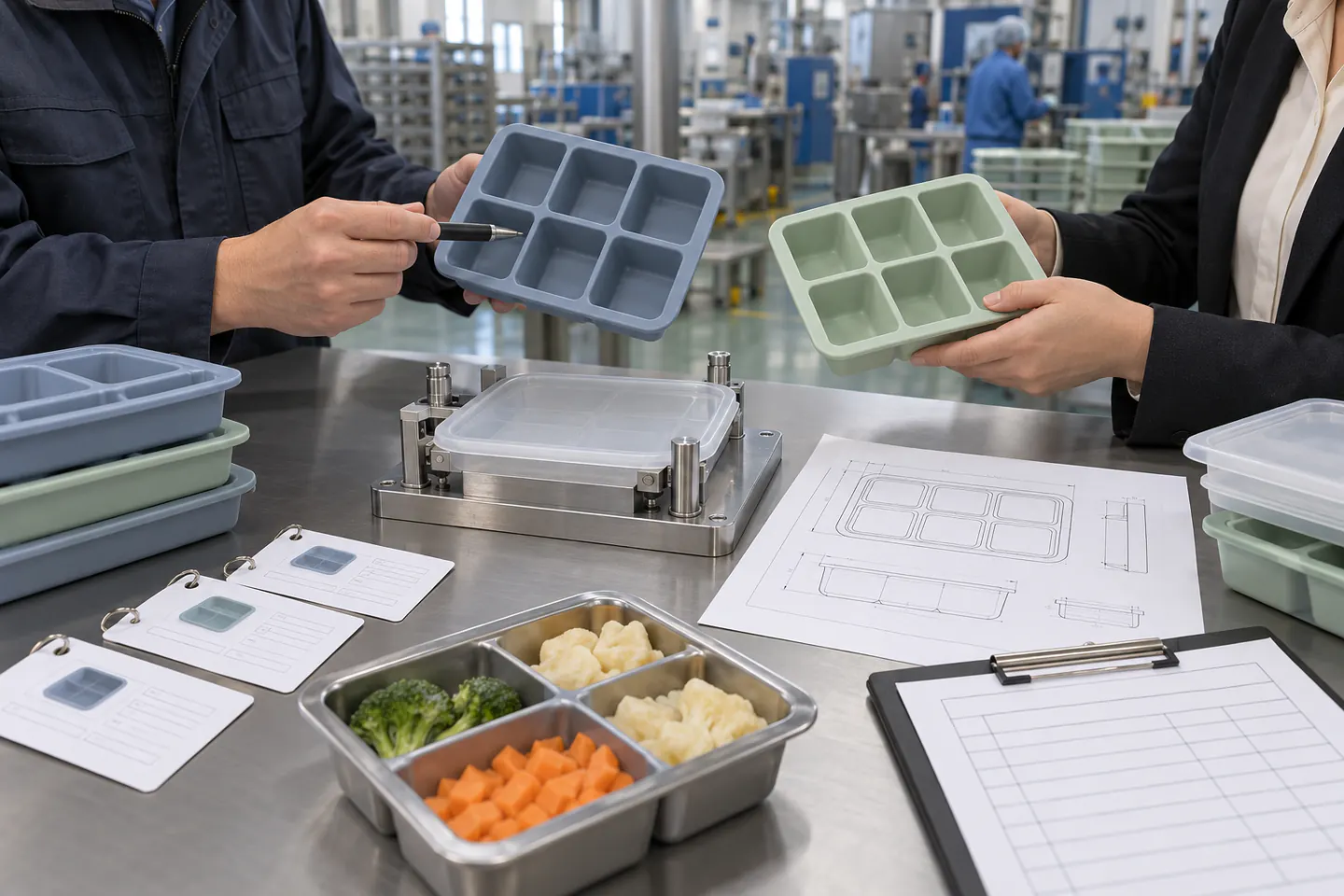
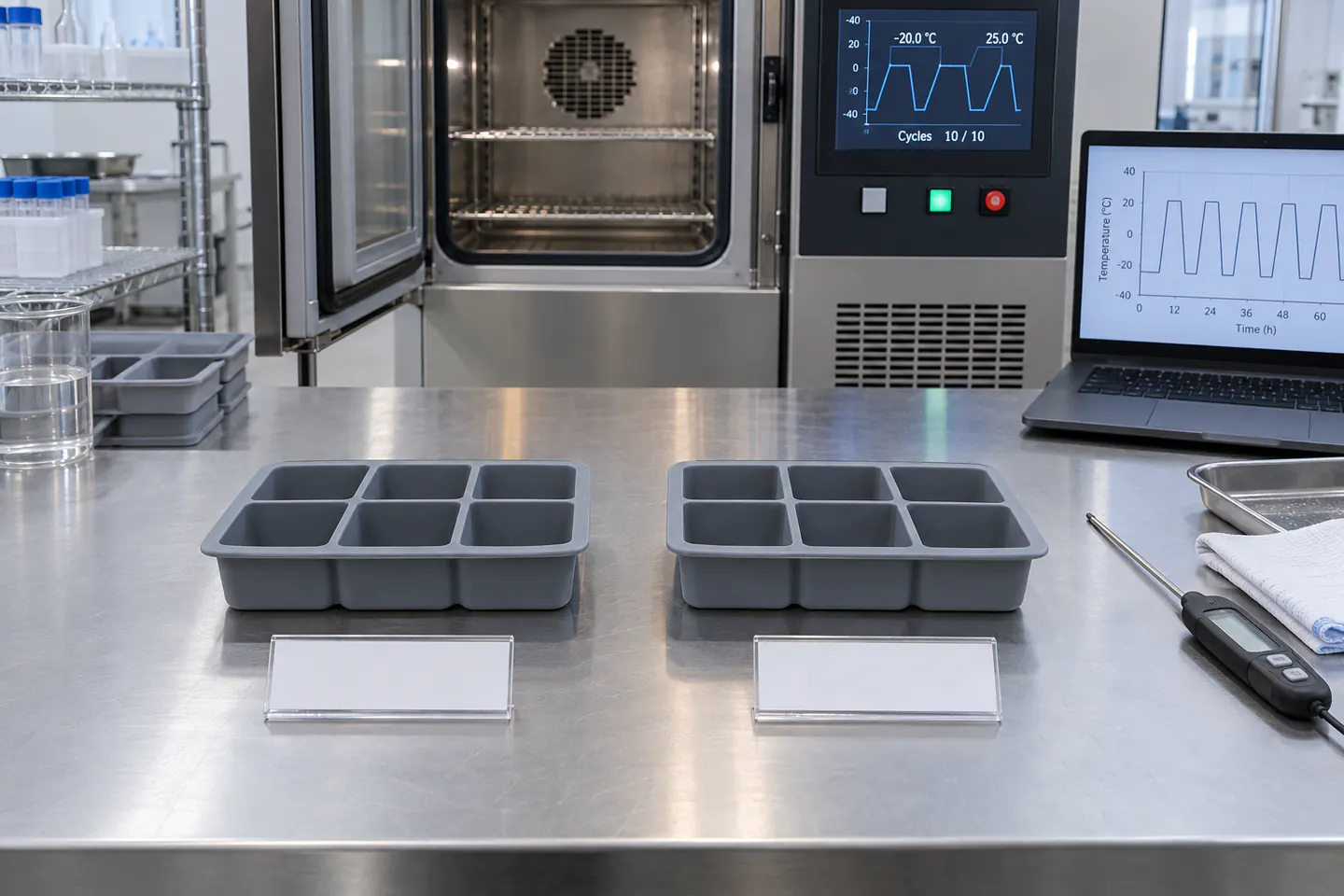
A representative sample must match the product that will ship. Use the approved material formulation, pigment, cure and post-cure route, molding revision, cavity, wall thickness, surface finish, lid and packaging where these could affect the observed result. Identify production-representative parts separately from prototypes, hand-cut coupons or samples built from a different material lot.
ISO 23529 provides general procedures for preparing, measuring, storing and conditioning rubber test pieces used in physical tests. It is useful context when a buyer commissions material specimens, but it does not set a silicone freezer product's cycle count or product-level acceptance criteria. Distinguish standard conditioning guidance from the project-specific exposure protocol in the quotation and final report.
Control Sample Identity, Lot and Matched Baseline
Before exposure, capture the characteristics that could change the approval decision. Depending on the design, this may include overall length and width, cavity volume, wall and rim thickness, flatness, lid engagement, opening or removal force, part mass, color reference, surface condition and odor observations. The record should name measurement locations, tools, conditioning, operator and acceptable variation.
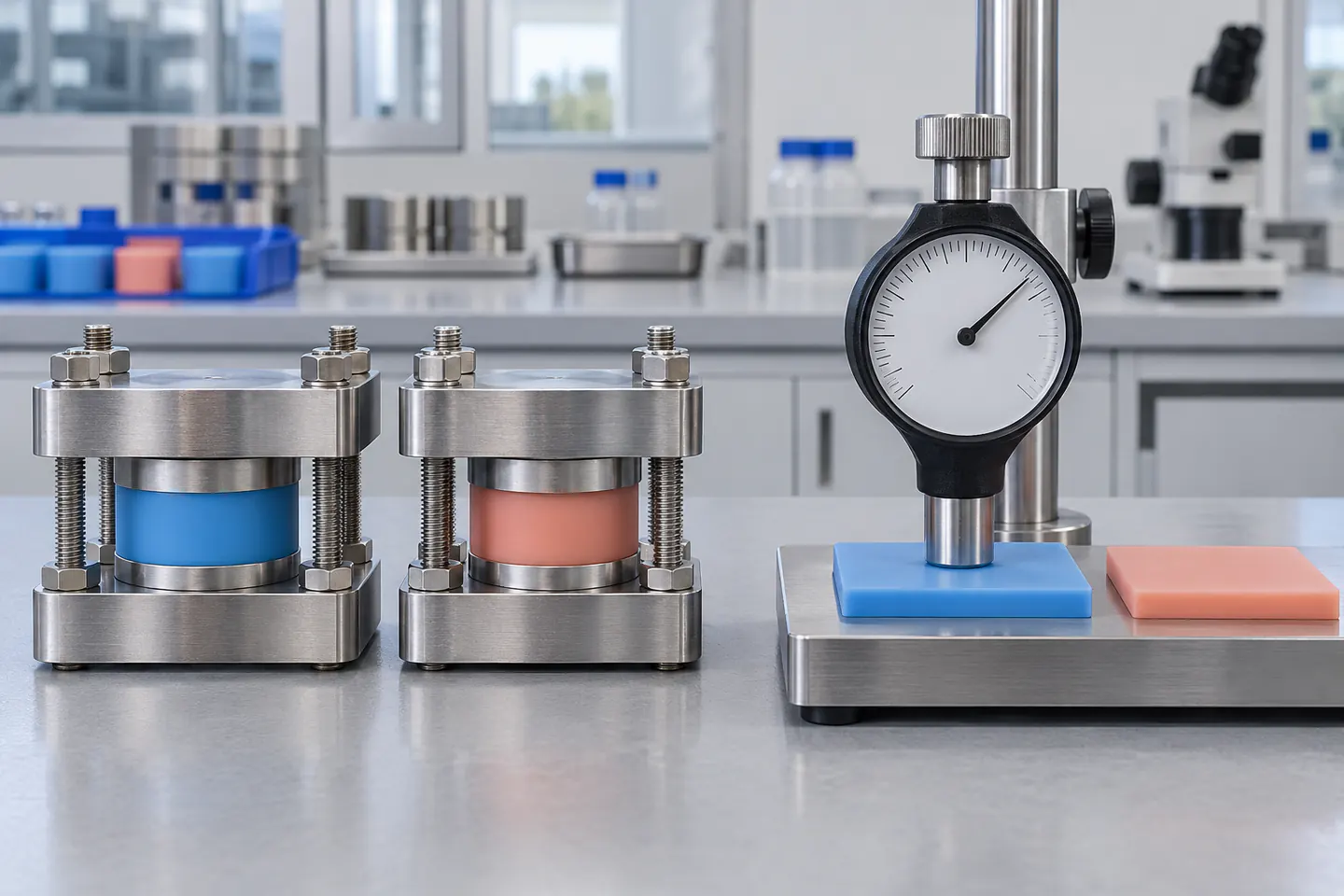
Flexible silicone is sensitive to measurement handling. A tray can be stretched by an operator, a rim can be measured at a different point, and a soft lid can be pulled harder during a subjective fit review. Use a defined fixture or technique, controlled sample temperature, repeated readings where useful and the same method for the baseline and cycled groups.
Measure Geometry and Appearance Before Exposure
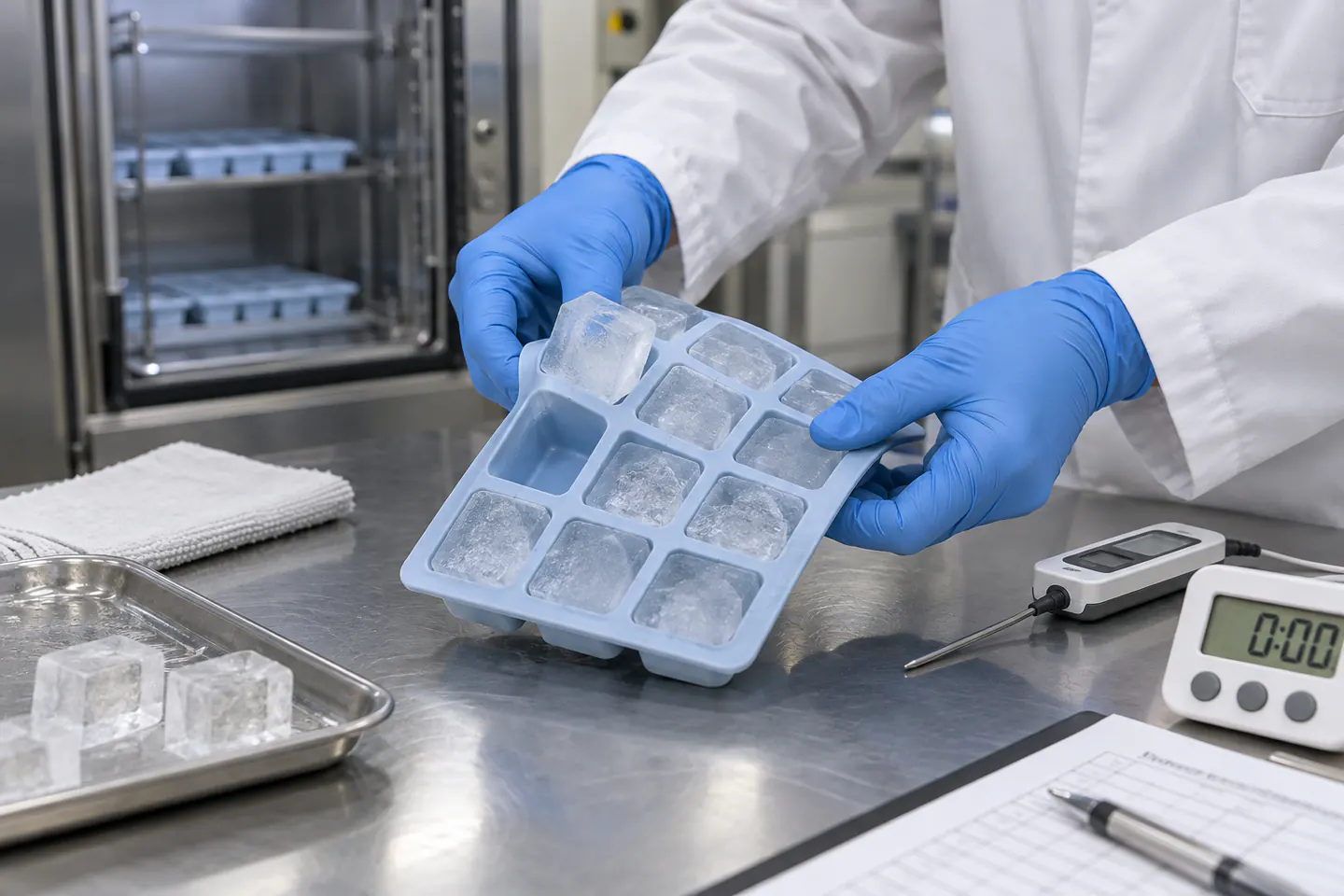
For a tray, measure release in the way the consumer will use it. A filled sample can be inverted, flexed, peeled or pressed; the protocol should specify which action is allowed and whether tools are prohibited. Record whether the portion releases intact, whether the tray recovers, and whether repeated flexing leaves whitening, tears, edge damage or permanent distortion.
Keep filling procedure controlled. Cavity fill level, food recipe or a justified surrogate, headspace, freezing orientation and storage support can affect ice formation and demolding force. If real food is used, document the preparation and handling; if a surrogate is used, explain how its mass, viscosity, fat or water behavior represents the question being tested.
SECTION 03
Inspect Release, Lid Fit and Product Condition at Defined Checkpoints
Finished geometry and its mating parts determine many practical risks. Evaluate release and fit on identified production-representative samples using the same handling method before and after cycling.
Test Portion Release With the Intended Consumer Method
A fitted lid adds an interface that must be tested with its intended mate. Identify container or tray revision, fit landmarks, engagement method, opening force or retention check, and whether a seal is claimed. Freezing can change food volume, stack loads can deflect a cover, and thawed condensation can make handling slippery; a lid that looks seated before exposure may behave differently after storage.
If the product is not designed as leakproof or airtight, the protocol must not imply that it is. Inspect fit, retention or containment only to the level promised in the specification and packaging. Where a leak or seal test is relevant, define orientation, contents or surrogate, duration, pressure or handling, and a measurable failure boundary before testing.
Check Lid Fit Against the Intended Mating Container
Repeated freezing, thawing, flexing and washing can reveal different risks. A tray may remain dimensionally stable but tear after repeated demolding; a cover may retain geometry but loosen after dishwasher exposure; odor or residue may emerge only after contact with a particular food and cleaning routine. Separate these sequences when the buyer needs to identify cause rather than combine every stress into one ambiguous endurance test.
For reusable products, define the order of operations and the intended reuse claim. If the user freezes, thaws, washes and refreezes, preserve that sequence and name the detergent, wash temperature, rack position or hand-wash method where relevant. If cleaning is outside the test scope, say so and avoid extending conclusions to a wash durability claim.
Separate Freezing Stress From Washing and Repeated Flexing
Acceptance criteria should be agreed before the first cycle. They may cover no visible cracking or tearing, dimensional change within a defined tolerance, acceptable lid retention, successful release with the stated method, appearance against a reference, and no unacceptable odor or residue under a documented observation method. Avoid inventing one arbitrary pass threshold for unrelated product designs.
For a development screen, the buyer may compare two candidate geometries or materials and rank them without claiming production qualification. For a release test, criteria should connect to the controlled drawing, approved golden sample, relevant risk and market. If uncertainty remains, define a hold-and-review outcome rather than forcing a false pass or fail from an incomplete method.
SECTION 04
Connect Validation Evidence to Buyer Approval and Change Control
Approval records should link the tested revision with the conclusion and any limitations. Keep claims, market compliance and change-control decisions within the evidence actually collected.
Set Acceptance Limits Before the First Cycle
A strong evidence file identifies the question, protocol revision, sample source, product and material identity, cycle definition, number of repetitions, measurement methods, acceptance criteria, raw observations, deviations, photographs, conclusion and approvers. Include the laboratory or factory location, equipment and calibration references when they materially support reproducibility. Keep evidence connected to the approved product revision and purchase specification.
Regulatory evidence is a separate layer. The FDA describes food-contact use by food type and conditions of use, including frozen storage, while the European Commission explains the food-contact materials framework. Those sources help scope the intended use and market review; neither source validates a buyer's silicone tray through repeated thermal cycles or substitutes for product-specific compliance assessment.
If an external lab is used, compare the proposed scope, sample handling, conditioning, report format, accreditation scope and timing before purchase. A lab logo alone does not establish relevance. Ask whether the report covers the exact SKU, color, material, food contact, test condition and current revision, and preserve the signed protocol so a later sample can be compared on the same basis.
Build a Traceable Report and Market-Specific Evidence File
A useful buyer specification turns the decision into a quotation-ready brief. State the destination market, intended food, use instructions, freezer range, fill or load, lid state, thaw method, washing sequence, cycle definition, checkpoints, critical dimensions, functional checks, visual criteria and evidence deliverables. Mark each value as fixed, proposed or supplier-confirmed so commercial comparison does not hide a different test scope.
Request that the supplier separate sample-making, internal screening, external laboratory work and production qualification in its proposal. Quantity, pricing, lead time, sample charges, MOQ and test availability depend on part design, tooling status, material, laboratory route and project schedule. A qualified quotation should state assumptions and exclusions rather than promise a generic result or timeline.
Use the same protocol when comparing suppliers. If one vendor proposes three home-use-like cycles and another proposes a severe chamber shock, their price and pass result are not equivalent. Normalize specimen count, product revision, conditioning, cycle definition, measurements, acceptance, report detail and responsibility before selecting a supplier or approving production.
Use Change Control to Protect Repeat-Order Approval
Change control keeps the original validation relevant. A new silicone compound, pigment, cure route, post-cure, wall thickness, cavity geometry, lid bead, mold cavity, supplier or package may alter release or fit. Review the changed characteristic against the failure mode and repeat only the tests needed to restore confidence; do not assume an old report automatically covers every revision.
A production release should name the approved material and product revisions, golden sample, protocol, test report, inspection plan, packaging and change-notification rule. Incoming teams should know whether routine checks are visual, dimensional, functional or document-based and what triggers a hold. This creates an auditable chain from development result to repeat purchase order.
Ask the supplier to disclose deviations and preserve retained samples where agreed. If a field complaint occurs, a traceable control sample can help distinguish storage, use, food, cleaning and manufacturing variables. The objective is not to claim that one cycle test predicts all consumer behavior; it is to make the product decision repeatable, bounded and useful for corrective action.
ACTION FRAMEWORK
Buyer Checklist Before Commercial Approval
Use this checklist before requesting a final protocol or comparing supplier proposals. Assign an owner to each open sample, measurement, market and acceptance question.
| Check | Question | Why It Matters |
|---|---|---|
| Use scenario | Are the food, fill level, freezer state, storage time, thaw, release, cleaning and reuse steps described? | A cycle protocol cannot represent a product when the commercial use sequence is unclear. |
| Cycle definition | Are frozen and thawed states, dwell, transition method, cycle boundary and target count written? | Different definitions can produce different exposures even when suppliers report the same cycle count. |
| Sample identity | Do samples identify SKU, drawing revision, compound, pigment, lot, cavity and lid/container pairing? | Untraceable samples cannot reliably support a quote, launch or repeat-order decision. |
| Baseline control | Is an uncycled control stored and measured under the same defined method? | Matched controls help distinguish exposure effects from normal production and measurement variation. |
| Functional checks | Are release, fit, retention, flex or cleaning checks performed with fixtures and instructions where needed? | Subjective handling can hide operator effects or imply functions the product does not claim. |
| Acceptance limits | Are dimensional, visual, odor and functional failure limits agreed before testing? | Predetermined criteria prevent post-test reinterpretation and cherry-picked results. |
| Evidence scope | Does the report state deviations, raw observations, sample source, protocol version and conclusion boundaries? | A pass statement alone does not show what the study established or left unresolved. |
| Change control | Will material, pigment, geometry, tooling, packaging or use-instruction changes trigger impact review? | The original evidence may not cover a materially changed finished SKU. |
NEXT READING
Continue the Supplier and Product Review
Use the linked freezer-tray guides to define the product geometry and portion layout before choosing functional checkpoints. The supplier and quality-control routes support a scoped sample discussion rather than a universal freeze-thaw claim.
Specify a silicone baby-food freezer tray with lid
Use specify a silicone baby-food freezer tray with lid to resolve one product or evidence question for this SKU. Keep the result tied to the tested revision, intended use and follow-up action.
Open internal resource →Compare separate cavities with connected portions
Use compare separate cavities with connected portions to resolve one product or evidence question for this SKU. Keep the result tied to the tested revision, intended use and follow-up action.
Open internal resource →Review silicone tensile, elongation and tear tests
Use review silicone tensile, elongation and tear tests to resolve one product or evidence question for this SKU. Keep the result tied to the tested revision, intended use and follow-up action.
Open internal resource →Review silicone quality-control capabilities
Use review silicone quality-control capabilities to resolve one product or evidence question for this SKU. Keep the result tied to the tested revision, intended use and follow-up action.
Open internal resource →Request a product-specific validation discussion
Use request a product-specific validation discussion to resolve one product or evidence question for this SKU. Keep the result tied to the tested revision, intended use and follow-up action.
Open internal resource →Explore all silicone product categories
Use explore all silicone product categories to resolve one product or evidence question for this SKU. Keep the result tied to the tested revision, intended use and follow-up action.
Open internal resource →PRIMARY REFERENCES
Authoritative External Sources
These official sources help frame food-contact use conditions and test-piece preparation. They do not establish a finished silicone product's cycle count, pass limit or market approval.
FDA: Food Types and Conditions of Use for Food Contact Substances
Official FDA guidance describing food types and conditions of use used when evaluating food-contact substance applications; applicability still depends on the actual material and finished product. This reference does not set a finished silicone product's freeze-thaw cycle count or acceptance limit.
European Commission: Food Contact Materials
Official European Commission overview of the EU framework for materials and articles intended to contact food. This reference does not set a finished silicone product's freeze-thaw cycle count or acceptance limit.
ISO 23529:2016 Rubber Test-Piece Preparation
Official ISO procedures for preparing, storing and conditioning rubber test pieces and the interval between forming and testing. This reference does not set a finished silicone product's freeze-thaw cycle count or acceptance limit.
BUYER QUESTIONS
Frequently Asked Questions
How many freeze-thaw cycles should a silicone product pass?
There is no universal cycle count for every silicone product. Set the count from intended use, expected reuse, failure risk and the decision being made, then define frozen and thawed states, dwell, transition, checkpoints and acceptance criteria. Record the count as a project-specific protocol, not a general guarantee.
Does FDA frozen-storage guidance define a silicone freeze-thaw test?
No. FDA food-type and conditions-of-use guidance includes frozen storage for food-contact evaluation, but it does not set mechanical cycle counts or approve finished silicone tray performance. Use it to scope intended food-contact conditions and keep product validation separate from regulatory review.
Should buyers test silicone material coupons or finished trays?
Use each for its proper question. Controlled specimens can support material comparison, while finished trays and lids reveal cavity release, rim fit, distortion and interface behavior. Identify the sample source, formulation, lot and product revision so results are not applied to a different construction.
What should a freeze-thaw cycle include?
State the target or measured frozen condition, dwell or stabilization rule, thaw route, transition time, product load, lid state, cycle boundary and recovery before inspection. Include washing or refreezing only if those steps reflect the intended use or a clearly labeled stress screen.
Can passing a freeze-thaw test prove a product will last for years?
Not by itself. A defined cycle test supports observations under its protocol; it does not automatically predict years of use, every food, all freezers or all cleaning routines. Any durability claim needs a justified use model, representative evidence and wording limited to the tested product and conditions.
How should a buyer check lid fit after freezing?
Use the intended mating container and product revision, with defined fit landmarks, seating procedure, retention or opening check, orientation and acceptance boundary. Test representative container dimensions when a range is sold, and do not describe the result as airtight or leakproof unless that function was specified and tested.
Editorial and Scope Note
Conclusion: Silicone Freeze-Thaw Validation for Buyers
Move from buyer research to a controlled supplier brief
Freeze-thaw validation is useful when the buyer defines a realistic use sequence, a repeatable exposure, traceable production-representative samples, controlled release and fit checks, and predetermined acceptance limits. It supports a decision about the listed silicone SKU and conditions; it does not create a universal cycle guarantee, prove a precise product lifetime or replace market-specific food-contact review. Share the drawing revision, intended food, freezer range, lid or container, cleaning routine and desired release decision with Naike Silicone to request a conditional protocol and quotation scope.
Freeze-thaw observations support only the listed protocol and product revision. They do not establish food-contact clearance or an unrestricted consumer service-life claim.