MATERIALS, QUALITY & COMPLIANCE
How Should Buyers Use Accelerated Heat Aging for Silicone Product Validation?
Learn how buyers define silicone accelerated heat aging tests, including temperature, duration, baseline properties, oven controls, acceptance limits and service-life claim boundaries.

DIRECT ANSWER
What B2B Buyers Need to Know
Buyers should use accelerated heat aging to compare defined silicone properties before and after a controlled elevated-temperature exposure—not to claim an exact service life from one oven condition. Specify the method, specimen, temperature, duration, oven controls, post-aging conditioning, measured properties and acceptance limits, then pair material results with finished-product functional validation.
This guide is written for silicone-product buyers, quality engineers, OEM developers, sourcing managers, laboratory reviewers and supplier-quality teams. It provides a decision framework rather than legal advice or a universal specification. Product classification, use conditions and destination market should be confirmed before final testing, labelling or compliance decisions.
Key Takeaways
- Define the buyer decision and product failure mode before selecting an aging condition.
- State the standard, edition, method, oven arrangement, specimen source and conditioning route.
- Use matched baseline and aged specimens from the same traceable material and process history.
- Select temperature and duration that create relevant comparison evidence without unrealistic damage.
- Measure only properties connected to product risk, and pair them with finished-product checks.
- Do not convert one accelerated condition into an exact service-life or universal heat-resistance claim.
Silicone Accelerated Heat Aging Decision Matrix
A useful program connects the test condition to a named decision and keeps conclusions within the evidence scope. Exact conditions and limits remain product-specific.
| Program type | What it can support | Critical limitation |
|---|---|---|
| Development screen | Rank candidate compounds or cure routes under one controlled condition | Does not by itself qualify production or predict field life |
| Material qualification | Confirm agreed property retention for a traceable formulation and specimen route | Needs finished-product evidence when geometry or interfaces drive risk |
| Change requalification | Compare an approved baseline with a changed material, pigment, cure or process | The change impact determines which properties and product checks must repeat |
| Complaint investigation | Test a defined hypothesis with retained, returned and control samples | Unknown field history and uncontrolled samples limit causal conclusions |
| Service-life modeling | Estimate time-temperature behavior only with designed multi-condition data and justified mechanisms | A single oven condition cannot establish years of service |
SECTION 01
Define the Aging Question and Test Method
Define the intended use, market and risk assumptions before choosing test methods or requesting supplier documents.
Start With the Product Risk and Buyer Decision for silicone accelerated heat aging test
Accelerated heat aging is useful only after the buyer defines the decision it must support. A program may compare candidate compounds, confirm a released formulation, investigate a complaint, or assess whether key properties remain acceptable after a controlled elevated-temperature exposure. Those purposes require different specimens, checkpoints and acceptance rules, so the purchase specification should name the decision before naming an oven temperature.
In factory reviews, we often see a temperature and duration copied from an old report without the original product context. That shortcut creates a test, but not necessarily relevant evidence. The buyer should first map the expected temperature range, exposure pattern, load, air contact, cleaning chemistry and critical failure mode of the finished silicone product.
A credible plan then states what will be compared before and after aging. Typical candidates include tensile strength, elongation, tear strength, hardness, compression set, mass, dimensions, appearance, odor observations or a finished-product function. Not every property belongs in every plan; the selected endpoints should explain the actual procurement risk and the action taken if change exceeds the agreed limit.
Select ISO 188 or ASTM D573 on a Declared Basis
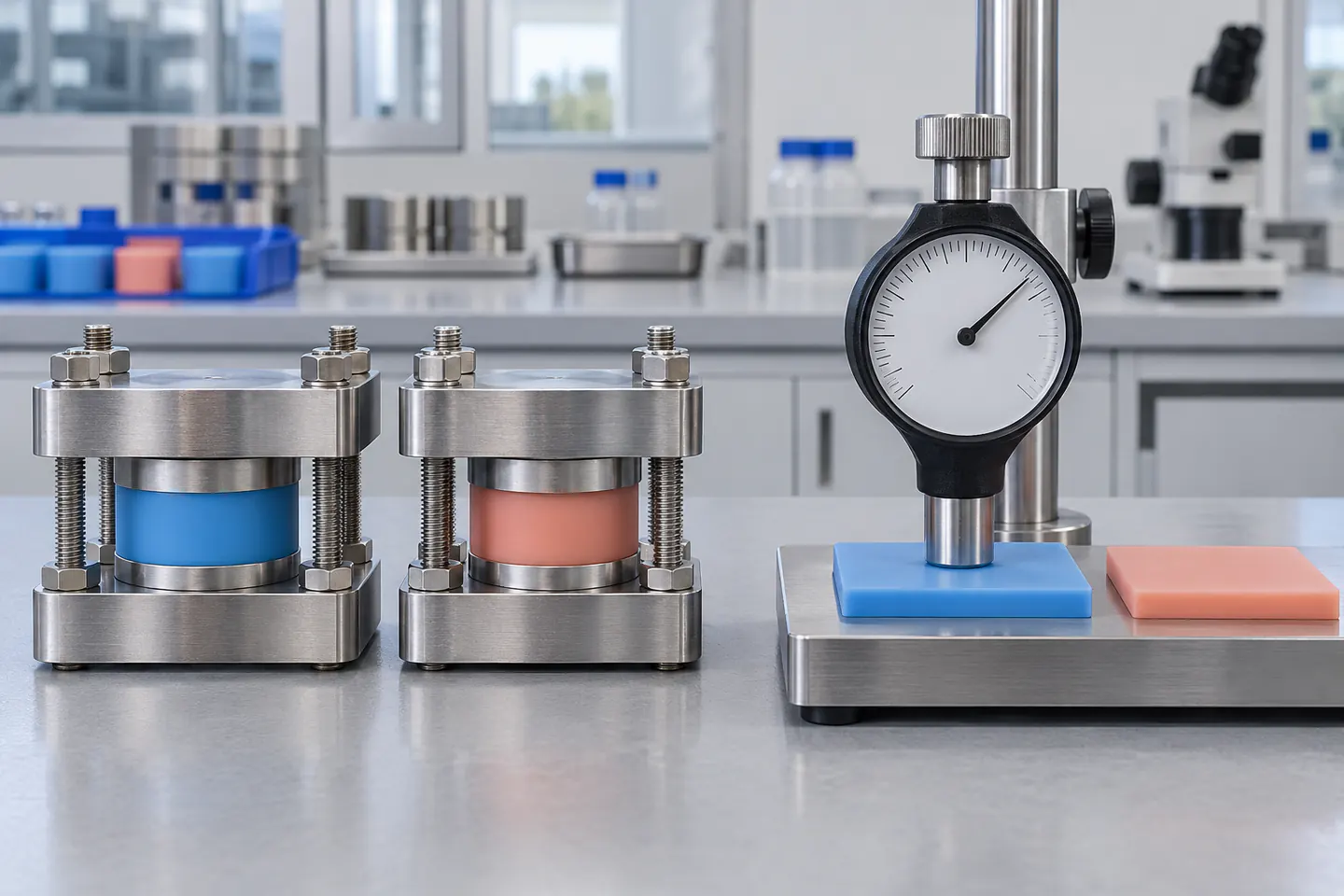
ISO 188:2023 specifies accelerated aging or heat-resistance tests for vulcanized or thermoplastic rubbers and describes multiple test methods. ASTM D573-04(2025) addresses deterioration of rubber in an air oven and explicitly frames results as laboratory comparisons under accelerated conditions rather than exact predictions of service performance. Buyers should identify the chosen standard, edition and method instead of requesting a generic oven-aging test.
The method choice controls air exchange, heating environment and specimen exposure, which can change the observed property shift. A circulating oven, cell-type apparatus or other defined arrangement is not interchangeable merely because the set temperature matches. Reports should identify the equipment and procedure well enough for a qualified laboratory to understand and, where appropriate, reproduce the test basis.
Standards define a method framework, not a universal pass limit for every silicone product. The buyer and supplier still need to agree the material, specimen, aging condition, properties, calculation, sampling and acceptance criteria. Any departure from the referenced method should be declared before testing and evaluated for its effect on comparability.
Choose Temperature and Duration Without Over-Accelerating
Aging temperature should be high enough to produce a measurable and decision-relevant change within a practical period, but not so severe that it creates mechanisms absent from intended use. Extreme heat can cause rapid oxidation, post-curing, volatilization, hardening, discoloration or cracking that may not represent the real product environment. More acceleration is not automatically more informative.
Duration works together with temperature, specimen geometry and the chosen property. A 24-hour screen may help rank development compounds, while a validation program may require longer exposure or several checkpoints to observe a trend. The plan should distinguish a screening condition from the condition used for qualification or change approval.
Buyers should document why the selected condition is relevant. That rationale can come from intended use, destination requirements, prior field data, material history, risk analysis or a controlled comparison to an approved baseline. If the relationship to real use is uncertain, the conclusion must remain conditional rather than being converted into an unsupported service-life claim.
SECTION 02
Control Specimens, Oven Exposure and Measurement
Match every claim and report to the correct material, finished SKU, sampling condition and current revision.
Build Matched Baseline and Aged Specimen Groups
Matched baseline specimens are essential because heat-aging results are expressed through change. The unaged and aged groups should come from the same traceable compound, pigment, cure route, post-cure, molding window and production lot whenever the objective is to measure aging influence. Mixing lots or specimen histories can make normal production variation look like heat-related deterioration.
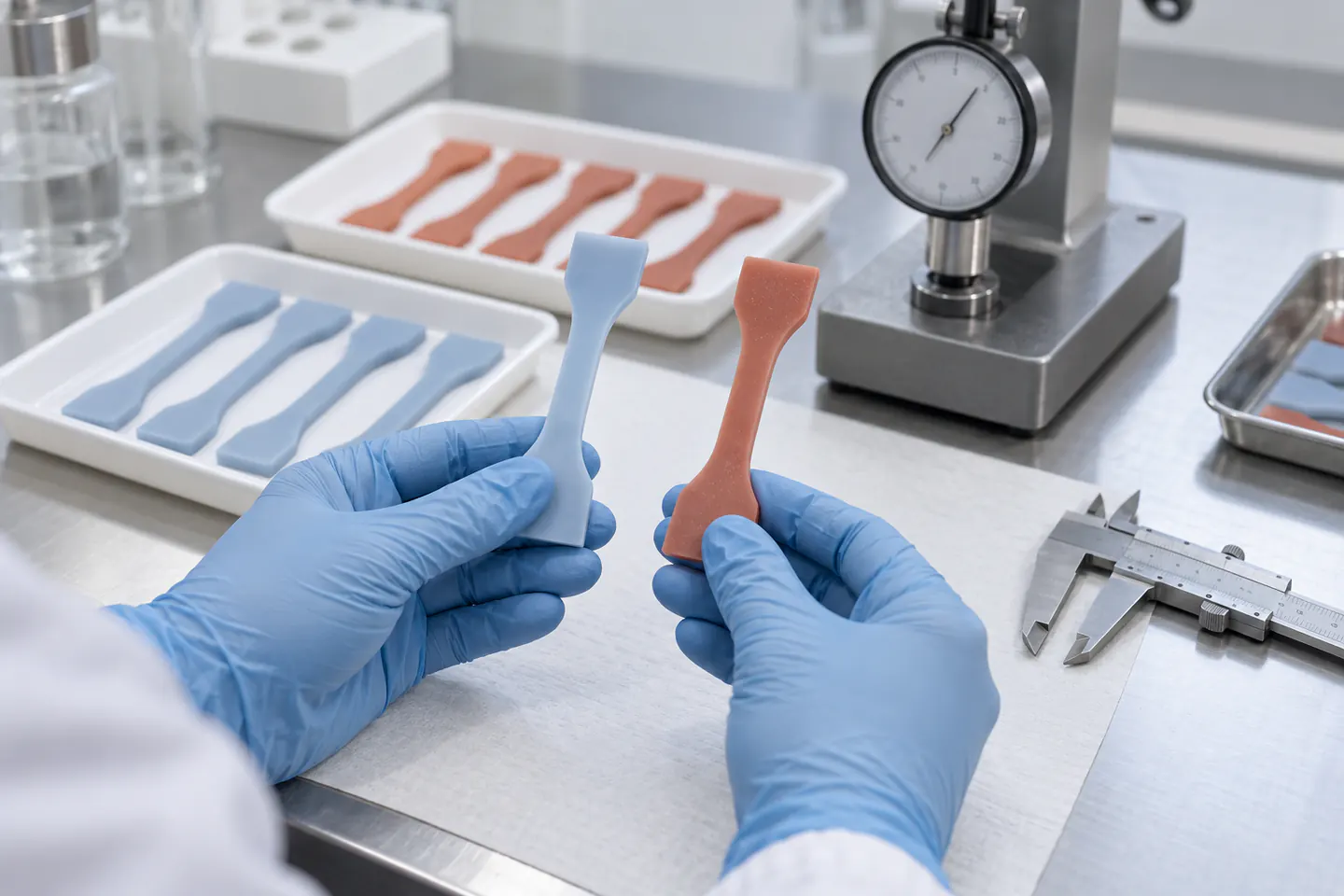
ISO 23529:2016 provides general procedures for preparation, storage and conditioning of rubber test pieces and for the interval between forming and testing. Thickness, cutting direction, edge quality, specimen location and conditioning can affect mechanical results before the oven is involved. Laboratories should preserve specimen identity and record damaged, invalid or excluded pieces rather than quietly selecting favorable results.
A production program also needs a clear sample source. Standard plaques may provide comparable material evidence, while specimens cut from finished products may include local thickness, orientation and process effects. The report should not present one source as the other, and product-level functions should be checked on representative finished parts when geometry matters.
Control Oven Loading, Timing and Post-Aging Conditioning
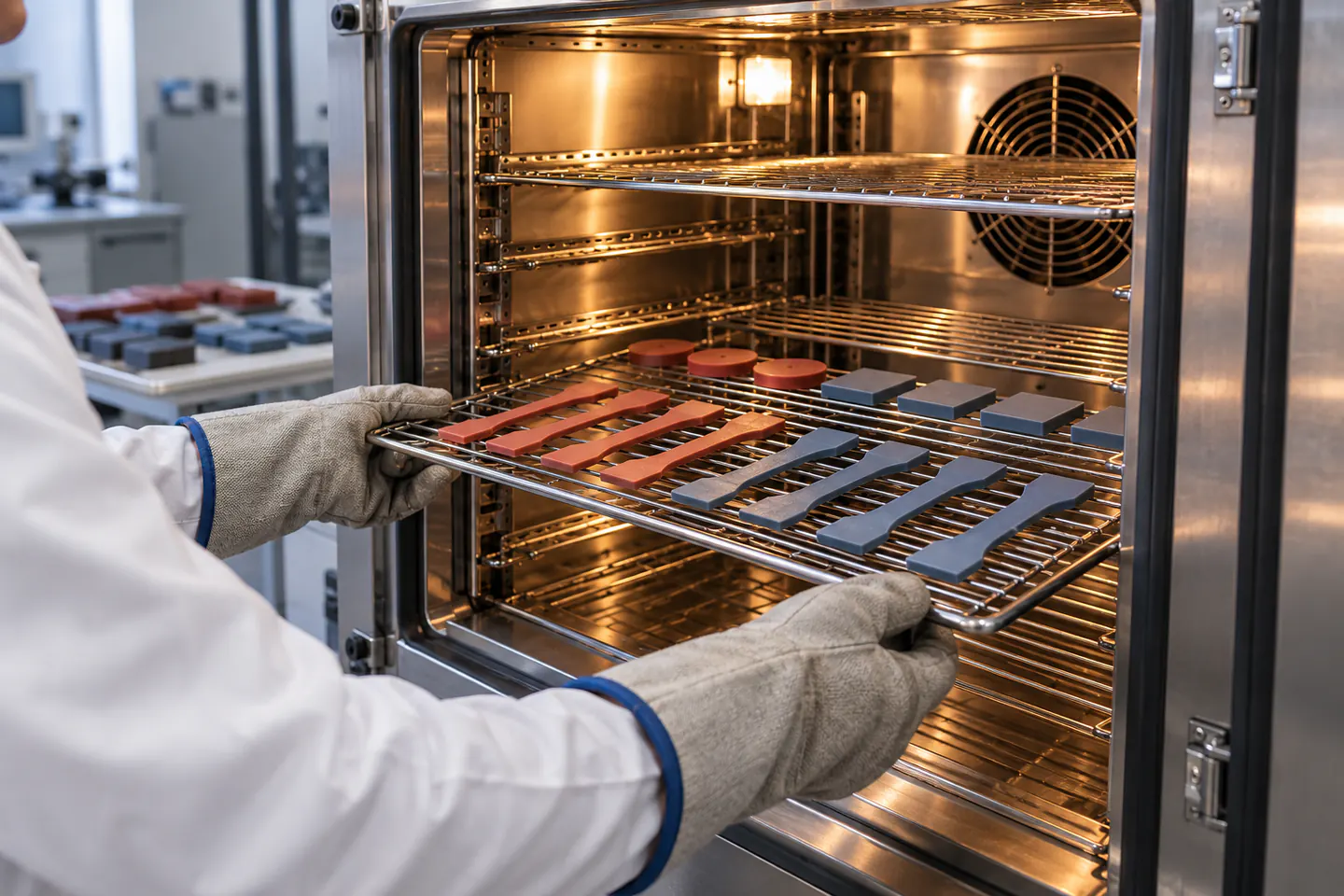
Oven loading is part of the method, not a housekeeping detail. Specimens should be arranged so air can circulate as required, with separation that prevents contact, contamination or shadowing from adjacent pieces. Mixed materials, volatile substances or residues can interact in the oven and compromise a supposedly controlled comparison.
Temperature uniformity, recovery after door opening and exposure timing need documented control. The clock should follow the applicable procedure, and technicians should avoid unrecorded delays between specimen groups. Calibration and equipment identification belong in the evidence package when results will release a supplier, material change or production order.
After exposure, cooling and conditioning must also be controlled before properties are measured. Testing one specimen hot and another after extended room-temperature recovery can create a false difference. The report should state removal time, conditioning environment, measurement interval and any visible specimen change that could affect the interpretation.
Measure Property Retention With Transparent Calculations
Property retention is often more useful than a single aged value because it connects the result to a controlled baseline. Buyers may review percentage change in tensile strength, elongation, hardness or another agreed property, but the calculation and sign convention must be explicit. Individual results, averages and variation should remain visible so an apparently acceptable mean does not hide one weak specimen.
Different properties can move in different directions. A silicone compound may become harder while elongation decreases, or it may show little hardness change while a sealing or recovery function shifts. That is why a single Shore A reading cannot release a heat-aging program whose actual risk is tear, compression recovery or repeated flexing.
Visual and dimensional observations can add context but require defined criteria. Color change should use a controlled reference, lighting or instrument basis where it matters, and surface condition should distinguish bloom, residue, cracking, tack or contamination. Vague notes such as looks good are not sufficient for a buyer acceptance record.
SECTION 03
Connect Property Retention With Product Decisions
Build production checks around critical characteristics that can be measured, recorded and investigated by lot.
Pair Standard Specimens With Finished-Product Functions
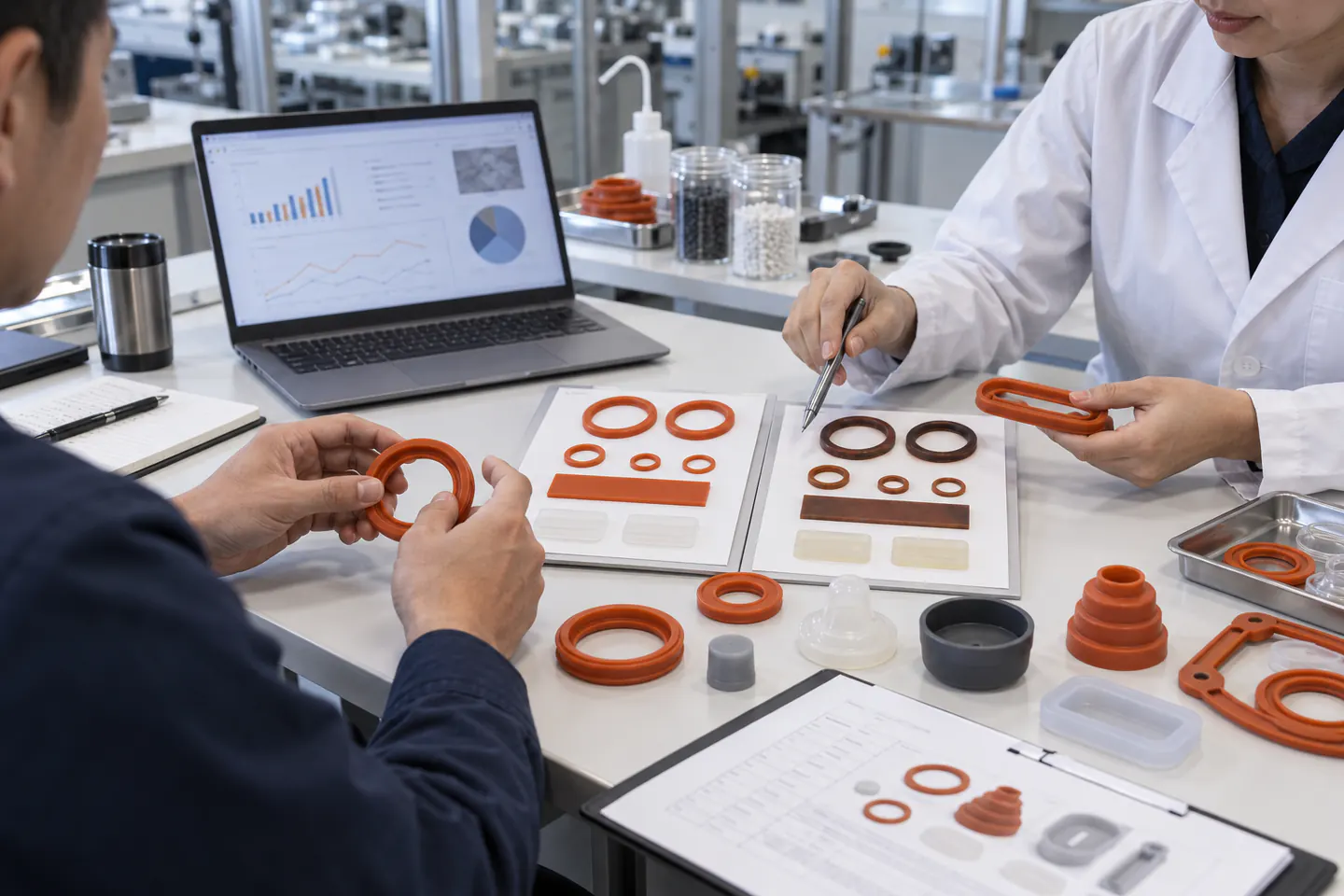
Standard specimens answer material-comparison questions, while finished products answer geometry and interface questions. A gasket may require leak or retention checks after aging, a lid may need fit and opening-force review, and a utensil head may need bend, bond or pull testing. The companion test should reproduce the important product feature without pretending to reproduce every field condition.
Product checks should use controlled mating parts, fixtures and procedures. If one laboratory tests a lid on a nominal container and another uses a distorted or different supplier container, the results are not directly comparable. The drawing revision, fixture identity, assembly condition, cycle count and failure definition should travel with the result.
The buyer can then separate material acceptance from product acceptance. A material may meet the agreed retention criteria but fail because the product geometry concentrates stress, or the product may pass a short functional check while material evidence shows a risky trend. Both outcomes require investigation rather than substituting one result for the other.
Keep Service-Life and Marketing Claims Conditional
Accelerated heat aging does not by itself prove a precise service life. Real products experience changing temperatures, oxygen availability, compression, flexing, chemicals, moisture, cleaning, light and periods of recovery that a single oven condition cannot reproduce. ASTM D573 specifically cautions that laboratory results may not correlate exactly with service performance because service conditions vary widely.
Arrhenius-style life estimates require defensible assumptions, multiple temperatures, an appropriate degradation mechanism and competent statistical treatment. A single time-temperature point cannot establish that model. Unless the program was designed and validated for life prediction, the report should describe comparative performance under the stated condition and avoid translating hours in an oven into years in use.
Marketing claims need the same discipline. Heat-resistant, durable or long-lasting language should be tied to a defined product, condition and evidence scope, with destination-market review where applicable. The quality file should preserve both what the test supports and what it does not support.
Write a Comparable Buyer Specification and Acceptance Plan
A buyer specification should identify the standard and edition, method, specimen source, compound and lot traceability, aging temperature, duration, oven arrangement, loading controls, post-exposure conditioning, measured properties and calculation basis. It should also state sample quantity, individual-result handling, acceptance criteria, invalid-test rules and responsible approvers. This turns an attractive laboratory report into a repeatable procurement control.
Acceptance limits should reflect product risk and demonstrated capability rather than a generic number copied from another silicone grade. An unnecessarily tight change limit can create repeated investigations without improving product performance, while a loose limit may miss a meaningful shift. Development data and finished-product evidence should inform the final tolerance.
The specification should also distinguish development, qualification, first-production and routine monitoring requirements. A comprehensive qualification package may not need to run on every shipment, but routine controls and change triggers must protect the approved baseline. Frequency, cost, lead time and external-laboratory scope remain conditional on the product and program.
SECTION 04
Write Acceptance, Claims and Change-Control Rules
Maintain an evidence file that remains usable when a material, color, process, supplier or destination market changes.
Use Heat-Aging Evidence for Supplier and Change Control
Change control is where heat-aging evidence earns long-term value. A new compound supplier, polymer or filler system, pigment level, cure chemistry, post-cure, molding window, part thickness or critical geometry can change the aging response. The impact review should select the necessary repeated tests instead of assuming an unchanged initial hardness value proves the entire performance profile.
For supplier comparison, require each quotation to state the proposed method, conditions, sample basis, laboratory route, reporting detail, cost and timing assumptions. Two suppliers are not comparable if one quotes a short internal screen and the other quotes an accredited external program with full mechanical retesting. Commercial review should align the evidence scope before ranking price or lead time.
Send the factory the drawing, intended use, temperature profile, exposure pattern, critical properties, mating parts, existing evidence and known failures. Ask for a conditional validation proposal that separates standard specimens from finished-product functions and identifies all assumptions. Production should be released only when the current material, process, test report, product checks, deviations and approved SKU revision form one traceable evidence chain.
ACTION FRAMEWORK
Buyer Checklist Before Commercial Approval
Use this checklist as a meeting agenda. It is intentionally concise so the team can identify missing evidence without replacing its own quality, legal or supplier-management procedure.
| Check | Question | Why It Matters |
|---|---|---|
| Decision purpose | Is the test screening, qualification, change control or investigation? | The purpose determines sample design, depth, acceptance and claim scope. |
| Use profile | What temperature, duration, load, air and chemical exposures occur in real use? | Aging conditions need a documented relationship to the actual product risk. |
| Method basis | Are standard, edition, method and equipment arrangement identified? | Matching temperature alone does not make two aging procedures comparable. |
| Specimen traceability | Do baseline and aged samples share compound, color, cure, post-cure and lot history? | Mixed histories can make production variation look like aging deterioration. |
| Exposure control | Are oven loading, separation, airflow, temperature, timing and recovery controlled? | Uncontrolled exposure creates misleading property differences. |
| Property endpoints | Are measured properties tied to the failure mode and tested by the same methods? | Irrelevant endpoints add cost without strengthening the buyer decision. |
| Product validation | Are material changes paired with finished-product fit, seal, pull or cycle checks? | Standard specimens do not reproduce every geometry and interface. |
| Claim boundary | Does the report state what the condition supports and what it cannot prove? | Comparative oven data should not become an unsupported service-life claim. |
NEXT READING
Continue the Supplier and Product Review
These internal resources connect the guide with Naike Silicone product, factory, customization and inquiry pages. Open the route that matches the next decision in your project.
Compare silicone tensile, elongation and tear tests
Use compare silicone tensile, elongation and tear tests to gather the next level of product, manufacturing or commercial information.
Open internal resource →Compare silicone compression set and Shore hardness
Use compare silicone compression set and shore hardness to gather the next level of product, manufacturing or commercial information.
Open internal resource →Understand silicone Shore A hardness testing
Use understand silicone shore a hardness testing to gather the next level of product, manufacturing or commercial information.
Open internal resource →Review Naike Silicone quality-control capabilities
Use review naike silicone quality-control capabilities to gather the next level of product, manufacturing or commercial information.
Open internal resource →Request a product-specific aging validation review
Use request a product-specific aging validation review to gather the next level of product, manufacturing or commercial information.
Open internal resource →Explore all silicone product categories
Use explore all silicone product categories to gather the next level of product, manufacturing or commercial information.
Open internal resource →PRIMARY REFERENCES
Authoritative External Sources
The sources below are official primary references. Applicability depends on the product, intended use and destination market. Buyers should obtain qualified advice for final legal or regulatory decisions.
ISO 188:2023 Accelerated Ageing and Heat Resistance Tests
Official current ISO standard for accelerated ageing or heat-resistance tests on vulcanized and thermoplastic rubbers; it defines method frameworks but not a universal product acceptance limit or exact service-life prediction.
ASTM D573-04(2025) Rubber Deterioration in an Air Oven
Official ASTM air-oven deterioration method for assessing changes in rubber physical properties under accelerated conditions; ASTM cautions that results may not correlate exactly with service performance because service conditions vary.
ISO 23529:2016 Rubber Test-Piece Preparation
Official ISO procedures for preparing, storing and conditioning rubber test pieces and the interval between forming and testing.
BUYER QUESTIONS
Frequently Asked Questions
What does an accelerated heat aging test tell a silicone buyer?
It compares how defined silicone properties change after a controlled elevated-temperature exposure. The result can support material selection, qualification, change control or investigation when the method, specimen, baseline, condition and acceptance rule are stated. It does not automatically predict exact product service life.
Which standard is used for silicone heat aging?
ISO 188:2023 and ASTM D573-04(2025) are commonly referenced for accelerated aging or air-oven deterioration of rubber. Buyers must identify the selected standard, edition and method because equipment, air exchange, procedure and reporting basis affect comparability.
How should aging temperature and duration be selected?
Select conditions from intended use, risk, material history and the decision required. The condition should produce meaningful comparative evidence without introducing an unrealistic degradation mechanism. Screening, qualification and life-modeling programs should not be treated as interchangeable.
Which properties should be measured before and after aging?
Choose endpoints from the product failure mode. Tensile strength, elongation, tear, hardness, compression set, mass, dimensions, appearance and finished-product function are possible, but only relevant properties should be included and each needs a defined method and acceptance basis.
Can oven aging prove a silicone product will last for years?
Not from a single time-temperature condition. Service-life estimation requires defensible degradation assumptions, suitable multi-temperature data and statistical modeling, plus evidence that the laboratory mechanism represents real use. Otherwise, report only comparative performance under the tested condition.
Should buyers test plaques or finished silicone products?
Often both, for different purposes. Standard plaques or test pieces support controlled material comparison, while finished products verify geometry, interfaces, assembly and function. The report should identify the sample source and never substitute one evidence type for the other.
Editorial and Scope Note
Conclusion: Silicone Accelerated Heat Aging Validation
Move from buyer research to a controlled supplier brief
Accelerated heat aging becomes useful procurement evidence only when the decision, method, specimen history, oven condition, property endpoints, acceptance rules and product link are controlled. It can compare materials, qualify a traceable baseline or support a change review, but one condition cannot prove exact service life. Exact temperatures, durations, samples, limits, costs and lead times remain conditional on product risk and destination requirements. Share Naike Silicone your drawing, use profile, critical properties, mating parts and current data to request a conditional validation plan.
This factory-insider guide supports sourcing preparation and supplier discussion; it does not replace product-specific engineering, laboratory, regulatory, legal or commercial review for the destination market.