MATERIALS, QUALITY & COMPLIANCE
Reinforced vs Unreinforced Silicone Pastry Mats: What Changes for Buyers?
Compare reinforced and unreinforced silicone pastry mats by lay-flat stability, edge integrity, cleaning, food-contact evidence, tooling and packout for B2B buyers.
DIRECT ANSWER
What B2B Buyers Need to Know
Choose a reinforced pastry mat when controlled in-plane stability and a validated encapsulated edge matter more than simple construction. Choose an unreinforced mat when its approved thickness, border and process meet the same lay-flat and handling targets without a textile interface. Test both finished designs after realistic rolling, washing and use exposure; neither construction is automatically food-contact compliant or oven safe.
This guide is written for B2B importers, distributors, retailers, private-label brands, product developers, quality teams and sourcing managers. It provides a decision framework rather than legal advice or a universal specification. Product classification, use conditions and destination market should be confirmed before final testing, labelling or compliance decisions.
Key Takeaways
- Specify the real rolling, baking, cleaning and storage uses before choosing a construction.
- A woven core can resist in-plane stretch but creates placement and edge-encapsulation risks.
- An all-silicone mat still needs controlled thickness, border geometry and lay-flat checks.
- Compare edge lift, dimensions, print and cleaning after the proposed packed-state dwell.
- Food-contact and heat claims require evidence for the exact finished article and market.
- Normalize tooling, material, inspection, packaging and MOQ assumptions in the RFQ.
Reinforced vs Unreinforced Pastry Mat Decision Matrix
These are design tendencies, not universal performance guarantees. The buyer must verify each finished construction under the same intended-use and packed-state conditions.
| Decision factor | Reinforced construction | Unreinforced construction |
|---|---|---|
| In-plane stability | Woven core may limit stretch if correctly placed and encapsulated | Depends on silicone thickness, border geometry and process control |
| Edge risk | Exposed yarn, delamination or thin coverage must be inspected | Curl, tears or uneven thickness remain possible |
| Cutting exposure | Damage may reach a hidden textile interface | Surface gouges still require explicit use limits |
| Cleaning | Finished edges and print require access and residue checks | Underside texture and print still require cleaning checks |
| Production | Adds fabric sourcing, cutting, placement and registration controls | May use more silicone or a larger border to reach stability targets |
| Packout | Roll recovery and print transfer must be checked | Roll recovery, corner lift and compression marks must be checked |
SECTION 01
Define the Pastry-Mat Use Case and Construction
Define the intended use, market and risk assumptions before choosing test methods or requesting supplier documents. Gate 1 links this construction question to an approved sample and acceptance record.
Fix the actual bakery mission for reinforced vs unreinforced silicone pastry mat
The first question on our review bench is what the mat must do after it leaves its retail sleeve. A home baker may roll dough, scrape flour and transfer pastry; a commercial kitchen may repeat those steps many times a day and clean the mat under a different routine. Reinforcement is useful only when the buyer has defined the handling, lay-flat, cutting and storage demands that justify it. Start the specification with a named application and the actual work surface rather than selecting a construction from a catalog photograph.
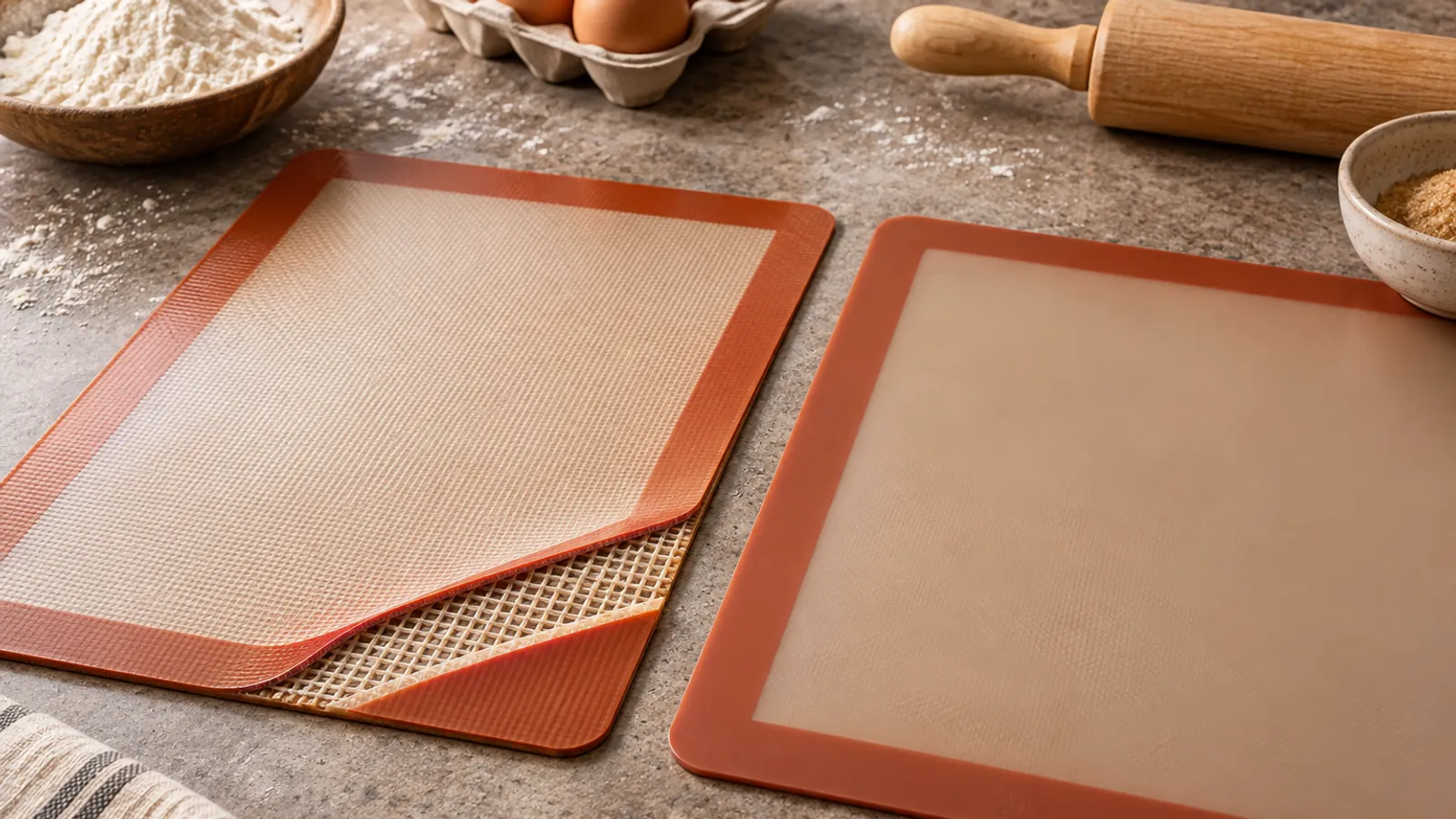
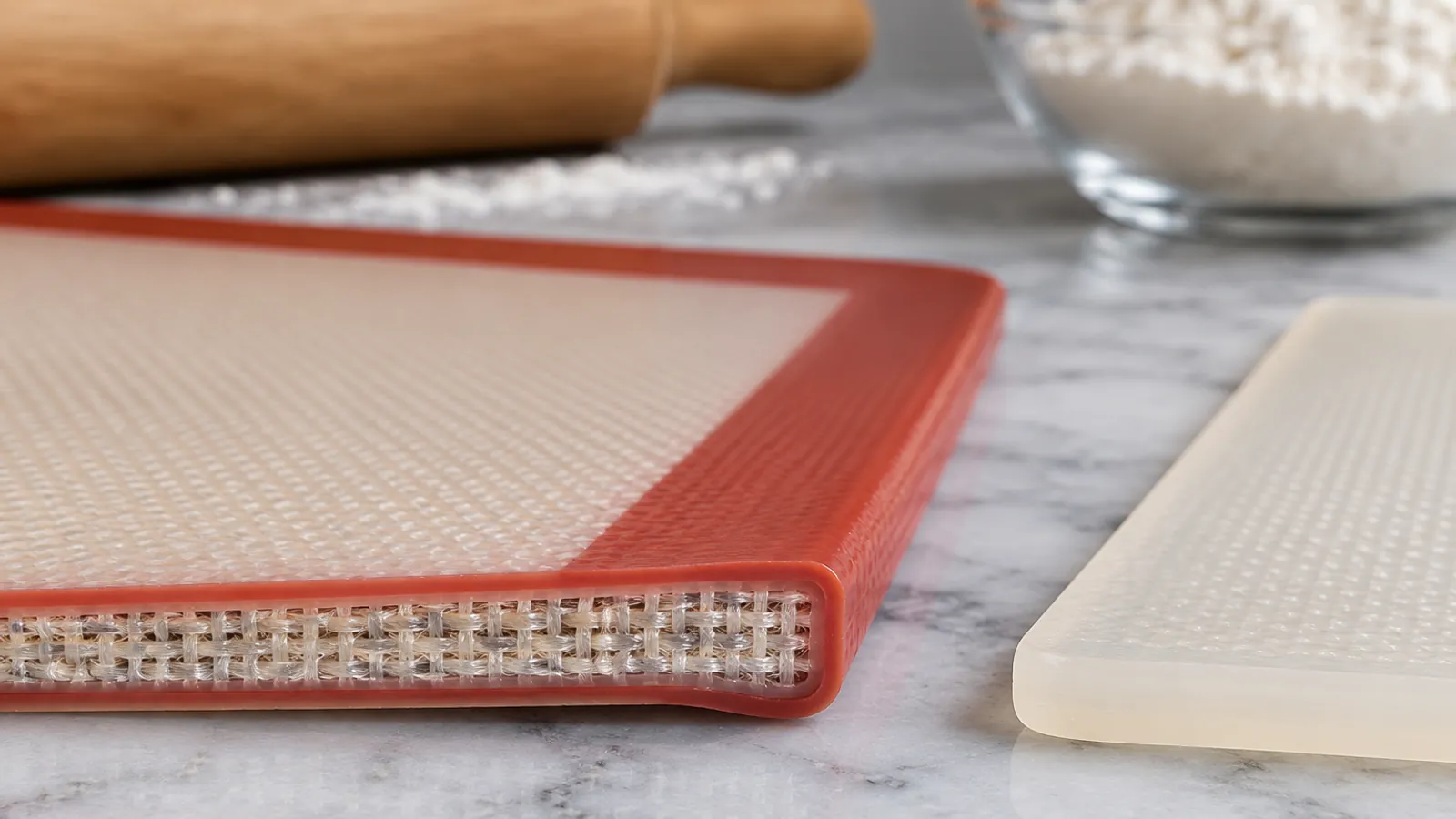
A reinforced pastry mat normally combines a flexible silicone surface with a textile core, while an unreinforced mat relies on silicone geometry and thickness for its body. That construction difference does not make either design automatically safer, longer lasting or better for every oven, countertop or dough. A fabric core may resist stretching in the plane of the mat, but exposed or poorly encapsulated yarn at an edge can introduce a different defect. An all-silicone mat avoids that particular interface yet may need a different thickness or edge profile to stay flat.
Ask the product team to define whether the mat is a rolling surface, a baking liner, a measuring aid or a multi-use item. The intended contact temperature, oven arrangement, detergent, storage method and whether knives or dough cutters touch the surface belong in the same brief. A supplier cannot validate an undefined universal use claim, and a test report for a different size or construction does not settle this decision. Separate critical functions from optional marketing features before committing to tooling or printed artwork.
Define the two constructions
The comparison should begin with a dimensioned plan view and a construction cross-section for both candidates. Record length, width, thickness range, edge width, corner radius, printed guide position and the location of any reinforcement relative to the finished perimeter. A statement such as “fiberglass reinforced” is insufficient unless the fabric type, coverage area, orientation and edge encapsulation are controlled. For an all-silicone version, identify the solid section and any ribs or thicker border that are intended to resist curl.
We ask buyers to mark the directions in which they stretch or pull a working mat because a woven core has different behavior along its yarn directions. A pull at the corner may also stress the border differently from a straight pull across the center. The selected test should reproduce the actual grip and movement rather than only quote a material tensile value from a standard specimen. Capture baseline dimensions after conditioning, then measure the same sample after rolling, washing and use exposure at agreed intervals.
The reinforcement must remain fully enclosed in the approved finished article unless the design and regulatory review specifically allow another construction. Inspect both faces and all trimmed edges under consistent light, then flex the border to look for yarn emergence, delamination, bubbles and weak silicone coverage. A visually clean center is not enough if repeated handling opens a corner seam. Define edge defects as critical, major or minor with photographs so a production inspector and buyer interpret the same boundary.
Unreinforced does not mean dimensionally uncontrolled. Wall thickness variation, cure, tension during demolding and cooling conditions can produce a mat that appears flat at one moment but curls after a day in a sleeve. Review the mold release route and the way the mat is laid down, stacked and packed after demolding. Compare the effective working area only after each specimen has rested under the same conditions, because a larger nominal size can be less useful if its edges lift from the bench.
SECTION 02
Compare Stability, Edge and Surface Geometry
Match every claim and report to the correct material, finished SKU, sampling condition and current revision. Gate 2 links this construction question to an approved sample and acceptance record.
Control textile placement
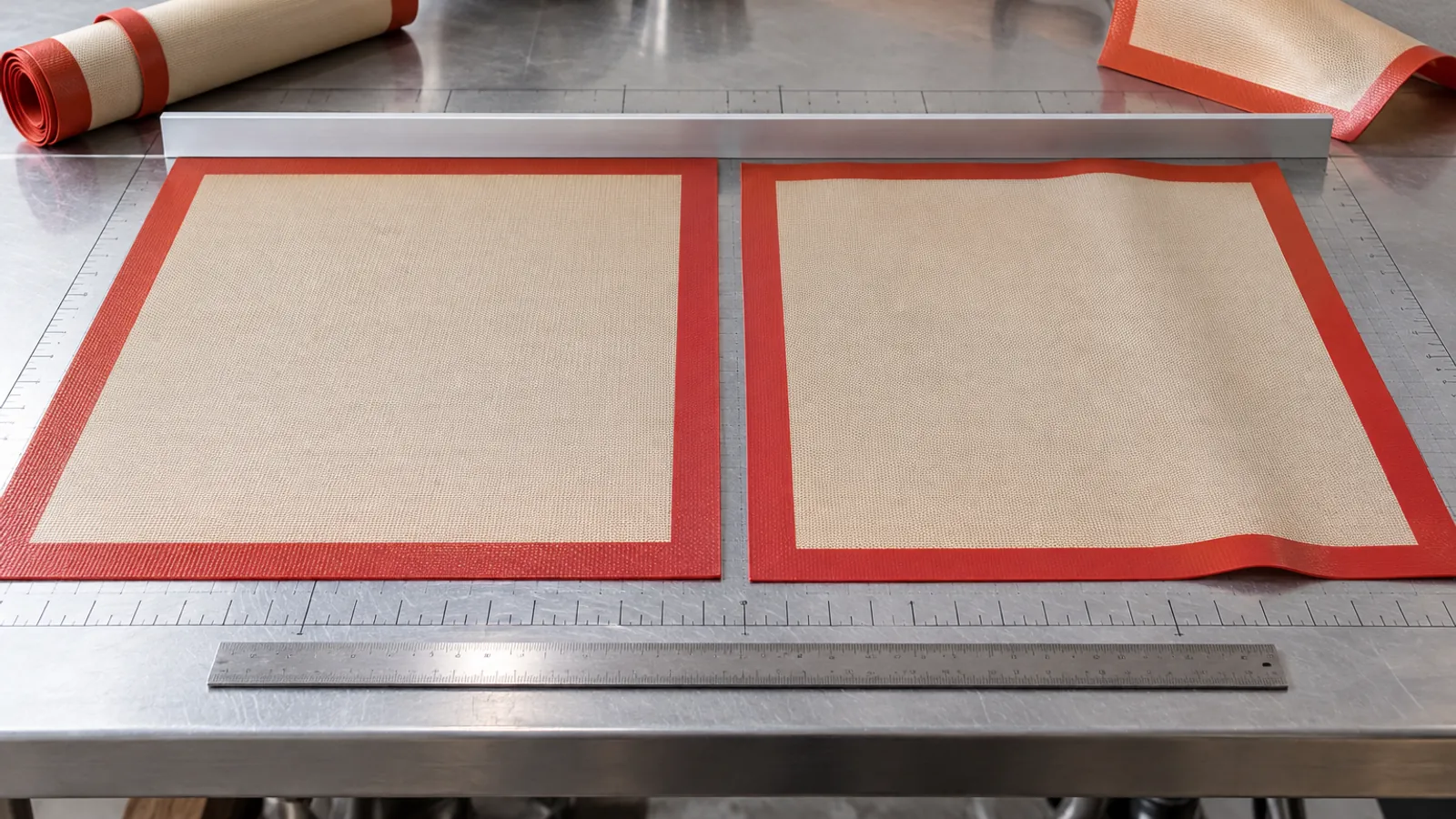
Lay-flat behavior needs a reproducible measurement rather than an adjective. Place a conditioned mat on the specified dry surface without hand-smoothing, record the maximum edge lift and corner lift, then repeat after a defined roll-storage interval. Note room temperature, surface material, rest time and whether the sleeve applied compression; otherwise two laboratories may report different results from identical parts. Test multiple production-representative samples and keep photographs at a fixed camera angle.
Dimensional stability is not the same as clean release from dough. A reinforced mat can resist in-plane stretching while a food-contact surface still picks up residue or transfers print; an all-silicone mat may release dough well yet shift under a vigorous rolling motion. Write separate acceptance checks for movement on the countertop, dough release, cleaning recovery and any measurement print. The buyer should prioritize the intended operation rather than averaging unlike properties into one vague quality score.
If a knife or cutter can touch the mat, do not convert a casual cut demonstration into a “cut resistant” claim. Define the implement, load, angle, number of passes and pass/fail criteria on representative samples, then inspect the surface and any hidden reinforcement. A damaged fabric core can be difficult to see from the top face and may create a cleaning or durability concern later. When cutting is not an approved use, care instructions and product images should say so clearly and avoid showing a blade on the mat.
Printed circles and conversion marks are useful only when their position, legibility and durability match the actual working method. Approve the artwork against a dimensioned coordinate system, inspect print registration after molding or decorating, and repeat wash and rub checks under a buyer-approved protocol. A line that shifts with an unreinforced mat may still be acceptable for visual guidance but not for a precision measurement claim. State what the print is for and what tolerance the buyer expects before selecting the construction.
Control all-silicone geometry
Food-contact documentation needs to cover the finished construction and its intended market, not merely the base silicone compound. For a reinforced mat, the buyer should understand the textile, any coating, colorants, printing and edge finish that form the article; for an all-silicone mat, decoration and additives still matter. The FDA explains that authorization is tied to an intended use, while the European Commission sets a general food-contact framework and separate material measures. Neither source grants a blanket “FDA approved” status to a pictured mat.
Set the testing conditions from foreseeable food, time and temperature exposure and ask the laboratory to identify the actual sample revision. If the mat will be used in an oven, document its location, heat source, duration and any contact with trays or racks; if it is only a rolling surface, avoid importing oven claims from another SKU. A statement about heat resistance needs product-specific evidence and a clear maximum-use boundary rather than a generic silicone property. Obtain destination-market regulatory advice where the construction or claim falls outside a standard report scope.
The textile core should be treated as a specified component even if it does not directly touch food in the approved design. ASTM D579 describes characteristics of greige woven glass fabric, including fabric construction and breaking strength, but that standard is not a finished silicone pastry-mat approval. Use a textile specification to control incoming material and then evaluate the encapsulated finished article for its own risks. Keep lot identity across fabric, silicone compound, printing and packed mats so a failure can be traced to a real process change.
Cleaning instructions also need validation on the released mat. A porous damaged edge, a lifted printed area or an over-compressed roll can retain flour or detergent even when the center wipes clean. Have users follow the proposed washing, drying and storage instructions, then inspect edges, underside texture and print with the same protocol for both constructions. If a commercial dishwasher claim is contemplated, test the relevant machine and chemistry rather than extending a domestic sink-wash observation.
SECTION 03
Validate Finished-Mat Performance and Claims
Build production checks around critical characteristics that can be measured, recorded and investigated by lot. Gate 3 links this construction question to an approved sample and acceptance record.
Measure lay-flat recovery
Tooling economics should be compared over the expected range, not by asking which single sample is cheaper. A reinforced construction may add fabric sourcing, placement, registration, encapsulation inspection and scrap paths; an unreinforced construction may require more silicone or a revised border to meet a lay-flat target. Request a quotation that separates tooling, compound, fabric, printing, inspection, packaging and expected yield assumptions. Any MOQ, unit price or lead time should be confirmed against the actual size mix, color plan, order quantity and available production schedule.
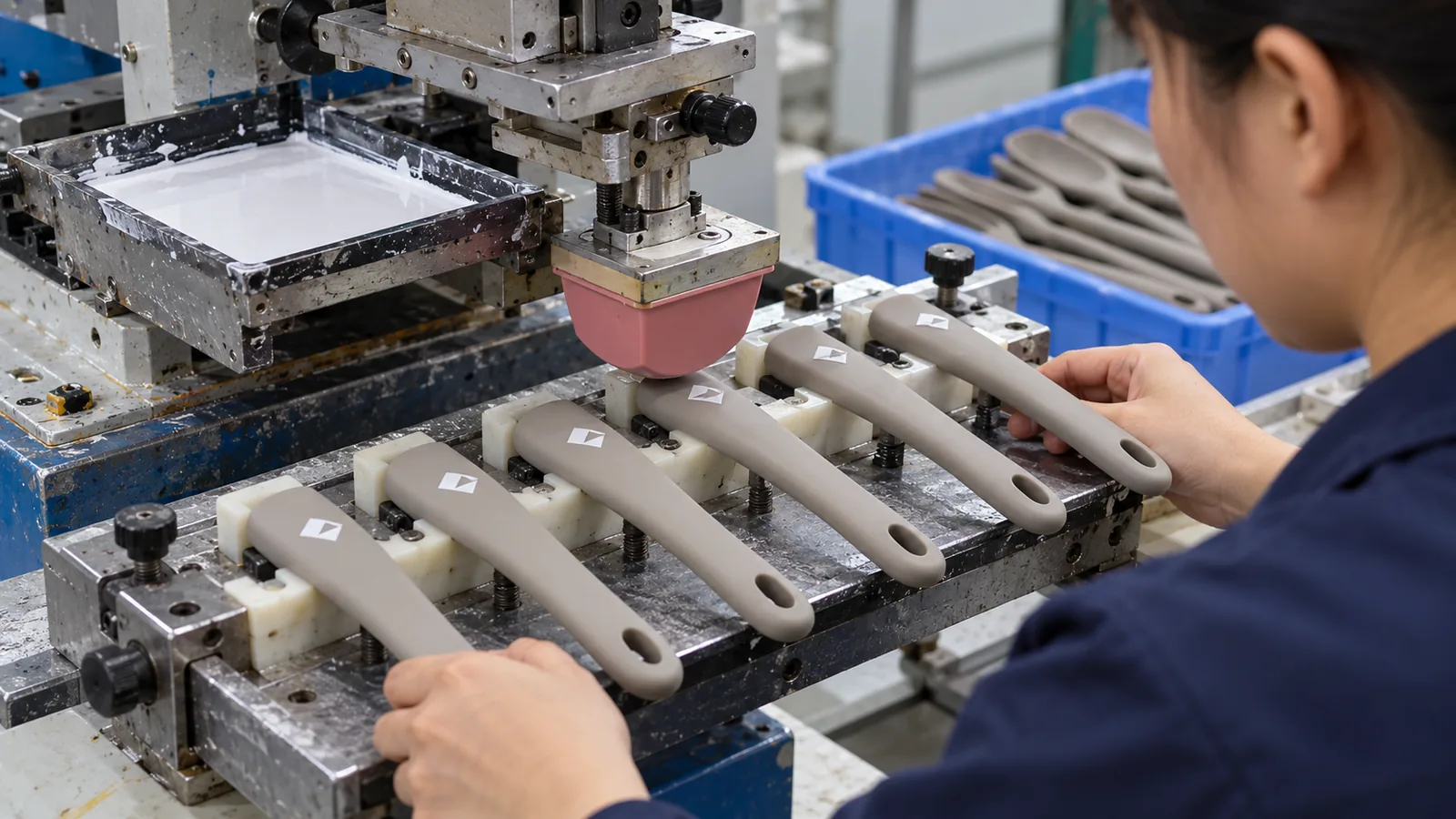
The factory should trial the reinforcement location and edge coverage with production-representative materials before the buyer approves a sellable sample. Record how the textile is cut, held and inspected, and identify whether a slipped insert can be detected before curing or only after trimming. For the all-silicone alternative, record the process conditions that affect thickness, shrinkage, handling and post-cure. A successful first sample is a design milestone, not proof that every cavity and color will repeat it.
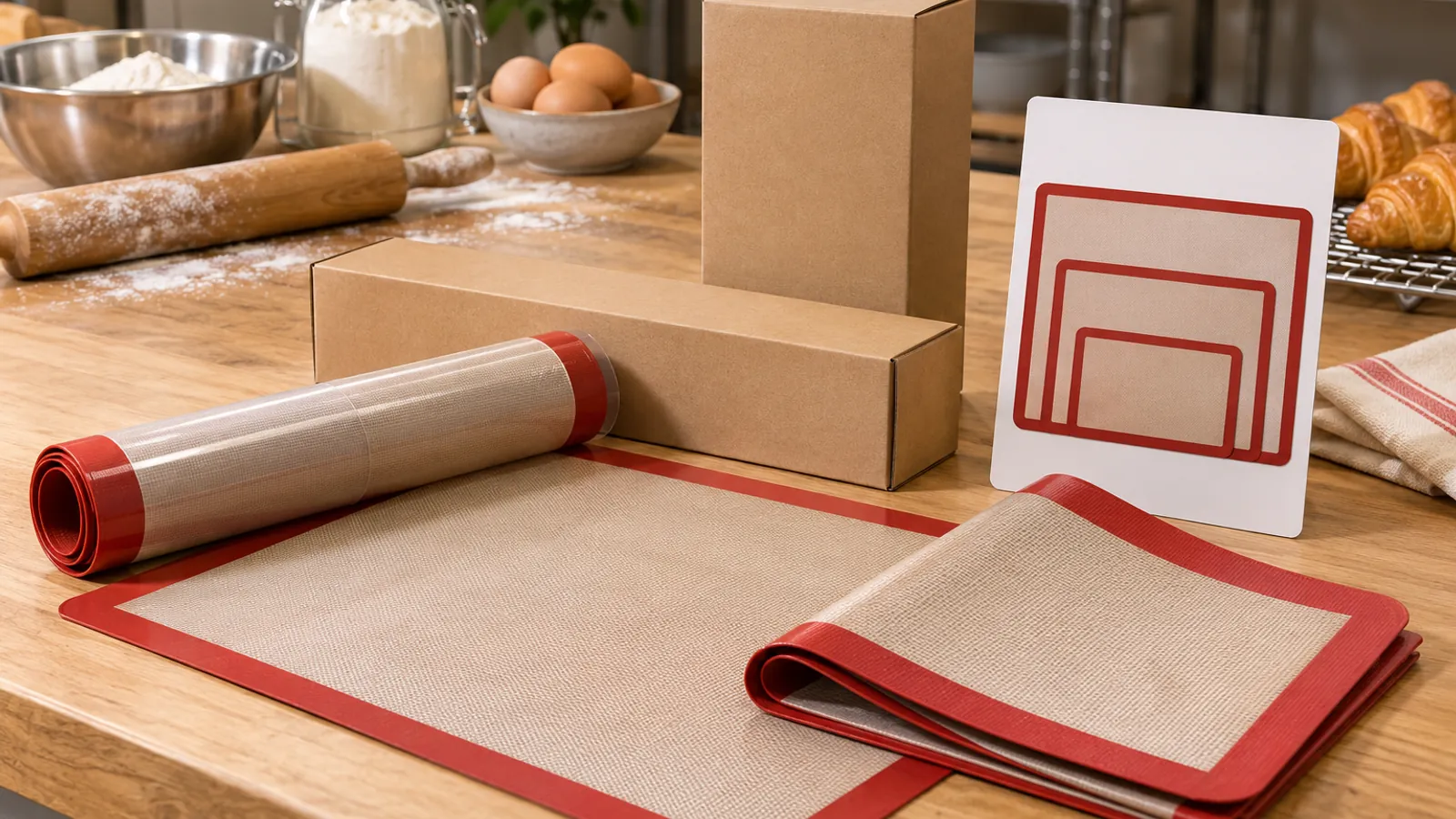
Packaging can reverse a good bench result. Measure the mat after the proposed roll, fold or flat-pack dwell, then check whether the sleeve causes a lasting curl, print transfer or edge compression. Compare carton cube, shelf presentation and freight volume using the real approved pack rather than a bare mat. A compact roll may save space but require a longer recovery interval before use, which changes customer experience and return risk.
Before the purchase order, define which dimensions, visual limits and functional outcomes will be checked at first-off, in process and at shipment. Approve a golden sample for each construction and critical size, then give inspectors a photo-based defect boundary for exposed fibers, tears, edge lift, print faults and contamination. Sampling can support lot release, but it cannot replace development validation of a material interface or a new claim. A factory that quotes both options should disclose the distinct quality-control steps for each.
SECTION 04
Select the Supply Route and Release Controls
Maintain an evidence file that remains usable when a material, color, process, supplier or destination market changes. Gate 4 links this construction question to an approved sample and acceptance record.
Review use-surface behavior
The release decision should be made from a side-by-side evidence pack. Include the use brief, drawings, construction sections, material and fabric identities, sample revisions, lay-flat and dimensional results, cleaning observations, food-contact scope, printed-artwork approval and packed-unit photographs. Score each candidate against the buyer's stated priorities, then document why the rejected option did not meet the program as well. This makes the decision defensible when retail, engineering and procurement teams value different attributes.
If the chosen construction changes later, reopen the affected approval gates instead of assuming the old report still applies. A new fabric supplier, border width, silicone compound, pigment, print process or package may alter the very result that justified the original selection. For a repeat order, compare the new first-off parts with retained references and verify the critical dimensions and defect limits before full production. Change control is particularly important when a retailer wants a new seasonal color without repeating every original test.
A practical RFQ is more useful than a request for “best quality pastry mat.” Provide the target size range, intended use, contact conditions, storage format, artwork, market, forecast and acceptance priorities, and ask the supplier to propose a reinforced and an unreinforced route where both are technically plausible. Request separate assumptions for tool ownership, sample rounds, evidence scope, minimum order quantities and packout. That gives the buyer a comparable decision, not two incomparable photographs and prices.
ACTION FRAMEWORK
Buyer Checklist Before Commercial Approval
Use this checklist as a meeting agenda. It is intentionally concise so the team can identify missing evidence without replacing its own quality, legal or supplier-management procedure.
| Check | Question | Why It Matters |
|---|---|---|
| Intended use | Is the mat for rolling, baking, cutting-adjacent work or several uses? | Claims and test methods change with the actual operation. |
| Construction | What is the silicone thickness, textile coverage and finished edge design? | The same retail label can describe materially different articles. |
| Lay-flat target | What edge and corner lift is acceptable after rolling and washing? | Fresh-sample flatness does not predict packed-state behavior. |
| Surface and print | Are release, cleaning and printed guide limits defined? | Stability alone does not establish usable bakery performance. |
| Evidence scope | Do reports identify the complete article, revision, market and use conditions? | Compound data cannot automatically approve fabric or decoration. |
| Commercial scope | Are tooling, fabric, yield, QC, packaging, MOQ and lead time normalized? | An incomplete quote can make the wrong construction appear cheaper. |
NEXT READING
Continue the Supplier and Product Review
These internal resources connect the guide with Naike Silicone product, factory, customization and inquiry pages. Open the route that matches the next decision in your project.
Explore silicone kitchen products
Use explore silicone kitchen products to resolve a specific mat-design question. Record the explore silicone kitchen products finding against the approved construction.
Open internal resource →Review custom silicone manufacturing
Use review custom silicone manufacturing to resolve a specific mat-design question. Record the review custom silicone manufacturing finding against the approved construction.
Open internal resource →Review quality-control capabilities
Use review quality-control capabilities to resolve a specific mat-design question. Record the review quality-control capabilities finding against the approved construction.
Open internal resource →Request a pastry-mat construction and RFQ review
Use request a pastry-mat construction and rfq review to resolve a specific mat-design question. Record the request a pastry-mat construction and rfq review finding against the approved construction.
Open internal resource →Review food-contact migration test conditions
Use review food-contact migration test conditions to resolve a specific mat-design question. Record the review food-contact migration test conditions finding against the approved construction.
Open internal resource →Compare household and commercial wash validation
Use compare household and commercial wash validation to resolve a specific mat-design question. Record the compare household and commercial wash validation finding against the approved construction.
Open internal resource →Review tensile, elongation and tear methods
Use review tensile, elongation and tear methods to resolve a specific mat-design question. Record the review tensile, elongation and tear methods finding against the approved construction.
Open internal resource →PRIMARY REFERENCES
Authoritative External Sources
The sources below are official primary references. Applicability depends on the product, intended use and destination market. Buyers should obtain qualified advice for final legal or regulatory decisions.
European Commission: Food Contact Materials
Official EU overview of food-contact material requirements; finished-product applicability depends on market, formulation and intended use. Check European Commission: Food Contact Materials against the actual pastry-mat construction and intended use before citing it as evidence.
FDA: Food types and conditions of use
Official FDA framework for food type and use conditions; it does not approve a finished silicone SKU or its mechanical performance. Check FDA: Food types and conditions of use against the actual pastry-mat construction and intended use before citing it as evidence.
ASTM D579/D579M woven glass fabric practice
Official ASTM practice for greige woven glass fabric characteristics; it is an incoming textile reference, not approval of a finished silicone pastry mat. Check ASTM D579/D579M woven glass fabric practice against the actual pastry-mat construction and intended use before citing it as evidence.
BUYER QUESTIONS
Frequently Asked Questions
Is a reinforced silicone pastry mat always more durable?
No. A core may improve in-plane dimensional stability, but edge encapsulation, textile placement, cleaning, cutting exposure and the finished construction determine the relevant failure modes. Compare both designs under the same intended-use protocol.
When might an unreinforced mat be the better choice?
It can suit a program that values simple construction, flexible handling or an all-silicone form, provided the approved thickness, border and process meet lay-flat and dimensional requirements. Validate the packed state as well as the fresh sample.
Should buyers permit exposed reinforcement at the edge?
Do not assume that an exposed yarn is acceptable. Define the finished edge, inspection method and defect classification, then evaluate the actual construction and destination-market food-contact scope before release.
Can a food-contact report for silicone compound approve both mats?
No. A material report does not necessarily cover textile, printing, pigments, processing or the finished article. Match evidence to the exact construction, sample identity, market and intended food-contact conditions.
How should lay-flat performance be compared?
Condition the same number of samples, place them on the specified surface without smoothing, measure edge and corner lift at agreed times, and repeat after the proposed roll or fold storage interval. Record temperature, rest time and package pressure.
May either mat be sold as cut resistant or oven safe?
Only with claim-specific finished-product evidence and clearly defined use limits. A generic silicone property or attractive kitchen image does not validate blade exposure, oven placement, temperature or service life.
What belongs in the first supplier RFQ?
Send dimensions, size mix, intended use, market, food-contact and thermal conditions, printing, packout, forecast and critical acceptance checks. Ask for separate construction, tooling, MOQ, sample, testing and unit-cost assumptions.
Editorial and Scope Note
Conclusion: Reinforced vs Unreinforced Silicone Pastry Mats
Move from buyer research to a controlled supplier brief
The right pastry-mat construction is the one that meets the buyer's named use, evidence scope and commercial constraints on representative finished samples. Reinforcement may improve a defined stability target, while an all-silicone design may simplify the interface, but neither label substitutes for edge, lay-flat, cleaning and packed-state validation. Send Naike Silicone the size matrix, intended use, destination, artwork, forecast and acceptance criteria to compare both routes with explicit tooling, sample, testing and packout assumptions.
This factory-insider guide supports sourcing preparation and supplier discussion for reinforced vs unreinforced silicone pastry mat. It does not replace product-specific engineering, laboratory, regulatory, legal or commercial review for the destination market.