CUSTOM MANUFACTURING & TOOLING
Silicone Family Mold Vs Dedicated Mold: Family Molds vs Dedicated Molds: Which Is Better for a Silicone Product Range?
Compare silicone family molds and dedicated molds for multi-SKU ranges: cavity balance, material and color compatibility, changeover, inspection, maintenance and total cost.
DIRECT ANSWER
What B2B Buyers Need to Know
Choose a family mold when related silicone SKUs can share material, color, cure conditions, cavity balance and a stable demand mix. Choose dedicated molds when sizes, volumes, change frequency or acceptance risks need independent control. Compare the complete tooling and operating cost, then validate every SKU and active cavity with production-representative samples before approving either route.
This guide is written for B2B importers, distributors, retailers, private-label brands, product developers, quality teams and sourcing managers. It provides a decision framework rather than legal advice or a universal specification. Product classification, use conditions and destination market should be confirmed before final testing, labelling or compliance decisions.
Key Takeaways
- A shared mold reduces tool count only if its SKUs can be molded together under compatible conditions.
- A family tool fixes a production mix unless cavities can be safely isolated or exchanged by design.
- Separate tools allow independent color, material, capacity, correction and maintenance decisions.
- Calculate good saleable pieces by SKU, not nominal cavities or total shots alone.
- Map trial samples by cavity and SKU, with functional and dimensional acceptance for each part.
- Write tool ownership, spare insert, revision and revalidation rules into the approval package.
Family Tool vs Dedicated Tools: Buyer Decision Matrix
These are conditional trade-offs, not universal cost rankings. The correct choice depends on the actual drawings, compound, color split, forecast, trial results and supplier process window.
| Decision | Family Mold | Dedicated Molds |
|---|---|---|
| Tool investment | One shared base may reduce duplicated hardware; complex balance or inserts can offset savings | More separate bases but each tool can be scoped and approved by SKU |
| SKU output mix | Usually tied to cavity allocation and shot count unless isolation is engineered | Each SKU can be scheduled and scaled independently |
| Material and color | Common process route and color are normally required in a shared shot | Different compound, hardness or color can be scheduled separately |
| Correction and maintenance | One cavity correction or downtime can affect the entire family | A problem can be isolated to its own tool, subject to shared machine capacity |
| Inspection and release | Every SKU and cavity still needs traceable evidence | Each tool needs its own first-off, inspection and change record |
SECTION 01
Define the Product Family and Shared Process Envelope
Convert the commercial concept into controlled dimensions, functions and approval criteria before DFM begins. Identify the proposed shared hardware and SKU output ratio before comparing quotes.
Freeze the family definition for silicone family mold vs dedicated mold
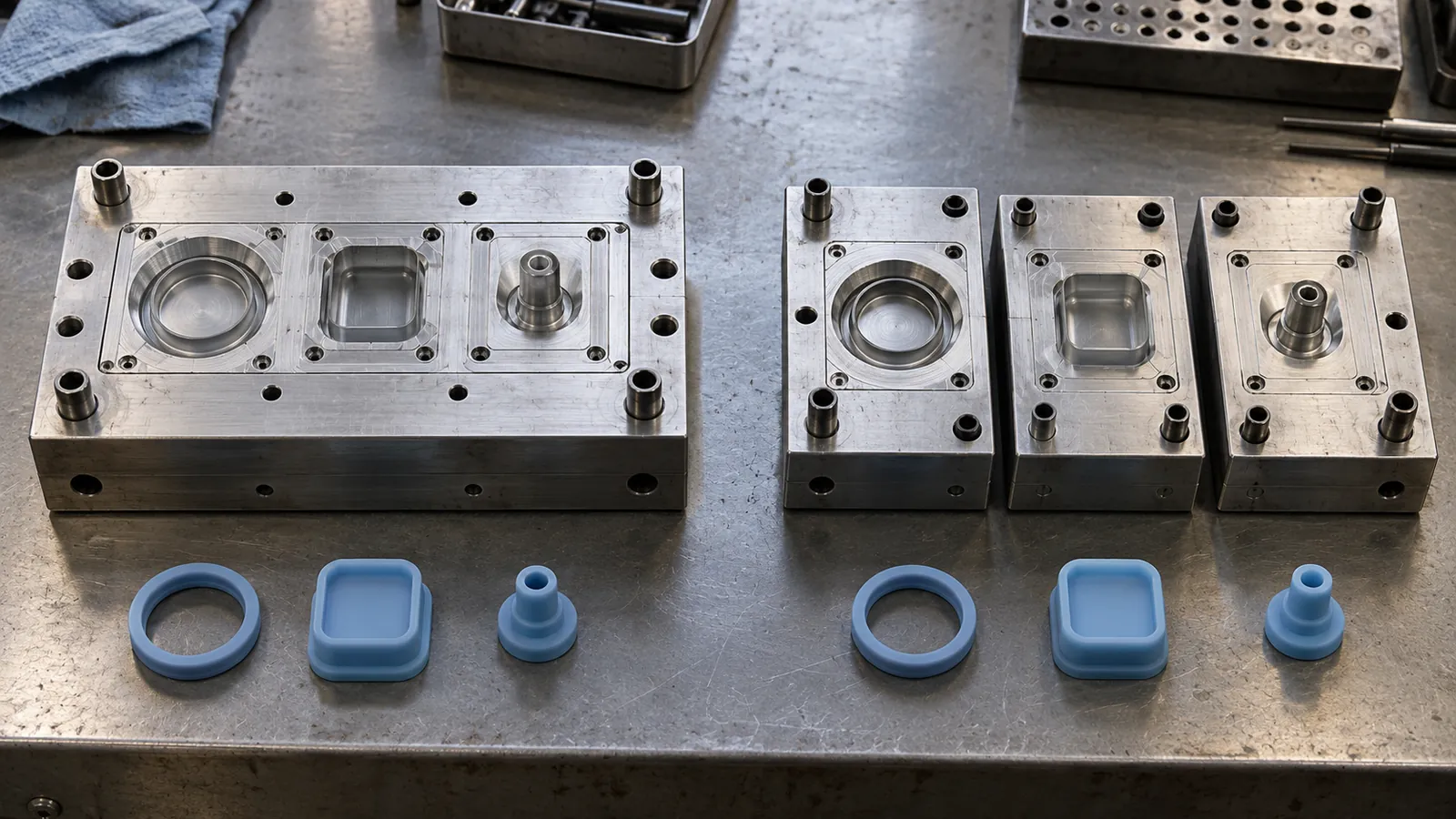
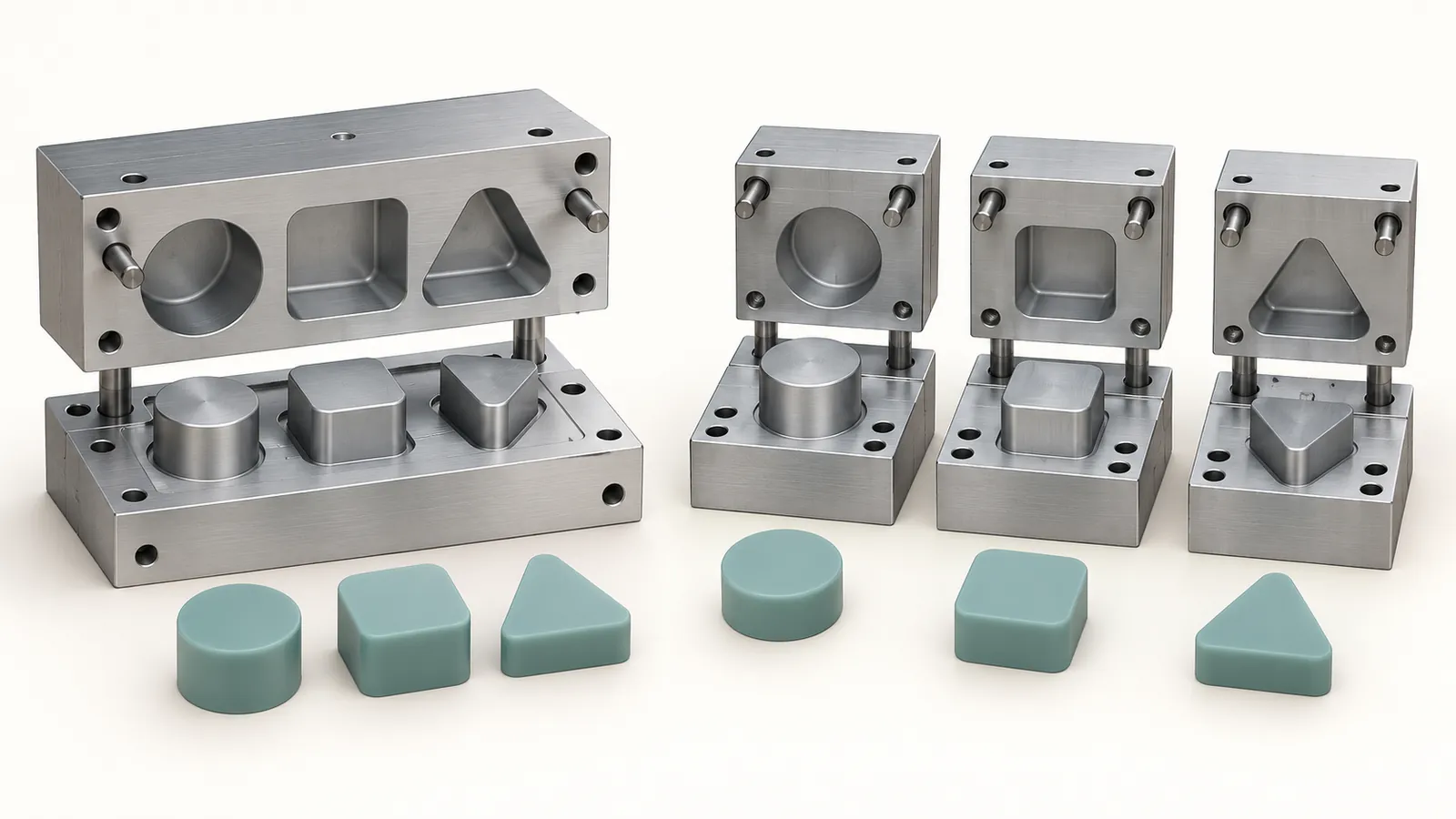
A family mold places two or more different product cavities in one tool and produces their parts in a linked molding cycle; that definition matters because a purchasing range is not automatically a manufacturable family: a ring, cap and tray sold together can have different sections, release directions, material needs and acceptance rules even if they share a brand color. We begin with an SKU-by-SKU drawing matrix that names function, part weight, critical dimensions, forecast, target color and planned revision date, then ask whether a common tool could run every cavity under one process window. A dedicated tool is not simply an expensive fallback; it is a way to separate manufacturing decisions when the proposed family has no stable technical or commercial center.
The word family can also hide several tool architectures that carry different risk; a fixed shared plate locks each cavity into a particular shot mix, an interchangeable-insert approach may permit planned substitutions, and a modular mold base can share hardware while still using distinct inserts or runs; none should be assumed without a drawing and a toolmaker review. Ask what is physically common, which part of the tool belongs to the buyer, and what must be disassembled to change one SKU. Two suppliers may both quote a family mold while one offers a fixed mixed-cavity plate and the other offers a more flexible but costlier insert system, making initial prices incomparable until the architecture is described.
Test process compatibility
Material compatibility is often the first technical gate; parts molded in the same shot normally share the compound, pigment, cure route and broad process settings, while different hardness targets or color families generally require separate runs or different tools. A buyer should not accept an assurance that every item in a range uses silicone as proof that the materials can be mixed in a family cavity. Ask the supplier to list each proposed formulation, hardness target, color split and any post-cure or finish requirement beside the SKU drawing. When one member needs a materially different route, a dedicated tool or staged modular strategy may be more practical than engineering compromises into the entire family.
Geometry compatibility is narrower than a shared material label; thick and thin sections can have different filling and cure behavior, while tall cores, delicate lips, deep textures or undercuts may require different venting, parting, release and handling. The mold designer should review where each cavity sits, how material reaches it, what determines the common cycle, and whether one part can be removed without deforming another. An easy cavity can produce attractive first samples while a difficult member drives flash, short fill or damage under a production-speed cycle. This is why the family layout should be treated as a DFM hypothesis with explicit trial questions, not as a guaranteed multiplier of tool capacity.
SECTION 02
Compare Cavity Balance, Changeover and Quality Risk
Close the process, material and mold decisions that determine tooling scope, trial evidence and revision cost. Test each cavity against its own drawing rather than a pooled family average.
Review flow and cure balance
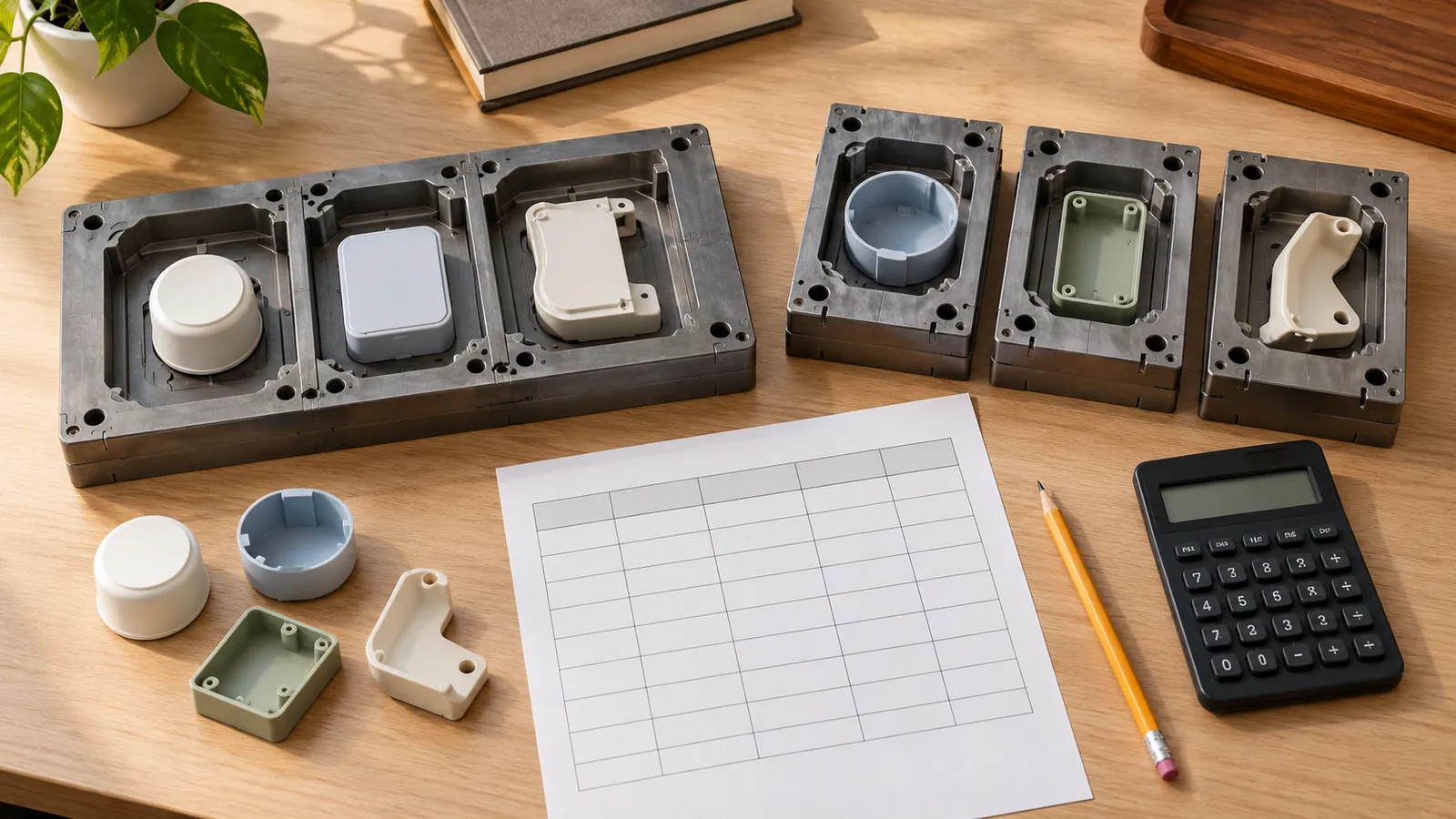
Cavity balance is a measurement problem, not merely a layout aesthetic; a multi-SKU family tool must deliver acceptable fill, venting, cure, dimensions, appearance and demolding across cavities that may have different volumes and wall sections. We would ask for a trial plan that maps each piece to its SKU, cavity location, material lot, color, tool revision and process condition, then checks the part against its own drawing and function. A pooled yield number can conceal that one SKU consistently needs trimming or sorting while another is stable. The approval record should retain raw observations so the buyer can see whether the shared process window works for the full family rather than only the best cavity.
The trial should include the conditions the factory expects to use commercially, not only a carefully tuned demonstration shot; compare first-off parts with a later run, record the active cavities and inspect the features that drive assembly, seal, grip, cleaning or package fit for each SKU. ISO 3302-1 describes dimensional-tolerance classes for solid molded rubber within its scope, but it does not select a family-mold layout or make one class suitable for every part in a mixed range. Where flexible parts are measured, the drawing should specify support, timing and contact method so a change in inspection technique is not mistaken for a cavity effect. A beautiful sample from each position is useful, but repeatable evidence under a defined method is what supports the release decision.
Plan changeover and correction
Changeover is where an apparently compact tool can become a scheduling constraint; if a family mold makes three SKUs at a fixed ratio, the factory may need to run all three when only one is ordered, or store the excess until it is sold. An insert-based design might change the ratio, but each change can require tool access, identification, setup, first-off checks and an approved instruction. A dedicated tool needs its own setup, yet can be put on a suitable machine for a single SKU and color without carrying unwanted companion output. Request a realistic changeover sequence and labor estimate for both routes, including cleaning, material or pigment changes, inspection and restart losses rather than a single undocumented setup-time number.
Tool correction has a different risk boundary in each architecture; a dimensionally weak cavity in a dedicated mold can usually be investigated and corrected while the other SKU tools remain physically unchanged; a shared tool may require removing the whole family from production, opening common steel or disturbing adjacent cavities. The mold design review should label steel-safe directions, replacement inserts, shared cooling or vent paths, and features that would require welding or a new component if the first correction fails. Record who pays for corrections and which approval samples must be repeated after each change. Without this map, an inexpensive common tool can shift the real cost of engineering iteration into unplanned downtime and a later dispute over responsibility.
SECTION 03
Model Tooling and Operating Cost by SKU
Treat each mold trial as a measured engineering gate rather than a visual sample-selection exercise. Model changeovers and corrections against the expected order mix.
Calculate saleable output by SKU
A proper cost model starts with the complete range rather than one mold invoice; list tool design and build, prototype or trial rounds, inserts, spare steel, validation, setup, cycle time, scrap, trimming, sorting, pack-out and storage, then assign each item to the affected SKU. Family tooling may reduce duplicated bases and some setup work, yet can force unwanted output or a slower common cycle; dedicated tooling can raise capital cost while reducing unit-level operational friction. Use a forecast that distinguishes launch demand from steady replenishment and include a low-volume scenario for a weak seller. The question is not which quotation has fewer digits today, but which route produces the needed saleable mix at acceptable risk across the expected program life.
Model the fixed output ratio visibly; suppose a shared tool has one cavity for each of three SKUs: every accepted shot produces one of each, regardless of whether purchase orders later request an uneven mix. Do not insert a convenient sales forecast into the quote and assume the ratio will remain balanced; ask the buyer's planning team for demand ranges, retailer minimums, color allocations and stockholding limits. If slower parts build inventory, include carrying cost, obsolete packaging, inspection at release from storage and possible disposal in the scenario. A modular insert or dedicated tool might change this result, but only after the supplier proves how a new cavity arrangement is validated and priced.
SECTION 04
Approve the Mold Architecture and Repeat-Order Controls
Release production only when drawings, golden samples, inspection records and change authority describe the same revision. Keep a cavity-specific release and revision record for repeat orders.
Release the chosen architecture
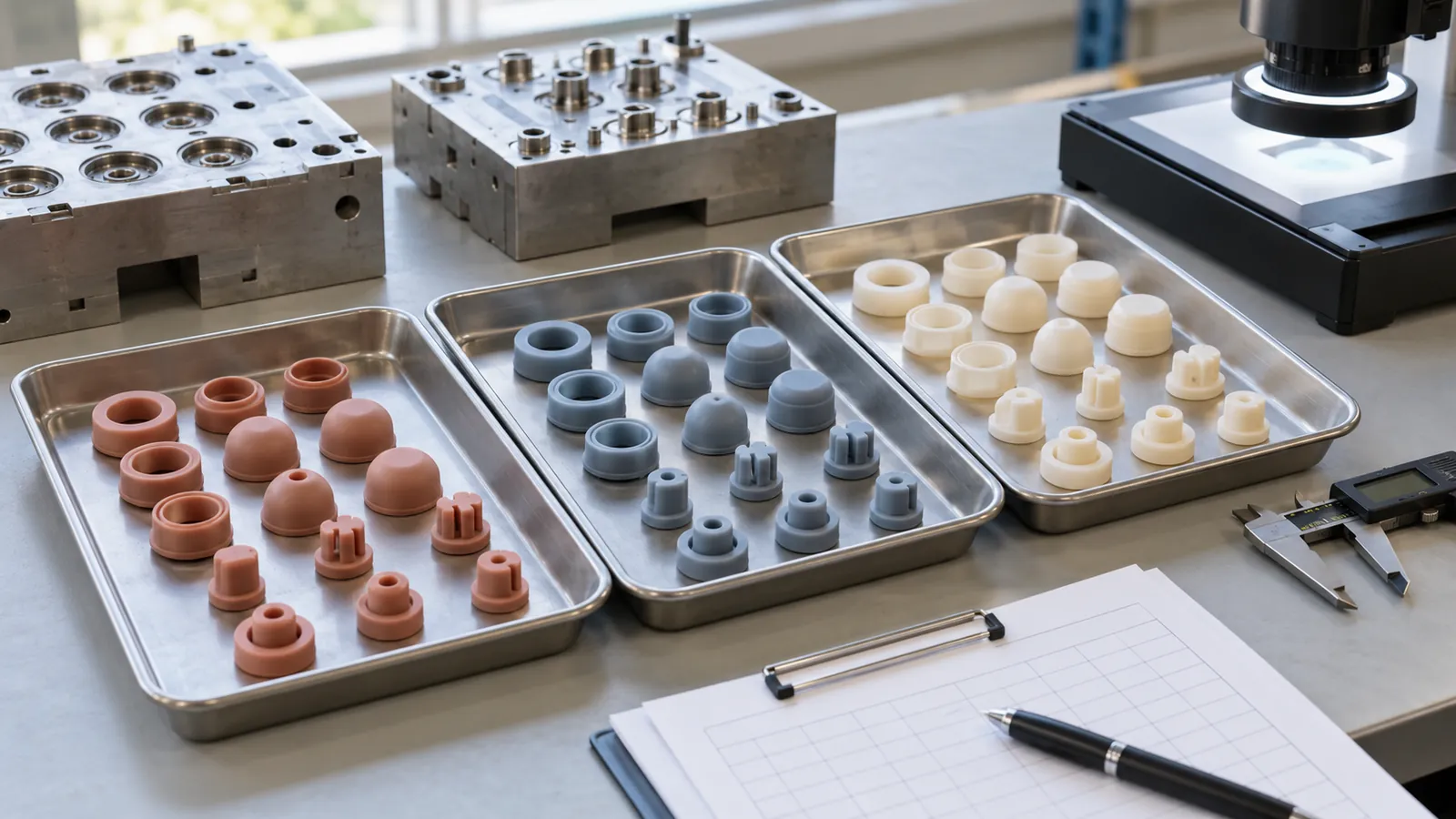
The tooling approval package should make the chosen architecture reconstructable by someone who did not attend the first DFM meeting; include SKU drawings, material and color matrix, cavity map, tool and insert IDs, process assumptions, trial records, inspection methods, accepted samples and the exact output mix the buyer expects. Each SKU needs its own acceptance decision, even if the parts come from one shared plate, because their functions and defects are not interchangeable. Where a trial is incomplete, label the open risk and owner rather than marking the whole family approved on the strength of its easiest part. This is the point at which a comparison article becomes a usable purchasing specification rather than a preference for fewer tools.
The release plan should also tell production what to do when demand or design changes; a new color, revised compound, shifted cavity ratio, local geometry correction, damaged insert or new packing configuration can change the approved basis; the buyer and supplier should agree which dimensional, functional and appearance checks must be repeated. Keep prior golden samples and raw data so the changed state can be compared with the original release, and identify who can authorize a deviation or a temporary cavity shutdown. ISO 23529 supplies general preparation and conditioning context for comparable rubber tests, but the whole-product inspection method still has to be documented for the actual SKU. A fixed change rule protects repeat orders better than a promise that the mold will simply keep running.
ACTION FRAMEWORK
Buyer Checklist Before Commercial Approval
Use this checklist as a meeting agenda. It is intentionally concise so the team can identify missing evidence without replacing its own quality, legal or supplier-management procedure.
| Check | Question | Why It Matters |
|---|---|---|
| SKU envelope | Which drawings, dimensions and functions are genuinely common? | Similar-looking parts may need incompatible cavities, loads or inspection methods. |
| Material and color | Can all SKUs share compound, hardness, pigment and cure route? | A shared shot cannot independently change material or color by cavity. |
| Demand mix | Will the forecast consume each family-mold SKU in its fixed cavity ratio? | Unwanted output, sorting and stock can erase a tooling saving. |
| Cavity balance | How will fill, vent, cure and demolding be proven for every SKU? | One easy part can mask a marginal cavity in the same cycle. |
| Change control | Can one part be corrected, isolated or replaced without changing others? | Shared steel can amplify correction and maintenance risk. |
| Lifecycle cost | Are tooling, yield, labor, sorting, changeover and inventory modeled by SKU? | Comparing only initial mold price produces an incomplete business case. |
NEXT READING
Continue the Supplier and Product Review
These internal resources connect the guide with Naike Silicone product, factory, customization and inquiry pages. Open the route that matches the next decision in your project.
Review silicone cavity-count selection
Use review silicone cavity-count selection to resolve its specific cavity, trial or tooling-approval question. Record the review silicone cavity-count selection finding against the current SKU matrix.
Open internal resource →Review silicone shrinkage and tolerance
Use review silicone shrinkage and tolerance to resolve its specific cavity, trial or tooling-approval question. Record the review silicone shrinkage and tolerance finding against the current SKU matrix.
Open internal resource →Review T0, T1 and T2 sample approval
Use review t0, t1 and t2 sample approval to resolve its specific cavity, trial or tooling-approval question. Record the review t0, t1 and t2 sample approval finding against the current SKU matrix.
Open internal resource →Review silicone mold maintenance
Use review silicone mold maintenance to resolve its specific cavity, trial or tooling-approval question. Record the review silicone mold maintenance finding against the current SKU matrix.
Open internal resource →Review custom silicone molding services
Use review custom silicone molding services to resolve its specific cavity, trial or tooling-approval question. Record the review custom silicone molding services finding against the current SKU matrix.
Open internal resource →Review manufacturing quality controls
Use review manufacturing quality controls to resolve its specific cavity, trial or tooling-approval question. Record the review manufacturing quality controls finding against the current SKU matrix.
Open internal resource →Explore all product categories
Use explore all product categories to resolve its specific cavity, trial or tooling-approval question. Record the explore all product categories finding against the current SKU matrix.
Open internal resource →Request a family-mold DFM review
Use request a family-mold dfm review to resolve its specific cavity, trial or tooling-approval question. Record the request a family-mold dfm review finding against the current SKU matrix.
Open internal resource →PRIMARY REFERENCES
Authoritative External Sources
The sources below are official primary references. Applicability depends on the product, intended use and destination market. Buyers should obtain qualified advice for final legal or regulatory decisions.
ISO 3302-1:2014 rubber dimensional tolerances
Official scope and dimensional-tolerance classes for solid molded rubber; it does not choose a mold architecture or authorize a particular SKU tolerance. Check the scope of ISO 3302-1:2014 rubber dimensional tolerances against this exact material, tool and SKU release before treating it as evidence of product conformity.
ISO 23529:2016 rubber test-piece conditioning
Official preparation and conditioning context for comparable rubber measurements; finished-product acceptance remains project-specific. Check the scope of ISO 23529:2016 rubber test-piece conditioning against this exact material, tool and SKU release before treating it as evidence of product conformity.
ISO 55000:2024 asset management
Official lifecycle asset-management principles relevant to documenting tool custody and maintenance; not a mold-design or ownership contract. Check the scope of ISO 55000:2024 asset management against this exact material, tool and SKU release before treating it as evidence of product conformity.
ISO quality management systems introduction
Official process-and-responsibility context; this source does not establish supplier certification or product conformance. Check the scope of ISO quality management systems introduction against this exact material, tool and SKU release before treating it as evidence of product conformity.
BUYER QUESTIONS
Frequently Asked Questions
Is a family mold always cheaper than separate molds?
No. A shared base can reduce some initial hardware cost, but balancing, inserts, unwanted SKU output, sorting, scrap, maintenance and inventory can outweigh that saving. Compare full-program scenarios.
Can one family mold make different colors or hardnesses at the same time?
A shared shot normally uses one compound and color route. Different grades, hardness targets or colors generally require separate runs or tools; ask the toolmaker to document any proposed exception and validation.
What happens when the SKU demand mix changes?
A fixed mixed-cavity plate keeps its output ratio unless isolation or replacement has been engineered and validated. Dedicated molds can be scheduled more independently, subject to factory capacity.
How do we test a family mold fairly?
Map parts by SKU, cavity, material lot, tool revision and process setting. Evaluate each product against its own drawing, measurement method, function and cosmetic acceptance over production-representative runs.
Can one cavity be corrected without affecting the others?
Sometimes, depending on the tool layout, inserts and shared features. Request a cavity-specific correction and revalidation map before approving the architecture; do not assume isolation is free or feasible.
Does a family mold need one acceptance sample or one per SKU?
Retain identified samples and approval evidence for every SKU and active cavity. One attractive sample cannot establish the dimensional, functional or appearance performance of the whole family.
When are dedicated molds the safer choice?
They are often preferable when compounds or colors differ, one SKU has a much higher volume, correction risk is localized, or launch and replenishment schedules need independent control. Validate the specific case rather than relying on a general rule.
Editorial and Scope Note
Conclusion: Family Molds vs Dedicated Molds
Move from buyer research to a controlled supplier brief
Treat mold architecture as a lifetime program choice rather than a tooling-price contest. Send Naike Silicone the SKU drawings, material and color matrix, expected mix, annual forecast, acceptance limits and launch sequence to compare a family tool with dedicated alternatives under explicit assumptions. Approve the route only after cavity-mapped trials and a signed plan for correction, maintenance and repeat-order changes.
This factory-insider guide supports sourcing preparation and supplier discussion for silicone family mold vs dedicated mold. It does not replace product-specific engineering, laboratory, regulatory, legal or commercial review for the destination market.