CUSTOM MANUFACTURING & TOOLING
Silicone Product Acceptance Criteria: How to Set Acceptance Criteria for Custom Silicone Products
Set silicone product acceptance criteria for drawings, appearance, dimensions, function, sampling, evidence, release authority and repeat-order control.

DIRECT ANSWER
What B2B Buyers Need to Know
Silicone product acceptance criteria should convert the buyer's intended use into measurable drawing requirements, visual defect limits, dimensional tolerances, functional test methods, sampling rules and release authority for one controlled SKU. Agree the methods before tooling trials, approve representative boundary samples, record raw results and require reapproval whenever material, color, tooling, process or packaging changes could affect performance.
This guide is written for B2B importers, distributors, retailers, private-label brands, product developers, quality teams and sourcing managers. It provides a decision framework rather than legal advice or a universal specification. Product classification, use conditions and destination market should be confirmed before final testing, labelling or compliance decisions.
Key Takeaways
- Start with intended use and failure risk, not a generic factory inspection template.
- Tie every criterion to one drawing revision, compound, color, tooling state and sale unit.
- Use measurable defect boundaries and approved limit samples for visual decisions.
- Define fixtures, conditioning, sequence and pass limits before functional testing begins.
- Separate development approval, production sampling and shipment release responsibilities.
- Require documented review when materials, tools, processes, suppliers or packaging change.
Acceptance Criteria Architecture for Custom Silicone Products
A release plan works only when each requirement names the sample, method, limit, evidence and decision owner. These layers should stay connected to the same SKU revision.
| Control Layer | Buyer Must Define | Release Evidence |
|---|---|---|
| Identity baseline | Drawing, compound, hardness, color, cavity, decoration and packaging revision | Controlled specification, approved sample and traceability record |
| Visual quality | Flash, short fill, contamination, color, texture, marks and distortion boundaries | Defect catalogue, limit samples, lighting and viewing method |
| Dimensions | Critical-to-function features, tolerance, datum, instrument and conditioning | Measurement record tied to calibrated equipment and sample identity |
| Function | Fixture, load, temperature, media, sequence, cycles and pass limits | Raw observations, photos, deviations and signed conclusion |
| Lot release | Sampling level, defect classes, acceptance numbers and escalation route | Inspection report, disposition and authorized shipment release |
SECTION 01
Build the Intended-Use and Risk Baseline
Convert the commercial concept into controlled dimensions, functions and approval criteria before DFM begins. Record the decision owner, applicable silicone product acceptance criteria revision and evidence required before the next gate.
Define the Intended Use and Approval Decision: Custom Silicone Product Acceptance Criteria for silicone product acceptance criteria
At the engineering gate, “Define the Intended Use and Approval Decision: Custom Silicone Product Acceptance Criteria” must move from a visual preference into a measurable design decision. Translate intended use, drawing requirements, visual limits, functional checks, sampling, evidence and release authority into measurable criteria for the exact silicone SKU, with the 1th gate assigned to a named buyer or supplier owner. For this decision, the team should identify who approves the requirement, how it will be measured and which later decisions depend on it.
During supplier review, the buyer should request retain the current drawing, sample identity, review notes, method, raw result and approval record that support this silicone product acceptance criteria decision. The unresolved exposure is if this gate is skipped, the team may compare different assumptions or apply evidence beyond the product, lot, condition or market it actually covers. Link the record to the current SKU revision and name the person authorized to release it.
Freeze the Drawing, Material and Sample Baseline: Custom Silicone Product Acceptance Criteria
A tooling project becomes easier to control when “Freeze the Drawing, Material and Sample Baseline: Custom Silicone Product Acceptance Criteria” is resolved before steel release and first-article trials. Translate intended use, drawing requirements, visual limits, functional checks, sampling, evidence and release authority into measurable criteria for the exact silicone SKU, with the 2th gate assigned to a named buyer or supplier owner. For this decision, this makes quotations more comparable because every potential supplier is responding to the same operating assumptions.
The approval file should contain retain the current drawing, sample identity, review notes, method, raw result and approval record that support this silicone product acceptance criteria decision. The unresolved exposure is if this gate is skipped, the team may compare different assumptions or apply evidence beyond the product, lot, condition or market it actually covers. Date the approval and preserve the conditions under which the evidence remains applicable.
SECTION 02
Write Measurable Product and Appearance Criteria
Close the process, material and mold decisions that determine tooling scope, trial evidence and revision cost. Record the decision owner, applicable silicone product acceptance criteria revision and evidence required before the next gate.
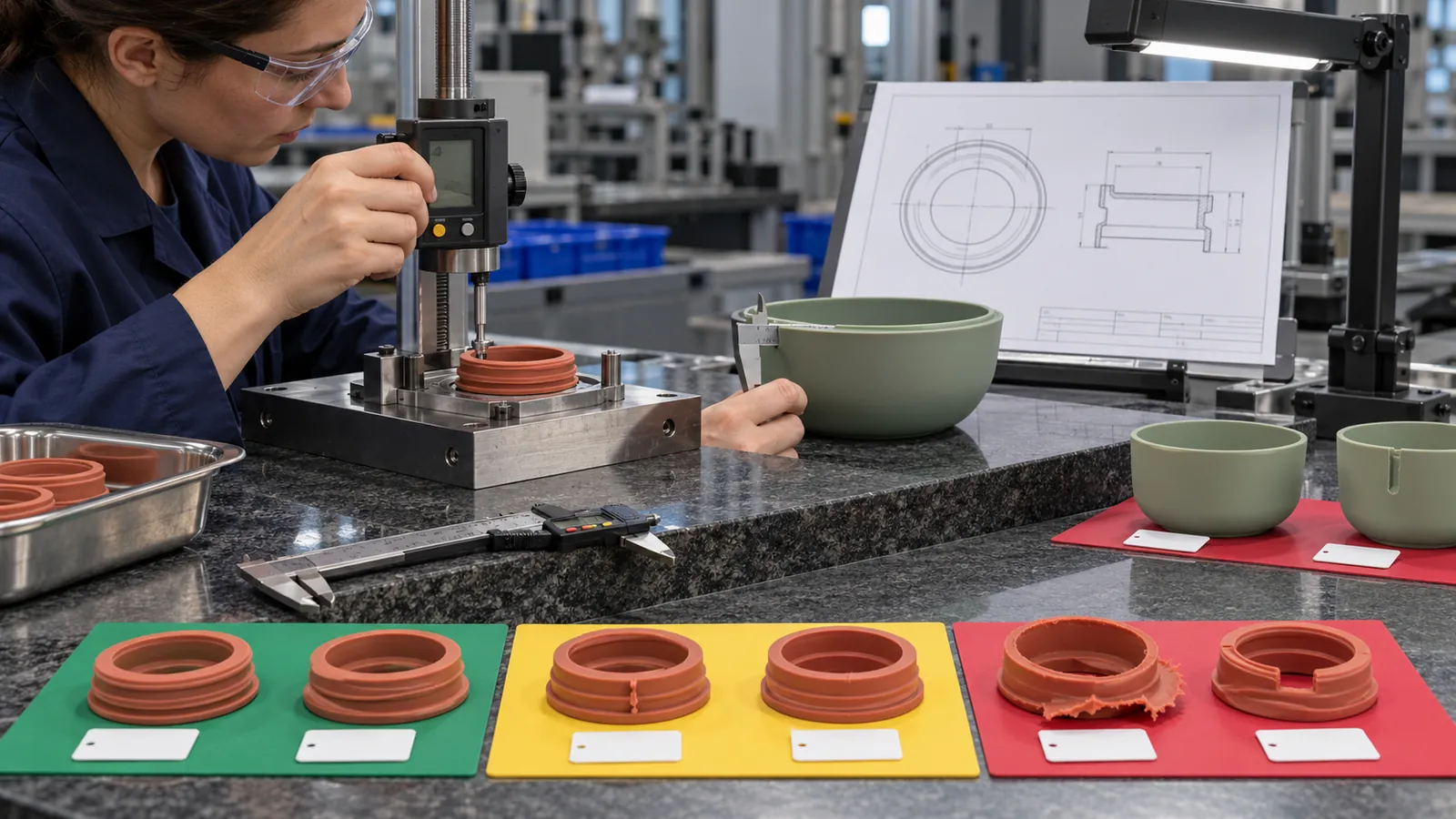
Convert Visual Language into Defect Boundaries: Custom Silicone Product Acceptance Criteria
The DFM review should expose the trade-offs around “Convert Visual Language into Defect Boundaries: Custom Silicone Product Acceptance Criteria” while changes are still economical. Translate intended use, drawing requirements, visual limits, functional checks, sampling, evidence and release authority into measurable criteria for the exact silicone SKU, with the 3th gate assigned to a named buyer or supplier owner. For this decision, a clear baseline also helps the supplier explain any trade-off instead of silently selecting the easiest manufacturing option.
Before the next project gate, both parties should agree on retain the current drawing, sample identity, review notes, method, raw result and approval record that support this silicone product acceptance criteria decision. The unresolved exposure is if this gate is skipped, the team may compare different assumptions or apply evidence beyond the product, lot, condition or market it actually covers. Record any deviation separately and prevent it from becoming an undocumented repeat-order precedent.
Build Dimensional and Functional Test Methods: Custom Silicone Product Acceptance Criteria
At the engineering gate, “Build Dimensional and Functional Test Methods: Custom Silicone Product Acceptance Criteria” must move from a visual preference into a measurable design decision. Translate intended use, drawing requirements, visual limits, functional checks, sampling, evidence and release authority into measurable criteria for the exact silicone SKU, with the 4th gate assigned to a named buyer or supplier owner. For this decision, the requirement becomes useful only when it can be converted into a drawing, sample, record or repeatable check.
The evidence package is stronger when it includes retain the current drawing, sample identity, review notes, method, raw result and approval record that support this silicone product acceptance criteria decision. The unresolved exposure is if this gate is skipped, the team may compare different assumptions or apply evidence beyond the product, lot, condition or market it actually covers. Carry the approved limit into the inspection instruction rather than leaving it only in meeting notes.
SECTION 03
Design the Validation, Sampling and Evidence Plan
Treat each mold trial as a measured engineering gate rather than a visual sample-selection exercise. Record the decision owner, applicable silicone product acceptance criteria revision and evidence required before the next gate.
Set Sampling, Evidence and Escalation Rules: Custom Silicone Product Acceptance Criteria
From a mold-development perspective, “Set Sampling, Evidence and Escalation Rules: Custom Silicone Product Acceptance Criteria” affects geometry, process stability and the correction loop at the same time. Translate intended use, drawing requirements, visual limits, functional checks, sampling, evidence and release authority into measurable criteria for the exact silicone SKU, with the 5th gate assigned to a named buyer or supplier owner. For this decision, a named decision owner prevents an open requirement from moving unnoticed into tooling or shipment release.
The buyer's release packet should preserve retain the current drawing, sample identity, review notes, method, raw result and approval record that support this silicone product acceptance criteria decision. The unresolved exposure is if this gate is skipped, the team may compare different assumptions or apply evidence beyond the product, lot, condition or market it actually covers. Reference the applicable drawing and order so evidence from another configuration is not substituted.
SECTION 04
Release Production and Protect Repeat Orders
Release production only when drawings, golden samples, inspection records and change authority describe the same revision. Record the decision owner, applicable silicone product acceptance criteria revision and evidence required before the next gate.
Release the SKU and Control Every Change: Custom Silicone Product Acceptance Criteria
A tooling project becomes easier to control when “Release the SKU and Control Every Change: Custom Silicone Product Acceptance Criteria” is resolved before steel release and first-article trials. Translate intended use, drawing requirements, visual limits, functional checks, sampling, evidence and release authority into measurable criteria for the exact silicone SKU, with the 6th gate assigned to a named buyer or supplier owner. For this decision, a measurable gate lets the team close the issue with evidence instead of relying on an undocumented verbal decision.
For repeat-order comparability, archive retain the current drawing, sample identity, review notes, method, raw result and approval record that support this silicone product acceptance criteria decision. The unresolved exposure is if this gate is skipped, the team may compare different assumptions or apply evidence beyond the product, lot, condition or market it actually covers. Close the decision with a revision-controlled record that can guide production and the next reorder.

ACTION FRAMEWORK
Buyer Checklist Before Commercial Approval
Use this checklist as a meeting agenda. It is intentionally concise so the team can identify missing evidence without replacing its own quality, legal or supplier-management procedure.
| Check | Question | Why It Matters |
|---|---|---|
| Intended use | Are user, environment, contact, temperature, cleaning and foreseeable misuse documented? | Acceptance limits need a defined product risk and use boundary. |
| SKU identity | Do drawing, compound, hardness, pigment, cavity, decoration and pack share one revision? | Evidence cannot reliably release a different configuration. |
| Visual limits | Are defect types, zones, viewing conditions and boundary samples approved? | Words such as clean or minor are not repeatable inspection rules. |
| Dimensions | Are critical features, datums, conditioning and measurement methods specified? | A tolerance without a method can produce conflicting results. |
| Function | Are fixtures, sequence, exposure, cycles and pass limits agreed before testing? | Changing the method after results appear undermines the decision. |
| Sampling | Are defect classes, sample size, acceptance numbers and escalation responsibilities written? | Lot release requires a consistent decision rule, not ad hoc judgement. |
| Evidence | Will raw observations, deviations, photos, reports and retained samples remain traceable? | A pass statement alone cannot support investigation or repeat orders. |
| Change control | Which material, tool, process, supplier or packaging changes trigger reapproval? | Approved performance can be altered by changes outside the drawing. |
NEXT READING
Continue the Supplier and Product Review
These internal resources connect the guide with Naike Silicone product, factory, customization and inquiry pages. Open the route that matches the next decision in your project.
Review custom silicone molding options
Use review custom silicone molding options to gather the next level of product, manufacturing or commercial information. Connect the result to the current silicone product acceptance criteria revision and next approval action.
Open internal resource →Review Naike Silicone quality-control capabilities
Use review naike silicone quality-control capabilities to gather the next level of product, manufacturing or commercial information. Connect the result to the current silicone product acceptance criteria revision and next approval action.
Open internal resource →Understand the OEM and ODM workflow
Use understand the oem and odm workflow to gather the next level of product, manufacturing or commercial information. Connect the result to the current silicone product acceptance criteria revision and next approval action.
Open internal resource →Review silicone tooling approval gates
Use review silicone tooling approval gates to gather the next level of product, manufacturing or commercial information. Connect the result to the current silicone product acceptance criteria revision and next approval action.
Open internal resource →Review golden and pre-production sample control
Use review golden and pre-production sample control to gather the next level of product, manufacturing or commercial information. Connect the result to the current silicone product acceptance criteria revision and next approval action.
Open internal resource →Request an acceptance-criteria review
Use request an acceptance-criteria review to gather the next level of product, manufacturing or commercial information. Connect the result to the current silicone product acceptance criteria revision and next approval action.
Open internal resource →PRIMARY REFERENCES
Authoritative External Sources
The sources below are official primary references. Applicability depends on the product, intended use and destination market. Buyers should obtain qualified advice for final legal or regulatory decisions.
WIPO: Industrial designs
Official WIPO overview of industrial-design protection; ownership and freedom-to-operate questions require project-specific review. Confirm applicability against the listed product, revision, intended use and destination before relying on it for approval.
ISO: Quality management principles
Official ISO overview of process-based quality management; it does not certify an individual product or supplier. Confirm applicability against the listed product, revision, intended use and destination before relying on it for approval.
ISO 2859-1:2026 lot-by-lot inspection
Official ISO page for attribute sampling schemes; the buyer must define defects, inspection level and release authority. Confirm applicability against the listed product, revision, intended use and destination before relying on it for approval.
BUYER QUESTIONS
Frequently Asked Questions
What should a buyer confirm first for silicone product acceptance criteria?
Translate intended use, drawing requirements, visual limits, functional checks, sampling, evidence and release authority into measurable criteria for the exact silicone SKU, with the 1th gate assigned to a named buyer or supplier owner as the first controlled decision in the buyer's review. Support that review with retain the current drawing, sample identity, review notes, method, raw result and approval record that support this silicone product acceptance criteria decision. The exact depth for define the intended use and approval decision: custom silicone product acceptance criteria depends on product use, market, order value and whether the program uses an existing design or new tooling. Keep this decision linked to the current SKU revision, and reassess define the intended use and approval decision: custom silicone product acceptance criteria whenever material, design, color, process, packaging or destination-market assumptions change.
How should buyers review freeze the drawing, material and sample baseline: custom silicone product acceptance criteria?
Translate intended use, drawing requirements, visual limits, functional checks, sampling, evidence and release authority into measurable criteria for the exact silicone SKU, with the 2th gate assigned to a named buyer or supplier owner as the first controlled decision in the buyer's review. Support that review with retain the current drawing, sample identity, review notes, method, raw result and approval record that support this silicone product acceptance criteria decision. The exact depth for freeze the drawing, material and sample baseline: custom silicone product acceptance criteria depends on product use, market, order value and whether the program uses an existing design or new tooling. Keep this decision linked to the current SKU revision, and reassess freeze the drawing, material and sample baseline: custom silicone product acceptance criteria whenever material, design, color, process, packaging or destination-market assumptions change.
How should buyers review convert visual language into defect boundaries: custom silicone product acceptance criteria?
Translate intended use, drawing requirements, visual limits, functional checks, sampling, evidence and release authority into measurable criteria for the exact silicone SKU, with the 3th gate assigned to a named buyer or supplier owner as the first controlled decision in the buyer's review. Support that review with retain the current drawing, sample identity, review notes, method, raw result and approval record that support this silicone product acceptance criteria decision. The exact depth for convert visual language into defect boundaries: custom silicone product acceptance criteria depends on product use, market, order value and whether the program uses an existing design or new tooling. Keep this decision linked to the current SKU revision, and reassess convert visual language into defect boundaries: custom silicone product acceptance criteria whenever material, design, color, process, packaging or destination-market assumptions change.
How should buyers review build dimensional and functional test methods: custom silicone product acceptance criteria?
Translate intended use, drawing requirements, visual limits, functional checks, sampling, evidence and release authority into measurable criteria for the exact silicone SKU, with the 4th gate assigned to a named buyer or supplier owner as the first controlled decision in the buyer's review. Support that review with retain the current drawing, sample identity, review notes, method, raw result and approval record that support this silicone product acceptance criteria decision. The exact depth for build dimensional and functional test methods: custom silicone product acceptance criteria depends on product use, market, order value and whether the program uses an existing design or new tooling. Keep this decision linked to the current SKU revision, and reassess build dimensional and functional test methods: custom silicone product acceptance criteria whenever material, design, color, process, packaging or destination-market assumptions change.
How should buyers review set sampling, evidence and escalation rules: custom silicone product acceptance criteria?
Translate intended use, drawing requirements, visual limits, functional checks, sampling, evidence and release authority into measurable criteria for the exact silicone SKU, with the 5th gate assigned to a named buyer or supplier owner as the first controlled decision in the buyer's review. Support that review with retain the current drawing, sample identity, review notes, method, raw result and approval record that support this silicone product acceptance criteria decision. The exact depth for set sampling, evidence and escalation rules: custom silicone product acceptance criteria depends on product use, market, order value and whether the program uses an existing design or new tooling. Keep this decision linked to the current SKU revision, and reassess set sampling, evidence and escalation rules: custom silicone product acceptance criteria whenever material, design, color, process, packaging or destination-market assumptions change.
How should buyers review release the sku and control every change: custom silicone product acceptance criteria?
Translate intended use, drawing requirements, visual limits, functional checks, sampling, evidence and release authority into measurable criteria for the exact silicone SKU, with the 6th gate assigned to a named buyer or supplier owner as the first controlled decision in the buyer's review. Support that review with retain the current drawing, sample identity, review notes, method, raw result and approval record that support this silicone product acceptance criteria decision. The exact depth for release the sku and control every change: custom silicone product acceptance criteria depends on product use, market, order value and whether the program uses an existing design or new tooling. Keep this decision linked to the current SKU revision, and reassess release the sku and control every change: custom silicone product acceptance criteria whenever material, design, color, process, packaging or destination-market assumptions change.
Editorial and Scope Note
Conclusion: Custom Silicone Product Acceptance Criteria
Move from buyer research to a controlled supplier brief
Silicone product acceptance criteria are the operating contract between the buyer's intended use and the factory's release decision. Freeze the SKU identity, define visual and dimensional boundaries, agree functional methods before trials, connect sampling to defect risk, preserve raw evidence and require change review. Share your drawing, application, destination market, test expectations and packaging plan with Naike Silicone to build a product-specific approval matrix before tooling or bulk production.
This factory-insider guide supports sourcing preparation and supplier discussion for silicone product acceptance criteria. It does not replace product-specific engineering, laboratory, regulatory, legal or commercial review for the destination market.