PRODUCT SOURCING GUIDES
Are Silicone Bibs Safe for Daily Baby Feeding?
Are silicone bibs safe for daily baby feeding? A factory-insider buyer guide to neck fit, closure, pocket hygiene, finished-product evidence, cleaning and market-specific claims.
DIRECT ANSWER
What B2B Buyers Need to Know
Silicone bibs can be suitable for daily baby feeding when the finished design, material, closure, fit and cleaning instructions are evaluated for the intended child and market. Silicone alone does not prove safety. Buyers should verify neck clearance, detachable-part risks, pocket integrity, cleanability and traceable product evidence, then approve claims only for the tested revision and conditions.
This guide is written for B2B importers, distributors, retailers, private-label brands, product developers, quality teams and sourcing managers. It provides a decision framework rather than legal advice or a universal specification. Product classification, use conditions and destination market should be confirmed before final testing, labelling or compliance decisions.
Key Takeaways
- Treat safety as a finished-bib decision, not a property inferred from a silicone material label.
- Define the age range, use setting, supervision, neck adjustment and closure design before choosing tests.
- Inspect the pocket, edges and fasteners after realistic flexing and cleaning, not only on a first sample.
- Separate material identity, applicable food-contact evidence and children's-product obligations by destination market.
- Tie validation results to the exact color, component construction, drawing revision and packed SKU.
- Use approved care instructions and change control to protect the release through repeat orders.
Silicone Bib Safety Evidence by Decision
A material statement, physical product check and market document answer different questions. Require the supplier to identify the exact sample and use condition behind each conclusion.
| Decision | Evidence to Request | What It Does Not Prove |
|---|---|---|
| Material and composition | Compound identity, color-system traceability and applicable supplier declarations | Neck fit, closure retention or pocket cleaning performance |
| Finished-bib function | Current drawing, retained samples, closure/flex/edge checks and cleaning observations | Every age group, every wash cycle or every market classification |
| Market obligations | Destination-specific classification and applicable laboratory, certification or labeling review | A blanket global safety approval based on another SKU's report |
| Repeat-order release | Lot identity, incoming controls, first-article checks and controlled change records | That a later material, color or tool revision needs no review |
SECTION 01
Define What Safe Daily Feeding Means for This Bib
Begin with the target buyer, channel and assortment role so every specification decision supports a sellable range.Name the child age and feeding scenario before a sample is accepted.
Define use and claim boundary for are silicone bibs safe
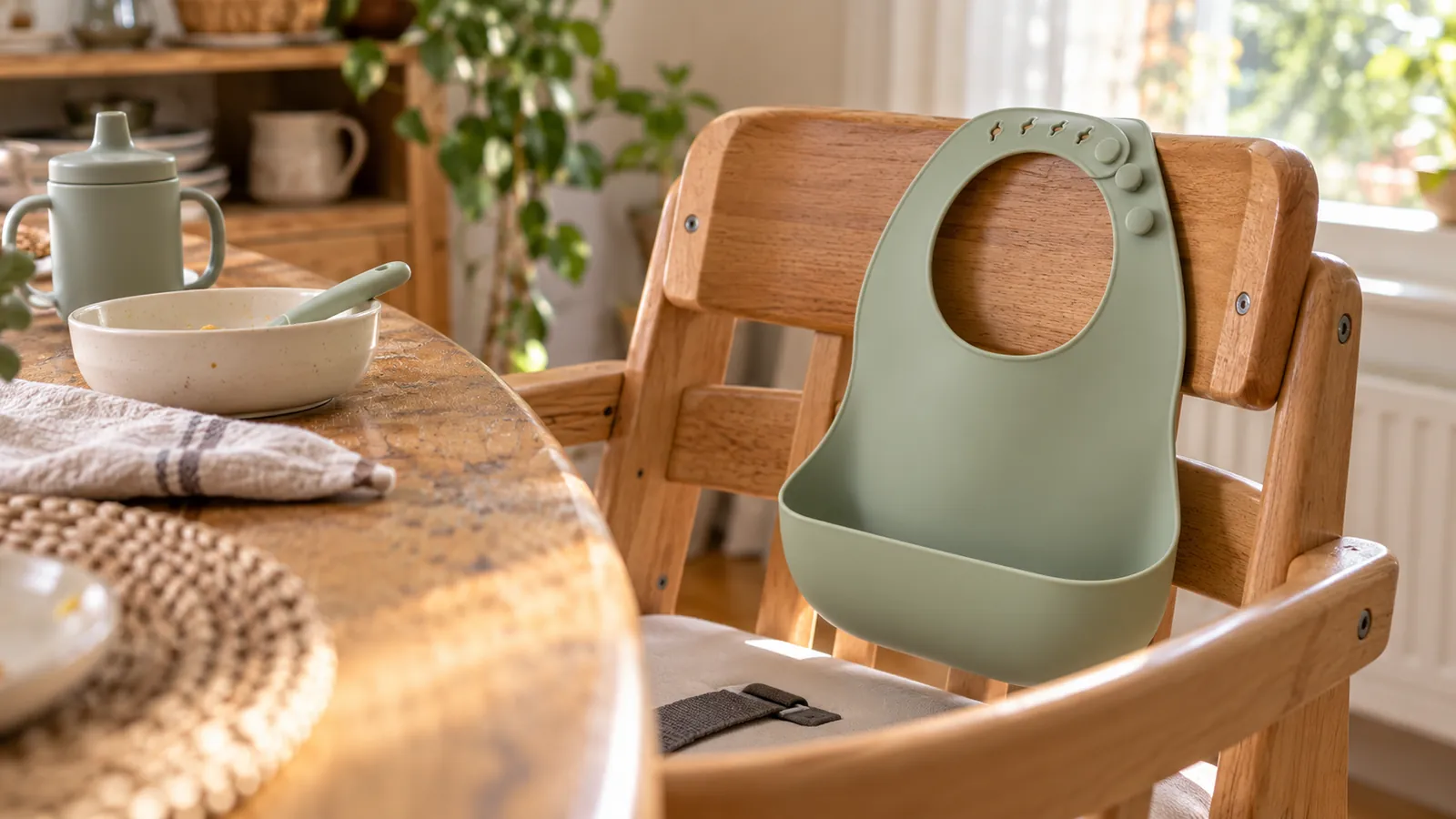
The first question in our sample review is not whether silicone is generally suitable for baby products. We ask which child, meal setting and caregiver routine this particular bib is designed to serve, because a loose neck setting, a deep pocket and a stiff body interact differently across age stages. A buyer brief should describe seated feeding, supervision, expected wear time, foods, cleaning method and any foreseeable mouthing or pulling. Those conditions set the boundary for design checks and packaging language.
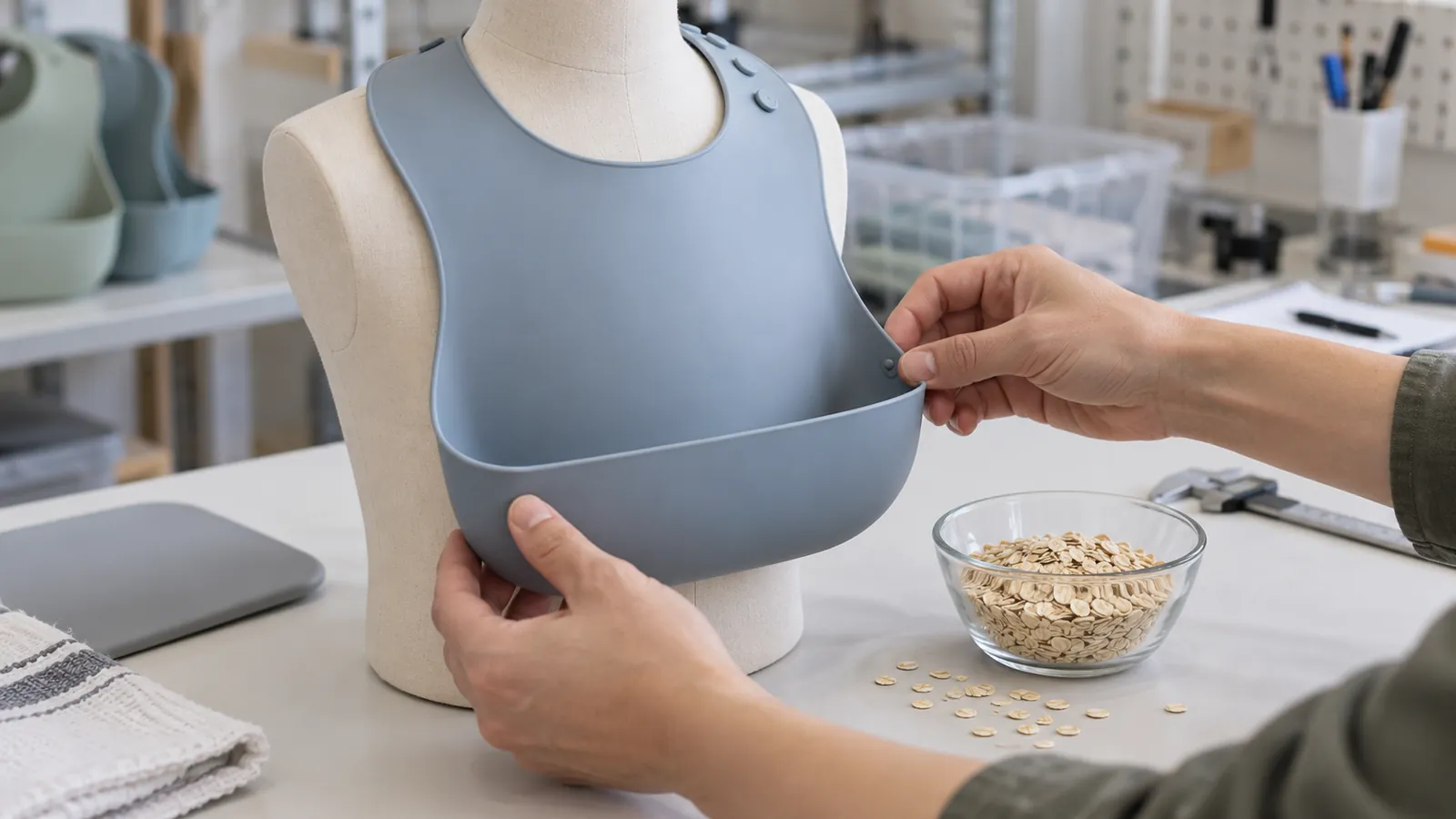
Age language needs a responsible owner rather than a borrowed label from a competing product. A distributor might specify one size for a narrow age stage, while a retailer may prefer adjustable positions spanning several stages; either route requires fit observations on representative users or justified fixtures. Record the assumptions, the adjustment points assessed and the cases deliberately outside scope. A photograph of a bib on one mannequin cannot establish comfort or fit for every child.
A safety file should separate the bib's normal function from claims about food contact, cleaning, heat exposure or therapeutic use. Food may touch the pocket during a meal, yet the applicable regulatory route still depends on foreseeable contact and the destination market. Ask the importer or responsible compliance team to classify the finished article and review the exact claim wording. The factory should then build the evidence plan around that written scope instead of promising a universal badge.
The supplier questionnaire should ask what the bib is not designed to do. If it is a spill-catching accessory for supervised meals, it should not be described as a teether, protective medical device or substitute for caregiver attention. This distinction also directs sample handling: record the real wear orientation, the chair and clothing interaction, and whether a loose strap or pocket position changes during an ordinary meal. A narrow, documented use case is more useful than a broad claim that no test plan could meaningfully support.
Resolve neck and closure hazards
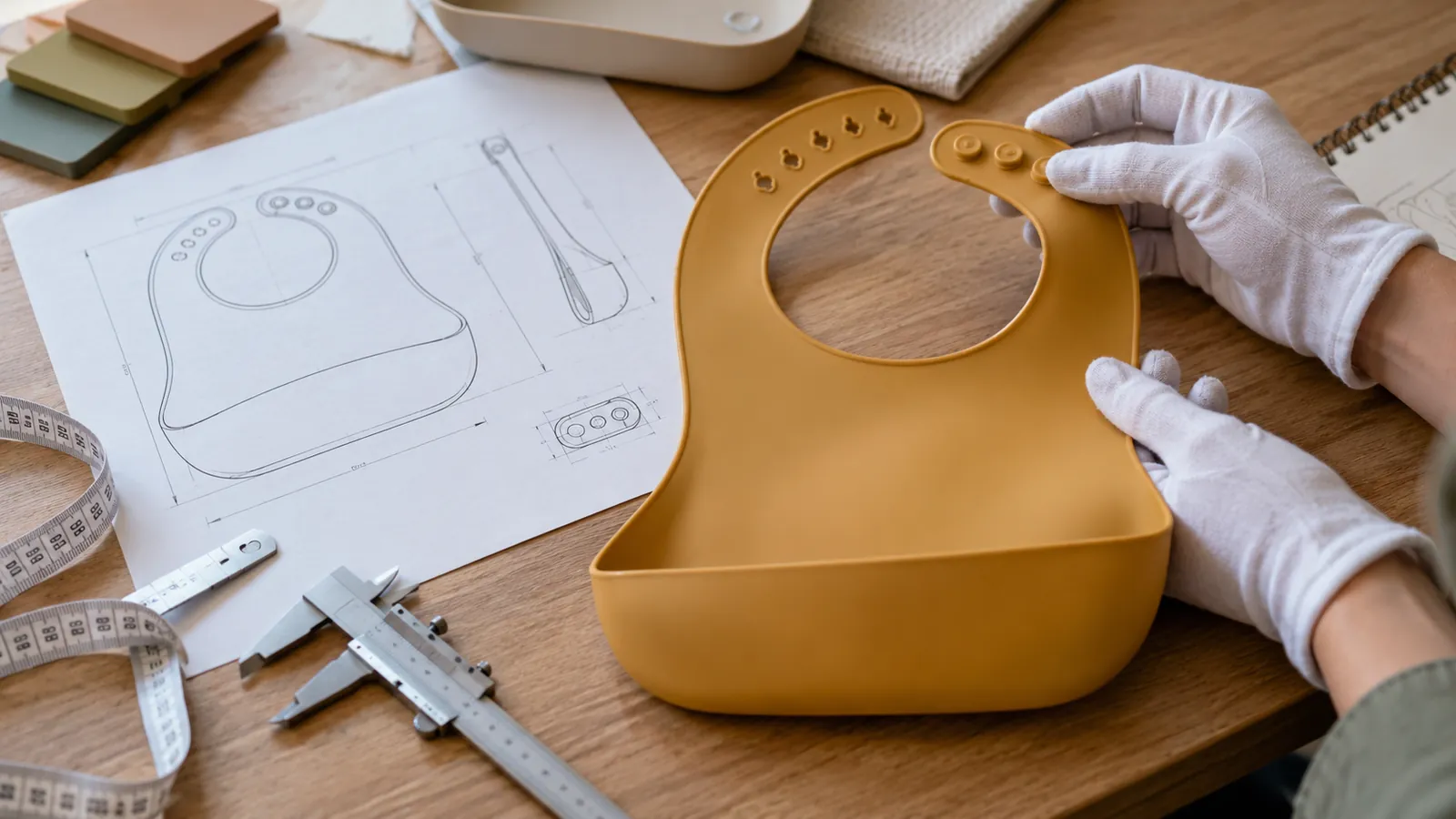
Neck geometry is a finished-product feature, not merely a flat drawing dimension. When the bib curves over shoulders and chest, the effective opening changes with body stiffness, thickness, closure position and the way the front pocket pulls downward. Check each intended setting on the approved construction, then record clearance and movement under a defined handling method. The result should identify a usable range, not a single attractive photograph.
Closure review should look at both staying closed and releasing under foreseeable stress. We would inspect molded posts, holes and surrounding webs for tear initiation, flash, uneven fill and deformation after repeated adjustment, then compare results across cavities and colors where relevant. A detachable button or decorative piece requires its own hazard and regulatory assessment; the cited US small-parts guidance has scope and exemptions, so it should not be reduced to a one-line universal rule. Record the actual failure mode and the reason the proposed acceptance limit is appropriate.
Edges and reachable details deserve the same attention as the main closure. Inspect trimmed rims, logo features, texture, mold parting and the back of fasteners for roughness or thin sections that can change after flexing. Use an agreed visual limit sample alongside dimensional and functional checks, since subjective phrases such as smooth enough are hard to reproduce across shifts. A good first article is not a substitute for a repeatable production check.
One closure option can behave differently after repeated caregiver adjustments than it did during the first fit trial. Record the number and sequence of openings, the way force is applied, the environmental conditioning and whether the same holes or posts show permanent deformation. If the buyer wants a softer body, check that the change does not create a weaker fastener web or a pocket that folds shut. These linked checks are why we review the full bib, not isolated neck coupons.
SECTION 02
Inspect the Finished Design and Real Cleaning Route
Translate the range plan into comparable product, packaging and approval evidence before requesting final quotations.Tie fit and cleaning observations to the actual molded bib and package.
Validate pocket and cleaning
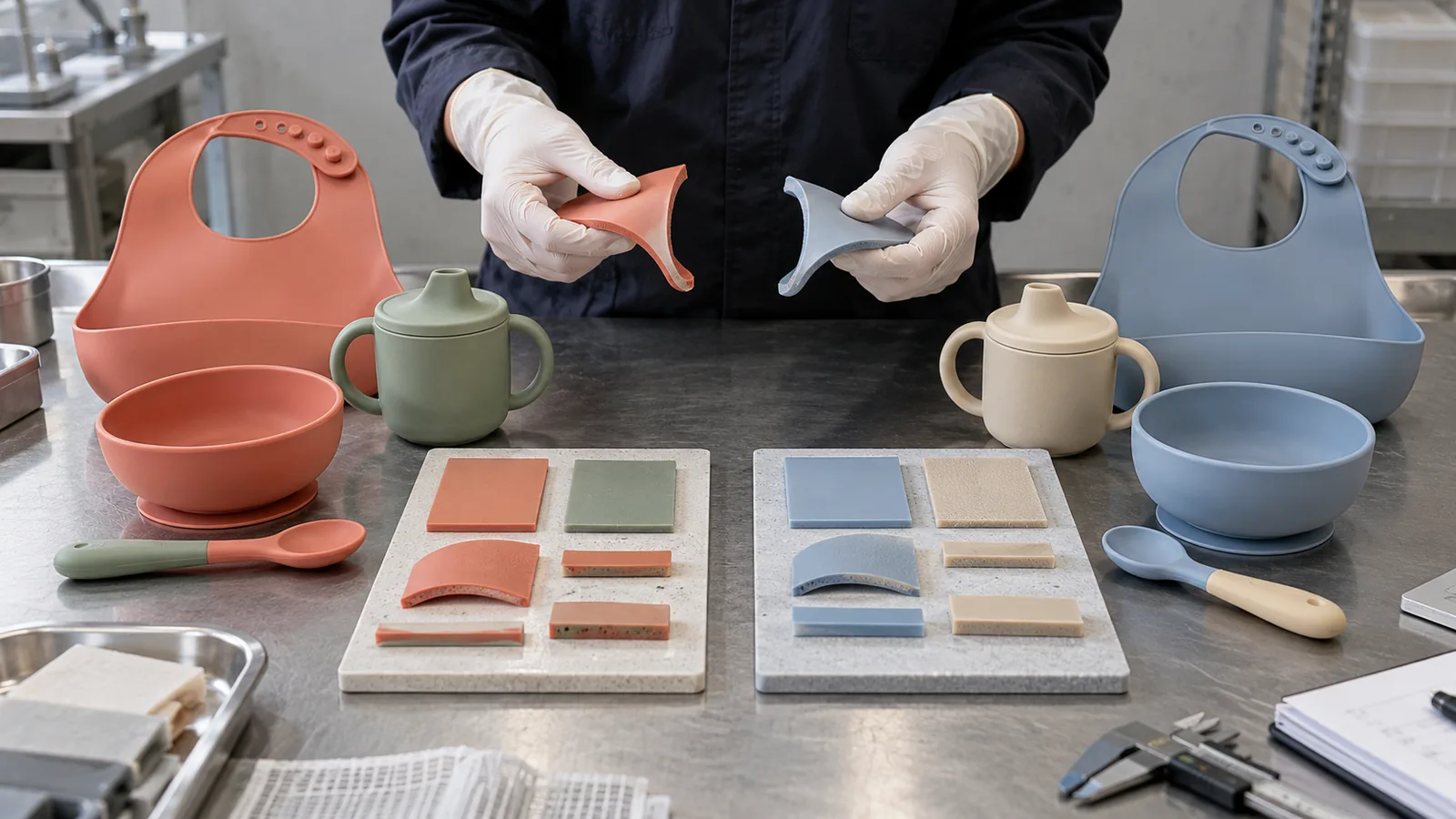
Material documentation is a starting point, not a certificate for a completed bib. The evidence file should identify the compound, curing route, pigment or color master, additives, supplier and lot, then explain which sample a declaration or laboratory report actually represents. A report on an uncolored plaque can answer a narrower question than a result on the molded, decorated bib. Purchasing should not silently extend one document to all colors, closures and packaging configurations.
Where food-contact rules may apply, test conditions should reflect the article's intended or reasonably foreseeable contact, not a generic phrase such as food grade. The European Commission framework sets overarching requirements for materials intended to contact food, but buyers must check any material-specific or national provisions and the final article's classification. The US route likewise depends on applicable use and product obligations; the CPSC certificate guidance concerns children's-product rules, not a blanket approval of silicone material. A qualified market review should map obligations before a pack claim is printed.
A useful evidence matrix has one row for each claim or acceptance decision. It records the issuing body, method, edition, report date, specimen identity, color, compound lot, finished geometry, destination, use condition and limitation. This makes an honest gap visible: perhaps composition is documented while closure strength is not, or one destination has a reviewed label while another remains open. Evidence that cannot be mapped to the current SKU should be treated as context until applicability is demonstrated.
Ask the supplier what changed between the reported specimen and the proposed production part. A pigment concentration, printing treatment, new fastener geometry or revised post-cure can alter the evidence route even when the product name remains the same. The buyer's compliance lead should decide whether bridging is justified and document that rationale, or request a new test on representative finished pieces. Avoid the common mistake of attaching a thick folder of unrelated certificates to a purchase order and calling it one product file.
Match evidence to SKU
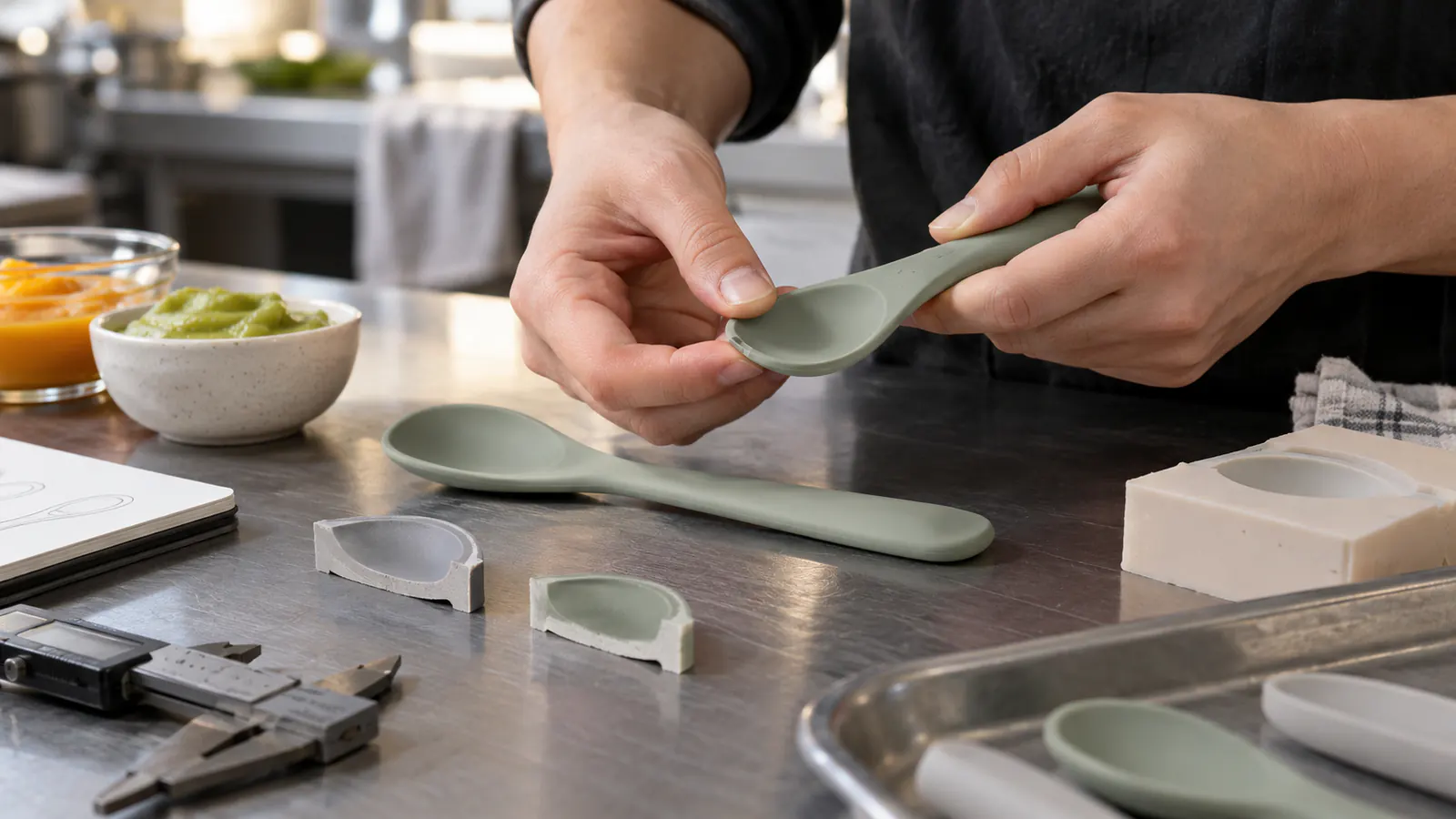
A validation plan should be written before the best-looking sample is selected. Define which mold cavities, colors, closure positions and production stages will be represented; specify conditioning and the order of fit, flex, wash and visual checks. If the program uses a new tool, retain trial-state identification so a corrected T1 sample is not confused with an earlier T0 piece. The approval decision must describe both the sample population and the limits of the conclusion.
For functional checks, choose methods that reproduce how a caregiver uses the product without inventing a universal numerical standard. Repeat opening and closing, assess pocket recovery, inspect edge condition, test the stated cleaning route and record any component separation under agreed foreseeable handling. State sample size, invalid-test rules, pass limits and who reviews a borderline observation. Supplier, buyer and laboratory should not each apply a different interpretation after results arrive.
Routine inspection then protects what was approved. Incoming material identity, first-article dimensions, mold-fill and trim checks, closure integrity, pocket form, surface cleanliness and packed SKU count can be assigned to named production gates. Frequencies and sampling levels depend on risk, process capability and contract requirements; they should not be copied from an unrelated bib program. Keep lot-linked records and retained samples so a later complaint can be investigated against a known baseline.
A factory handover should identify which defects stop the line and which require buyer disposition. A torn closure web, missing button, blocked pocket or unexplained contaminant is not equivalent to a minor appearance variation, so the approved defect dictionary needs examples and escalation owners. If production changes a mold cavity or trimming method to solve a problem, capture the corrective action and inspect the next affected pieces against the same criterion. This keeps validation from becoming a one-time report disconnected from daily output.
SECTION 03
Build Market-Relevant Evidence and Production Controls
Protect margin by reviewing production controls, landed-cost drivers and launch risks as one commercial system.Map each document to the color, construction and destination it covers.
Build validation and inspection
SECTION 04
Release Bounded Claims and Protect Repeat Orders
Use early sales and replenishment assumptions to decide which variants deserve expansion and which should remain controlled.Carry the approved claim boundary into repeat-order change control.
Release claims and changes

ACTION FRAMEWORK
Buyer Checklist Before Commercial Approval
Use this checklist as a meeting agenda. It is intentionally concise so the team can identify missing evidence without replacing its own quality, legal or supplier-management procedure.
| Check | Question | Why It Matters |
|---|---|---|
| User and scenario | Which age stage, caregiver supervision and feeding conditions does the pack describe? | An undefined user prevents a defensible fit and hazard review. |
| Neck and closure | Are adjustment positions, clearance, retention and breakaway behavior specified and tested? | A closure that only looks secure on one sample is not a release criterion. |
| Edges and small parts | Can molded details, buttons or decorations detach under agreed foreseeable handling? | Detached pieces require a product-specific hazard and market-rule review. |
| Pocket and cleaning | Does the pocket remain open in use and accessible for the stated cleaning method? | Trapped residue and poorly defined care create avoidable complaints. |
| Evidence scope | Do declarations and reports match the material, color, finished SKU and destination? | A generic compound report cannot approve every bib configuration. |
| Pack and claims | Are age, care, food-contact and dishwasher statements reviewed against actual evidence? | Packaging language often extends beyond a narrowly tested condition. |
| Production release | Are the drawing, sample, defect limits, lot records and change owner aligned? | Repeat orders can drift even when the original sample looked acceptable. |
NEXT READING
Continue the Supplier and Product Review
These internal resources connect the guide with Naike Silicone product, factory, customization and inquiry pages. Open the route that matches the next decision in your project.
Explore silicone baby products
Use explore silicone baby products to resolve the next specific finished-bib question. Record the explore silicone baby products implication for the current SKU's design, evidence or inquiry brief.
Open internal resource →Read the silicone bib specification guide
Use read the silicone bib specification guide to resolve the next specific finished-bib question. Record the read the silicone bib specification guide implication for the current SKU's design, evidence or inquiry brief.
Open internal resource →Compare wholesale silicone bib suppliers
Use compare wholesale silicone bib suppliers to resolve the next specific finished-bib question. Record the compare wholesale silicone bib suppliers implication for the current SKU's design, evidence or inquiry brief.
Open internal resource →Review food-contact evidence by market
Use review food-contact evidence by market to resolve the next specific finished-bib question. Record the review food-contact evidence by market implication for the current SKU's design, evidence or inquiry brief.
Open internal resource →Review quality-control capabilities
Use review quality-control capabilities to resolve the next specific finished-bib question. Record the review quality-control capabilities implication for the current SKU's design, evidence or inquiry brief.
Open internal resource →Request a bib sample and evidence review
Use request a bib sample and evidence review to resolve the next specific finished-bib question. Record the request a bib sample and evidence review implication for the current SKU's design, evidence or inquiry brief.
Open internal resource →PRIMARY REFERENCES
Authoritative External Sources
The sources below are official primary references. Applicability depends on the product, intended use and destination market. Buyers should obtain qualified advice for final legal or regulatory decisions.
CPSC: Children's Product Certificate
Official US guidance on certification for children's products subject to applicable rules; applicability must be determined for the exact bib and market. Recheck cpsc: children's product certificate against the actual bib classification, sample and claim.
CPSC: Small Parts and Choking Hazard Guidance
Official guidance includes scope and exemptions; do not assume a bib has the same treatment as a toy or that an exemption removes all hazard review. Recheck cpsc: small parts and choking hazard guidance against the actual bib classification, sample and claim.
European Commission: Food Contact Materials Legislation
Official EU framework for articles intended to contact food; classify the finished bib's foreseeable contact and applicable national requirements separately. Recheck european commission: food contact materials legislation against the actual bib classification, sample and claim.
European Commission: General Product Safety Regulation factsheet
Official EU overview of general product safety obligations; obtain destination-specific advice for classification, technical documentation and claims. Recheck european commission: general product safety regulation factsheet against the actual bib classification, sample and claim.
BUYER QUESTIONS
Frequently Asked Questions
Are all silicone bibs safe for babies?
No material name establishes safety for every finished bib. Assess the intended age, neck fit, closure, detachable details, pocket, cleaning route and market-specific obligations on the exact approved construction.
Does a food-grade silicone report approve the finished bib?
No. A material report may support a defined composition or contact question, but it does not prove closure integrity, fit, pocket function or the applicability of every label claim. Map the report to the molded SKU and intended market.
What should be checked around the neck closure?
Define the adjustment positions and inspect clearance, retention, repeated opening, tear initiation and any detachable components under justified use conditions. Retain the current drawing and sample identity with the results.
Can a buyer claim the bib is dishwasher-safe?
Only when a defined dishwasher procedure and acceptance criteria support the claim for the current construction. Record the cycle, detergent, load placement and observed changes to pocket, closure, color and surface.
Does a silicone bib need a Children's Product Certificate in the US?
That depends on whether the finished bib is a children's product subject to specific CPSC-enforced rules. The importer or manufacturer should determine applicable rules and certification duties for the exact product, rather than assuming either universal coverage or exemption.
How should a retailer approve different bib colors?
Keep compound and pigment identity traceable, review whether existing evidence covers each color, and inspect representative finished samples. A report for one uncolored plaque should not be automatically extended to every pigmented SKU.
What should trigger a repeat-order safety review?
Reopen the evidence matrix when material, color, closure, mold, cleaning claim, artwork or destination changes. Decide which physical checks, market review and retained references need renewal before the revised order is released.
Editorial and Scope Note
Conclusion: Silicone Bib Safety for Daily Feeding
Move from buyer research to a controlled supplier brief
A reliable are silicone bibs safe decision links the intended use, controlled product revision, measurable specification, representative samples, traceable evidence, quotation assumptions and release authority. Material, tooling, testing, MOQ, pricing and lead time remain conditional on the approved scope and current production situation. Share the drawing, use conditions, destination market, forecast and evidence expectations with Naike Silicone to request a product-specific review, sample plan or quotation.
This factory-insider guide supports sourcing preparation and supplier discussion for are silicone bibs safe. It does not replace product-specific engineering, laboratory, regulatory, legal or commercial review for the destination market.