SUPPLY CHAIN & PROCUREMENT
Collapsible Silicone Travel Set Sourcing: How Should Outdoor Retailers Build a Collapsible Silicone Travel Set?
Build a collapsible silicone travel set for outdoor retail with controlled cup and bowl specifications, fold-cycle validation, packout, evidence and replenishment planning.

DIRECT ANSWER
What B2B Buyers Need to Know
Build the set around one named outdoor use scenario and a deliberate SKU architecture, not a collection of foldable items. Specify deployed and packed dimensions, cup and bowl functions, fold recovery, stability, attachment strength, cleaning and material claims separately. Approve a complete packed set on production-representative samples, then align colors, carton quantities and replenishment rules with the forecast.
This guide is written for B2B importers, distributors, retailers, private-label brands, product developers, quality teams and sourcing managers. It provides a decision framework rather than legal advice or a universal specification. Product classification, use conditions and destination market should be confirmed before final testing, labelling or compliance decisions.
Key Takeaways
- Choose a target user and selling unit before selecting a cup, bowl, pouch or accessory.
- Treat collapsed height and deployed stability as separate measurable requirements.
- Validate every flexible component after realistic folding, carrying, washing and storage.
- Food-contact evidence must match the exact cup or bowl, market, formulation and use conditions.
- Approve the complete packout and shipment carton, not isolated attractive samples.
- Plan colors, replacement parts and reorder ratios by sellable SKU.
Outdoor Travel-Set Component Decision Matrix
The table compares candidate roles; it does not imply that every product should be bundled or that a single material declaration validates a complete kit. Buyers should decide which evidence belongs to each component and which belongs to the packed selling unit.
| Component | Buyer-Facing Function | Approval Evidence |
|---|---|---|
| Collapsible cup | Portable drinking vessel with a stable deployed base and usable rim | Capacity, rim shape, heat/use scope, fold recovery and cleaning checks |
| Collapsible bowl | Portable serving or pet-water vessel sized for the intended user | Capacity, leakage, base contact, tip resistance and fold-cycle checks |
| Carry pouch or clip | Protect and retain folded components without creating contamination traps | Fit, retention, abrasion, drying and packed-unit inspection |
| Retail carton | Communicate contents and protect the exact selling unit in transit | Physical packout, count, dimensions, barcode and transit review |
SECTION 01
Choose the Outdoor User and Selling-Unit Architecture
Set the purchasing scenario with a realistic SKU mix, forecast, delivery window and cost-comparison basis. Define the primary trip and who owns the selling-unit decision.
Define one outdoor mission for collapsible silicone travel set sourcing
The first factory question is not how many collapsible items fit in a carton; it is who carries the set and what each item is expected to hold. A hiker who needs a compact drinking cup, a car camper who wants a serving bowl and a pet owner who needs water on a trail impose different capacity, stability, cleaning and carry requirements. Build one primary use scenario with realistic temperature, storage duration, washing access and handling conditions before a designer chooses attractive forms. If the brand wants several audiences, specify separate variants or a clearly modular offer instead of claiming one untested kit serves every use.
Treat the selling unit as an engineered assembly even when its components never mechanically lock together. The buyer should identify the cup, bowl, pouch, clip, printed card and carton by part number and revision, then state which items are essential, optional or replaceable. This matrix gives product development a way to compare the perceived value of a bundle against its cost, size, handling and replenishment complexity. A set that looks coherent in a photograph can still be commercially weak if one slow-moving component must be bought in the same quantity as a fast-moving hero item.
Retail context should be written into the brief with the same care as dimensions. A shop-floor sample can be handled gently by an engineer, while a shopper may compress it into a pack, tug at the attachment point, wash it with limited water and reuse it before it has dried. These behaviors do not justify invented universal durability claims, but they do give the team realistic test questions. Document which scenarios are in scope and which are excluded so a marketing line cannot quietly outrun the approved design evidence.
Choose a coherent component mix
A component range should have an explicit hierarchy rather than three equal claims on the front panel. If the cup is the hero, decide whether the bowl solves a related trip need or merely increases retail price and parcel weight; if the bowl is for pets, do not imply that the same cleaning and contact assumptions apply to human drinking. We often ask buyers to model a base SKU, a premium kit and separately available replacements before any mold family is quoted. That exercise shows whether colors, capacities and component quantities can share a production calendar without creating stock that has no clear selling role.
Compatibility means more than matching colors. Measure the folded pieces inside the actual pouch, check whether a damp component can be separated from a clean cup, and confirm that the clip can be attached without crushing a rim or fold. A single pouch size may not fit both the smallest and largest capacity variants once wall thickness and hardware are finalized. Establish the kit bill of materials and pack arrangement early, then revisit both after each geometry correction so packaging does not quietly become the limiting design constraint.
SECTION 02
Engineer Foldability, Function and Carry Details
Separate fixed development costs from variable production and logistics costs before negotiating commercial terms. Compare the actual cup, bowl and pouch roles before finalizing molds.
Specify folded and deployed states
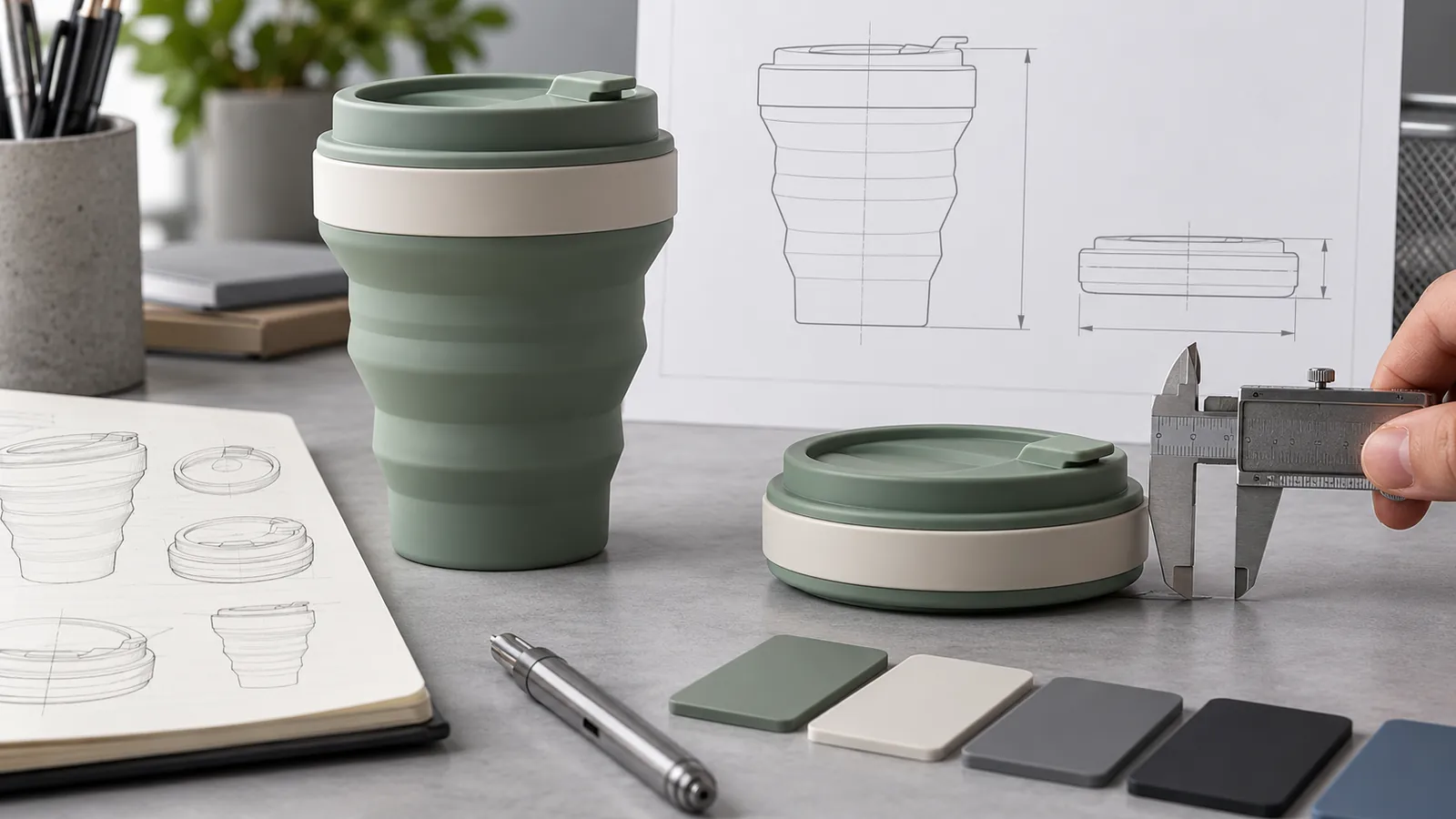
For every collapsible vessel, record both deployed and stored geometry on the drawing. Capacity should be measured at a stated fill line, while base contact, rim roundness and usable height should be checked after a defined rest period following deployment. Folded height is valuable for the shelf and backpack, but a thin wall or aggressive hinge can trade away stability, tear resistance and a comfortable drinking edge. Tooling review should identify the folds, transition radii, parting line, venting and demolding direction that create these competing outcomes instead of promising a generic compactness percentage.
The validation plan should separate easy folding from reliable recovery. Define the fold sequence, cycle count, dwell time, storage compression, temperature and rest interval, then inspect the same marked samples for visible set, rim distortion, leakage, base wobble and functional capacity. Material tensile data can help compare compounds, but a standardized specimen is not the finished cup or bowl and cannot by itself establish product life. Approve the method and limits against the intended user, and retain failed parts as well as attractive ones so a later mold correction has a usable baseline.
Validate carrying and cleaning
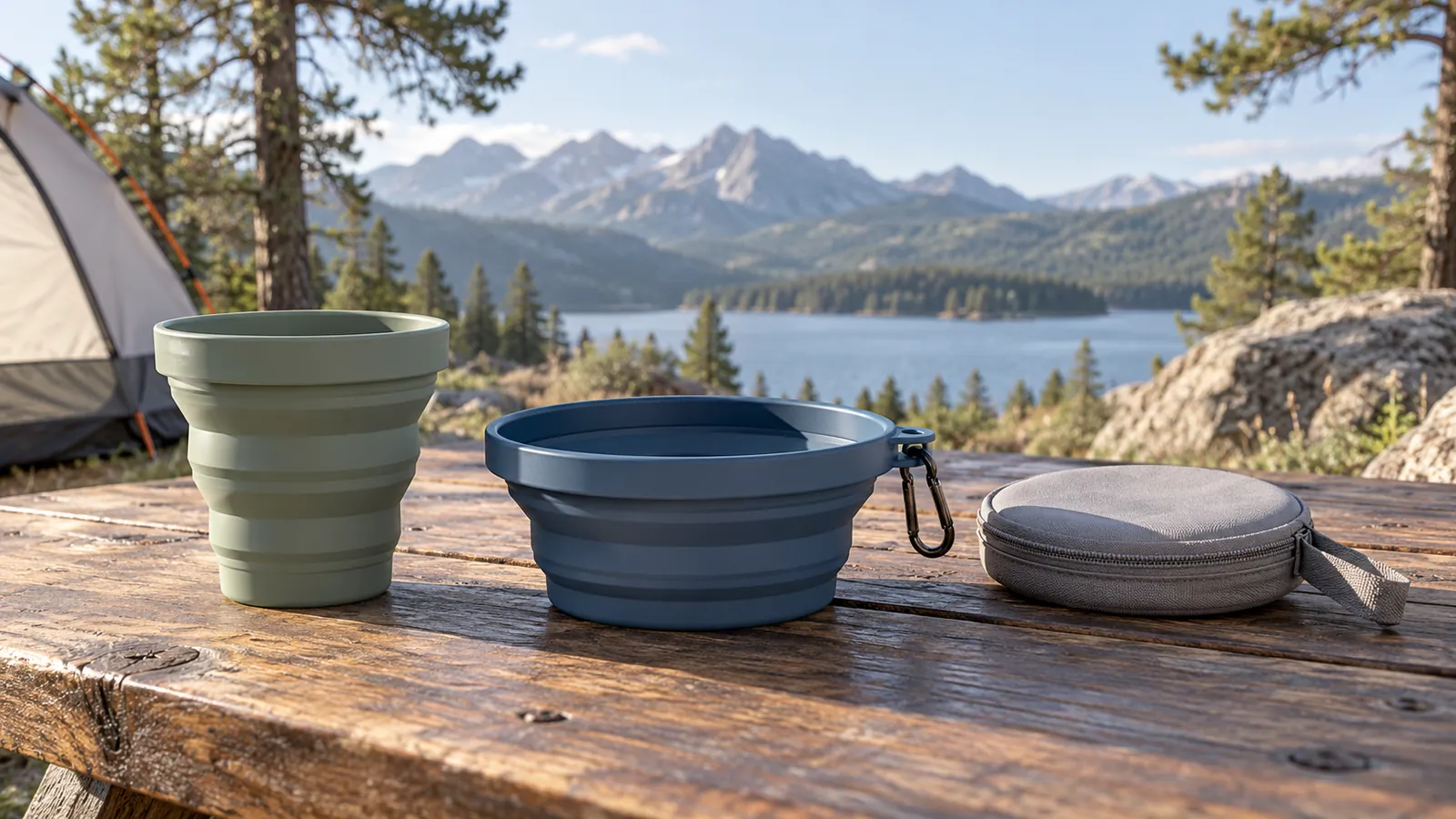
Carrying hardware is a separate failure path that deserves its own acceptance rule. A carabiner, molded tab, ring or pouch loop may concentrate force at a thin silicone section, abrade a rim or detach when the kit is repeatedly pulled from a pack. Test the complete interface under an agreed load and motion sequence using production-representative pieces, and inspect for permanent deformation, cuts, loose hardware and interference with deployment. Do not turn an illustrative camp photograph into evidence that the assembled set has passed any load or durability test.
Cleaning and drying are also field-use problems rather than only laboratory material properties. Folds can retain liquid or soil, while a closed pouch can hold a wet cup against a printed card, metal clip or second component during storage. Ask users to follow the proposed care instructions on representative samples, then inspect the inner folds, rim, base and accessory contact points for residue, odor, staining and incomplete drying. If the package says dishwasher safe or safe for hot drinks, define those claims and test conditions for the exact finished SKU rather than extending evidence from a different product.
A useful validation record identifies the failure boundary, not merely a pass mark. For a cup, note whether distortion appears at the rim, fold junction or base; for a bowl, distinguish leakage from tipping and from a shallow capacity after recovery. Photograph the part in the same orientation and record the interval between removal from the pouch and measurement. This prevents a supplier from attributing every observation to handling and helps the buyer decide whether to change the wall, the carry system, the package or the stated use claim.
SECTION 03
Validate the Set and Its Packed State
Connect capacity, inspection, packaging and shipment readiness to named milestones and escalation triggers. Validate both deployed and packed states on identified samples.
Approve the real retail pack
The retail carton must be tested with the real contents in the real orientation. Compare folded dimensions, pouch compression, hardware position, card stock and carton clearance after a realistic storage period, then open the pack and check whether the cup and bowl deploy to their approved shape. Record package mass and dimensions at unit and master-carton level because a compact product can still create poor freight economics through excessive void space or presentation materials. A buyer should reject a quotation that prices the molded parts but leaves the pouch, print, sorting and physical packing work outside the assumed scope.
Evidence follows the component and the selling unit, not the visual theme of the range. A food-contact declaration or test report needs a traceable material and finished-article scope that matches its intended use and destination market, while a tensile result describes its stated specimen and method. Keep color, compound, cavity, batch and revision identities attached to samples and inspection records so a later substitution can be evaluated rather than silently accepted. Attribute-sampling plans may help lot release, but they must name the defect categories and cannot replace design validation of fold recovery or stability.
SECTION 04
Release the Range and Plan Replenishment
Protect replenishment by recording review conditions for forecasts, prices, lead times, materials and order changes. Assign release and replenishment authority to the exact kit SKU.
Plan replenishment by SKU
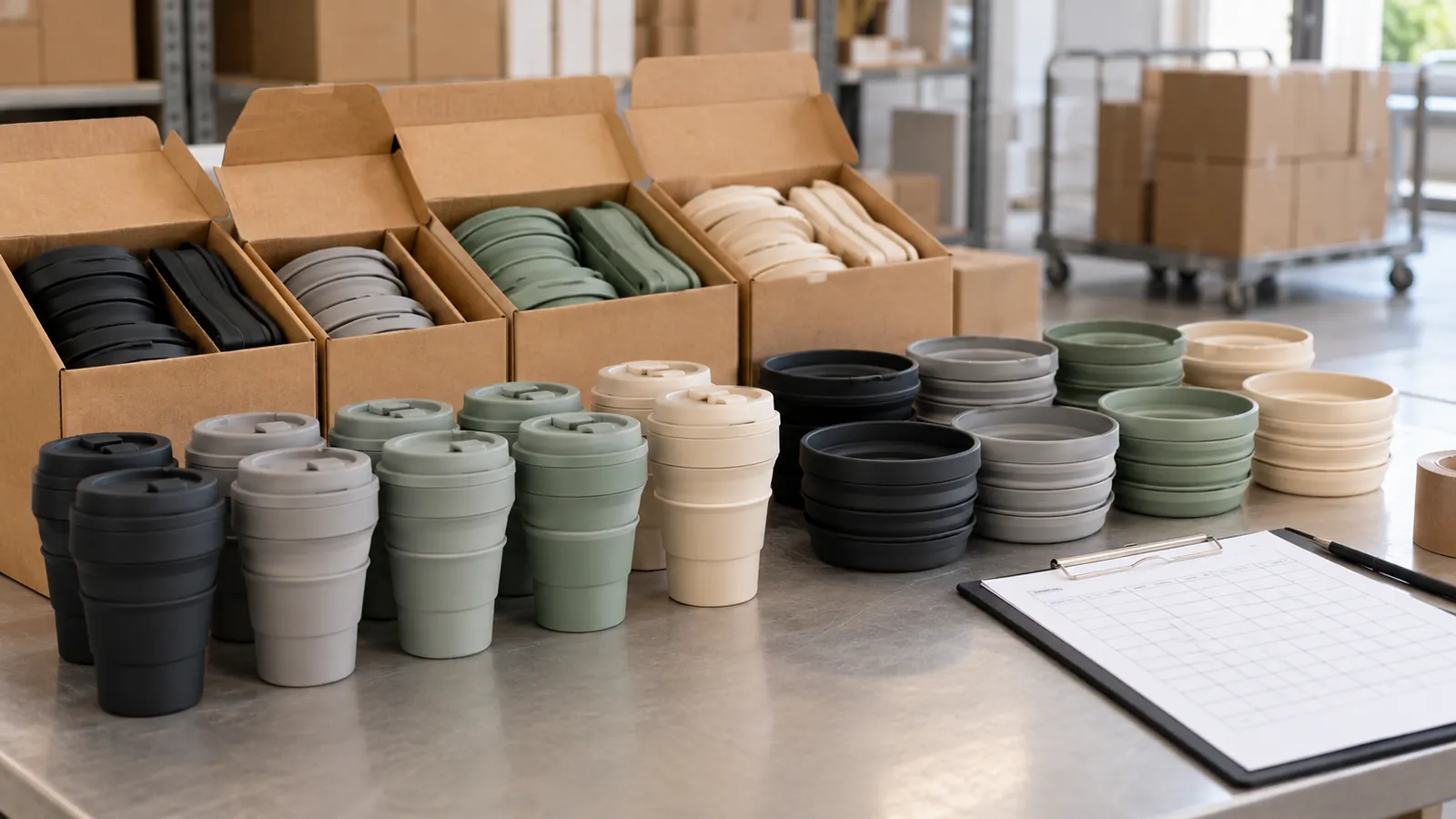
An outdoor set often sells as one SKU but consumes components at different rates. Model a launch forecast by color and kit tier, then calculate how many cups, bowls, pouches and clips the factory must make, buy, sort and hold to meet that mix. Decide whether a missing accessory can be replaced without changing the approved retail presentation, and whether the buyer will keep spares for warranty or customer-service needs. A low initial quote is not comparable with a complete program quote unless both include decoration, assembly, inspection, packout, spare inventory and the allowed reorder quantities.
Release authority should be visible before the first purchase order. The final file should contain the SKU matrix, drawings, material and color masters, finished-use evidence, fold and carry methods, signed samples, carton layout, critical defects and change triggers for each component and the assembled kit. When a cup wall, bowl capacity, pouch fabric, clip supplier or destination claim changes, identify the affected checks and approval owner before shipping the revised set. That discipline lets a retailer replenish the promised product instead of buying a visually similar collection with an unreviewed performance or compliance boundary.
The handover to production should include a first-off check for each molded component and a final check of the packed kit. Ask who releases color, who verifies clip installation, who counts parts, who checks barcode placement and who resolves a mixed-revision carton. Inspection cannot repair an undefined bill of materials, so settle the approved part identity before setting an attribute sampling plan. For repeat orders, compare the current lot with retained references and reopen only the tests affected by a documented material, mold, accessory or claim change.
ACTION FRAMEWORK
Buyer Checklist Before Commercial Approval
Use this checklist as a meeting agenda. It is intentionally concise so the team can identify missing evidence without replacing its own quality, legal or supplier-management procedure.
| Check | Question | Why It Matters |
|---|---|---|
| User and channel | Is the kit for hikers, car campers, pet owners or a mixed channel? | Different users change capacity, cleaning, portability and claim priorities. |
| Component matrix | Which items are mandatory, optional or sold separately? | A vague bundle creates incompatible quantities and replenishment gaps. |
| Fold geometry | What are deployed height, folded height, wall sections and recovery limits? | Compactness alone does not establish stable use or repeat durability. |
| Carry interface | Can a pouch or clip retain the loaded kit without damaging silicone? | A weak attachment can fail even when the molded vessel passes. |
| Evidence scope | Do test reports match the exact material, color, SKU and destination? | A generic material statement cannot approve every finished component. |
| Pack and reorder | Are carton dimensions, color split, spare items and SKU ratios approved? | The retail promise fails if the replacement and shipment system is uncontrolled. |
NEXT READING
Continue the Supplier and Product Review
These internal resources connect the guide with Naike Silicone product, factory, customization and inquiry pages. Open the route that matches the next decision in your project.
Review travel bowl fold-recovery testing
Use review travel bowl fold-recovery testing to resolve the next kit-design or supply decision. Record the review travel bowl fold-recovery testing implication in the current component matrix.
Open internal resource →Compare silicone pet feeding-set roles
Use compare silicone pet feeding-set roles to resolve the next kit-design or supply decision. Record the compare silicone pet feeding-set roles implication in the current component matrix.
Open internal resource →Explore silicone pet products
Use explore silicone pet products to resolve the next kit-design or supply decision. Record the explore silicone pet products implication in the current component matrix.
Open internal resource →Explore silicone kitchen products
Use explore silicone kitchen products to resolve the next kit-design or supply decision. Record the explore silicone kitchen products implication in the current component matrix.
Open internal resource →Review product quality controls
Use review product quality controls to resolve the next kit-design or supply decision. Record the review product quality controls implication in the current component matrix.
Open internal resource →Review custom silicone manufacturing
Use review custom silicone manufacturing to resolve the next kit-design or supply decision. Record the review custom silicone manufacturing implication in the current component matrix.
Open internal resource →Explore all product categories
Use explore all product categories to resolve the next kit-design or supply decision. Record the explore all product categories implication in the current component matrix.
Open internal resource →Request an outdoor travel-set review
Use request an outdoor travel-set review to resolve the next kit-design or supply decision. Record the request an outdoor travel-set review implication in the current component matrix.
Open internal resource →PRIMARY REFERENCES
Authoritative External Sources
The sources below are official primary references. Applicability depends on the product, intended use and destination market. Buyers should obtain qualified advice for final legal or regulatory decisions.
FDA food types and conditions of use
Official FDA reference for food-type and use-condition distinctions; it is not a finished-set approval or a universal silicone certification. Check the scope of FDA food types and conditions of use against this exact component, material, market and use condition before making a product claim.
ISO 37:2024 rubber tensile test method
Official ISO method scope for tensile stress-strain properties; a specimen result does not replace finished fold-cycle or attachment testing. Check the scope of ISO 37:2024 rubber tensile test method against this exact component, material, market and use condition before making a product claim.
ISO 2859-1:2026 lot inspection sampling
Official ISO scope for attribute sampling; the buyer must define defects, lot identity, inspection level and release authority. Check the scope of ISO 2859-1:2026 lot inspection sampling against this exact component, material, market and use condition before making a product claim.
BUYER QUESTIONS
Frequently Asked Questions
Should an outdoor travel set always include both a cup and a bowl?
No. Start with the target user and selling-unit economics. A base cup SKU, pet bowl SKU and optional bundle may serve demand better than forcing every buyer to purchase all components.
What dimensions should be specified for collapsible components?
Specify deployed capacity and height, base contact and rim geometry, folded height, wall sections and the measurement method after a defined deployment rest period. Include the exact package envelope.
How should fold durability be checked?
Agree the fold sequence, repetitions, storage compression, temperature and rest interval. Inspect the same identified parts for leakage, recovery, stability, tearing and visible set at planned checkpoints.
Does a material tensile test prove the cup will survive repeated folding?
No. Material tests describe stated specimens under stated methods. Finished-product fold cycles, geometry and carry interfaces need their own application-specific validation.
Can one food-contact report cover every color and component?
Only if its scope, sample identity and applicable market rules actually cover those constructions and intended use conditions. Buyers should map reports to each released SKU and color before making a claim.
What should be included in a comparable supplier quotation?
Ask for tooling, molded parts, decoration, pouch and clip supply, assembly, inspection, retail packout, master cartons, MOQ by SKU and color, sample rounds and change-control assumptions. Compare suppliers only after those inclusions are normalized.
How can a retailer avoid bundle replenishment problems?
Forecast each component and color separately, set reorder and substitution rules, retain approved samples and keep the packed-unit bill of materials under revision control. Review the forecast when the kit mix changes.
Editorial and Scope Note
Conclusion: Collapsible Silicone Travel Set
Move from buyer research to a controlled supplier brief
A collapsible silicone travel set is ready for retail only when its user, component roles, folded and deployed performance, carry system, cleaning route, packed unit and reorder plan are aligned. Send Naike Silicone your target channel, drawings, capacities, destination markets, color forecast and packaging brief to request a conditional DFM, sampling and packout review. Approve each component and the complete kit against traceable evidence before committing to the first purchase order.
This factory-insider guide supports sourcing preparation and supplier discussion for collapsible silicone travel set sourcing. It does not replace product-specific engineering, laboratory, regulatory, legal or commercial review for the destination market.