PRODUCT SOURCING GUIDES
Wholesale Silicone Kitchen Utensils: Silicone Kitchen Utensil Sets: A Buyer's Assortment Planning Guide
Plan wholesale silicone kitchen utensils by function, handle design, color, packaging and forecast. Build a retail-ready assortment with Naike Silicone.
DIRECT ANSWER
What B2B Buyers Need to Know
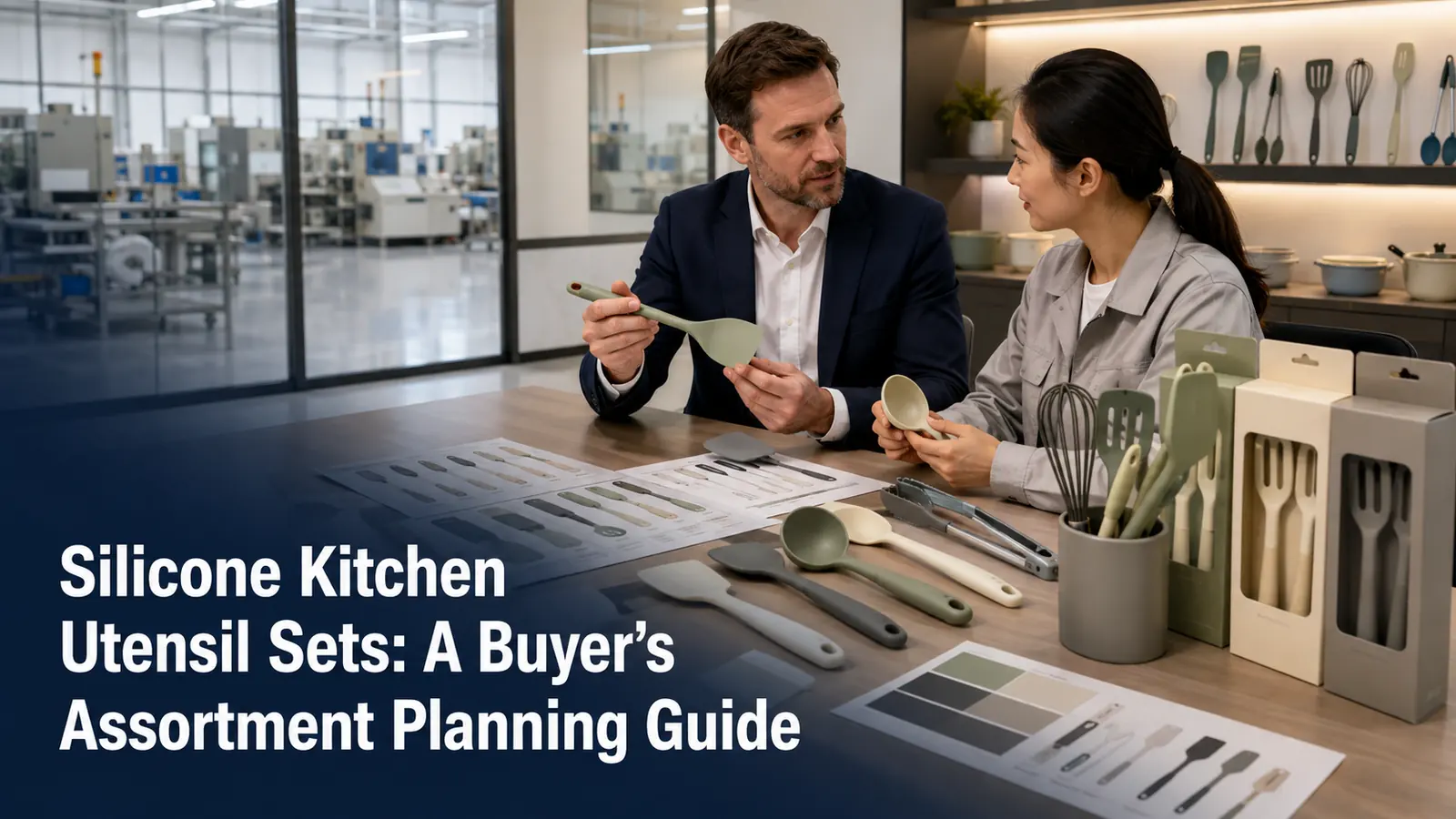
Wholesale silicone kitchen utensils should be planned as a coordinated retail assortment rather than a random collection of tools. Buyers need to define cooking functions, head geometry, handle construction, temperature conditions, color families, set sizes, packaging and SKU forecasts together. This approach reveals which utensils can share materials and components, where custom tooling adds value and how each finished set should be approved.
This guide is written for kitchenware importers, private-label brands, retailers, distributors, category managers, product developers and sourcing teams. It provides a decision framework rather than legal advice or a universal specification. Product classification, use conditions and destination market should be confirmed before final testing, labelling or compliance decisions.
Key Takeaways
- Give every utensil a defined cooking task and commercial role before selecting set size or color.
- Control head dimensions, edge profile, flexibility, handle construction and hanging features through measurable specifications.
- Compare all-silicone, reinforced and overmolded handle routes against the actual use, cleaning and price architecture.
- Build color families and shared components around realistic SKU-level forecasts instead of multiplying low-volume variants.
- Approve retail packaging, labeling, master cartons and finished-set presentation alongside the physical utensils.
- Keep temperature claims, MOQ, price, capacity, lead time and conformity conditional on the approved design, test conditions and order mix.
Wholesale Silicone Kitchen Utensil Set Architecture
The appropriate range depends on cooking tasks, channel, retail price, product construction and demand by SKU. Exact MOQ, cost, timing and performance remain conditional on the approved set and order conditions.
| Assortment route | Best commercial use | Factory and buyer implication |
|---|---|---|
| Focused essential set | Entry programs, promotional offers and initial market tests | Three to five high-usage tools reduce packaging, color and inventory complexity but must still cover the target cooking tasks |
| Coordinated core set | Mainstream retail and established private-label kitchen ranges | Five to eight tools can share a handle language and color family while each head keeps a specific functional role |
| Premium construction set | Higher price tiers requiring reinforced handles, refined finishes or distinctive packaging | More construction and approval detail can improve differentiation but increases tooling, sampling and quality-control work |
| Open-stock plus bundles | Multi-channel brands that sell individual tools and several gift or starter sets | Shared items improve merchandising flexibility, although forecasts and packaging inventory must be controlled by each finished SKU |
SECTION 01
Define the Wholesale Silicone Kitchen Utensil Assortment Strategy
Begin with the target buyer, channel and assortment role so every specification decision supports a sellable range.
Cooking Functions and Product-Line Roles for wholesale silicone kitchen utensils
Before a sourcing team adds another product option, “Cooking Functions and Product-Line Roles” needs a clear buyer, channel and repeat-order purpose. Compare cooking functions and product-line roles across entry, core and premium scenarios instead of reviewing one sample in isolation. For this decision, the decision should be written in language that purchasing, engineering, quality and packaging teams can interpret consistently.
A useful sourcing discussion asks the supplier to provide a range review linking cooking functions and product-line roles to product role, forecast, color plan and repeat-order assumptions. The unresolved exposure is weak channel assumptions around cooking functions and product-line roles can make a technically acceptable product commercially unworkable. Keep the sample identity, lot and decision outcome together so a later reviewer can reconstruct the release.
Spatula and Turner Edge Geometry
The factory view of “Spatula and Turner Edge Geometry” begins with the finished selling unit, not an isolated silicone part. Decide whether spatula and turner edge geometry creates meaningful differentiation or only adds low-volume SKU complexity. For this decision, a clear baseline also helps the supplier explain any trade-off instead of silently selecting the easiest manufacturing option.
Before the next project gate, both parties should agree on an assortment map, finished-SKU specification, target-cost model and dated approval sample covering spatula and turner edge geometry. The unresolved exposure is selecting spatula and turner edge geometry from appearance alone can hide landed-cost, packaging and replenishment constraints. Record any deviation separately and prevent it from becoming an undocumented repeat-order precedent.
Ladle, Spoon, Whisk and Tong Performance
A category buyer should judge “Ladle, Spoon, Whisk and Tong Performance” by the role it plays in the assortment, price architecture and retail channel. Give ladle, spoon, whisk and tong performance a defined role in the assortment, channel and target price architecture before adding variants. For this decision, the requirement becomes useful only when it can be converted into a drawing, sample, record or repeatable check.
The evidence package is stronger when it includes a range review linking ladle, spoon, whisk and tong performance to product role, forecast, color plan and repeat-order assumptions. The unresolved exposure is undefined assortment logic for ladle, spoon, whisk and tong performance can multiply inventory without improving the buyer proposition. Carry the approved limit into the inspection instruction rather than leaving it only in meeting notes.

SECTION 02
Engineer Tool Functions, Handles and Material Construction
Translate the range plan into comparable product, packaging and approval evidence before requesting final quotations.
All-Silicone, Reinforced and Overmolded Handles
For kitchenware importers, private-label brands, retailers, distributors, category managers, product developers and sourcing teams, the commercial question behind “All-Silicone, Reinforced and Overmolded Handles” is whether it improves sell-through without creating avoidable SKU complexity. Connect all-silicone, reinforced and overmolded handles with the intended buyer, selling unit, pack format and replenishment plan. For this decision, early alignment is less expensive than correcting a mold, replacing printed packaging or sorting finished inventory.
For an audit-ready decision, retain an assortment map, finished-SKU specification, target-cost model and dated approval sample covering all-silicone, reinforced and overmolded handles. The unresolved exposure is uncontrolled variants of all-silicone, reinforced and overmolded handles can fragment volume and weaken repeat-order economics. Retain enough context to distinguish a process correction from a change to the buyer's requirement.
Temperature, Load and Cleaning Test Conditions
Before a sourcing team adds another product option, “Temperature, Load and Cleaning Test Conditions” needs a clear buyer, channel and repeat-order purpose. Compare temperature, load and cleaning test conditions across entry, core and premium scenarios instead of reviewing one sample in isolation. For this decision, a named decision owner prevents an open requirement from moving unnoticed into tooling or shipment release.
The buyer's release packet should preserve a range review linking temperature, load and cleaning test conditions to product role, forecast, color plan and repeat-order assumptions. The unresolved exposure is weak channel assumptions around temperature, load and cleaning test conditions can make a technically acceptable product commercially unworkable. Reference the applicable drawing and order so evidence from another configuration is not substituted.
Shared Components and Custom Tooling Decisions
The factory view of “Shared Components and Custom Tooling Decisions” begins with the finished selling unit, not an isolated silicone part. Decide whether shared components and custom tooling decisions creates meaningful differentiation or only adds low-volume SKU complexity. For this decision, the buyer should distinguish a mandatory acceptance point from a preference that can be traded against cost or timing.
A traceable project record should connect an assortment map, finished-SKU specification, target-cost model and dated approval sample covering shared components and custom tooling decisions. The unresolved exposure is selecting shared components and custom tooling decisions from appearance alone can hide landed-cost, packaging and replenishment constraints. Assign an escalation trigger for any material, tooling, packaging or destination-market change.
SECTION 03
Build Coordinated Sets, Colors and Retail Packaging
Protect margin by reviewing production controls, landed-cost drivers and launch risks as one commercial system.
Color Families, Finish and Logo Approval
A category buyer should judge “Color Families, Finish and Logo Approval” by the role it plays in the assortment, price architecture and retail channel. Give color families, finish and logo approval a defined role in the assortment, channel and target price architecture before adding variants. For this decision, recording the applicable condition keeps the requirement from being reused outside its original product and market scope.
The next decision gate should reference a range review linking color families, finish and logo approval to product role, forecast, color plan and repeat-order assumptions. The unresolved exposure is undefined assortment logic for color families, finish and logo approval can multiply inventory without improving the buyer proposition. Make the result accessible to purchasing, engineering and quality before the next commercial commitment.
Essential, Core, Premium and Open-Stock Set Sizes
For kitchenware importers, private-label brands, retailers, distributors, category managers, product developers and sourcing teams, the commercial question behind “Essential, Core, Premium and Open-Stock Set Sizes” is whether it improves sell-through without creating avoidable SKU complexity. Connect essential, core, premium and open-stock set sizes with the intended buyer, selling unit, pack format and replenishment plan. For this decision, a measurable gate lets the team close the issue with evidence instead of relying on an undocumented verbal decision.
For repeat-order comparability, archive an assortment map, finished-SKU specification, target-cost model and dated approval sample covering essential, core, premium and open-stock set sizes. The unresolved exposure is uncontrolled variants of essential, core, premium and open-stock set sizes can fragment volume and weaken repeat-order economics. Close the decision with a revision-controlled record that can guide production and the next reorder.
Retail Packaging, Holder and Master-Carton Design
Before a sourcing team adds another product option, “Retail Packaging, Holder and Master-Carton Design” needs a clear buyer, channel and repeat-order purpose. Compare retail packaging, holder and master-carton design across entry, core and premium scenarios instead of reviewing one sample in isolation. For this decision, the team should identify who approves the requirement, how it will be measured and which later decisions depend on it.
During supplier review, the buyer should request a range review linking retail packaging, holder and master-carton design to product role, forecast, color plan and repeat-order assumptions. The unresolved exposure is weak channel assumptions around retail packaging, holder and master-carton design can make a technically acceptable product commercially unworkable. Link the record to the current SKU revision and name the person authorized to release it.

SECTION 04
Qualify Samples, Production and Repeat-Order Supply
Use early sales and replenishment assumptions to decide which variants deserve expansion and which should remain controlled.
Golden Samples, Forecasts and Repeat-Order Control
The factory view of “Golden Samples, Forecasts and Repeat-Order Control” begins with the finished selling unit, not an isolated silicone part. Decide whether golden samples, forecasts and repeat-order control creates meaningful differentiation or only adds low-volume SKU complexity. For this decision, this makes quotations more comparable because every potential supplier is responding to the same operating assumptions.
The approval file should contain an assortment map, finished-SKU specification, target-cost model and dated approval sample covering golden samples, forecasts and repeat-order control. The unresolved exposure is selecting golden samples, forecasts and repeat-order control from appearance alone can hide landed-cost, packaging and replenishment constraints. Date the approval and preserve the conditions under which the evidence remains applicable.

ACTION FRAMEWORK
Buyer Checklist Before Commercial Approval
Use this checklist as a meeting agenda. It is intentionally concise so the team can identify missing evidence without replacing its own quality, legal or supplier-management procedure.
| Check | Question | Why It Matters |
|---|---|---|
| Cooking tasks | Which stirring, scraping, turning, serving, whisking and gripping functions must the range cover? | A set should solve a coherent group of kitchen tasks rather than repeat similar head shapes. |
| Head geometry | Are length, width, thickness, edge profile, slot pattern and flexibility defined? | These features influence pan contact, food release, drainage, stiffness and measurable sample approval. |
| Handle route | Will tools use all-silicone, reinforced, inserted or overmolded handle construction? | Construction changes feel, weight, tooling, process control, cleaning review and commercial cost. |
| Use conditions | Are representative cookware, temperature, load, cleaning and storage conditions documented? | Functional and temperature statements require defined methods and cannot be unconditional promises. |
| Set architecture | Does each tool have a role in an essential, core, premium or open-stock offer? | A commercial role helps buyers prevent duplicate functions and unsupported inventory complexity. |
| Color plan | Are core colors, accent colors, tolerance and SKU-level forecasts approved? | Pigment, changeover and packaging commitments depend on the real color mix rather than total volume. |
| Packaging | Are holder, sleeve, box, insert, hanging method, barcode area and carton quantity fixed? | Packaging affects presentation, deformation risk, freight cube, MOQ and production schedule. |
| Release evidence | Are golden samples, functional checks, defect standards and change approvals linked to every set? | Repeat orders need traceable references for products, packaging and process changes. |
NEXT READING
Continue the Supplier and Product Review
These internal resources connect the guide with Naike Silicone product, factory, customization and inquiry pages. Open the route that matches the next decision in your project.
Plan a coordinated silicone bakeware set
Use plan a coordinated silicone bakeware set to gather the next level of product, manufacturing or commercial information.
Open internal resource →Evaluate wholesale silicone baking molds
Use evaluate wholesale silicone baking molds to gather the next level of product, manufacturing or commercial information.
Open internal resource →Control Pantone color matching for silicone products
Use control pantone color matching for silicone products to gather the next level of product, manufacturing or commercial information.
Open internal resource →Explore all silicone product categories
Use explore all silicone product categories to gather the next level of product, manufacturing or commercial information.
Open internal resource →Review Naike Silicone manufacturing knowledge
Use review naike silicone manufacturing knowledge to gather the next level of product, manufacturing or commercial information.
Open internal resource →Understand the customized-service workflow
Use understand the customized-service workflow to gather the next level of product, manufacturing or commercial information.
Open internal resource →PRIMARY REFERENCES
Authoritative External Sources
The sources below are official primary references. Applicability depends on the product, intended use and destination market. Buyers should obtain qualified advice for final legal or regulatory decisions.
European Commission: Food Contact Materials
Official European Commission overview of the EU framework for materials and articles intended to contact food.
FDA: Food Packaging and Food Contact Substances
Official U.S. Food and Drug Administration consumer overview of substances that come into contact with food and their regulatory context.
BfR Recommendation XV: Silicones
Official German Federal Institute for Risk Assessment recommendation covering silicones and silicone elastomers.
BUYER QUESTIONS
Frequently Asked Questions
What should a buyer confirm first for wholesale silicone kitchen utensils?
Compare cooking functions and product-line roles across entry, core and premium scenarios instead of reviewing one sample in isolation as the first controlled decision in the buyer's review. Support that review with a range review linking cooking functions and product-line roles to product role, forecast, color plan and repeat-order assumptions. The exact depth for cooking functions and product-line roles depends on product use, market, order value and whether the program uses an existing design or new tooling. Keep this decision linked to the current SKU revision, and reassess cooking functions and product-line roles whenever material, design, color, process, packaging or destination-market assumptions change.
How should buyers review spatula and turner edge geometry?
Decide whether spatula and turner edge geometry creates meaningful differentiation or only adds low-volume SKU complexity as the first controlled decision in the buyer's review. Support that review with an assortment map, finished-SKU specification, target-cost model and dated approval sample covering spatula and turner edge geometry. The exact depth for spatula and turner edge geometry depends on product use, market, order value and whether the program uses an existing design or new tooling. Keep this decision linked to the current SKU revision, and reassess spatula and turner edge geometry whenever material, design, color, process, packaging or destination-market assumptions change.
How should buyers review ladle, spoon, whisk and tong performance?
Give ladle, spoon, whisk and tong performance a defined role in the assortment, channel and target price architecture before adding variants as the first controlled decision in the buyer's review. Support that review with a range review linking ladle, spoon, whisk and tong performance to product role, forecast, color plan and repeat-order assumptions. The exact depth for ladle, spoon, whisk and tong performance depends on product use, market, order value and whether the program uses an existing design or new tooling. Keep this decision linked to the current SKU revision, and reassess ladle, spoon, whisk and tong performance whenever material, design, color, process, packaging or destination-market assumptions change.
How should buyers review all-silicone, reinforced and overmolded handles?
Connect all-silicone, reinforced and overmolded handles with the intended buyer, selling unit, pack format and replenishment plan as the first controlled decision in the buyer's review. Support that review with an assortment map, finished-SKU specification, target-cost model and dated approval sample covering all-silicone, reinforced and overmolded handles. The exact depth for all-silicone, reinforced and overmolded handles depends on product use, market, order value and whether the program uses an existing design or new tooling. Keep this decision linked to the current SKU revision, and reassess all-silicone, reinforced and overmolded handles whenever material, design, color, process, packaging or destination-market assumptions change.
How should buyers review temperature, load and cleaning test conditions?
Compare temperature, load and cleaning test conditions across entry, core and premium scenarios instead of reviewing one sample in isolation as the first controlled decision in the buyer's review. Support that review with a range review linking temperature, load and cleaning test conditions to product role, forecast, color plan and repeat-order assumptions. The exact depth for temperature, load and cleaning test conditions depends on product use, market, order value and whether the program uses an existing design or new tooling. Keep this decision linked to the current SKU revision, and reassess temperature, load and cleaning test conditions whenever material, design, color, process, packaging or destination-market assumptions change.
How should buyers review shared components and custom tooling decisions?
Decide whether shared components and custom tooling decisions creates meaningful differentiation or only adds low-volume SKU complexity as the first controlled decision in the buyer's review. Support that review with an assortment map, finished-SKU specification, target-cost model and dated approval sample covering shared components and custom tooling decisions. The exact depth for shared components and custom tooling decisions depends on product use, market, order value and whether the program uses an existing design or new tooling. Keep this decision linked to the current SKU revision, and reassess shared components and custom tooling decisions whenever material, design, color, process, packaging or destination-market assumptions change.
Editorial and Scope Note
Conclusion: Wholesale Silicone Kitchen Utensils Buyer Guide
Move from buyer research to a controlled supplier brief
Wholesale silicone kitchen utensils perform best as a controlled product system connecting cooking tasks, head geometry, handle construction, use conditions, set architecture, color, packaging and repeat-order evidence. Buyers should approve the finished retail SKU rather than judging isolated samples. Temperature performance, food-contact scope, MOQ, price, capacity and lead time remain conditional on the approved material, construction, test conditions, packaging and purchase order. Share your target channel, utensil list, reference products, forecast and package concept with Naike Silicone to request an assortment and sample review.
This factory-insider guide supports sourcing preparation and supplier discussion; it does not replace product-specific engineering, laboratory, regulatory, legal or commercial review for the destination market.