CUSTOM SILICONE OEM & ODM

Custom Silicone Product Manufacturing for Scalable B2B Supply

A controlled route from product brief and DFM to mold development, approval samples, platinum-cured production and private-label packaging.

CUSTOMIZATION WITHOUT GUESSWORK

Turn a Buyer Brief Into a Production-Ready Specification

Custom silicone manufacturing is not simply choosing a color and placing a logo on an existing item.

A successful product connects consumer use, brand identity, food-contact material, mold engineering, production efficiency, compliance, packaging and commercial volume.

If one part is decided without considering the others, changes often appear late, after tooling investment or during production.

Naike Silicone provides an integrated OEM and ODM workflow for wholesalers, chain retailers, private-label distributors and product brands.

We focus on food-grade silicone children's tableware, silicone bibs, silicone ice molds, silicone baking molds and silicone kitchenware, supported by custom silicone molding and tooling.

This single-material focus allows our engineers, mold technicians, operators and quality team to work around the behavior of platinum-cured silicone every day.

A project can begin with an existing product that needs private-label colors and packaging, or with a new concept that requires CAD development and a dedicated mold.

We help define the appropriate level of customization so the investment matches the commercial opportunity.

The objective is a clear, approved specification that can move from sample to mass production and remain consistent over repeat orders.

Our in-house mold center, three hydraulic compression molding lines and two LSR injection molding lines support development and volume production under one coordinated system.

Monthly capacity exceeds 300,000 pieces across our core categories.

Incoming, in-process and outgoing quality controls support each project, while required testing is confirmed for the finished SKU and destination market.

Start a Custom Project
3D CAD design and mold-development stages for custom silicone products

What Can Be Customized?

Product, material, appearance, brand and packaging decisions are developed as one connected specification.

01

Product Concept & Structure

A custom program can begin with a sketch, reference sample, product brief or complete CAD file.

We translate the available information into a clear product specification covering dimensions, wall thickness, draft, suction geometry, flexible zones, grip details, capacity and intended user experience.

For children's tableware, bibs, ice molds, baking molds and kitchenware, the structure must balance function with reliable demolding and scalable production.

Our team identifies questions early, records decisions and recommends practical adjustments before mold steel is cut.

02

Material & Performance

Naike Silicone works exclusively with food-grade platinum-cured liquid silicone rubber and high-consistency rubber.

Material selection considers hardness, flexibility, rebound, tear resistance, temperature exposure, color stability, food-contact requirements and the way a consumer handles the finished item.

Shore hardness can be tuned from approximately A10 to A70 when the application supports it.

We do not treat material as a generic purchasing item; it is part of the product design.

The approved grade, color and processing route become controlled project requirements for sampling and repeat production.

03

Color, Texture & Finish

Color is one of the fastest ways to connect a silicone product with a brand.

We support Pantone-based color matching for single products, coordinated sets and seasonal collections.

Matte, gloss and soft-touch appearances can be evaluated according to the material, mold texture and intended use.

Surface details may include fine texture, polished areas, geometric patterns, grip zones or decorative relief.

During sampling, color is reviewed together with thickness and lighting because silicone appearance can change across different sections.

An approved physical sample provides a practical reference for production control.

04

Logo & Brand Identity

Branding can be engineered into the product instead of added as an afterthought.

Available directions include embossed or debossed logos, silk-screen printing, laser engraving and heat-transfer labeling where appropriate.

We review logo size, location, legibility, curvature, product contact areas and likely wear.

A molded mark can provide a durable premium result, while printing may support multiple colors or more detailed graphics.

The right option depends on product geometry, brand guidelines, order volume and target cost.

Artwork and logo placement are confirmed before the final mold or decoration fixture is released.

05

Packaging & Product Sets

Private-label products must arrive ready for the intended sales channel.

We support color boxes, display cartons, gift boxes, hang-sell cards, blister packs and custom inserts.

Packaging development considers product protection, efficient packing, retail presentation, barcode and labeling space, carton size and shipping consolidation.

Individual products can also be combined into coordinated feeding, baking or kitchenware sets.

By reviewing packaging while the product is still being developed, we can confirm fit, reduce unnecessary volume and make sure the presentation communicates the value of the customized silicone product.

06

Compliance & Documentation

Destination-market requirements are part of the project brief.

Naike Silicone can support LFGB, FDA 21 CFR 177.

2600, EU 10/2011, REACH and RoHS documentation routes, together with ISO 9001:2015 quality-system controls and BSCI sourcing expectations.

Existing reports are reviewed for relevance to the finished SKU.

When new evidence is required, project samples can be prepared for third-party testing.

Shape, color, printing, food type, contact time and age group can affect the required scope, so compliance planning begins before production.

SEE THE DECISIONS, NOT ONLY THE PROCESS

Three Reviews That Protect a Custom Program

Images, samples and approval records make technical communication easier for purchasing, product and quality teams.

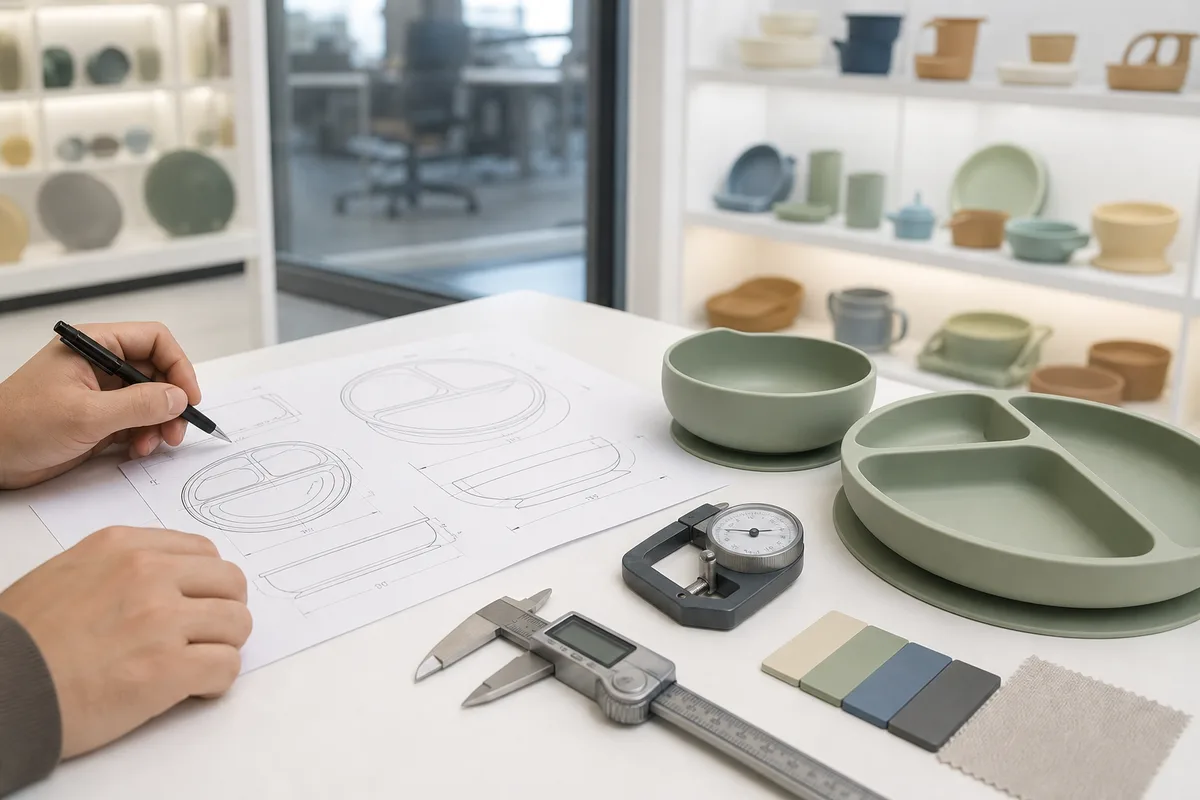
Engineering review of silicone tableware drawings, dimensions and physical samples
DESIGN REVIEW

Make the Product Moldable Before Tooling Begins

A DFM review connects the buyer's intended function with stable silicone molding. We examine wall transitions, draft, parting, suction geometry, venting and likely deformation.

The review also identifies which dimensions control fit, capacity or user experience. Agreed changes are recorded in the controlled drawing before mold manufacture.

  • Drawing and revision control
  • Critical dimension review
  • Molding risk identification
  • Tooling basis confirmation
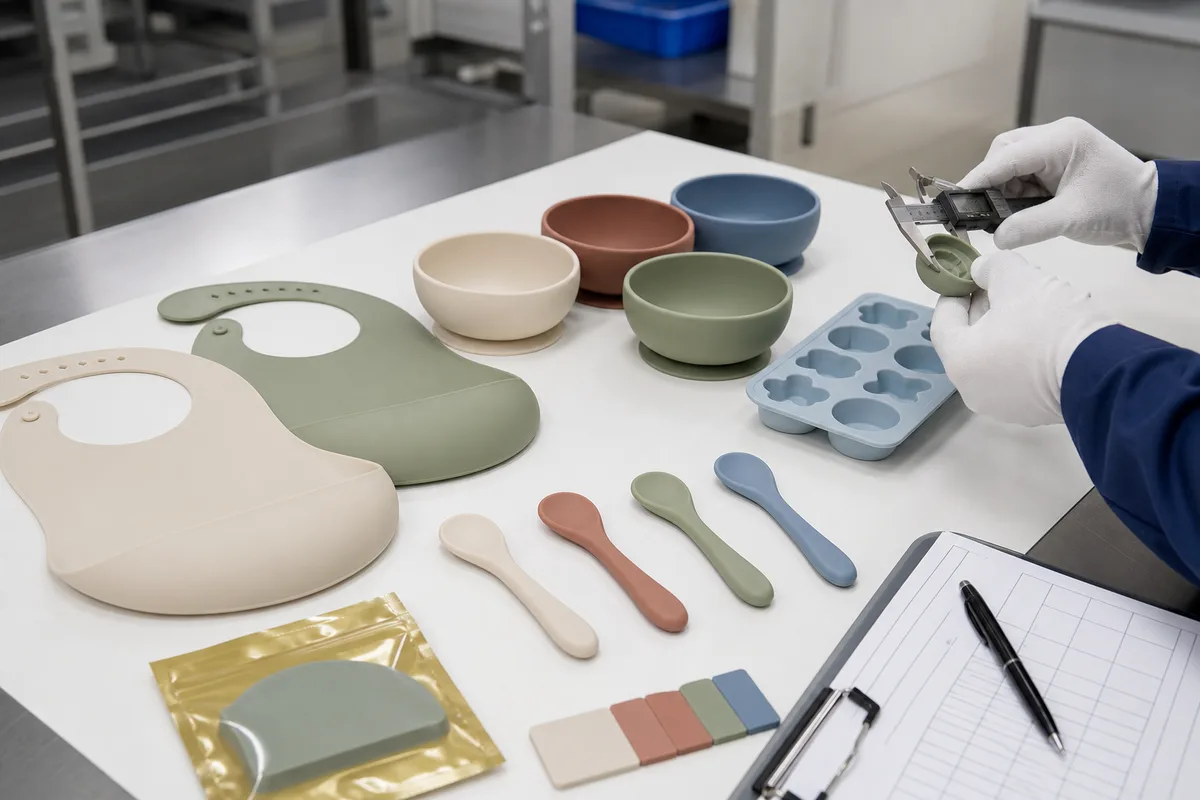
Quality inspection and approval of custom silicone product samples
SAMPLE APPROVAL

Approve Color, Function and Workmanship Together

A sample is more than a color reference. It confirms dimensions, hardness, appearance, function, branding and the handling expected from the finished product.

Buyer feedback is consolidated into one approval round whenever possible. The final approved sample becomes a practical production and inspection reference.

  • Color and hardness check
  • Dimension and function check
  • Branding appearance review
  • Golden sample approval
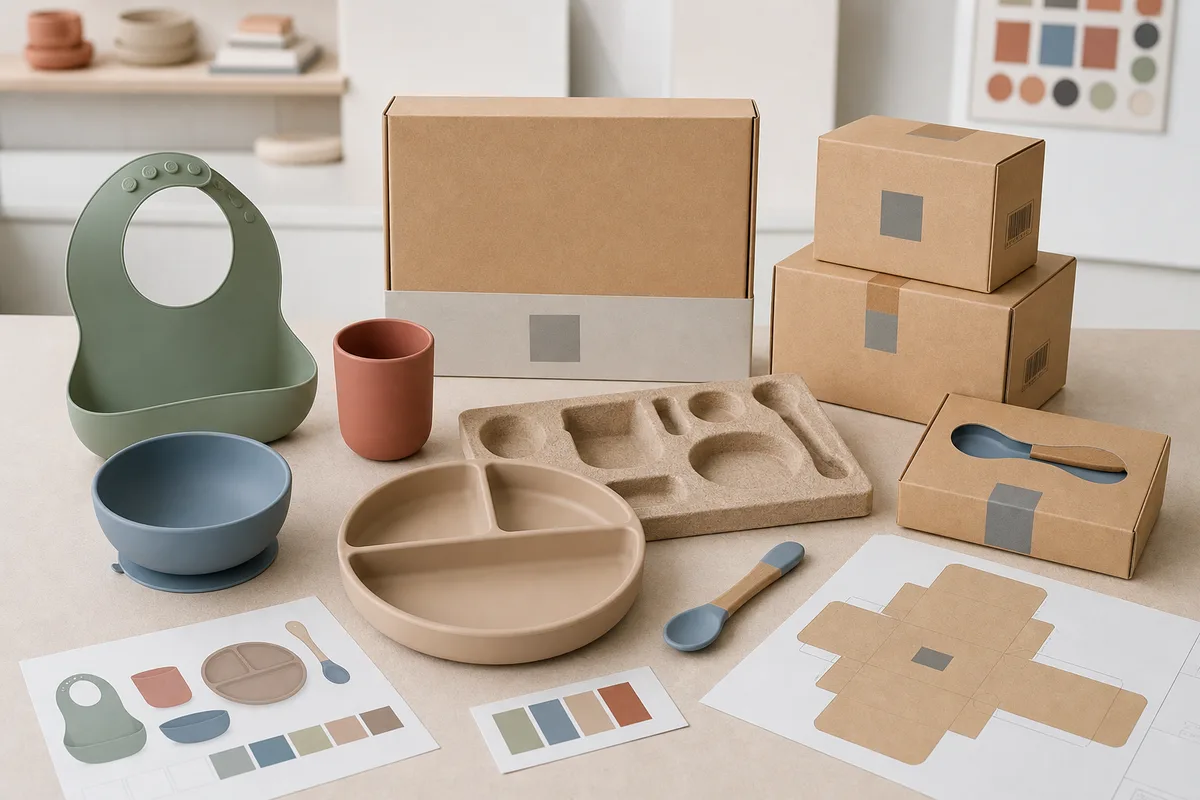
Private-label silicone tableware set with packaging structure and color planning
BRAND & PACKAGING

Validate the Retail Presentation Before Mass Production

Packaging must protect the product, communicate the brand and remain efficient for export cartons. We review the structure while product dimensions and sets are still being confirmed.

Artwork, inserts, labeling space and pack-out direction are approved before volume packing. This prevents late changes from delaying an otherwise finished order.

  • Logo and artwork placement
  • Insert and box fit
  • Barcode and label space
  • Master-carton efficiency

CUSTOM MOLD DEVELOPMENT

Eight Stages from Brief to Repeat Production

Clear approval points reduce uncertainty, protect tooling investment and prepare the product for scalable manufacturing.

01

Discovery & Commercial Brief

The first stage defines what the product must achieve and how the business plans to sell it.

We ask about target users, product category, destination market, reference products, expected order quantity, annual forecast, target cost, launch date and preferred packaging.

If the concept is still early, a photo, sketch or physical sample may be enough to begin a useful discussion.

If CAD data already exists, we review file format, dimensions and critical functions.

Clear commercial context helps the technical team recommend a mold route that is appropriate for the program rather than overengineering or underengineering the product.

02

CAD Review & Design for Manufacturing

Our engineering review examines wall thickness, draft angles, parting lines, shutoffs, ribs, undercuts, suction features, radii, venting, gate position and likely deformation.

Silicone is flexible, but flexibility does not remove the need for disciplined design.

A product that looks attractive in a rendering may be difficult to demold, may trap air or may not hold its intended shape.

Design-for-manufacturing work converts the concept into geometry that can be molded repeatedly.

Recommended changes are discussed with the customer, and the controlled drawing or 3D model becomes the technical basis for quotation and mold development.

03

Material, Hardness & Color Definition

The product specification identifies whether platinum-cured LSR or HCR is the better route, along with target hardness, color, transparency and performance needs.

A soft bib, a suction plate and a large ice mold may all use food-grade silicone, but they need different handling characteristics.

We consider flexibility, rebound, tear resistance, weight, wall thickness and temperature exposure.

Pantone references are used for custom colors, while the approved physical sample remains the most useful production reference.

Material information is recorded so that purchasing, preparation, molding and quality teams work from the same requirement.

04

Mold Engineering & CNC Machining

Naike Silicone's in-house mold center coordinates mold design and CNC machining for custom projects.

The mold structure is planned around the selected process, cavity count, expected volume, surface finish, venting, flash control and demolding method.

Keeping tooling development connected to production reduces communication gaps and helps protect customer intellectual property.

A typical custom mold-development cycle is approximately 15 to 25 days, depending on geometry, cavity count, complexity and approval speed.

During this stage, branding details and product surfaces are finalized because embossed, debossed and textured features are created directly in the tool.

05

Trial, Prototype & Sample Approval

The first mold trial is used to evaluate filling, curing, demolding, flash, dimensions, function, color and appearance.

Existing-style samples typically require about 3 to 5 days, while custom-tooling samples typically require about 7 to 12 days after the relevant tooling stage is ready.

Stock samples can be provided free within three days; custom samples are charged at tooling cost and that cost can be refundable against production orders according to the agreed commercial terms.

Feedback is recorded, necessary changes are implemented and a final approved sample becomes the reference for mass production.

06

Branding & Packaging Validation

Logo appearance and packaging fit are approved before volume production.

For molded logos, the sample confirms depth, clarity and placement.

For printing, laser engraving or heat-transfer labeling, the decoration sample confirms color, registration, adhesion and overall presentation.

Packaging trials check how the product sits in an insert or box, whether surfaces are protected and whether the pack is efficient for master cartons and export shipment.

This validation prevents a technically correct silicone product from being delayed by avoidable branding or packaging changes at the end of production.

07

Pilot Run & Quality Planning

Before a large custom order, a pilot run can confirm the complete production route.

Incoming quality control verifies raw silicone identity and batch information.

In-process quality control monitors molding, vulcanization, post-cure, dimensions, color, appearance and critical functions.

Outgoing quality control verifies finished products, quantities, branding, packaging and agreed reports.

The quality plan identifies inspection points, methods, frequency and acceptance references.

Any adjustment is documented before the full order proceeds.

This creates a stable bridge between an approved development sample and repeatable commercial manufacturing.

08

Mass Production & Repeat Supply

After approval, production is scheduled across three hydraulic compression molding lines and two LSR injection molding lines.

Monthly capacity exceeds 300,000 pieces across the core product categories.

Standard orders typically require about 15 to 25 days, while bulk custom production commonly requires about 30 to 40 days, subject to product complexity, quantity, decoration and packaging.

Stock-design MOQ begins at 500 pieces per SKU.

Custom molding normally begins around 1,000 to 3,000 pieces depending on complexity.

Approved specifications, samples and tooling records support consistent repeat orders and future collection extensions.

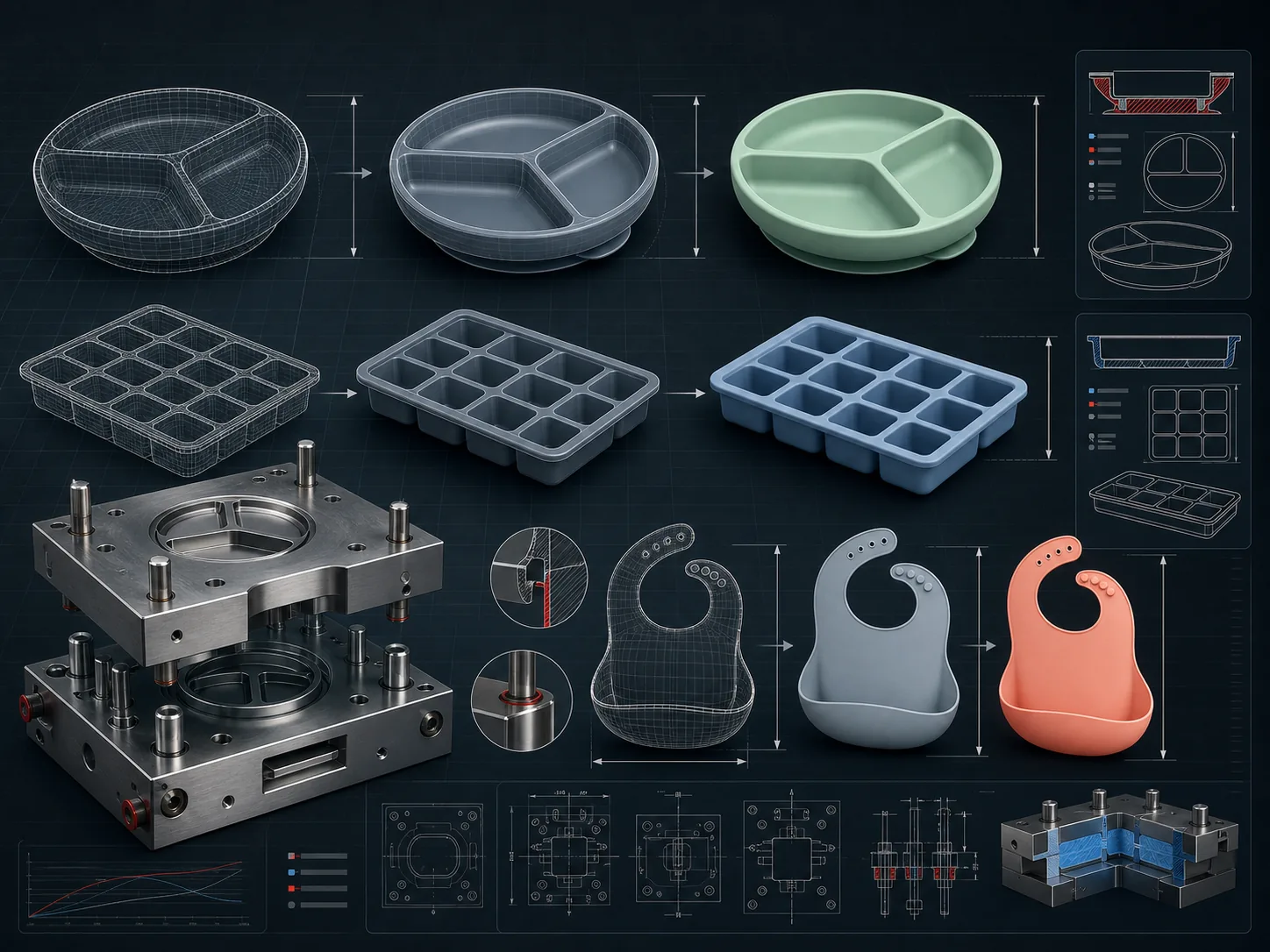
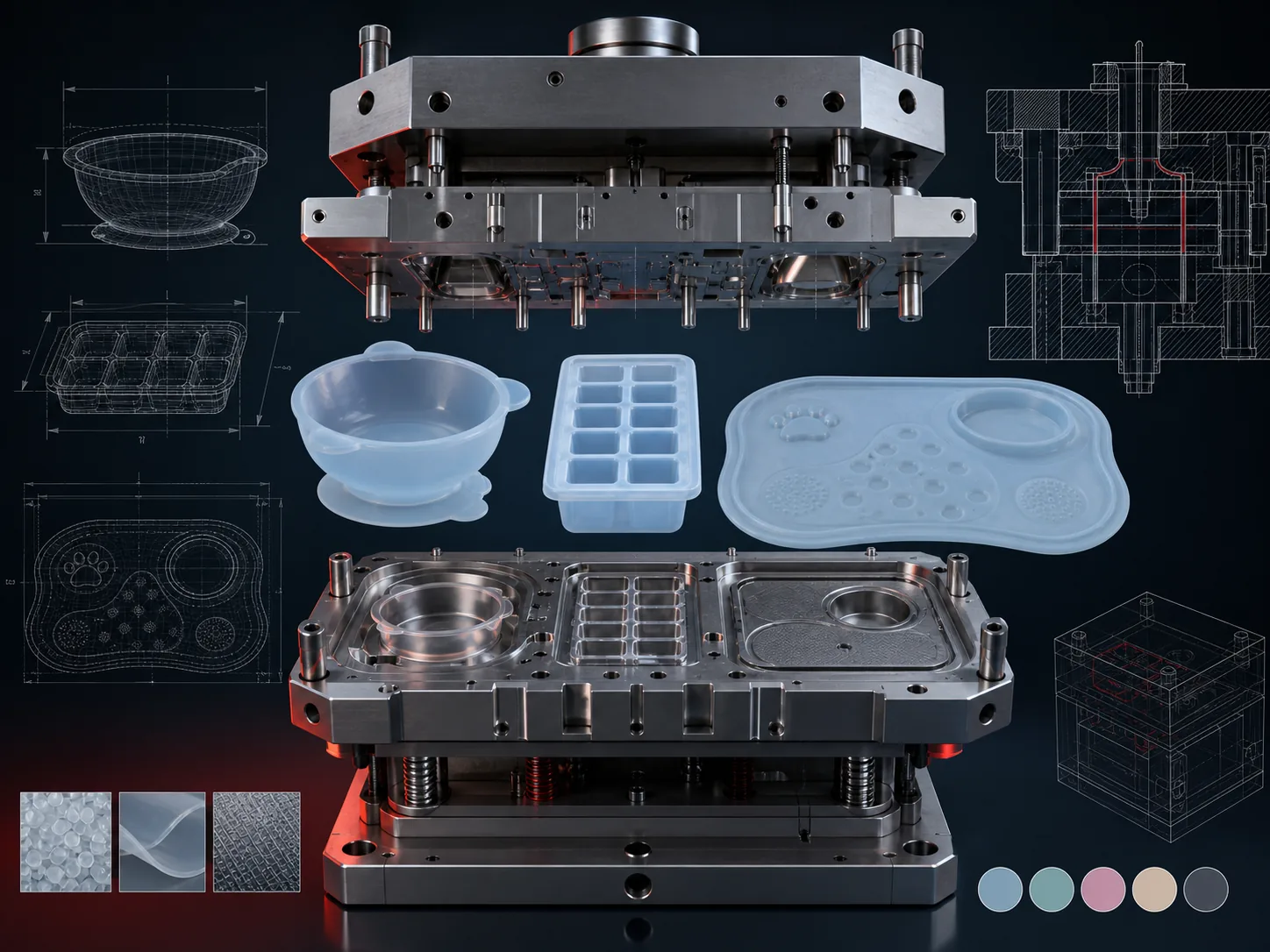
3D DESIGN & ENGINEERING

CAD Decisions Become Molded Product Details

Three-dimensional modeling allows structure, proportions and key functions to be reviewed before machining begins.

For a suction plate, engineers study base geometry, wall transitions, compartment radii and demolding.

For an ice tray, they review cavity depth, release behavior, lid fit and stacking.

For a silicone bib, they evaluate neck adjustment, pocket shape, thickness and roll-up flexibility.

The CAD model also communicates branding and finish.

Embossed or debossed logos, texture, measurement marks and decorative relief must be built into the correct surfaces with enough definition for the selected material and molding process.

Section views and mold drawings help confirm parting, venting, cavity layout and production handling.

Customers approve the controlled design before mold manufacture.

When revisions are requested, the drawing version, sample status and production requirement are updated together.

This discipline protects both sides from using an outdated file and creates a traceable path from design intent to the approved physical sample.

Exploded silicone product mold, finished parts and precision engineering visualization

Customization for Importers, Brands, Retailers and Distributors

Private-Label Product Development

Private-label customers often need more than a logo on a standard item.

We can adjust dimensions, color combinations, surface details, product sets, packaging structure and accessory selection so the finished offer fits a specific retail position.

The project can begin with an existing style to reduce investment and lead time, or with a fully custom mold when differentiation is central to the brand.

Our team helps separate essential changes from expensive changes that do not improve consumer value.

This creates a more disciplined path from a sourcing idea to a recognizable product collection.

New Brand Launch Support

A new brand may have a strong visual identity but limited manufacturing experience.

We help convert brand guidelines into practical product specifications.

That includes choosing silicone colors, defining logo treatment, selecting an appropriate product mix, reviewing initial MOQ, preparing packaging dimensions and setting realistic sample and production dates.

We can also help organize a launch around a small coordinated collection instead of many unrelated SKUs.

A focused first range gives the brand clearer photography, simpler inventory and a more consistent customer experience while leaving room for later extensions.

Retailer & Distributor Programs

Chain retailers and distributors need reliable supply, documentation and packaging consistency across repeated orders.

We plan programs around SKU structure, tiered volume, carton efficiency, destination-market labeling, test reports and forecast visibility.

Existing molds can provide a faster route for seasonal or promotional products, while custom molds support exclusive programs.

Product and packaging changes are documented so different purchase orders do not drift from the approved standard.

Our B2B workflow is designed for wholesale relationships where price, MOQ, timing, consolidation and repeatability matter as much as the first sample.

Collection Extension & Cost Optimization

Successful products often lead to new sizes, colors, sets or related items.

We review whether an extension can reuse existing design language, packaging formats or manufacturing knowledge.

Cost optimization may come from adjusting cavity count, simplifying a feature, improving carton utilization, choosing a more suitable logo process or aligning several products around shared colors.

The objective is not to remove value; it is to direct investment toward features consumers notice and functions they use.

A structured review helps a brand grow its range without creating unnecessary tooling, inventory or quality complexity.

QUALITY BUILT INTO CUSTOMIZATION

Control the Product You Approved

A custom product is only successful when the approved design can be reproduced consistently.

01

Material Traceability

Incoming batches are identified and checked against the approved food-grade platinum-cured silicone specification.

Color, hardness and relevant material information are connected to the production program.

Traceability supports investigation, repeat orders and customer documentation.

It also helps prevent uncontrolled substitutions that could change appearance or performance.

02

Process Control

Approved machine settings, cure conditions, post-cure requirements and handling instructions provide a controlled manufacturing window.

Operators and quality personnel monitor defined characteristics during production.

If a deviation is found, affected material is separated and the issue is reviewed before production continues.

03

Finished-Product Testing

Dimensions, appearance, function, branding and packaging are checked against drawings and the approved sample.

Existing laboratory evidence is reviewed for relevance, and project-specific testing can be arranged when the finished SKU needs new documentation.

Destination-market requirements are discussed early so the correct product and sample configuration is evaluated.

04

Repeat-Order Consistency

Tooling condition, controlled specifications, approved color references, packaging requirements and inspection records are retained for repeat programs.

When a customer requests a change, the revised drawing, sample and production instruction are aligned.

This reduces ambiguity and protects the consistency of established product lines.

COMMERCIAL PLANNING

Balance Tooling, MOQ, Lead Time and Target Unit Cost

Custom product development is a technical and commercial decision.

A more complex mold can create stronger differentiation or higher output, but it may also increase investment and approval time.

We review expected order volume, annual forecast, target price and launch schedule before recommending a tooling direction.

Stock designs normally begin at an MOQ of 500 pieces per SKU.

Custom molded products usually begin around 1,000 to 3,000 pieces depending on size, geometry, process and packaging.

Standard orders typically require 15 to 25 days, while bulk custom programs commonly require 30 to 40 days after approval.

These ranges are planning references; the quotation confirms the schedule for the specific project.

For customers building a new brand, beginning with a focused range can reduce inventory pressure and make product photography, packaging and marketing more consistent.

For established retailers and distributors, higher forecasts may justify multi-cavity tooling, exclusive geometry or coordinated packaging.

We provide the technical information needed to compare these options before the customer commits.

Information That Improves a Quotation

  • Product use, target customer and destination market
  • Sketch, photo, physical sample or 2D/3D file
  • Dimensions, capacity and critical functional details
  • Platinum-cured material, hardness and color requirements
  • Logo artwork and preferred branding method
  • Individual packaging or multi-product set concept
  • Initial quantity, annual forecast and target cost
  • Required standards, reports and launch schedule

Custom Silicone Project FAQ

Practical answers for product teams preparing an OEM, ODM or private-label program.

What information should we send for a custom quotation?

Send the product name, intended use, target market, reference photos or samples, available 2D or 3D files, preferred dimensions, hardness, color, logo method, packaging idea, estimated order quantity and launch schedule.

If some information is unknown, identify the decisions already made and the areas where you need guidance.

A complete brief allows us to evaluate material, mold structure, cavity planning, sample timing and commercial assumptions more accurately.

Can Naike Silicone develop a product from only a sketch or sample?

Yes.

A project can begin from a sketch, reference photo, physical sample or concept description.

Our team can organize dimensions, create or refine 3D geometry and conduct a design-for-manufacturing review.

The customer remains responsible for confirming product ownership and approving the final design.

Clear feedback during the drawing and sample stages is important because every approved detail affects tooling, production and cost.

What is the difference between using an existing mold and opening a new mold?

An existing mold reduces tooling investment and usually supports a faster sample and production schedule.

Customization can focus on color, logo, packaging and product combinations.

A new mold creates stronger differentiation because dimensions, geometry, function, texture and integrated branding can be designed around the brand.

The correct route depends on budget, expected volume, exclusivity, timing and the importance of unique product features.

How long does custom mold development take?

A typical custom silicone mold requires approximately 15 to 25 days from confirmed design to the relevant trial stage.

Complex geometry, multiple cavities, detailed textures, large tools or slow approval feedback can extend the schedule.

Existing-style samples commonly take about 3 to 5 days, while custom-tooling samples commonly take about 7 to 12 days after the required tooling work is ready.

We confirm a project-specific timeline in the quotation.

What are the typical minimum order quantities?

For stock designs, the typical MOQ begins at 500 pieces per SKU.

Fully custom molded products generally begin around 1,000 to 3,000 pieces depending on size, geometry, process, color, decoration, packaging and production efficiency.

A higher cavity count may improve unit economics for larger forecasts but requires more tooling investment.

We review MOQ together with annual demand and target pricing so the commercial plan supports both launch and repeat supply.

Which silicone materials are available?

Naike Silicone uses food-grade platinum-cured liquid silicone rubber and high-consistency rubber.

Hardness can be adjusted within an approximate Shore A10 to A70 range when suitable for the product.

Color, wall thickness, weight and surface finish can also be customized.

Material selection is based on food-contact use, flexibility, tear resistance, rebound, temperature exposure and the selected molding process.

The approved material becomes part of the controlled product specification.

Can you match our brand colors and add our logo?

Yes.

We support Pantone-based color matching and coordinated color palettes for individual products or collections.

Logo options include embossed or debossed molding, silk-screen printing, laser engraving and heat-transfer labeling where appropriate.

The best method depends on geometry, contact areas, artwork detail, expected wear and order volume.

Final color and branding are approved on a physical sample before mass production.

Can you provide custom retail packaging?

Yes.

Packaging options include color boxes, display cartons, gift boxes, hang-sell cards, blister packs and custom inserts.

We can review product fit, protection, presentation, labeling space, barcode position, master-carton efficiency and shipping consolidation.

Packaging should be discussed before final product approval because the product dimensions, set composition and logo presentation influence the most suitable structure.

How do you protect a customer's design and intellectual property?

In-house mold development reduces the number of external parties involved in a custom project.

Drawings, samples, tooling and commercial information are managed as project information, and NDA review can be arranged before proprietary files are exchanged.

Customers should clearly identify ownership requirements, exclusive features and any restricted markets.

Controlled file versions and approval records help the production team use the correct information without unnecessary circulation.

What quality and compliance documents can be supplied?

Our programs can support LFGB, FDA 21 CFR 177.

2600, EU 10/2011, REACH and RoHS documentation routes, together with ISO 9001:2015 quality-system and BSCI sourcing requirements.

Existing evidence can be reviewed for relevance, while project-specific samples can be prepared when new testing is required.

The scope is confirmed according to product shape, color, decoration, age group, food type, contact conditions and destination market.

B2B PROJECT INQUIRY

Request a Product, Tooling and Supply Review

Share the intended product, destination market, order quantity and launch plan. Our project team will review the information and identify the next practical step.

Drawings are helpful but not required. A sketch, reference photo or physical sample can be used for an initial discussion.

Emailinfo@naikegroup.com
WhatsApp+86 199 5979 7076
PROJECT REVIEW

Tell Us What You Need to Source

Receive a practical response based on product scope, quantity, market and customization route.

No payment is requested. MOQ, price, lead time and testing scope are confirmed only after project review.

WA