PRODUCT SOURCING GUIDES
How to Build a Profitable Silicone Baby Tableware Product Line
Build a profitable silicone baby tableware product line with factory-backed guidance on assortment, costing, tooling, compliance, packaging and repeat orders.
DIRECT ANSWER
What B2B Buyers Need to Know
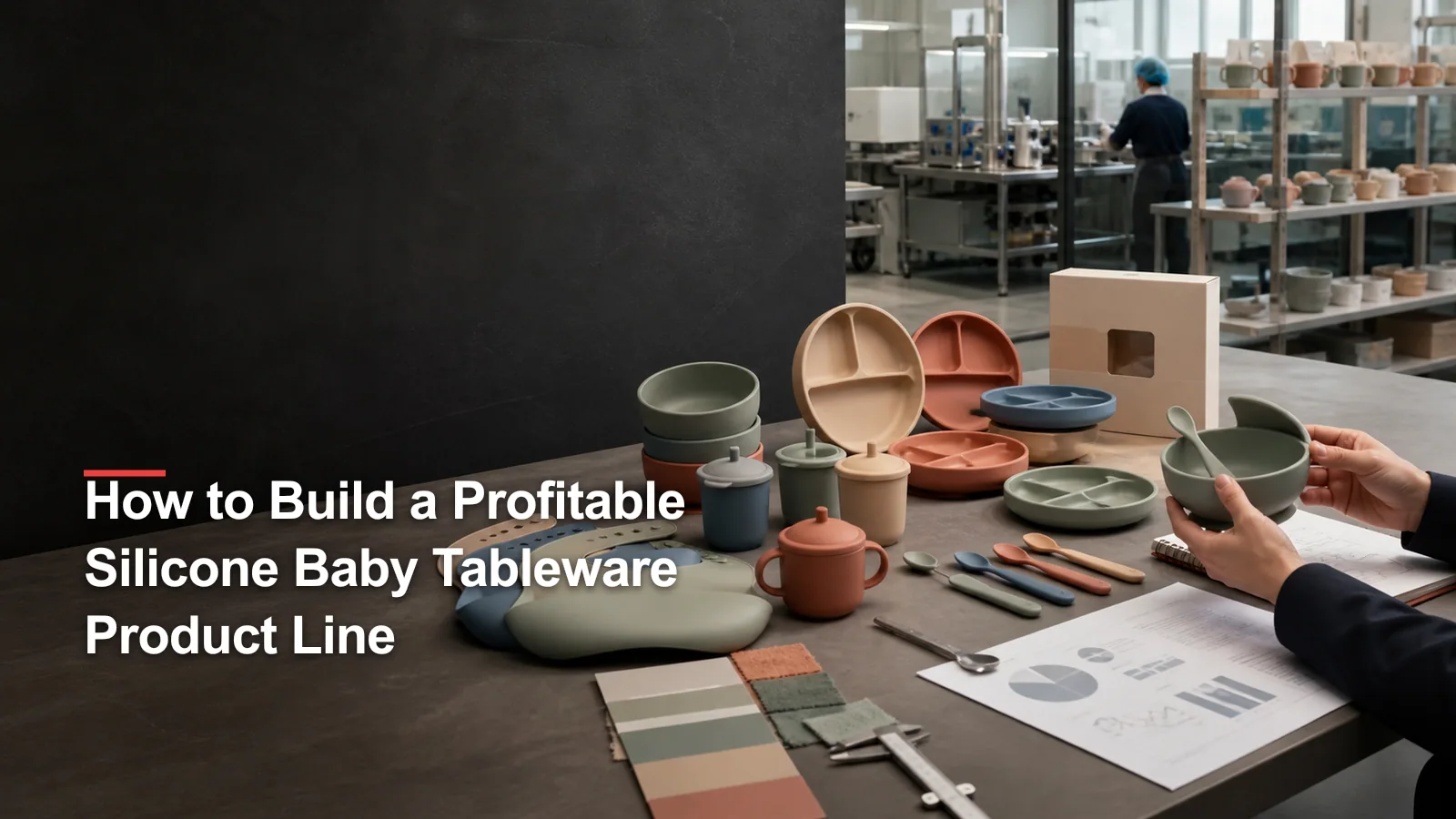
A profitable silicone baby tableware product line is not created by adding more shapes or colors. It is built by connecting a specific buyer and channel with a disciplined assortment, controlled product specifications, realistic landed-cost assumptions and a repeatable approval system. From our factory perspective, the strongest programs start with a compact core range, share components and color families where practical, reserve custom tooling for genuine differentiation, and treat packaging, testing and replenishment as part of product architecture rather than late-stage additions.
This guide is written for baby-product importers, private-label brands, distributors, retailers, category managers and sourcing teams. It provides a decision framework rather than legal advice or a universal specification. Product classification, use conditions and destination market should be confirmed before final testing, labelling or compliance decisions.
Key Takeaways
- Start with a buyer, channel and price architecture before selecting products.
- Give each SKU a commercial role and remove variants that do not earn their complexity.
- Model tooling, packaging, testing, freight and inventory alongside unit price.
- Use shared components and controlled color families to improve repeat-order economics.
- Approve function, appearance, packaging and evidence as one sale-ready SKU.
- Treat the first collection as a platform that can expand from proven demand data.
Compare Three Practical Assortment Architectures
The right launch width depends on channel, forecast confidence and the buyer's ability to carry inventory. These scenarios are planning models, not unconditional MOQ or margin promises.
| Architecture | Best Fit | Factory and Commercial Implication |
|---|---|---|
| Focused starter line | New brands, test markets and distributor pilots | Two to four hero SKUs reduce packaging, color and inventory complexity while buyer feedback is collected. |
| Coordinated core range | Established retailers and private-label programs | Shared colors and components support a stronger shelf story, but demand planning must be controlled by SKU. |
| Tiered portfolio | Multi-channel brands with proven category demand | Entry, core and premium tiers can widen price coverage, although tooling, test samples and replenishment controls increase. |
SECTION 01
Build a Profitable Silicone Baby Tableware Product Line Brief
Begin with the target buyer, channel and assortment role so every specification decision supports a sellable range.
Define the Commercial Job for silicone baby tableware product line
The factory view of “Define the Commercial Job” begins with the finished selling unit, not an isolated silicone part. Identify the target customer, sales channel, retail price tier, purchase occasion and reason the range should exist. For this decision, the buyer should distinguish a mandatory acceptance point from a preference that can be traded against cost or timing.
A traceable project record should connect a one-page category brief linking customer need, channel, target price, forecast and launch date. The unresolved exposure is beginning with attractive factory samples can create disconnected SKUs that compete for the same buyer and inventory budget. Assign an escalation trigger for any material, tooling, packaging or destination-market change.
Build the Silicone Baby Tableware Product Line Architecture
A category buyer should judge “Build the Silicone Baby Tableware Product Line Architecture” by the role it plays in the assortment, price architecture and retail channel. Assign every plate, bowl, cup, spoon and bib a role as a hero SKU, attachment, bundle component or premium upgrade. For this decision, recording the applicable condition keeps the requirement from being reused outside its original product and market scope.
The next decision gate should reference a portfolio map showing user stage, price tier, component relationships, colors and forecast by SKU. The unresolved exposure is adding products without a defined role increases tooling, packaging, photography, testing and replenishment work without guaranteed revenue. Make the result accessible to purchasing, engineering and quality before the next commercial commitment.
Set the Price and Margin Envelope
For baby-product importers, private-label brands, distributors, retailers, category managers and sourcing teams, the commercial question behind “Set the Price and Margin Envelope” is whether it improves sell-through without creating avoidable SKU complexity. Work backward from realistic channel pricing to a conditional target landed cost and then allocate room for product, packaging, testing, logistics and risk. For this decision, a measurable gate lets the team close the issue with evidence instead of relying on an undocumented verbal decision.
For repeat-order comparability, archive a scenario model with retail price, channel deductions, target margin, trade term, freight assumptions and sensitivity ranges. The unresolved exposure is a target based only on factory unit price can fail after packaging, inspection, freight, duty, returns and promotional allowances are included. Close the decision with a revision-controlled record that can guide production and the next reorder.

SECTION 02
Translate the Assortment Into Factory-Ready Specifications
Translate the range plan into comparable product, packaging and approval evidence before requesting final quotations.
Create a Controlled Product Specification
Before a sourcing team adds another product option, “Create a Controlled Product Specification” needs a clear buyer, channel and repeat-order purpose. Define dimensions, capacity, weight range, hardness, finish, color direction, suction conditions, component fit and care assumptions. For this decision, the team should identify who approves the requirement, how it will be measured and which later decisions depend on it.
During supplier review, the buyer should request revision-controlled drawings, specification sheets and identified physical approval samples. The unresolved exposure is verbal expectations make quotations incomparable and turn later quality discussions into subjective arguments. Link the record to the current SKU revision and name the person authorized to release it.
Select Existing or Custom Tooling
The factory view of “Select Existing or Custom Tooling” begins with the finished selling unit, not an isolated silicone part. Use existing molds when speed and lower development exposure matter, and reserve custom tooling for features that support a defendable commercial difference. For this decision, this makes quotations more comparable because every potential supplier is responding to the same operating assumptions.
The approval file should contain a route comparison covering available molds, modification limits, new-tool concept, ownership, trial stages and change assumptions. The unresolved exposure is treating a stock sample as proof of a custom program's final cost or timing creates false expectations. Date the approval and preserve the conditions under which the evidence remains applicable.
Engineer Suction and User Function
A category buyer should judge “Engineer Suction and User Function” by the role it plays in the assortment, price architecture and retail channel. Define representative table surfaces, product temperature, loading, removal method and the way each component should perform in use. For this decision, the decision should be written in language that purchasing, engineering, quality and packaging teams can interpret consistently.
A useful sourcing discussion asks the supplier to provide repeatable sample trials, dimension records, photos and a signed function reference tied to the product revision. The unresolved exposure is suction performance can vary with surface texture, cleanliness, geometry and use conditions, so an undefined claim is difficult to reproduce. Keep the sample identity, lot and decision outcome together so a later reviewer can reconstruct the release.

SECTION 03
Control Cost, Quality and Compliance Before Launch
Protect margin by reviewing production controls, landed-cost drivers and launch risks as one commercial system.
Rationalize Colors and Components
For baby-product importers, private-label brands, distributors, retailers, category managers and sourcing teams, the commercial question behind “Rationalize Colors and Components” is whether it improves sell-through without creating avoidable SKU complexity. Launch only the colors and component combinations supported by credible demand, while sharing pigments, utensils or packaging structures where commercially sensible. For this decision, a clear baseline also helps the supplier explain any trade-off instead of silently selecting the easiest manufacturing option.
Before the next project gate, both parties should agree on a SKU matrix with forecast by color, common-component map and rules for future color additions. The unresolved exposure is too many low-volume colors increase changeovers, pigment commitments, pack inventory and the risk of unbalanced stock. Record any deviation separately and prevent it from becoming an undocumented repeat-order precedent.
Plan Food-Contact and Market Evidence
Before a sourcing team adds another product option, “Plan Food-Contact and Market Evidence” needs a clear buyer, channel and repeat-order purpose. Confirm product classification, intended use, destination market and final SKU construction before defining tests, documents or packaging claims. For this decision, the requirement becomes useful only when it can be converted into a drawing, sample, record or repeatable check.
The evidence package is stronger when it includes a compliance matrix linked to material, pigment, finished product, market, test sample and responsible approver. The unresolved exposure is a generic report for another color, formulation or geometry may not support the actual sale unit or its marketing language. Carry the approved limit into the inspection instruction rather than leaving it only in meeting notes.
Validate Packaging and Retail Presentation
The factory view of “Validate Packaging and Retail Presentation” begins with the finished selling unit, not an isolated silicone part. Develop the insert, folding method, label copy, barcode placement, ventilation, carton pack and unboxing sequence around the approved product. For this decision, early alignment is less expensive than correcting a mold, replacing printed packaging or sorting finished inventory.
For an audit-ready decision, retain a physical packaging prototype, final dieline, controlled copy deck, master-carton data and pack-out approval. The unresolved exposure is packaging designed after tooling can deform soft parts, increase freight cube or force unsupported claims onto the selling unit. Retain enough context to distinguish a process correction from a change to the buyer's requirement.
SECTION 04
Scale the Range With Repeat-Order Discipline
Use early sales and replenishment assumptions to decide which variants deserve expansion and which should remain controlled.
Build the Production Quality Plan
A category buyer should judge “Build the Production Quality Plan” by the role it plays in the assortment, price architecture and retail channel. Convert the approved range into incoming, in-process, final and packaging checks with defect examples and escalation rules. For this decision, a named decision owner prevents an open requirement from moving unnoticed into tooling or shipment release.
The buyer's release packet should preserve golden samples, measurement methods, inspection criteria, batch records, retained samples and release authority. The unresolved exposure is a factory cannot consistently protect requirements that remain only in emails or presentation images. Reference the applicable drawing and order so evidence from another configuration is not substituted.
Model Launch Inventory and Reorders
For baby-product importers, private-label brands, distributors, retailers, category managers and sourcing teams, the commercial question behind “Model Launch Inventory and Reorders” is whether it improves sell-through without creating avoidable SKU complexity. Separate launch uncertainty from stable demand, then set reorder triggers using production, packaging, approval, transit and receiving time. For this decision, the buyer should distinguish a mandatory acceptance point from a preference that can be traded against cost or timing.
A traceable project record should connect base, upside and downside forecasts by SKU and color, plus reorder assumptions and safety-stock logic. The unresolved exposure is ordering every color equally or reordering from category totals can create shortages in winners and excess stock in slower variants. Assign an escalation trigger for any material, tooling, packaging or destination-market change.
Use the First Range as a Platform
Before a sourcing team adds another product option, “Use the First Range as a Platform” needs a clear buyer, channel and repeat-order purpose. Collect sales, returns, reviews, inspection data and operational feedback before adding shapes, colors or bundles. For this decision, recording the applicable condition keeps the requirement from being reused outside its original product and market scope.
The next decision gate should reference a post-launch review with approved corrective actions, next-range priorities and preserved tooling and specification references. The unresolved exposure is expanding before the first range proves its economics multiplies unresolved product and supply-chain weaknesses. Make the result accessible to purchasing, engineering and quality before the next commercial commitment.

ACTION FRAMEWORK
Buyer Checklist Before Commercial Approval
Use this checklist as a meeting agenda. It is intentionally concise so the team can identify missing evidence without replacing its own quality, legal or supplier-management procedure.
| Check | Question | Why It Matters |
|---|---|---|
| Target buyer | Which parent, retailer or distributor problem does this range solve? | A clear use case prevents a catalog-style assortment with no coherent reason to buy. |
| Channel economics | What retail price, margin structure and landed-cost ceiling apply? | The cost ceiling determines feasible weight, packaging, decoration and assortment width. |
| SKU role | Is each item a hero, attachment, bundle component or premium upgrade? | Every SKU must justify its inventory, packaging and operational complexity. |
| Product specification | Are dimensions, capacity, hardness, finish and suction conditions controlled? | Comparable quotations and inspections require one measurable baseline. |
| Tooling route | Can an existing mold support the launch, or does differentiation require new tooling? | The route affects capital, lead time, exclusivity and revision flexibility. |
| Color plan | How many launch colors are supported by a credible SKU-level forecast? | Color changes can increase material, setup and inventory exposure. |
| Compliance plan | Which finished SKUs, markets and intended-use conditions must be evaluated? | Generic material reports do not automatically support every finished product or claim. |
| Packaging | Has the team approved the physical pack-out, claims, codes and master carton? | Packaging can change product recovery, freight cube, presentation and market readiness. |
| Quality release | Which golden sample, defect standard and batch records control production? | A beautiful development sample is not a mass-production control plan. |
| Replenishment | What reorder trigger protects lead time without creating excess stock? | Repeat-order economics depend on forecast visibility and preserved approvals. |
NEXT READING
Continue the Supplier and Product Review
These internal resources connect the guide with Naike Silicone product, factory, customization and inquiry pages. Open the route that matches the next decision in your project.
Browse silicone baby tableware products
Use browse silicone baby tableware products to gather the next level of product, manufacturing or commercial information.
Open internal resource →Review custom development and mold support
Use review custom development and mold support to gather the next level of product, manufacturing or commercial information.
Open internal resource →Explore factory capability and quality evidence
Use explore factory capability and quality evidence to gather the next level of product, manufacturing or commercial information.
Open internal resource →Prepare a structured silicone project inquiry
Use prepare a structured silicone project inquiry to gather the next level of product, manufacturing or commercial information.
Open internal resource →Read the wholesale baby tableware sourcing guide
Use read the wholesale baby tableware sourcing guide to gather the next level of product, manufacturing or commercial information.
Open internal resource →Plan MOQ, pricing and lead-time assumptions
Use plan moq, pricing and lead-time assumptions to gather the next level of product, manufacturing or commercial information.
Open internal resource →PRIMARY REFERENCES
Authoritative External Sources
The sources below are official primary references. Applicability depends on the product, intended use and destination market. Buyers should obtain qualified advice for final legal or regulatory decisions.
U.S. eCFR 21 CFR 177.2600
Official U.S. regulatory text for rubber articles intended for repeated use.
European Commission: Food Contact Materials
Official overview of the EU framework, general safety requirements and good manufacturing practice.
ISO 9001 Quality Management Systems
Official ISO page describing the published ISO 9001 quality-management standard.
BUYER QUESTIONS
Frequently Asked Questions
What should a buyer confirm first for silicone baby tableware product line?
Identify the target customer, sales channel, retail price tier, purchase occasion and reason the range should exist as the first controlled decision in the buyer's review. Support that review with a one-page category brief linking customer need, channel, target price, forecast and launch date. The exact depth for define the commercial job depends on product use, market, order value and whether the program uses an existing design or new tooling. Keep this decision linked to the current SKU revision, and reassess define the commercial job whenever material, design, color, process, packaging or destination-market assumptions change.
How should buyers review build the silicone baby tableware product line architecture?
Assign every plate, bowl, cup, spoon and bib a role as a hero SKU, attachment, bundle component or premium upgrade as the first controlled decision in the buyer's review. Support that review with a portfolio map showing user stage, price tier, component relationships, colors and forecast by SKU. The exact depth for build the silicone baby tableware product line architecture depends on product use, market, order value and whether the program uses an existing design or new tooling. Keep this decision linked to the current SKU revision, and reassess build the silicone baby tableware product line architecture whenever material, design, color, process, packaging or destination-market assumptions change.
How should buyers review set the price and margin envelope?
Work backward from realistic channel pricing to a conditional target landed cost and then allocate room for product, packaging, testing, logistics and risk as the first controlled decision in the buyer's review. Support that review with a scenario model with retail price, channel deductions, target margin, trade term, freight assumptions and sensitivity ranges. The exact depth for set the price and margin envelope depends on product use, market, order value and whether the program uses an existing design or new tooling. Keep this decision linked to the current SKU revision, and reassess set the price and margin envelope whenever material, design, color, process, packaging or destination-market assumptions change.
How should buyers review create a controlled product specification?
Define dimensions, capacity, weight range, hardness, finish, color direction, suction conditions, component fit and care assumptions as the first controlled decision in the buyer's review. Support that review with revision-controlled drawings, specification sheets and identified physical approval samples. The exact depth for create a controlled product specification depends on product use, market, order value and whether the program uses an existing design or new tooling. Keep this decision linked to the current SKU revision, and reassess create a controlled product specification whenever material, design, color, process, packaging or destination-market assumptions change.
How should buyers review select existing or custom tooling?
Use existing molds when speed and lower development exposure matter, and reserve custom tooling for features that support a defendable commercial difference as the first controlled decision in the buyer's review. Support that review with a route comparison covering available molds, modification limits, new-tool concept, ownership, trial stages and change assumptions. The exact depth for select existing or custom tooling depends on product use, market, order value and whether the program uses an existing design or new tooling. Keep this decision linked to the current SKU revision, and reassess select existing or custom tooling whenever material, design, color, process, packaging or destination-market assumptions change.
How should buyers review engineer suction and user function?
Define representative table surfaces, product temperature, loading, removal method and the way each component should perform in use as the first controlled decision in the buyer's review. Support that review with repeatable sample trials, dimension records, photos and a signed function reference tied to the product revision. The exact depth for engineer suction and user function depends on product use, market, order value and whether the program uses an existing design or new tooling. Keep this decision linked to the current SKU revision, and reassess engineer suction and user function whenever material, design, color, process, packaging or destination-market assumptions change.
Editorial and Scope Note
Conclusion: Profitable Baby Tableware Product Line
Move from buyer research to a controlled supplier brief
A profitable silicone baby tableware product line is a controlled commercial system rather than a large collection of attractive products. Buyers improve the probability of sustainable margin when assortment roles, specifications, tooling, evidence, packaging, quality gates and replenishment assumptions are resolved together. The practical next step is to share the target channel, destination market, expected quantity, reference products and target launch window so the factory can test the concept against a realistic development and supply plan.
This factory-insider guide supports sourcing preparation and supplier discussion; it does not replace product-specific engineering, laboratory, regulatory, legal or commercial review for the destination market.