MATERIALS, QUALITY & COMPLIANCE
Food Contact Silicone Testing: Which Food-Contact Silicone Tests Do Buyers Need by Market?
Food contact silicone testing by market helps B2B buyers define product evidence for the U.S., EU and Germany before samples, claims and purchase approval.
DIRECT ANSWER
What B2B Buyers Need to Know
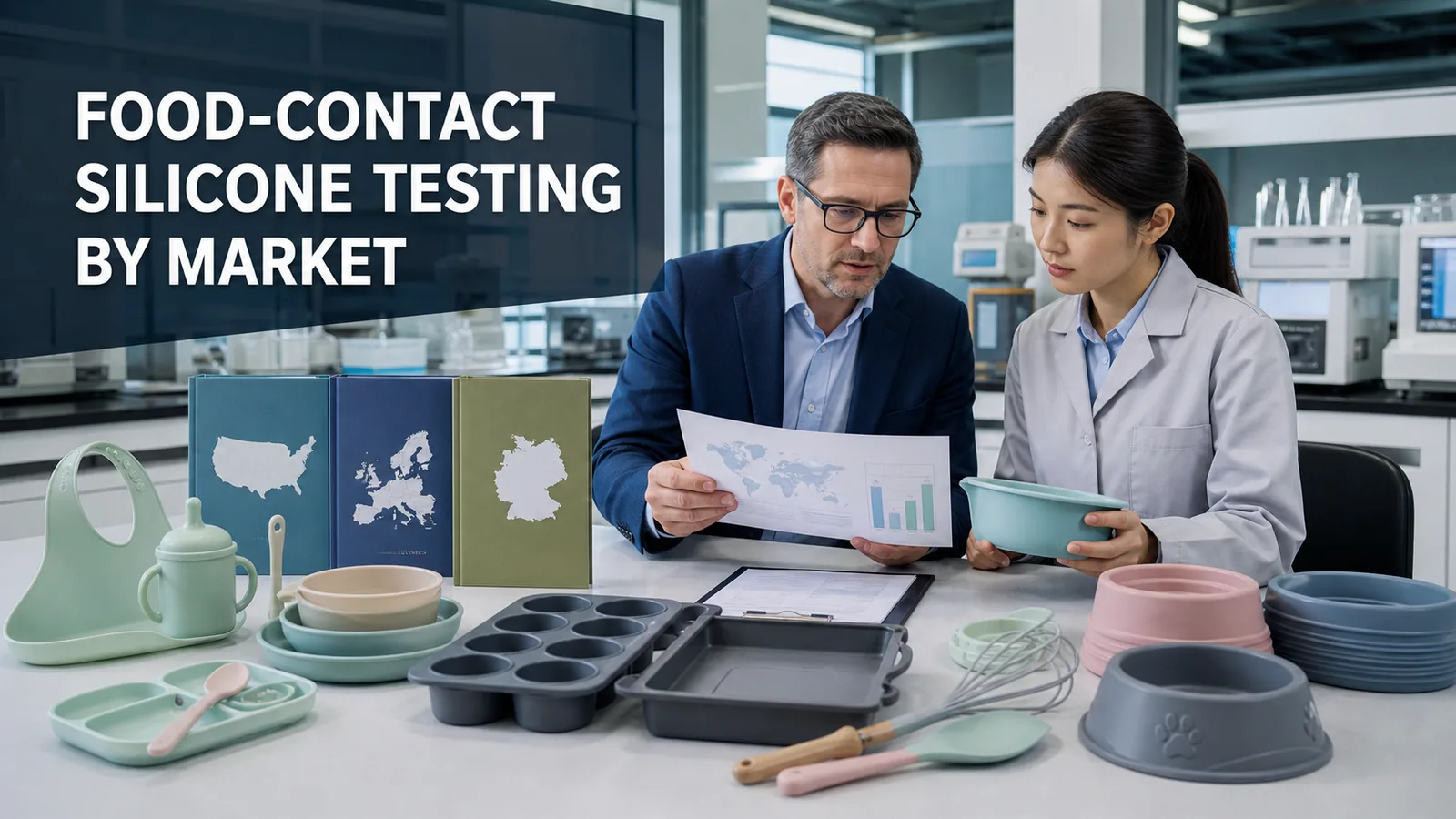
Food contact silicone testing should be selected from the destination market, finished product, formulation, color, food type, contact time, temperature and repeated-use conditions. U.S., EU and German buyer files may share evidence, but they are not interchangeable. Buyers should map each SKU to the applicable framework, laboratory scope, supplier declaration and change-control record before approving claims or orders.
This guide is written for international importers, retailers, private-label brands, distributors, compliance managers, supplier-quality teams and procurement professionals. It provides a decision framework rather than legal advice or a universal specification. Product classification, use conditions and destination market should be confirmed before final testing, labelling or compliance decisions.
Key Takeaways
- Begin with destination market and intended use instead of asking for one universal food-grade certificate.
- Test the finished SKU or justify how representative samples cover its formulation, color and geometry.
- Define food type, temperature, contact duration, repeated use and cleaning conditions before laboratory submission.
- Separate legal framework evidence from retailer specifications, voluntary standards and marketing claims.
- Control material, pigment, design and process changes so earlier reports are not applied automatically.
- Include test responsibility, sample quantity, timing and conditional cost assumptions in the sourcing plan.
Food Contact Silicone Testing by Market: Buyer Decision Matrix
Use this matrix to define the evidence route before requesting quotations or laboratory work. It is a procurement framework, not legal advice, and exact requirements depend on product classification, current rules and intended use.
| Market decision | Evidence focus | Buyer control point |
|---|---|---|
| United States | Applicable food-contact substance status, intended conditions of use and product-specific supporting evidence | Identify formulation references, use limitations, finished SKU and claim wording instead of relying on an undefined FDA-approved statement |
| European Union | Framework Regulation, good manufacturing practice and applicable specific measures or national provisions | Link declarations, supporting test reports, sample identity and intended use for every sale-ready SKU |
| Germany | EU framework plus German enforcement expectations and relevant BfR recommendations for silicone articles | Confirm finished-article scope, extractables or sensory conditions where applicable, color and current revision |
| Multi-market program | A controlled evidence matrix showing shared tests, market-specific gaps and responsible approvers | Prevent one market file from being copied to another without a documented applicability review |
SECTION 01
Food Contact Silicone Testing Begins With Market and Intended Use
Define the intended use, market and risk assumptions before choosing test methods or requesting supplier documents.
Map the Destination Market and Sales Channel for food contact silicone testing
Quality teams should treat “Map the Destination Market and Sales Channel” as an evidence question with a named method, sample and acceptance basis. Define the intended use, sample basis, method and acceptance rule for map the destination market and sales channel before requesting a report. For this decision, a named decision owner prevents an open requirement from moving unnoticed into tooling or shipment release.
The buyer's release packet should preserve a method-specific report, sample identification, lot record and revision-linked acceptance statement for map the destination market and sales channel. The unresolved exposure is a report that does not identify the tested SKU can give false confidence about map the destination market and sales channel. Reference the applicable drawing and order so evidence from another configuration is not substituted.
Define Food Type, Temperature and Contact Duration
A claim about “Define Food Type, Temperature and Contact Duration” is useful only when it can be traced to the correct material, SKU revision and test condition. Link define food type, temperature and contact duration to the correct material lot, finished SKU, color and destination-market requirement. For this decision, the buyer should distinguish a mandatory acceptance point from a preference that can be traded against cost or timing.
A traceable project record should connect a risk review connecting define food type, temperature and contact duration with intended use, market, test condition and responsible approver. The unresolved exposure is a pass/fail statement without method and sample details leaves define food type, temperature and contact duration difficult to audit. Assign an escalation trigger for any material, tooling, packaging or destination-market change.
Classify Repeated Use, Cleaning and Heating Conditions
For supplier-quality review, “Classify Repeated Use, Cleaning and Heating Conditions” connects risk classification with inspection and retained records. Agree who reviews classify repeated use, cleaning and heating conditions, what evidence is retained and which change triggers reassessment. For this decision, recording the applicable condition keeps the requirement from being reused outside its original product and market scope.
The next decision gate should reference a method-specific report, sample identification, lot record and revision-linked acceptance statement for classify repeated use, cleaning and heating conditions. The unresolved exposure is uncontrolled material or color changes can invalidate earlier conclusions about classify repeated use, cleaning and heating conditions. Make the result accessible to purchasing, engineering and quality before the next commercial commitment.

SECTION 02
Translate Product Conditions Into a Defensible Laboratory Scope
Match every claim and report to the correct material, finished SKU, sampling condition and current revision.
Identify Silicone Formulation, Cure System and Pigment
The compliance file becomes more defensible when “Identify Silicone Formulation, Cure System and Pigment” is defined before samples are submitted to a laboratory. Convert identify silicone formulation, cure system and pigment into a repeatable incoming, in-process or release control with a named record. For this decision, a measurable gate lets the team close the issue with evidence instead of relying on an undocumented verbal decision.
For repeat-order comparability, archive a risk review connecting identify silicone formulation, cure system and pigment with intended use, market, test condition and responsible approver. The unresolved exposure is using the wrong test condition for identify silicone formulation, cure system and pigment can make the evidence irrelevant to the intended use. Close the decision with a revision-controlled record that can guide production and the next reorder.
Select a Representative Finished SKU and Revision
Quality teams should treat “Select a Representative Finished SKU and Revision” as an evidence question with a named method, sample and acceptance basis. Define the intended use, sample basis, method and acceptance rule for select a representative finished sku and revision before requesting a report. For this decision, the team should identify who approves the requirement, how it will be measured and which later decisions depend on it.
During supplier review, the buyer should request a method-specific report, sample identification, lot record and revision-linked acceptance statement for select a representative finished sku and revision. The unresolved exposure is a report that does not identify the tested SKU can give false confidence about select a representative finished sku and revision. Link the record to the current SKU revision and name the person authorized to release it.
Write the Laboratory Scope and Acceptance Basis
A claim about “Write the Laboratory Scope and Acceptance Basis” is useful only when it can be traced to the correct material, SKU revision and test condition. Link write the laboratory scope and acceptance basis to the correct material lot, finished SKU, color and destination-market requirement. For this decision, this makes quotations more comparable because every potential supplier is responding to the same operating assumptions.
The approval file should contain a risk review connecting write the laboratory scope and acceptance basis with intended use, market, test condition and responsible approver. The unresolved exposure is a pass/fail statement without method and sample details leaves write the laboratory scope and acceptance basis difficult to audit. Date the approval and preserve the conditions under which the evidence remains applicable.
SECTION 03
Connect Reports, Declarations and Finished SKUs Through Traceability
Build production checks around critical characteristics that can be measured, recorded and investigated by lot.
Review Supplier Declarations Against Supporting Reports
For supplier-quality review, “Review Supplier Declarations Against Supporting Reports” connects risk classification with inspection and retained records. Agree who reviews review supplier declarations against supporting reports, what evidence is retained and which change triggers reassessment. For this decision, the decision should be written in language that purchasing, engineering, quality and packaging teams can interpret consistently.
A useful sourcing discussion asks the supplier to provide a method-specific report, sample identification, lot record and revision-linked acceptance statement for review supplier declarations against supporting reports. The unresolved exposure is uncontrolled material or color changes can invalidate earlier conclusions about review supplier declarations against supporting reports. Keep the sample identity, lot and decision outcome together so a later reviewer can reconstruct the release.
Control Claims on Packaging and Sales Materials
The compliance file becomes more defensible when “Control Claims on Packaging and Sales Materials” is defined before samples are submitted to a laboratory. Convert control claims on packaging and sales materials into a repeatable incoming, in-process or release control with a named record. For this decision, a clear baseline also helps the supplier explain any trade-off instead of silently selecting the easiest manufacturing option.
Before the next project gate, both parties should agree on a risk review connecting control claims on packaging and sales materials with intended use, market, test condition and responsible approver. The unresolved exposure is using the wrong test condition for control claims on packaging and sales materials can make the evidence irrelevant to the intended use. Record any deviation separately and prevent it from becoming an undocumented repeat-order precedent.
Trigger Reassessment After Material or Design Changes
Quality teams should treat “Trigger Reassessment After Material or Design Changes” as an evidence question with a named method, sample and acceptance basis. Define the intended use, sample basis, method and acceptance rule for trigger reassessment after material or design changes before requesting a report. For this decision, the requirement becomes useful only when it can be converted into a drawing, sample, record or repeatable check.
The evidence package is stronger when it includes a method-specific report, sample identification, lot record and revision-linked acceptance statement for trigger reassessment after material or design changes. The unresolved exposure is a report that does not identify the tested SKU can give false confidence about trigger reassessment after material or design changes. Carry the approved limit into the inspection instruction rather than leaving it only in meeting notes.

SECTION 04
Approve Market Evidence Without Creating Uncontrolled Commercial Claims
Maintain an evidence file that remains usable when a material, color, process, supplier or destination market changes.
Plan Test Timing, Cost and Sample Responsibility
A claim about “Plan Test Timing, Cost and Sample Responsibility” is useful only when it can be traced to the correct material, SKU revision and test condition. Link plan test timing, cost and sample responsibility to the correct material lot, finished SKU, color and destination-market requirement. For this decision, early alignment is less expensive than correcting a mold, replacing printed packaging or sorting finished inventory.
For an audit-ready decision, retain a risk review connecting plan test timing, cost and sample responsibility with intended use, market, test condition and responsible approver. The unresolved exposure is a pass/fail statement without method and sample details leaves plan test timing, cost and sample responsibility difficult to audit. Retain enough context to distinguish a process correction from a change to the buyer's requirement.
ACTION FRAMEWORK
Buyer Checklist Before Commercial Approval
Use this checklist as a meeting agenda. It is intentionally concise so the team can identify missing evidence without replacing its own quality, legal or supplier-management procedure.
| Check | Question | Why It Matters |
|---|---|---|
| Destination | Which countries and sales channels will receive the finished product? | Market and channel determine the framework, buyer specification and evidence route. |
| Intended use | Are food type, temperature, duration, repeated use and cleaning conditions defined? | Laboratory conditions need to represent the marketed use rather than a convenient generic scenario. |
| Finished SKU | Does the tested sample match the current product, size, color and revision? | A report on another article may not cover geometry, surface area, pigment or processing differences. |
| Material identity | Can the silicone compound, curing system, pigment and supplier lot be traced? | Material changes can alter the applicability of earlier evidence and declarations. |
| Laboratory scope | Are method, simulant, temperature, duration, repetitions, limits and result interpretation visible? | A pass statement without conditions cannot support a controlled buyer decision. |
| Declarations | Do supplier declarations identify the product, market basis and supporting evidence? | Declarations should summarize a traceable file rather than replace it. |
| Claims | Are packaging and sales claims limited to what the evidence actually supports? | Broad FDA, LFGB or food-grade wording can misstate regulatory status or test scope. |
| Commercial plan | Are responsibility, sample quantity, cost, timing and change triggers agreed? | Testing affects launch timing and budget, while exact figures remain conditional on scope and laboratory route. |
NEXT READING
Continue the Supplier and Product Review
These internal resources connect the guide with Naike Silicone product, factory, customization and inquiry pages. Open the route that matches the next decision in your project.
Compare FDA and LFGB silicone testing evidence
Use compare fda and lfgb silicone testing evidence to gather the next level of product, manufacturing or commercial information.
Open internal resource →Review a food-grade silicone compliance plan
Use review a food-grade silicone compliance plan to gather the next level of product, manufacturing or commercial information.
Open internal resource →Check food-grade silicone supplier documents
Use check food-grade silicone supplier documents to gather the next level of product, manufacturing or commercial information.
Open internal resource →Explore all silicone product categories
Use explore all silicone product categories to gather the next level of product, manufacturing or commercial information.
Open internal resource →Review Naike Silicone manufacturing knowledge
Use review naike silicone manufacturing knowledge to gather the next level of product, manufacturing or commercial information.
Open internal resource →Understand the customized-service workflow
Use understand the customized-service workflow to gather the next level of product, manufacturing or commercial information.
Open internal resource →PRIMARY REFERENCES
Authoritative External Sources
The sources below are official primary references. Applicability depends on the product, intended use and destination market. Buyers should obtain qualified advice for final legal or regulatory decisions.
FDA: Food Packaging and Food Contact Substances
Official U.S. Food and Drug Administration consumer overview of substances that come into contact with food and their regulatory context.
European Commission: Food Contact Materials
Official European Commission overview of the EU framework for materials and articles intended to contact food.
BfR Recommendation XV: Silicones
Official German Federal Institute for Risk Assessment recommendation covering silicones and silicone elastomers.
BUYER QUESTIONS
Frequently Asked Questions
What should a buyer confirm first for food contact silicone testing?
Define the intended use, sample basis, method and acceptance rule for map the destination market and sales channel before requesting a report as the first controlled decision in the buyer's review. Support that review with a method-specific report, sample identification, lot record and revision-linked acceptance statement for map the destination market and sales channel. The exact depth for map the destination market and sales channel depends on product use, market, order value and whether the program uses an existing design or new tooling. Keep this decision linked to the current SKU revision, and reassess map the destination market and sales channel whenever material, design, color, process, packaging or destination-market assumptions change.
How should buyers review define food type, temperature and contact duration?
Link define food type, temperature and contact duration to the correct material lot, finished SKU, color and destination-market requirement as the first controlled decision in the buyer's review. Support that review with a risk review connecting define food type, temperature and contact duration with intended use, market, test condition and responsible approver. The exact depth for define food type, temperature and contact duration depends on product use, market, order value and whether the program uses an existing design or new tooling. Keep this decision linked to the current SKU revision, and reassess define food type, temperature and contact duration whenever material, design, color, process, packaging or destination-market assumptions change.
How should buyers review classify repeated use, cleaning and heating conditions?
Agree who reviews classify repeated use, cleaning and heating conditions, what evidence is retained and which change triggers reassessment as the first controlled decision in the buyer's review. Support that review with a method-specific report, sample identification, lot record and revision-linked acceptance statement for classify repeated use, cleaning and heating conditions. The exact depth for classify repeated use, cleaning and heating conditions depends on product use, market, order value and whether the program uses an existing design or new tooling. Keep this decision linked to the current SKU revision, and reassess classify repeated use, cleaning and heating conditions whenever material, design, color, process, packaging or destination-market assumptions change.
How should buyers review identify silicone formulation, cure system and pigment?
Convert identify silicone formulation, cure system and pigment into a repeatable incoming, in-process or release control with a named record as the first controlled decision in the buyer's review. Support that review with a risk review connecting identify silicone formulation, cure system and pigment with intended use, market, test condition and responsible approver. The exact depth for identify silicone formulation, cure system and pigment depends on product use, market, order value and whether the program uses an existing design or new tooling. Keep this decision linked to the current SKU revision, and reassess identify silicone formulation, cure system and pigment whenever material, design, color, process, packaging or destination-market assumptions change.
How should buyers review select a representative finished sku and revision?
Define the intended use, sample basis, method and acceptance rule for select a representative finished sku and revision before requesting a report as the first controlled decision in the buyer's review. Support that review with a method-specific report, sample identification, lot record and revision-linked acceptance statement for select a representative finished sku and revision. The exact depth for select a representative finished sku and revision depends on product use, market, order value and whether the program uses an existing design or new tooling. Keep this decision linked to the current SKU revision, and reassess select a representative finished sku and revision whenever material, design, color, process, packaging or destination-market assumptions change.
How should buyers review write the laboratory scope and acceptance basis?
Link write the laboratory scope and acceptance basis to the correct material lot, finished SKU, color and destination-market requirement as the first controlled decision in the buyer's review. Support that review with a risk review connecting write the laboratory scope and acceptance basis with intended use, market, test condition and responsible approver. The exact depth for write the laboratory scope and acceptance basis depends on product use, market, order value and whether the program uses an existing design or new tooling. Keep this decision linked to the current SKU revision, and reassess write the laboratory scope and acceptance basis whenever material, design, color, process, packaging or destination-market assumptions change.
Editorial and Scope Note
Conclusion: Food Contact Silicone Testing by Market for Buyers
Move from buyer research to a controlled supplier brief
Food contact silicone testing should produce a market-specific decision file, not a universal badge. Buyers need to connect destination, intended use, formulation, pigment, finished SKU, laboratory method, supplier declaration and change-control record before purchase approval. Test cost, sample quantity, timing, MOQ, production lead time, capacity and compliance claims remain conditional on the approved product, destination and laboratory plan. Share your market list, product drawings and use conditions with Naike Silicone to request a structured test-scope and quotation review.
This factory-insider guide supports sourcing preparation and supplier discussion; it does not replace product-specific engineering, laboratory, regulatory, legal or commercial review for the destination market.